Math for 5-Year-Olds: What Your Child Should Know and How to Help
reviewed by Jo-ann Caballes
Updated on July 31, 2026
Key Points:
- Math for 5-year-olds skills are set under Common Core kindergarten (K) standards and include counting up to 100 by tens and reading/writing numbers 0–20.
- Comparing groups up to 10, naming 2D and 3D shapes, and adding/subtracting fluently within 5 round out the core preschool math checklist.
- Math for 5-year-olds worksheets add clear, trackable practice alongside play-based learning.
- Everyday play-based teaching for 10–15 minutes with small math-related questions and activities is enough for math learning at the age of 5.
To teach math to 5-year-olds, you need engaging math activities and tips to help them understand and like what they learn. This guide shows how to teach key skills expected from kindergarten kids so they feel comfortable with school-level math.
What Math Should a 5-Year-Old Know?
Math skills and knowledge expected from 5-year-olds include counting and number recognition, comparing numbers and number sense, addition and subtraction, shapes and geometry, patterns and sorting, and measurement and comparison skills. The exact math developmental milestones for 5-year-olds are determined in accordance with Common Core kindergarten math standards and presented in the infographic below.
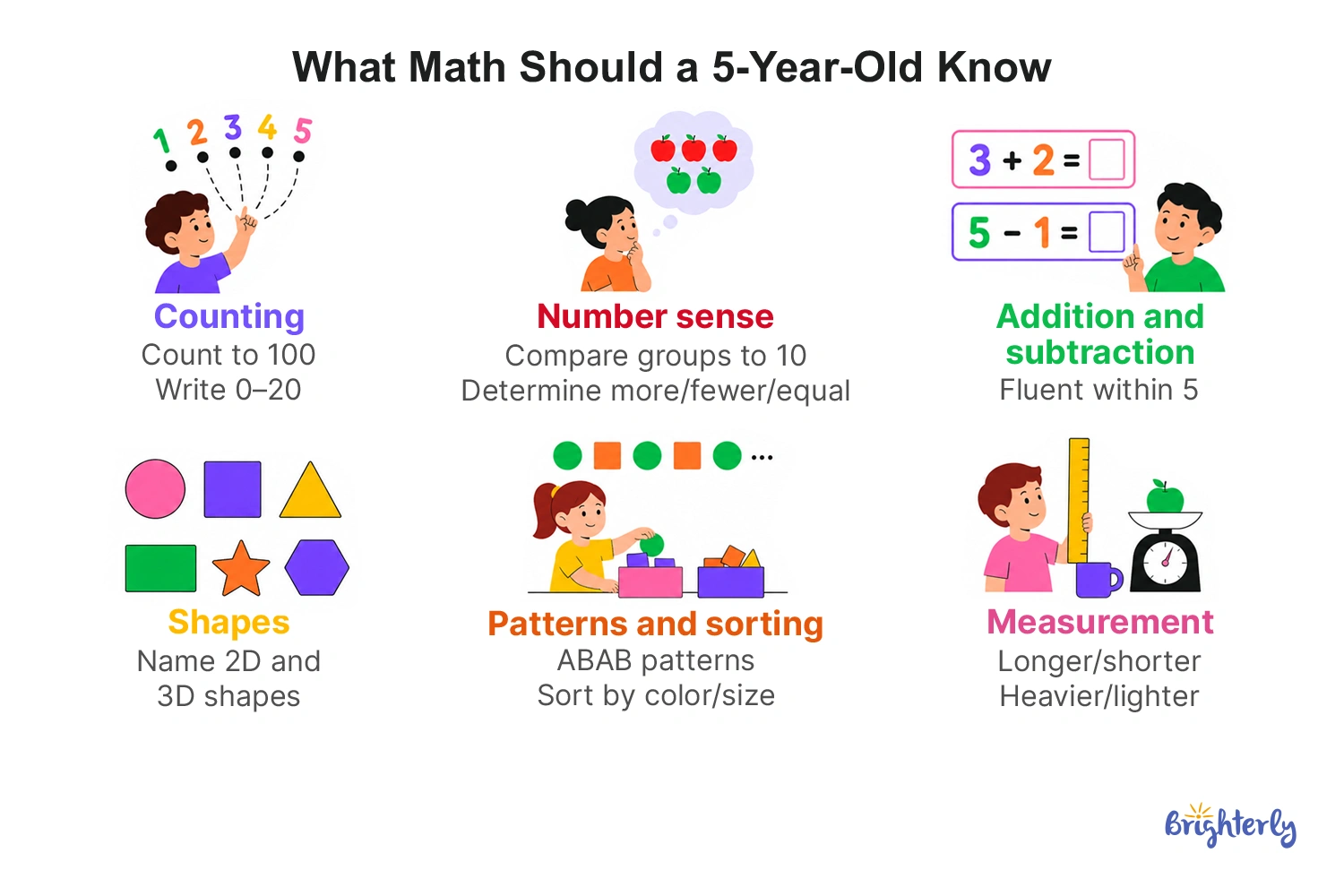
Once working at home on each of the kindergarten math skills, prioritize the domains that are easier for your kid and make learning fun with curious questions and explorative freedom. This way, you can keep math engaging and steadily increase the complexity of learning for them.


See where your 5-year-old stands in math
Find out if your 5-year-old is ready for school and exactly what to practice next
Explore Brighterly Learning Experience
Learn exactly how Brighterly helps students thrive through expert sessions, online tools, and proven feedback from thousands of satisfied parents
Counting and Number Recognition
Math questions for 5-year-olds in counting and number recognition include counting objects up to 100 (1-20, 20-100), while reading and writing number names and building one-to-one correspondence for numbers from 1 to 20. Additional skills for learning numbers include place value (tens and ones), counting from 20 to 100 by 10s, and optional skip counting in 2s and 5s (within the 0–20 numeral range).
Numbers and place value are the building blocks of mathematics, and you can reinforce the knowledge of specific skills with counting worksheets and numbers worksheets. Math for 5-year-olds is all about learning to count coupled with problem-solving ability.
Comparing Numbers and Number Sense
The expected math problems for 5-year-olds to solve include comparing numbers (more / fewer / equal) for groups up to 10 and deciding which one is greater.
At home, you can help your kid improve their comparing numbers and number sense skills by splitting their favorite toys in two groups. Then, you can ask them questions about how many toys are in each group and which number is greater, smaller, or whether they are equal.
Addition and Subtraction
At age 5, addition practice and subtraction skills are expected to be fluent within 5. Make them fun with toys, games, or any objects your child can easily manipulate. Many children learn better when they can see the things they count.
Help your kid add two numbers together by showing them how to write the numbers down on paper or in a workbook. It will be easier when you teach them the facts. Number bonds, like the pairs that make 10 (6+4, 7+3), give kids a mental shortcut before they memorize facts.
Alternative ways to teach 5-year-olds simple addition and subtraction include:
- Play games like Tic-Tac-Toe and Bingo and ask math questions that involve counting.
- Use math toys for 5-year-olds like blocks, beads, and small cars for counting activities involving operations of adding and subtracting.
- Cook together by counting the ingredients for a recipe.
- Use math activities for 3-5 year olds PDF via printable worksheets
Shapes and Geometry
5-year-olds should be able to differentiate and name common 2D shapes (circle, triangle, square) and 3D shapes (cube, sphere, cone). Additionally, they should be able to use position words such as above, below, and next to.
The exact shapes and geometry skills include:
- Recognizing circles, triangles, squares, cubes, cuboids, and cones
- Naming 2D and 3D shapes correctly
Note: Get wooden blocks or other toys shaped like the 2D and 3D shapes to make it easier for a kid to learn new concepts via multisensory learning.
Patterns and Sorting
5-year-old math skills for patterns and sorting include operations with ABAB patterns, including the ability to copy, extend, create and sort and classify them by color, size, or shape.
The most effective techniques for learning ABAB patterns and sorting skills include hands-on tools like beads or blocks. Get for your kids hands-on math examples in different colors and shapes or go outside and collect leaves and rocks in nature.
Measurement and Comparison
A 5-year-old should feel comfortable with basic measurements and comparison, meaning determining a longer/shorter, heavier/lighter or holds more/less in a pair of different objects.
Everyday items like paper clips you use around the house are great for practicing non-standard measurement and comparison skills. Get the same size objects, start at the edge, don’t overlap, and get creative with the objects you use to make practice fun.
Fun Math Activities for 5-Year-Olds at Home
Fun math activities for 3-5-year-olds mostly involve play and objects kids meet everyday to explain the basic math rules. Since learning math requires lots of practice, making it fun for youngsters is key to keep them involved and engaged in the long run.
You can decide to offer numerous math activities for 5-year-olds that make the learning process exciting:
- Use the same tools to teach several math skills (like counting, sorting, and measurement) so your child will be ready for whatever topic comes next.
- Get colored and engaging worksheets to make basic math concepts and ideas visual.
- Apply colorful objects and toys to each math activity for 5-year-olds you practice to make math relatable and fun for them.
The infographic below offers concrete ideas you can test at home to see what your kid likes most.
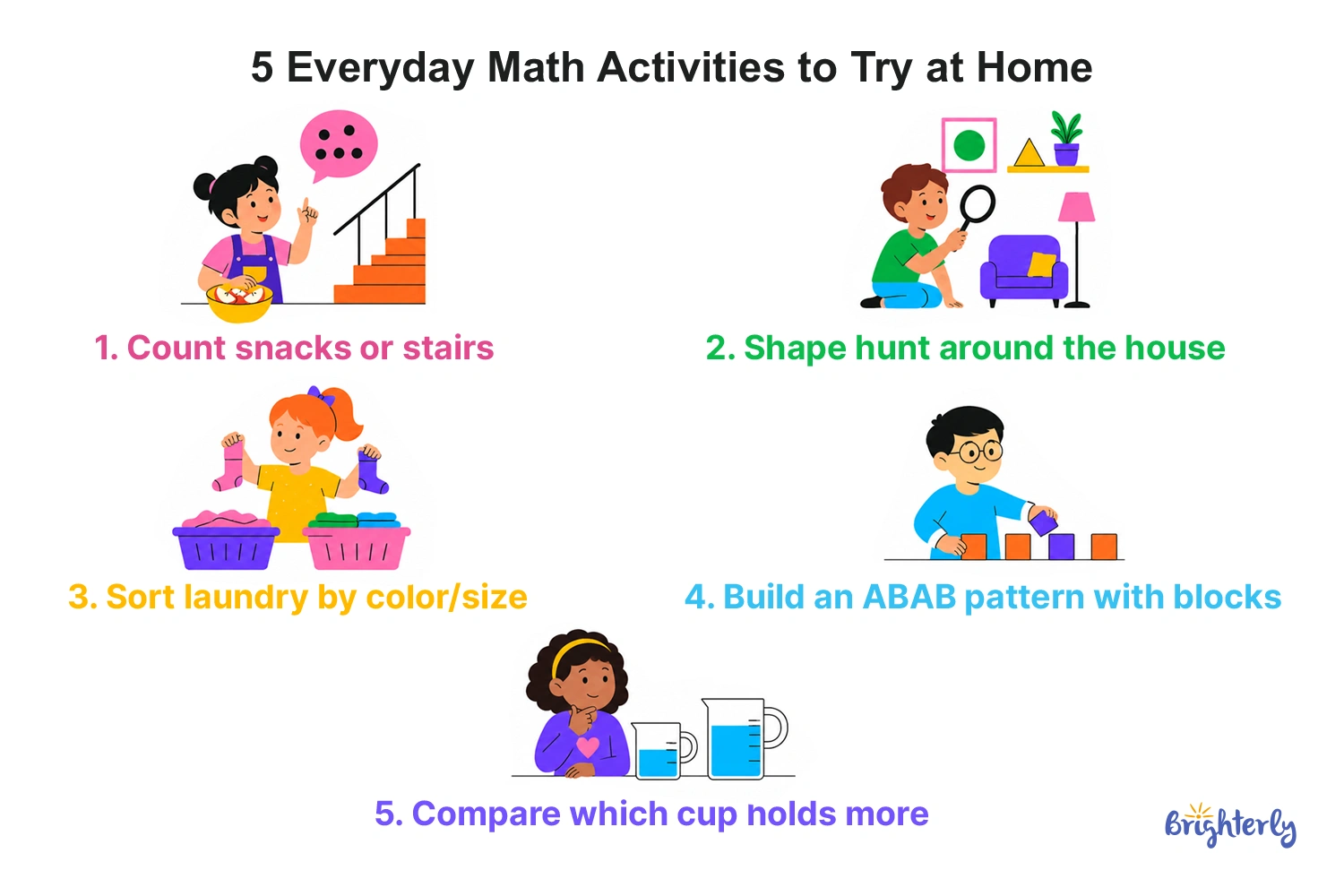
How to Teach Math to a 5-Year-Old
Each kid is different, yet making them understand math at a 5-year-old level requires the sequence of typical steps:
- Start with what they love. Since math is abstract, the most suitable way to introduce it into a child’s life is to show how it additionally describes their reality. By picking their favorite toys and activities, you can naturally spark their interest in math and make it more relatable to them.
- Ask curious questions. Keep your child engaged by constantly asking them interesting questions that trigger their creative and problem-solving skills. Check our knowledge base for additional support and approachable explanations.
- Let them play. Teaching math as a formal lesson is a common mistake parents make for 5-year-olds. In contrast, introduce math in their play and show how it helps them see fun things in the world on a different level.
- Introduce symbols when ready. Don’t rush into teaching abstract concepts. Start with real-life objects first and wait till a 5-year-old feels confident with them. You can also try a math quiz for 5-year-olds to detect when they are ready for symbols.
- Keep sessions 10–15 min. Don’t overwhelm your child with long math lessons to keep it fun and engaging for them.
Turn everyday play into real math progress
Watch your child build math confidence.
Common Mistakes to Avoid When Teaching Math
Parents frequently rely too heavily on math worksheets instead of play-based learning, trace milestones instead of prioritizing math understanding, and prefer formal lessons instead of introducing several playful moments during the day.
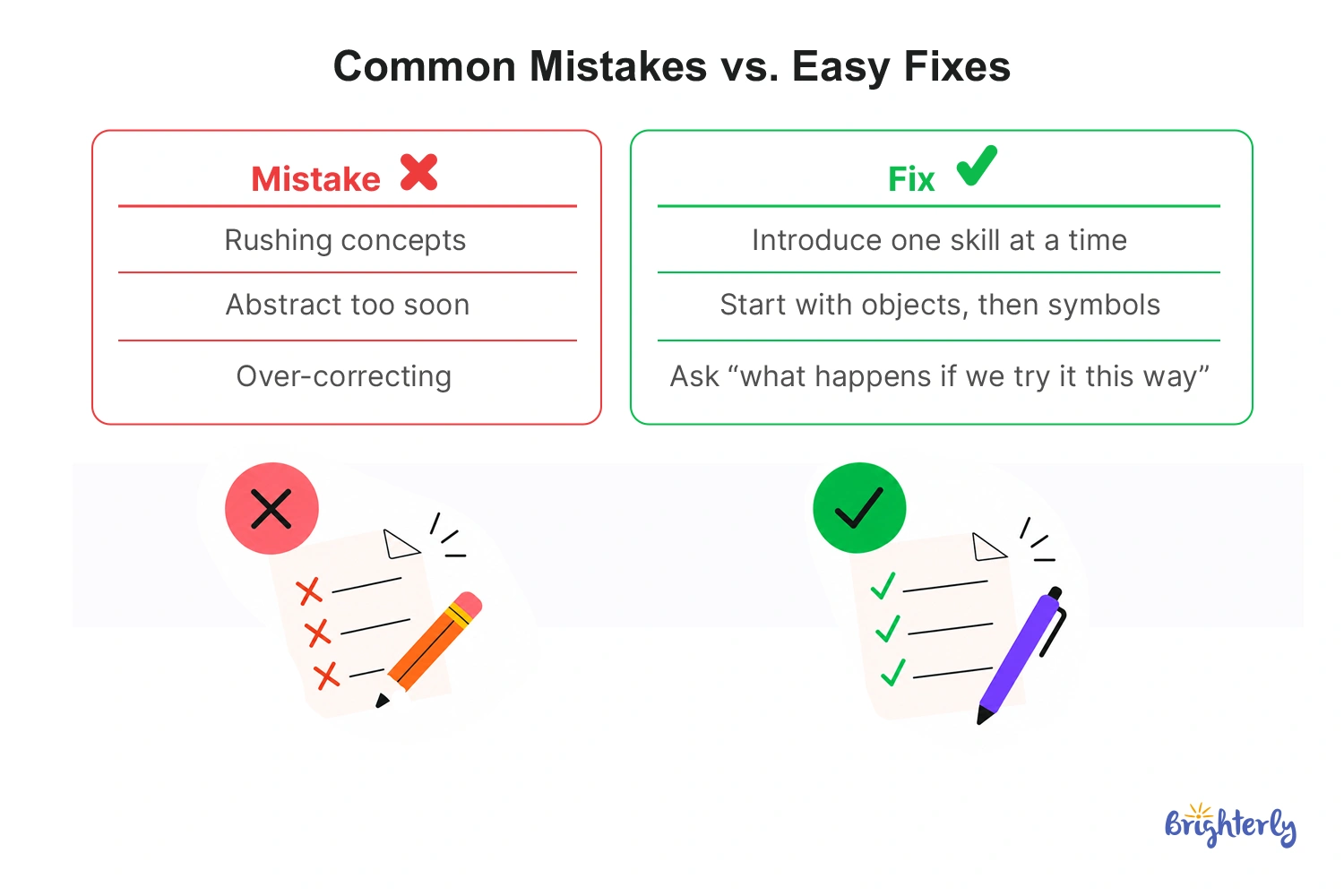
The table below shows the exact mistakes parents make while teaching math, why they happen, and how to avoid them.
|
Common Mistake |
Why It Happens |
How to Avoid It |
|
Sit-down drills |
Math worksheets are easier to track and require less effort from parents |
Mix drills with play-based learning to keep math fun |
|
Rushing math milestones |
Anxiety that a child won’t be ready for school |
Focus on developing math learning skills instead |
|
Introducing abstract concepts too soon |
Math is abstract so it feels natural |
Rely on multisensory learning techniques to keep math real |
|
Forcing all math skills at once |
Feels natural and convenient as math operations are interrelated |
Teach each skill step by step and be careful not to stress out your child |
|
Being strict and overcorrecting |
Common Core expectations feel rigid |
Be patient and prioritize their problem-solving and creative abilities |
Frequently Asked Questions
How High Should a 5-Year-Old Be Able to Count?
Under the Common Core standards, a 5-year-old should be able to count to 20, as they are expected to reach the counting to 100 milestone by the end of kindergarten. The additional skills include visually recognizing numbers 0–20, comparing numbers 0–10, and adding or subtracting numbers 0–5.
Is My 5-Year-Old Behind in Math?
Each kid has their individual learning style and pace, so making the decision if they are on track or behind in early math skills at 5 years old requires additional consultation with the 1st grade math tutor. If you feel that your child is falling behind, get additional tutoring help and prioritize their play-based learning abilities over reaching concrete milestones to maintain math fun.
How Many Minutes of Math a Day Is Enough for a 5-Year-Old?
10 to 15 minutes of math per day within a play-based learning practice is enough to keep them on track while developing core math skills. Note that the practice should be split during the day in occasional playful moments rather than a 20-minute formal lesson.
Do 5-Year-Olds Need Math Worksheets, or Is Play Enough?
Though play is mostly enough, getting math worksheets for 5-year-olds helps to make practice more sustainable and their progress easier to track. You can get free math worksheets with colorful visuals and carefully designed practices to help you reinforce addition, subtraction, number recognition, and other foundational math skills.
What Are Signs a 5-Year-Old Is Gifted in Math?
If your kid enjoys math and demonstrates math skills above the expected milestones for 5 years old, chances are high that they are gifted in math. To nurture their progress, keep challenging them with math problems and logic puzzles to encourage their problem-solving capabilities and creative abilities or enroll them in an after school math program to accelerate their readiness for school.
How Can I Help a 5-Year-Old Who Finds Math Frustrating?
Failure to recognize math as fun and engaging may frustrate a math learner. To bring back their joy, introduce more play-based math activities for 5-year-olds that involve their favorite toys and objects they find fascinating. Also, take a step back in teaching them a new math skill to decrease the complexity of a task and reduce stress.
Next Steps
Reaching expected math milestones for 5-year-olds is an important step for preparing your kid for school. If you want more control and a deeper understanding of their progress, consider adding math sheets for 5-year-olds to know exactly where they stand and get writing practice to improve their skills.
If you feel that your kid is above or behind the expectations regarding math for 5 year olds, consider getting extra support from an online math tutor, This way, you can use professional help from a certified math instructor to supplement your play-based home practice.
Book free lesson to get a consultation from a math tutor and clearly see what’s next!


If your child struggles with numbers without the use of a calculator, you need to figure out how to get better at mental math. In brief, mental math is the ability to calculate in your head. This guide provides 11 proven tips to develop mental arithmetic skills through a simple daily routine. How to Improve […]

May 06, 2022

As adults, we take numbers for granted, but preschoolers and kindergartners have no idea what these symbols mean. Yet, we often demand instant understanding and flawless performance when we start teaching numbers to our children. If you don’t have a clue about how to teach numbers for kids, browse no more. You will get four […]
May 19, 2022
Math & reading from 1st to 12th grade
Looking for homework support for your child?

Choose kid's grade

Math & Reading for Grades 1–12
Build real confidence for your child with a Brighterly math or reading tutor.