Metacognitive Strategies: What They Are and How to Use Them (2026)
reviewed by Jo-ann Caballes
Updated on May 29, 2026

Key Points: Metacognitive learning strategies help your child identify, understand, and manage how they think, making their studying process more effective. These strategies include the think-aloud method, error analysis, goal setting, self-questioning, the learning wrapper, concept mapping, confidence rating, the “Why” inquiry, and time/effort management. Metacognitive or metacognition strategies are specific techniques that help a student plan, monitor, or evaluate their own thinking when they learn. These strategies are based on metacognition — the ability to think about thinking, according to psychologist John Flavell, who first mentioned the term in a 1979 American Psychologist publication. *Flavell also divided metacognition strategies into several categories, with the major ones being knowledge of cognition (strategies focused on what children know about how they think) and regulation of cognition (strategies that focus on how children manage and control their thinking).
Metacognitive strategies for your child
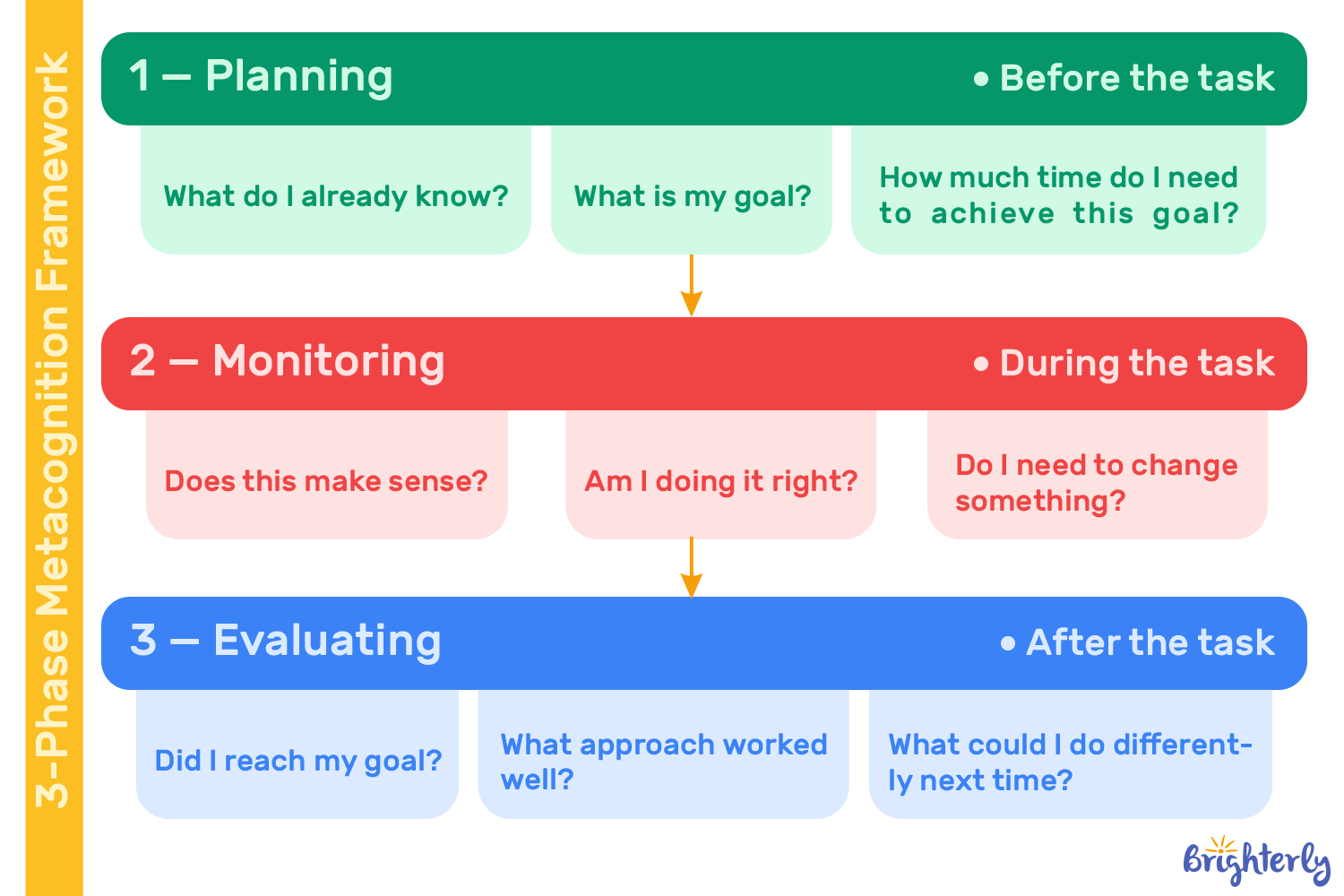
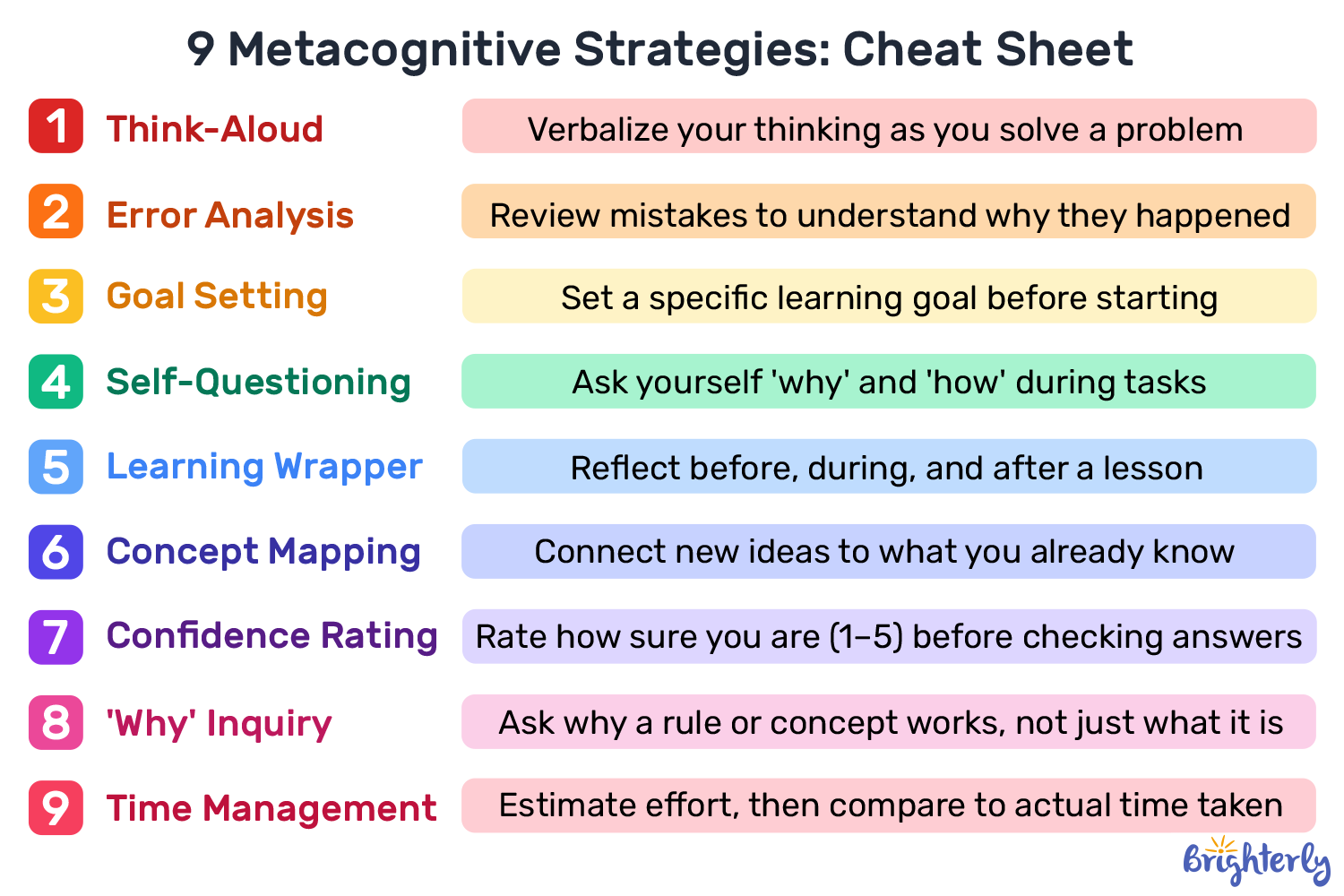
Brighterly tutors help your kid learn by teaching them metacognitive strategies. Explore Brighterly Learning Experience Learn exactly how Brighterly helps students thrive through expert sessions, online tools, and proven feedback from thousands of satisfied parents Cognitive strategies are the tools students use to learn, like highlighting, summarizing, or re-reading a text, while metacognition questions if those tools are actually working. For example, a child uses a cognitive strategy when reading and uses a metacognitive strategy when pausing to ask themselves, “Am I understanding what I’m reading, or just moving my eyes across the page?” *Find out more about reading comprehension strategies. So, in the first case, a child simply executes a task, while in the other, evaluates the process. This means the biggest difference between cognitive and metacognitive strategies is that the latter helps a child to study smarter instead of studying harder. Note: April 2024 publication in the Journal of Pedagogical Research provides evidence that metacognitive strategies positively influence the students’ problem-solving skills and self-efficacy. Each metacognition technique/strategy consists of 3 phases: planning, monitoring, and evaluating. Planning and monitoring phases happen before and during the task when a child sets learning goals and executes them. The evaluating phase happens when the task is done, and the child reflects on their performance. The planning phase is when, before doing a learning task, a student asks themselves questions like “What do I already know on this topic/how to solve this problem?” “What’s my goal for this task?” “How much time do I need to achieve this goal?” In general, the planning phase is based on the student’s prior knowledge that they should use to create a learning roadmap before starting work on a task. Goal setting during this phase doesn’t need to be elaborate — even one sentence will do. For example, “I want to understand the logic behind this theorem by the end of this learning session” is a good enough goal that can be part of different metacognitive strategies for students. The monitoring phase is when, during the task execution, a student pauses to ask themselves questions like, “Does this make sense?” “Am I doing it right?” “Do I need to change something?” Basically, this is a self-regulation phase, when a child catches any confusion before it messes with their task execution. The evaluating phase happens after finishing the task, when a student asks themselves questions like, “Did I reach my goal?” “What approach worked?” “What could I do differently?” So, this phase is a review and assessment of the work already done on a learning task. Nine examples of metacognitive strategies that are effective for subjects like math, reading, and writing include thinking aloud, error analysis, goal setting, self questioning, the learning wrapper, concept mapping, confidence rating, the “Why” inquiry, and time meanagement Each strategy can be used either before, during, or after doing a learning task and helps students learn more efficiently, developing metacognition skills. Think-aloud strategy is when a student verbalizes each step out loud when they’re working on a task. For example, if it’s a math task, they can tell themselves, “I need to find the perimeter. I’ll multiply a side’s length by 4. Wait, are all the sides the same length?” If it’s reading — “This character is acting weird. I think they’re hiding something”. And if it’s writing — “This paragraph feels too long. What point can I drop to make it shorter?” Claire Smizer, Brighterly Educational Advisor, considers reading aloud as one of the best strategies for problem-solving in math and reading strategies: “Think-aloud is one of the simplest metacognitive strategies and one of the most underused, especially in math.” In general, this strategy allows a parent or a teacher to actually hear how the child thinks and where exactly they start to struggle, which means the adult would be able to help a child figure out these issues. Error analysis strategy is when, after noticing a mistake in a finished task, a student reflects on what has led them to make this mistake by asking, “Why did I get this wrong? Did I misread something? Did I skip a step?” This strategy helps children discover their own error patterns and notice them easily when working on the next tasks. Across subjects, it helps to turn the shame that comes from making mistakes into a strategy to prevent them in the future. We’ve already established that goal setting and path planning are examples that fit the planning phase of metacognitive learning strategies, when a student sets a clear learning goal before doing a task and develops a plan of how they’re going to reach that goal. These strategies help students to take the pressure off doing a task by figuring out how they’re going to do it first. Self-questioning strategy helps a student to build the habit of asking themselves, “Why” and “How” type of questions/prompts mid-task. For example, in writing or reading, the question could be, “Why does this sentence feel unclear?” In math — “How does this connect to the previous lesson/topic?” A prompt like “Can I explain this in my own words?” can also push a child to think beyond surface level to really understand something. The learning wrapper strategy fits two phases of metacognitive study strategies — planning (before) and evaluating (after). The pre-wrapper (planning) happens before the task, when a student activates their prior knowledge and sets expectations for a task by asking themselves questions like, “What do I already know about this concept/topic?” “What do I want to achieve today?”, and “What strategies will I use to achieve this?”. After the task is done, a student consolidates their knowledge and adjusts their strategies by asking themselves,“What was the most important thing I learned today?””Where did I struggle while learning it?”, and “What can I do differently next time?” Concept mapping strategy helps students add new information to their prior knowledge based on visual maps. For example, in reading, students can map how certain events link to character decisions. In math, children can create a map that illustrates how multiplication connects to area, which connects to fractions. Then the students can reinforce these links and connections by summarizing everything. Confidence rating metacognitive thinking strategy is when, before checking if they are right on a task, students rate how confident they are of being right on a scale from 1 to 5. Such self-assessment helps them to see if they are overconfident (when they rated themselves 5 but made critical mistakes) or build self-trust (when they rated themselves 1 but were actually right). “Why” inquiry strategy is when a student asks questions that start with “Why”. For example, “Why does order of operations work this way?”, or “Why does a story need this conflict?”, or “Why does this historical event matter today?”. Asking “Why” helps children connect information to meaning, which improves memorization and the ability to apply knowledge to unfamiliar problems. Time and effort management strategy is when, before a task, a student estimates how long it will take them to do and how much effort it will take. After the task is done, the child compares their estimate to reality. This strategy helps children learn planning and estimation since they have to plan time and estimate effort based on how they could do tasks of similar complexity in the past.
Get professional learning help
During our one-on-one lessons, your child will learn to plan, monitor, and evaluate how they study. You can provide metacognitive strategy instruction for your child at home by using several practical approaches: modeling your thinking out loud, using a two-minute reflection routine, and putting the learning process before the results, like scores or the number of mistakes. Parents who want to deepen their understanding of learning science and instructional techniques can also explore online teaching master’s programs, which often cover topics such as metacognition, self-regulated learning, and effective teaching strategies. When speaking about modeling your own thinking out loud, Claire Smizer shares a quick example of how parents can do that with a math task: “Here's what it looks like with fractions, which is where I see this strategy do the most good.” 'Okay, I've got two-thirds and one-fourth. I want to add them, but I can't just add the tops and bottoms - these pieces aren't the same size. Two-thirds means I cut something into three equal pieces and took two of them. One-fourth means I cut something into four equal pieces and took one. Those pieces are different sizes, so I can't add them yet. I need to find a way to cut both into the same-size pieces. Let me think about what size would work for both…' You can also use online learning materials to help your child practice metacognitive thinking. For example, we have reading comprehension worksheets and math questions among lots of other resources you can download for free. If you want professional learning support for your students, you can consider getting them a tutor. For example, our middle school reading tutors teach kids self-monitoring metacognition strategies for handling complex reading texts during one-on-one lessons. *You can get an online reading tutor for a kid in grades K–12, not just middle school. Besides, our curricula align with the US state standards. We also have an online math program where our educators build metacognitive habits into personalized learning sessions, prompting a student to explain their reasoning, review errors, and set future goals. Cognitive strategies are the mental tools students use to directly process, learn, and manipulate information (re-reading, highlighting, note-taking). In contrast, metacognitive strategies are the tools a student uses to plan, monitor, and evaluate their understanding of information. In short, cognitive strategies rely on the act of thinking, while metacognitive strategies focus on thinking about how you think. Children start using basic metacognitive strategies as early as age 2 to 3, which are basically trial-and-error-based. Foundational abilities, like monitoring their own knowledge and seeking help, develop during preschool (age 3-5). Explicit, formal metacognitive learning strategies fully develop in kids around the age of 7 or 8. Metacognitive skills development is a process that lasts your whole life, so there is no set period of time you must take to develop them. In general, basic metacognitive skills, like self-awareness, usually emerge in early childhood, while consciously applying effective metacognitive strategies to learning or problem-solving usually takes several years of dedicated practice to master. Yes, metacognitive strategies can help students with learning disabilities. These strategies help teach these kids to plan, monitor, and evaluate their own work. This empowers students with learning disabilities to become independent and confident in their learning, which allows them to easily navigate through studies. Teachers assess metacognitive skills in students by evaluating the kids’ thinking process rather than focusing on the final answer or a grade. For that, teachers can use formative assessment techniques like think-aloud protocols, reflective journaling (like “exam wrappers”), and targeted self-regulation prompts. ⭐Average rating: 7/10 Sylvan Learning Center reviews from families disclose a lot about its main features, tutoring method, user interface and experience, effectiveness, customer support, cost, and pros and cons. This comprehensive overview stands on public feedback from parents who’ve tried Sylvan and explains whether or not it’s worth your time and money. Rating Methodology […] Aug 10, 2025 Prodigy membership costs between $9.95 for a monthly payment and $118.95 billed annually. Annual plans start from $4.91/month. But is Prodigy worth it? Let’s take a closer look at each tier, weigh their value for money, and investigate alternative options to address your child’s learning needs more accurately. How Much Does the Prodigy Membership Cost? […] Aug 12, 2025
What Are Metacognitive Strategies?


Metacognition vs. Cognitive Strategies: Key Difference
The 3 Phases of Metacognition: Planning, Monitoring, and Evaluating
Planning: Setting Goals Before You Learn
Monitoring: Checking Understanding While You Learn
Evaluating: Reflecting After You Learn
9 Metacognitive Strategies Examples for Students
1. The Think-Aloud Method


2. Error Analysis for Deeper Understanding
3. Goal Setting and Path Planning
4. Self-Questioning Prompts
5. The Learning Wrapper
6. Concept Mapping and Summarization
7. Confidence Rating and Targeted Practice
8. The ‘Why’ Inquiry
9. Time and Effort Management
How to Teach Metacognitive Strategies at Home
Frequently Asked Questions
What Is the Difference Between Cognitive and Metacognitive Strategies?
At What Age Can Children Start Using Metacognitive Strategies?
How Long Does it Take to Develop Metacognitive Skills?
Can Metacognitive Strategies Help Students With Learning Disabilities?
How Do Teachers Assess Metacognitive Skills in Students?





Math & reading from 1st to 12th grade
Looking for homework support for your child?

Choose kid's grade

Math & Reading for Grades 1–12
Build real confidence for your child with a Brighterly math or reading tutor.