Creative Ways to Use AI in Education: 25 Ideas to Help Kids Learn Better
reviewed by Franz Jerby Delos Santos
Updated on August 25, 2026
Key Ideas:
- Among creative ways to use AI in learning is the creation of lesson summaries, turning stories into images, and turning abstract math into a story.
- The extent of adult involvement when it comes to kids using AI should depend on the kids’ age — kids aged 6-12 need substantially more guidance and support with AI than kids over 13 (Common Sense Media, 2026).
- 59% of teachers say AI allows for more personalized learning, while 55% also admit AI helps them free up time they can use to connect with students (EdWeek, 2025).
Your child’s process of doing homework is probably very different from what yours was. One of the biggest reasons for this difference is AI — creative ways to use AI in education now help students turn a chatbot into an AI tutor or a study partner. Find out what these ways are for reading, math, writing, and critical thinking tasks, including the exact prompts.
How to Use AI for Learning by Subject (Quick Reference)
|
Subject |
How AI Helps |
Example Prompt |
|
Reading |
Adjusts the written piece to the kid’s reading level |
“Reword this text to make it fit the 5th-grader reading level.” |
|
Math |
Explains steps in simple language |
“Explain how to add fractions to a 3rd grader step-by-step.” |
|
Writing |
Starts a story with a strong opening sentence. |
“Write a strong and attention-grabbing first sentence for this story: [story].” |
|
Science & Thinking |
Explains the concept and does fact-checking |
“Explain how clouds form, and then list what you might have gotten wrong.” |
|
Languages |
Sets up a role-play for practice |
“Start a dialogue with me in Spanish at a 4th-grader level.” |
Explore Brighterly Learning Experience
Learn exactly how Brighterly helps students thrive through expert sessions, online tools, and proven feedback from thousands of satisfied parents
How Can AI Help Kids Learn?
AI can help kids learn by explaining complex concepts in simpler terms, turning learning materials into stories and games to make them more engaging and easier to grasp, and providing instant feedback. However, the exact help AI can provide in learning depends on the subject and the purpose for which kids use it.
As a parent, make sure your child uses AI as a learning tool that supplements a real teacher or tutor, rather than substituting for them.
As for educators, an October 2025 EdWeek research article found that 59% of teachers think AI makes learning more personalized, and 55% say AI lets them free up time to spend interacting with students directly.
Combine AI with a professional tutor
Brighterly educators add human feedback and support to your kid’s learning.
Using AI for Reading and Language
AI activities for students to try for reading and language learning include creating lesson summaries, making up unique stories for practicing sight words, generating stories that mix easy and hard words to build vocabulary, creating dialogues between favorite characters to make kids more excited about reading, practicing foreign languages, etc.
Turn a Lesson into a Summary
Before reading, set an AI recorder or note taker to record the lesson. Read the text, and when you’re done, stop the note-taker. After that, the tool will automatically provide the summary of your reading it has recorded.
If you already have a recorded reading lesson, you can ask an AI tool, like ChatGPT, to generate its summary.
Prompt example:
- “Summarize this reading lesson for a 7-year-old, using simple words.”
Practice Sight Words with a Custom Story
If you’re wondering how to teach sight words with AI, identify a list of sight words your kid struggles with, like “they” or “was” and ask the AI tool to create a unique story that you would read to a kid, including these words.
Prompt example:
- Create a unique story for an 8-year-old using the words “they” and “was”.
Mix Easy and Hard Words into Familiar Stories
Mixing what a kid already knows with new information is part of scaffolding — an educational method when you provide a child with temporary support to learn a skill, gradually withdrawing it as the child starts getting a hold of it.
In reading, you can use AI tools for scaffolding to help a child build vocabulary — ask an AI tool to create a unique story with the words your kid already knows, while including new words the kid has yet to learn. You can use already pre-made story prompts and just add words to include.
Write Dialogue with Favorite Characters
Ask an AI tool to write a dialogue between your child’s favorite character from a book or a movie they’ve already read or watched, but make sure the dialogue revolves around the topic the child is practicing — mention the exact theme of the dialogue and words it should include. Reading conversations between characters they already know and like helps kids get more involved in reading, which in turn helps them remember new words better.
Personalize Bedtime Stories
Ask an AI tool to build a bedtime story for your child, but make it personal. For example, it could be a story based on your kid’s favorite toy, narrated from that toy’s POV. Such personalized stories turn reading from a learning activity to an experience kids look forward to, since they actually care about the story’s character.
Practice a Foreign Language Together
Ask an AI tool to write a dialogue between you and your kid in a specific setting — a train station, a toy shop, a cafe, etc. Ask a kid to play this dialogue out with you, but in the language you’re learning.
Play Silent Letter Detective
Ask an AI tool to write a story where every third sentence has a silent-letter word, like “knight” or “psychologist”. Ask your child to play detective and catch these words — this is how they learn pattern spotting, which is part of reading skills.
Using AI for Math and Problem-Solving
Some of the best ways to use AI for math practice and problem-solving include wrapping abstract math into a story, learning fractions through food, turning a math learning plan into a learning quest, and getting math homework help through simplified explanations.
Turn Abstract Math into a Story
Describe your child’s favorite toy to an AI tool and ask it to generate a story about this toy’s experience in the real-world setting (like shopping), involving a math concept your child is studying, like multiplication, for example. Turning a math concept into a real-life scenario makes kids get this concept faster than through traditional school-like practice.
Learn Fractions While Eating
Look for the fruits and vegetables you have at home, and ask the AI to create a fractions activity using them in the form of math worksheets, involving actions like splitting them into halves or quarters. Then ask your child to recreate these actions in real life.
Turn a To-Do List into a Learning Quest
Share your child’s math learning plan with an AI tool and ask it to turn each task into a mini quest, like explaining a new math concept to a neighbor or a friend.
Get “Explain It Like I’m Five” Homework Help
How to use AI for homework? You can turn an AI tool into a homework helper by asking it to explain a concept in the simplest way possible and according to your child’s age and knowledge level. In general, using technology is one of the strategies for helping kids with homework.
Personalize your kid’s learning experience
Brighterly tutors identify your kid’s learning gaps and customize lessons accordingly.
Using AI for Writing and Storytelling
Good uses of AI for writing and storytelling include creating texts with mistakes for a kid to fix, turning stories into images for a kid to describe, narrating stories for kids who prefer auditory learning, writing songs and rhymes, getting feedback, brainstorming ideas and bringing kid’s drawings to life.
Give Kids Texts with Mistakes to Fix
Ask an AI tool to write a short, age-appropriate story for your kid, but include the mistakes your kid makes the most. Then, tell your kid to edit this story by finding and fixing these mistakes.
Turn Stories into Story Images
Ask an AI image generator to create several pictures based on a moment from a particular story your child likes. Let your child describe what they see on these pictures.
Runbo Li, the CEO of Magic Hour AI video and image creation platform, shares his experience with this activity:
What can I use AI for in education?


Give Stories a Unique Narrator Voice
If your child prefers listening to reading, ask a text-to-speech AI tool to narrate a particular story in different character voices while also modeling expressive reading.
Write Rhymes and Songs on Demand
Give an AI tool specific words you’re practicing with your kid and ask it to create a short rhyme or song including these words. Repeat the rhyme or song together with your kid until they remember it.
Ask AI for Peer-Like Feedback
Ask your child to write a short piece. Share this piece with an AI tool and ask it to provide friendly, peer-like feedback on this piece.
Lin Meyer, the CEO of Crucial Exam also adds that using AI for feedback can be a good way for kids to evaluate their work and see where they could be wrong:
“Students will often learn more when they first explain their answer (i.e., provide a rationale for their answer).”

Bring Absurd Ideas to Life
Think of something absurd and ridiculous with your kid, like a flying dog that loves tomatoes, for example. Ask AI to turn this idea into an image or a short video to use as a fun break between practice.
Make a Kid’s Drawing Come Alive
Ask your kid to draw something or someone on paper, take a photo of this drawing, and ask an AI tool to expand or animate it.
Lydia Hall, the co-founder of Project Aqua, Adobe, explains how this activity helps with learning:
“A child might sketch a character, creature, or invention on paper, then use an AI tool like Adobe's Aqua app to transform that drawing into a simple 3D version they can place and explore in their room using augmented reality.”

Using AI for Creativity and Critical Thinking
Cool things AI can do for creativity and critical thinking include helping explain metaphors, learning to spot bias, practicing media literacy, improvising role-play around a specific scenario, generating interviews with a historical figure, and turning any learning material into a quiz for practice. Creating AI posters can also give kids a fun way to combine visual creativity with what they’re learning about a particular topic.
Explain Metaphors with an Image Generator
Pick a metaphor you want your kid to understand, like “bubbly personality”, for example. Ask an AI image generator to visualize this metaphor, and let your child try to explain how what they see in the generated image connects to the metaphor.
Learn to Spot Bias
Take a story your child already knows, ask AI to rewrite one character as clearly unfair, and see whether your child notices and pushes back.
Practice Media Literacy with Real vs. Fake News
Ask an AI tool to generate several real and fake news headlines in tabloid form. Mix these headlines up and ask your kid to find out which one is fake.
Figuring out which news is fake helps kids build media literacy and critical thinking, since they have to be able to find errors and inconsistencies in the AI output. Geillan Aly, the founder/CEO of Compassionate Math, stresses how important these skills are:
“A great activity for students to push their learning is to ask AI for other information about a topic and then vet the response.”

Run an Improvised Role-Play
Choose a topic or word list and ask an AI tool to create a scenario around it. Let your kid act this scenario out and decide what happens next.
Interview a Historical Figure
Ask an AI tool to pretend it’s a specific person, like Neil Armstrong, Marie Curie, or any other historic figure. Ask your child to interview this figure about their professional work to challenge your kid’s thinking process.
Priten Soundar-Shah, Harvard Scholar in Education Management Policy, also agrees that AI can be used to push kids to think deeper:
“Students can focus on pushing their own thinking by using AI.”

Turn Any Text into a Quiz
Take a piece you and your kid have read and ask an AI tool to create different types of questions about this piece to check your kid’s reading comprehension.
What’s the Right Age for Kids to Use AI?
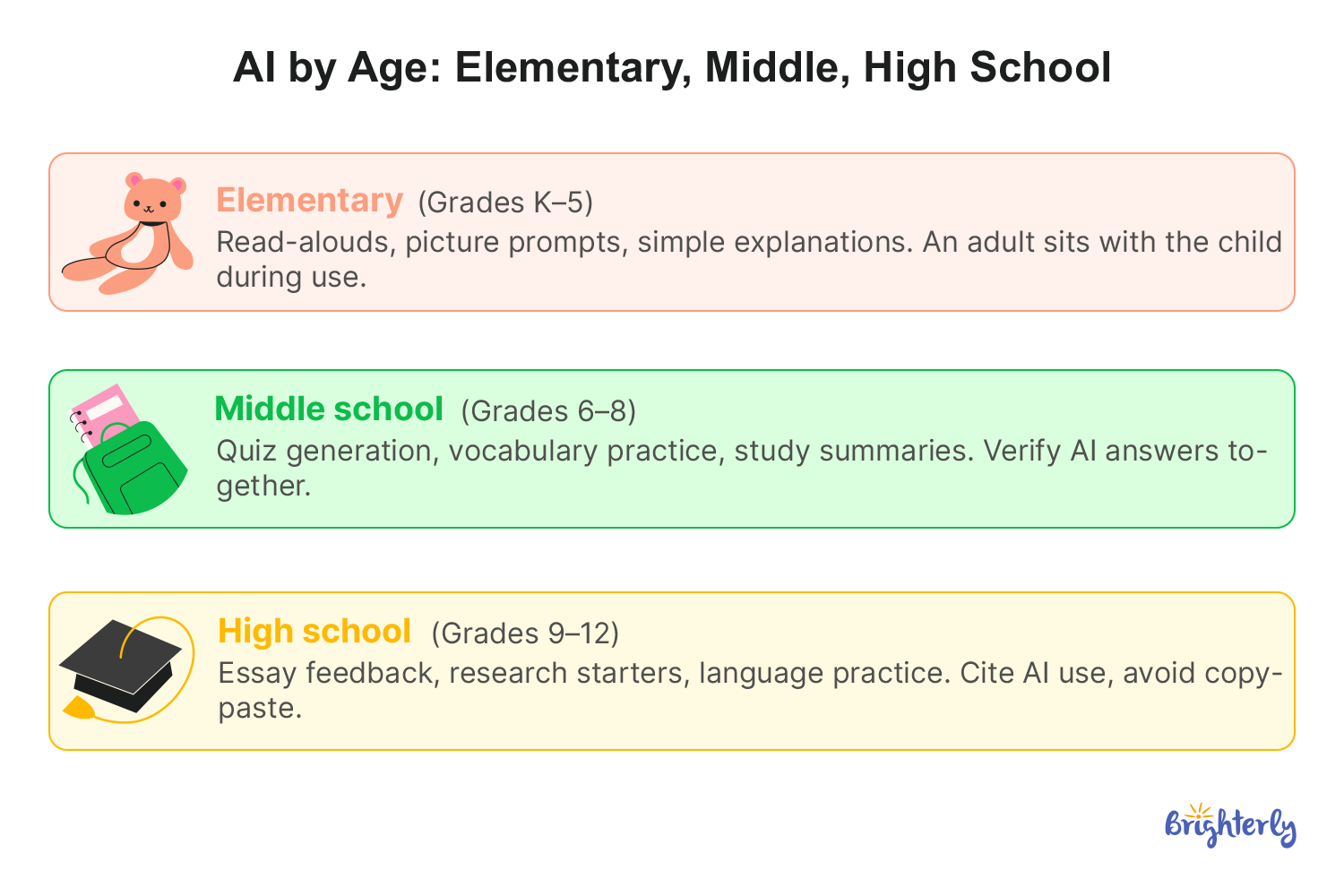
There’s no right age to start using AI for kids learning — it all depends on the child’s age and development. However, the Common Sense Media June 2026 article states that younger kids need more support and guidance with AI compared to older students:
- Age 5 and under: No use of AI
- Ages 6–12: Limited AI use with supervision
- Ages 13+: Partial supervision is advised.
How to Use AI Responsibly and Safely
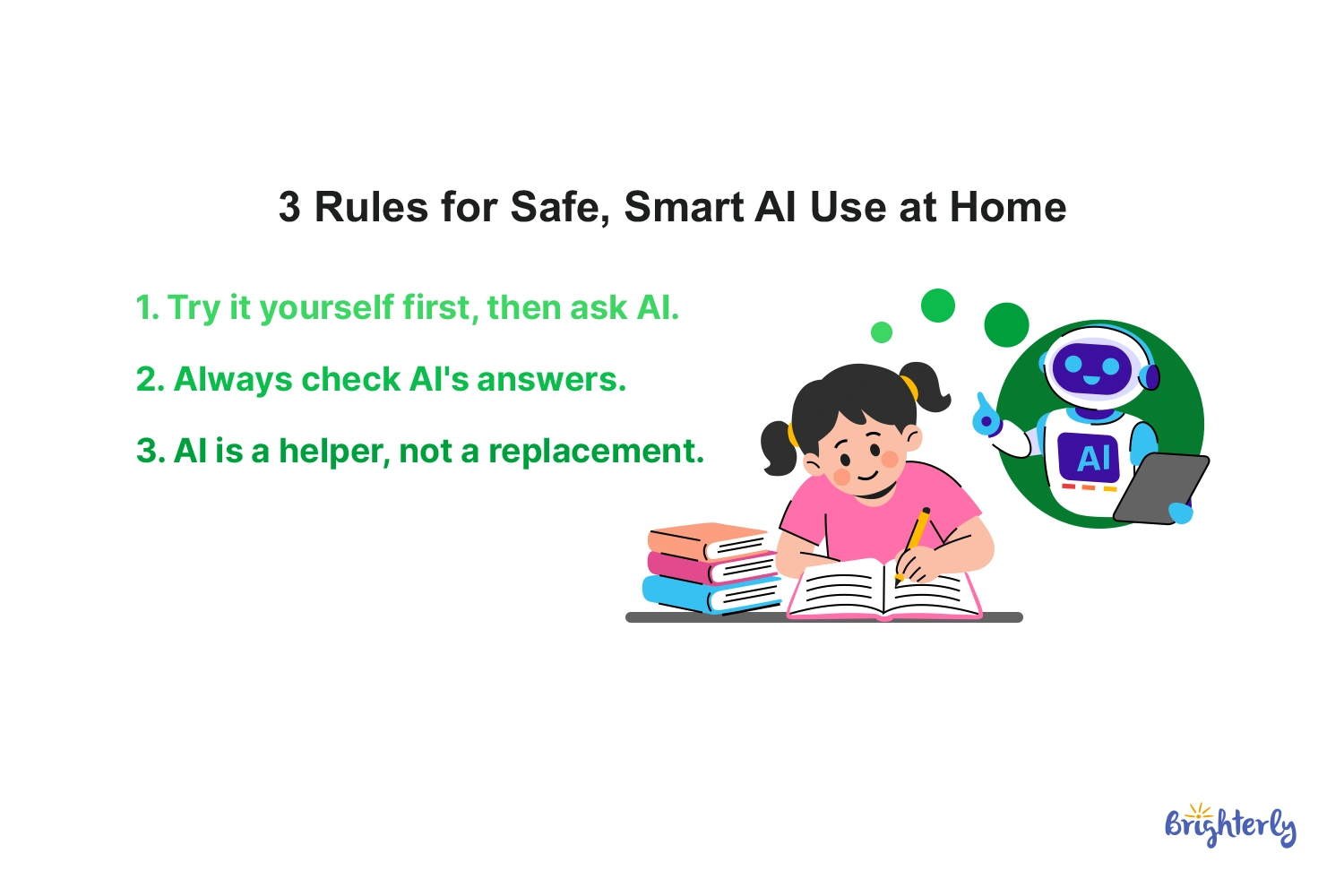
To use AI responsibly and safely, make sure it’s a supplementary tool in your kid’s learning rather than a solution that does all the work for them, depriving them of the opportunity to think on their own. For example, the October 2025 EdWeek article found that 70% of teachers worry AI is weakening students’ critical thinking and research skills — a concern worth considering.
To make sure your kid uses AI responsibly and safely:
- Watch for over-reliance on AI tools
- Always verify AI answers
- Don’t enter private information into prompts
- Agree on honesty policy — a kid tells you when they use AI and how.
Explore Brighterly Learning Experience
At Brighterly, we explore how to use AI in education while prioritizing instant and human one-on-one feedback. For example, when our professional online math tutor for K-12 students teaches math courses, you get AI lesson summaries, which you can use for practice or knowledge renewal.
The same concept applies to our ELA lessons, where we provide kids with reading and writing support. No matter math or reading, all our programs align with US standards, but our tutors personalize lessons according to your child’s knowledge gaps, learning style, and pace.
Conclusion
The use of AI in education examples vary depending on your kid’s age and purpose. Whether your goal is homework help or more engaging learning, AI can be a supporting tool. What matters most when guiding and supporting your kid’s learning with the help of AI is to make sure they don’t rely on AI tools for thinking and analyzing everything for them.
For a balanced solution that mixes AI and professional human teacher support, you can consider Brighterly personalized lessons and customized learning plans.
Frequently Asked Questions
What’s the Difference Between AI and Generative AI?
AI is a general and broad term for all tools that are designed to mimic human intelligence. Generative AI is a term for specific AI tools that are designed to create entirely new, unique content. In other words, AI analyzes data, while Generative AI creates new data.
Which AI Tools Are Best for Kids and Students?
The choice of an AI tool for kids and students depends on the task they need AI to perform. General chatbots are good for providing text-based explanations and creating material supporting study skills based on prompts. For tasks that involve images, specific AI for image processing and generation can be a better option.
Can AI Replace a Tutor or Teacher?
No, AI can’t replace a real tutor or a teacher — an AI tool can explain a concept or generate practice material, but it can’t provide support and guidance a human educator can. AI learning tools work best paired with a human who knows the child’s learning style, knowledge gaps, and feels accountability for this child’s success.
How Can Parents Tell If a Child Used AI for Their Homework?
To see if your child uses AI in their homework, look for an unusual and sudden change in their vocabulary and sentence complexity. Anything that doesn’t match how your child usually talks or writes can be a clue they use AI. Also, when their answers sound too polished, ask them follow-up questions — if they can’t answer, they may’ve used AI.
How Is AI Different from a Search Engine Like Google?
A search engine shows you existing pages created and written by other people. AI generates a new, unique answer based either on the info you provided or on the available data the AI tool analyzed. Since AI generates an answer based on the data available online or from the prompt, its result may not always be correct.



Reading.com is winning over parents with its “co-play” model, built on the Science of Reading, where parent and child tackle short daily lessons together using tactile phonics sliders and guided scripts. In just 15 minutes a day, the app turns caregivers into confident reading tutors for their own kids. As for the cons, some parents […]

Apr 07, 2026
Looking for a BrightCHAMPS review that will answer all your questions? This article contains relevant, up-to-date parents’ feedback, key features, and important details to help you decide if BrightCHAMPS is the right platform for you. Key Points Range of features: 9/10. BrightCHAMP provides students with a good selection of features for STEM subjects, and the […]

Apr 08, 2026
Math & reading from 1st to 12th grade
Looking for homework support for your child?

Choose kid's grade

Math & Reading for Grades 1–12
Build real confidence for your child with a Brighterly math or reading tutor.