Shapes for Kids: 2D and 3D Shape Names With Easy Activities
reviewed by Jessica Kaminski
Updated on November 13, 2026
Key Points
- Shapes for kids include 10 flat shapes, from the circle to the octagon, and 7 solid shapes, from the sphere to the triangular prism.
- The Common Core kindergarten geometry standards (2010) list 9 shapes: squares, circles, triangles, rectangles, hexagons, cubes, cones, cylinders, and spheres.
- Kids identify a shape by its attributes, such as sides and corners, not by its color, size, or tilt, so a turned square is still a square.
- Brighterly’s online math tutors teach shapes and early geometry in 1:1 lessons aligned with US state standards.
Shapes for kids are the flat (2D) and solid (3D) figures children name first, such as the circle, square, triangle, cube, and sphere, along with the sides and corners that set each apart. Below, you’ll find a shapes chart for kids with real-life examples, a shape list by age, and 9 activities matched to your child’s stage.
What Are the Basic Shapes for Kids?
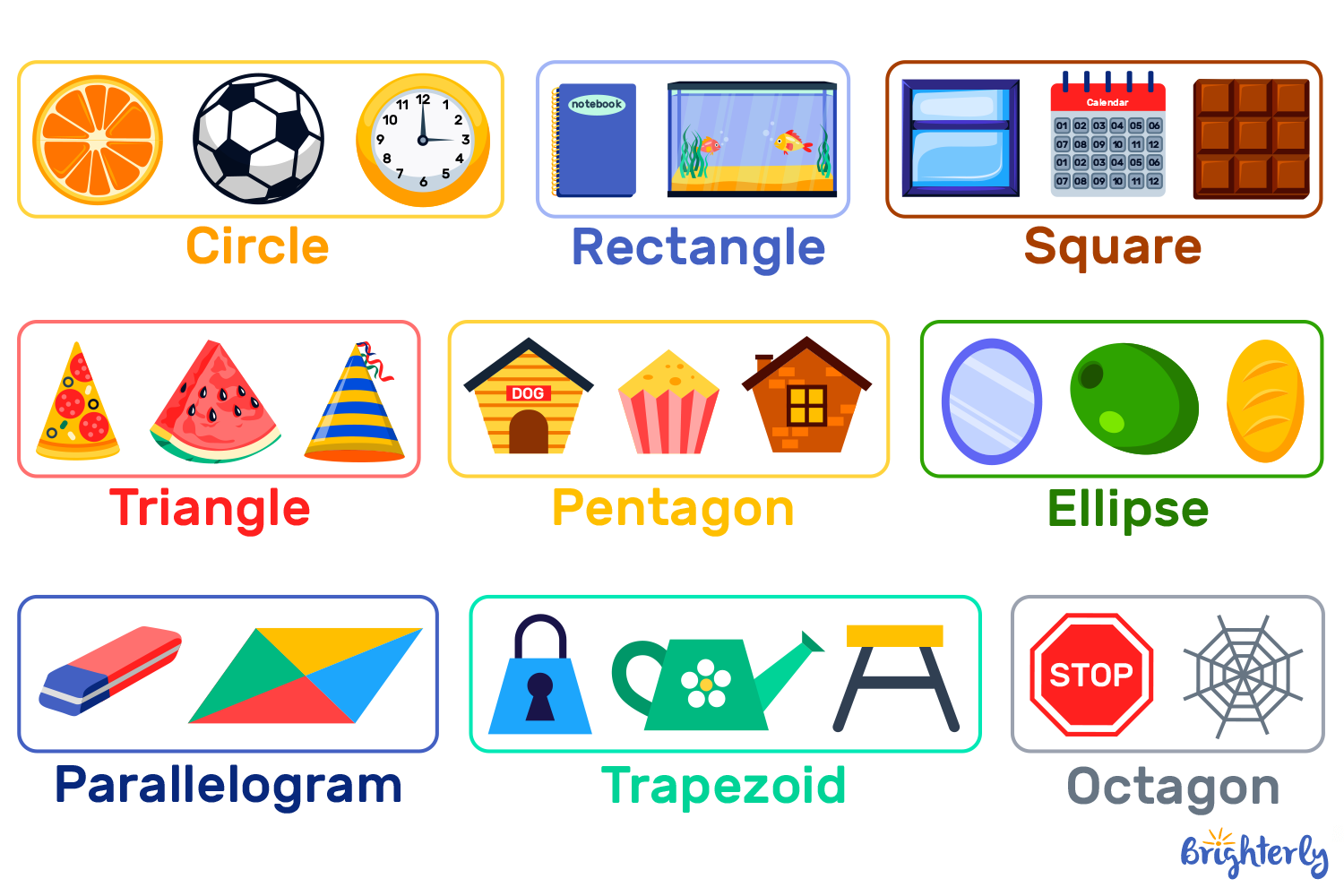
The basic shapes for kids are flat, two-dimensional figures with a set number of sides and corners, also called vertices. Children usually learn the circle, square, triangle, and rectangle first, then the oval, rhombus, trapezoid, pentagon, hexagon, and octagon. The chart below lists each shape’s sides, corners, and a place kids see it every day.
| Shape | Sides | Corners (Vertices) | Where Kids See It |
| Circle | 0 (curved) | 0 | Clock, coin |
| Oval | 0 (curved) | 0 | Mirror, platter |
| Triangle | 3 | 3 | Yield sign |
| Square | 4 equal sides | 4 | Cheese slice, sticky note |
| Rectangle | 4 (opposite sides equal) | 4 | Door, phone screen |
| Rhombus (diamond) | 4 equal sides | 4 | Diamond on playing cards |
| Trapezoid | 4 (1 pair parallel) | 4 | Side of a popcorn bucket |
| Pentagon | 5 | 5 | Home plate in baseball |
| Hexagon | 6 | 6 | Honeycomb cell |
| Octagon | 8 | 8 | Stop sign |
Every straight-sided shape here is a polygon, a closed figure made of line segments; the circle and oval aren’t polygons because they have no corners. From educators’ experience, kids remember long names faster once they hear the number inside: penta means 5, hexa means 6, and octa means 8, like an octopus’s arms. This guide to 2D shapes goes deeper.
Is a Square Also a Rectangle?
Yes. A square is a special rectangle: both have 4 sides and 4 square corners, but a square’s sides are all equal, so a door is a rectangle but not a square. A square is also a special rhombus, and all four shapes, plus the trapezoid, belong to the quadrilateral family.


Need personalized math help from a teacher?
Brighterly’s tutors offer 1:1 individualized learning paths for each child.
Explore Brighterly Learning Experience
Learn exactly how Brighterly helps students thrive through expert sessions, online tools, and proven feedback from thousands of satisfied parents
What Are the 3D Shapes for Kids?
3D shapes for kids are solid figures that take up space, so a child can hold, stack, or roll them. The 7 common ones are the sphere, cube, rectangular prism, cylinder, cone, square pyramid, and triangular prism. Each solid has faces (flat surfaces), edges (where faces meet), and vertices (corners).
| 3D Shape | Flat Faces | Vertices | Rolls, Stacks, or Both? | Real-Life Example |
| Sphere | 0 | 0 | Rolls | Ball |
| Cube | 6 | 8 | Stacks | Dice |
| Rectangular prism | 6 | 8 | Stacks | Cereal box |
| Cylinder | 2 | 0 | Both | Soup can |
| Cone | 1 | 1 | Rolls in a circle | Party hat |
| Square pyramid | 5 | 5 | Sits flat | Pyramids in Egypt |
| Triangular prism | 5 | 6 | Stacks | Tent |
For practice, try this kindergarten 3D shapes worksheet or study this overview of 3D shapes.
How to Draw 3D Shapes for Kids?
To draw 3D shapes, kids start with a flat shape and add depth: two copies of a shape joined at the corners, or an oval with lines running to a point. A cube needs two squares, a cylinder an oval and two lines, and a cone an oval and a dot.
- Cylinder: Draw an oval for the top. Draw a straight line down from each end, then join the bottoms with a curved “smile.”
- Cone: Draw a flat oval with a dot above it, then draw a line from each end of the oval to the dot.
- Cube: Draw a square, then a same-size square a little up and to the right. Connect the 4 matching corners with short slanted lines.
Which Shapes Should Kids Learn at Each Age?
The first shapes for kids to learn are the circle, square, and triangle, usually as toddlers. Preschoolers add the rectangle, oval, star, and heart, kindergartners name 9 core flat and solid shapes, and 2nd graders identify pentagons and hexagons by counting sides. Every child moves at a different pace, so treat these as typical goals, not deadlines.
| Age or Grade | Shapes to Learn | What Kids Can Do |
| Toddlers (2-3) | Circle, square, triangle | Match and sort shapes |
| Preschool (3-5) | Adds rectangle, oval, star, heart | Name, trace, and find shapes |
| Kindergarten | Squares, circles, triangles, rectangles, hexagons, cubes, cones, cylinders, spheres | Name shapes at any size or tilt; tell 2D from 3D |
| 1st grade | Adds trapezoids, half-circles, quarter-circles | Combine shapes; split circles into halves and fourths |
| 2st grade | Quadrilaterals, pentagons, hexagons, cubes | Draw shapes from clues, such as a number of angles |
In 1st and 2nd grade, learning shapes shifts from naming to combining, splitting, and early fractions. Brighterly’s 1st grade math and 2nd grade math lessons cover these skills with a 1:1 tutor and interactive tasks aligned with US state standards.
“Children make the fastest progress when they hold a shape before they name it.”

9 Fun Shape Activities for Kids by Age
Shape activities work well when they’re short and hands-on, asking a child to touch, build, or find a shape instead of pointing at a picture. Plan 5- to 10-minute sessions: toddlers sort, preschoolers hunt and feel, and kindergartners build and describe attributes. Repeat one activity for a week before adding another.
Shape Activities for Toddlers (Ages 2-3)
Learning shapes for toddlers means three shapes and lots of repetition, so these shape activities for toddlers use items you already own.
- Lid sort: Drop 6-8 round and square container lids into two bowls. Goal: sort them all without help.
- Tape-shape hop: Tape a large circle, square, and triangle on the floor, call out a shape, and your child jumps inside.
- Playdough cutters: Press circle, square, and triangle cutters into playdough and name each shape as it pops out.
Shape Activities for Preschoolers (Ages 3-5)
Shapes for preschoolers get more interesting once kids count to 5, so these shape activities for preschoolers add counting and touch.
- Mystery bag: Hide 4-5 wooden shapes in a cloth bag. Your child feels one, counts its corners, and guesses before pulling it out.
- Scavenger hunt with tally marks: Draw 4 shapes on paper, and your child tallies each match found in 10 minutes. Goal: 3 finds per shape.
- Flashlight shadows: In a dark room, shine a flashlight on a cup from above, then from the side, and ask why the shadow changes from a circle to a rectangle.
Kindergarten Shape Activities (Ages 5-6)
Kindergarten shape activities ask children to build shapes and explain their names. For quiet practice, add these identifying shapes worksheets.
- Toothpick-and-playdough builds: Playdough balls are corners and toothpicks are sides: a triangle takes 3 of each, and a cube takes 8 balls and 12 toothpicks.
- Tangram challenge: A tangram is a 7-piece puzzle with 5 triangles, 1 square, and 1 parallelogram. Join the two small triangles into a square, the shape described in standard K.G.B.6, then build a cat or a boat.
- Shape riddles: “I have 6 sides, and bees build with me” (hexagon). “I roll, but I have 2 flat faces” (cylinder).
Younger kids can start with shape tracing worksheets or preschool shapes worksheets, and outdoor shapes, from honeycombs to spiral shells, appear in this look at math in nature.
Learn reading the fun way with private tutors.
Book a free 1:1 lesson with a math tutor who adapts to your child.
What Shape Mistakes Do Kids Make, and How Can You Fix Them?
| Mistake | Quick Fix |
| Calls a tilted square a “diamond” | Turn one cutout back and forth, counting 4 equal sides each time |
| Says an upside-down triangle isn’t a triangle | Show triangles pointing 4 directions and count 3 sides for each |
| Calls an oval a circle | Fold cutouts: a circle’s halves match every way it folds, an oval’s only 2 ways |
| Calls a cube a “square” | Point to one square face, then count all 6 faces |
Each fix replaces guessing with counting. For more routines, see this guide on how to teach shapes to kids, and use 2D and 3D shapes worksheets for extra sorting practice.
Conclusion
Shape learning grows from daily hands-on play. Pick one activity from your child’s age group, repeat it for a week, and count sides and corners out loud every time before moving on. When your elementary student is ready for more structured geometry practice, book a free lesson with a Brighterly elementary math tutor.
Related Articles
- Math activities for preschoolers
- Math activities for toddlers
- Kindergarten math skills
- Geometry games for kids
Frequently Asked Questions
Why Are Shapes Important for Kids?
Shapes give children words for what they see and where things are. Saying “the round clock above the door” practices shape names and position words together, a pairing that kindergarten standards include. Shape skills also support reading, since letters like b, d, p, and q differ only in direction.
Are a Heart and a Star Geometric Shapes?
A star is a polygon, and a heart isn’t. A 5-pointed star outline has 10 straight sides and 10 corners, 5 pointing out and 5 pointing in, so it counts as a 10-sided polygon. A heart has curved edges, which keeps it out of the polygon family, though it’s still a fine shape name for preschoolers.
What Is the Hardest Shape for Kids to Learn?
Teachers often see kids struggle most with the trapezoid and the rhombus. Both have 4 sides, like the familiar square, and their names don’t sound like everyday words. Placing each one next to a square helps: count the sides, then check which sides are equal and which run in the same direction.
What If My Child Still Can’t Name Basic Shapes in Kindergarten?
Start smaller. Pick 3 basic shapes, such as the circle, square, and triangle, and play with them 5 minutes a day until your child names them without hints; then add one shape at a time. If shape naming lags along with other early skills, such as copying simple lines, mention it to your child’s teacher or pediatrician.
Can Shape Songs and Videos Help Kids Learn Shapes?
Shape songs and short videos help children hear and repeat names, especially long ones like hexagon. They work best as a warm-up, not the whole lesson. After a song, pause the screen and ask your child to find the same shape in the room, which turns watching into active practice with basic geometric shapes.


Long division clicks when kids learn it in order: facts, meaning, then steps. This guide gives parents a 6-step plan, grade-by-grade expectations, a strategy picker, and fixes for common mistakes. How Do You Teach Long Division Step by Step? To teach long division step by step, check that your child knows division facts within 100, […]

Jun 05, 2024

If your child is approaching the sophomore year of high school, you’re probably wondering, “What do 10th graders learn in math?” After teaching math for 10 years, I’m here to answer your question and help you prepare your child and yourself effectively for math success. Key points In their sophomore year, high-school students study Algebra […]

Jun 15, 2024
Math & reading from 1st to 12th grade
Looking for homework support for your child?

Choose kid's grade

Math & Reading for Grades 1–12
Build real confidence for your child with a Brighterly math or reading tutor.