30 Teaching Strategies To Try in 2026
reviewed by Jo-ann Caballes
Updated on May 4, 2026
Key points
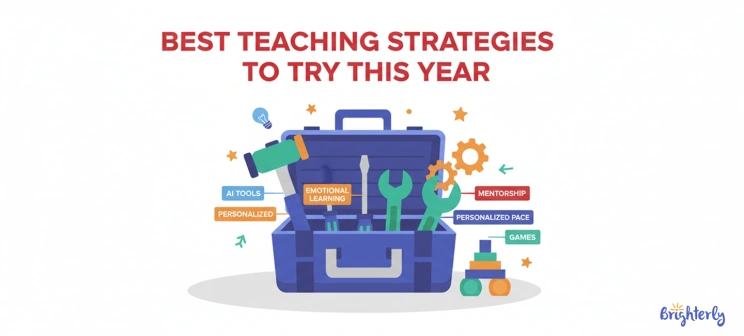
Teaching strategies are instructional models that parents and teachers apply to make learning smoother and more enjoyable. These 30 modern tactics – 9 groups, tips to choose the right approach, and expert insights – provide a versatile toolkit for any learning environment and every child, according to their individual needs.
What are Teaching Strategies?
Teaching strategies are particular methods and approaches educators apply to ensure that children learn as effectively as they can. Effective teaching methods should enhance students’ comprehension, engagement, and retention of the concepts they learn. Good teaching strategies involve personalized learning, adaptability, and engaging children in active learning.
Explore Brighterly Learning Experience
Learn exactly how Brighterly helps students thrive through expert sessions, online tools, and proven feedback from thousands of satisfied parents
How to Choose the Right Teaching Strategy (for Parents and Tutors)?
To choose a teaching strategy that fits your student best, evaluate their current state, learning style, material difficulty, intended outcome, and feedback requirements.
| Type of Strategies | Best For | Preferred Learning Style | Goal |
| Virtual 1:1 mentorship | K-12 students needing emotional engagement | Personalized | To make complex subjects accessible while providing motivational coaching. |
| Engagement strategies | Younger learners and preschoolers with short attention spans | Math games and active breaks | To manage focus, encourage creativity, and create emotional safety. |
| Instructional strategies | Students solving complex subjects or seeking real-world applications | Hands-on projects | To build problem-solving skills and simplify difficult concepts. |
| Cognitive strategies | Students needing to memorize facts | Reading, writing, and auditory | To ensure mastery and develop student self-awareness. |
| Collaborative & social strategies | Parents/tutors needing to define knowledge gaps or mastery | Discussions and teamwork | To build communication and social-emotional skills. |
| Assessment strategies | Students who are chaotic, disorganized, or need security. | Quizzes, recall, interviews | To provide data for customization. |
| Learning environment strategies | Students who are chaotic, disorganized, or need security. | Focus on physical space | To establish routines and manage behavior. |
| Personalization strategies | Gifted students or those progressing at different speeds. | Adaptable to individual styles | To adjust pace and complexity to match particular academic goals. |
Brighterly adapts to every child’s needs
Seasoned tutors adjust lessons to match how your kiddo learns best


Top Teaching Strategies for 2026
- Virtual one-on-one mentorship
- Using active teaching
- Adding math games
- Learning gamification
- Incorporating active breaks
- Encouraging creativity
- Project-based learning
- Problem-based learning
- Inquiry-based learning
- Blended and hybrid learning
- Structured literacy
- Convergent and divergent thinking
- Metacognition
- Retrieval practice
- Spaced repetition
- Scaffolding
- Peer teaching
- Small-group instruction
- Think-pair-share
- Group discussion
- Cooperative learning
- Formative assessment
- Summative assessment
- Diagnostic assessment
- Classroom management
- Establishing routines and expectations
- Creating a welcoming environment
- Personalized learning
- Student-centered learning
- Social and emotional learning
Virtual One-on-One Mentorship
Virtual 1:1 mentorship entails that a student works exclusively with a professional educator in a digital environment, who acts as both an academic guide and a motivational coach. At the Brighterly learning platform, in particular, K-12 students meet experienced tutors who specialize in making complex subjects accessible and enjoyable.
Brighterly tutor reviews feature specialists selected for their subject-specific expertise and their ability to engage students emotionally, ensuring a safe and productive learning environment. Our math program and reading classes are structured around materials 100% aligned with U.S. state standards.
We combine different teaching strategies simultaneously to deliver decent results with affordable learning plans:
- Personalized learning – adjusting the pace and complexity of every session to your kid’s particular academic goals and learning style.
- Foundation-first approach – prioritizing solidifying basic concepts before moving to advanced topics, following the initial diagnostic phase.
- AI implementation – providing AI-generated summaries after every lesson with recommendations for further home practice.
“First, through conversation, reflection, and observation of my student, I figure out his/her learning style.”


Engagement Strategies
- Using active teaching
- Adding math games
- Learning gamification
- Incorporating active breaks
- Encouraging creativity
Using Active Teaching
The real goal of active teaching is to engage the students as much as possible in what’s going on in the classroom. Great student engagement is the first step to making kids enjoy learning and boosting retention. Teachers need to seek approaches that promote students’ engagement in class and apply them to their teaching. It’s not about how likable they are by the students (which is also quite important), but rather how well students comprehend the material.
Keep kids fully engaged and active
Brighterly employs proven and effective engagement strategies with affordable learning plans
Adding Math Games
Teachers often debate over which teaching methods will be the most effective when, in reality, they know for sure that games are the way to go, especially in situations where students feel intimidated by math. With these games, teachers and tutors can easily keep kids interested by making math fun.
Math games are numerous, so teachers can easily find what will work best for their students. For instance, if the animal counting game doesn’t really work, they could love the fruit-slashing counting game. The goal is not plain fun; teachers have to make sure students get the ideas in their math lessons at the end of the day.
Learning Gamification
Learning gamification is one of the teaching techniques where teachers incorporate games into non-game educational contexts to help students learn new concepts. This approach works greatly with kids who are constantly distracted and can’t pay focused attention for long periods of time. The benefits of gamification include improved knowledge retention, increased learner motivation levels, and better learner engagement through social mechanisms.
For instance, teachers can use different elements of gamification in their lessons, like challenges and progress indicators (e.g., points, badges, leaderboards) to further motivate students. Some of the best examples are:
- Assigning points for meeting academic and non-academic objectives
- Giving badges for a certain amount of points
- Opting to use levels and checkpoints to show progression
- Reflecting on personalized performance
Incorporating Active Breaks
Pre-schoolers have a very short attention span. Having an active break every 15 minutes is a good teaching strategy if teachers want their students to have good results and enhanced focus during lessons. Among multiple active break activities out there, every parent and tutor can choose what suits the needs of their student best.
Encouraging Creativity
Practicing art, music, and drama is very helpful in fostering self-expression and emotional regulation, as well as in developing social skills, motor skills, and cognitive abilities. Teaching methods that encourage creativity are especially needed for kindergarteners, as some creative expression is necessary at this age.
Instructional Strategies
- Project-based learning
- Problem-based learning
- Inquiry-based learning
- Blended and hybrid learning
- Structured literacy
Project-Based Learning
Project-based learning involves engaging kids in hands-on experiences after learning. Not all students pay focused attention in class, which leads to much confusion afterward. Projects are a way to reinforce what they have learned and apply their knowledge after the class. There are no wrong or right answers to projects, but it does simplify applying difficult concepts to real-life situations, as kids will think outside the box and look for creative ideas.
Teachers can divide children into groups and give them group projects, but personal projects are another option.
The first one teaches them teamwork, leadership, organization, and collaboration, while the second approach fosters self-confidence and independence.
Problem-Based Learning
Teachers use problem-based learning to see if students can solve problems independently without help. With problem-based learning, students get open-ended problems that they have to solve in groups. These problems are complex issues and encourage students to use their problem-solving skills and learn new concepts, not just absorbing facts.
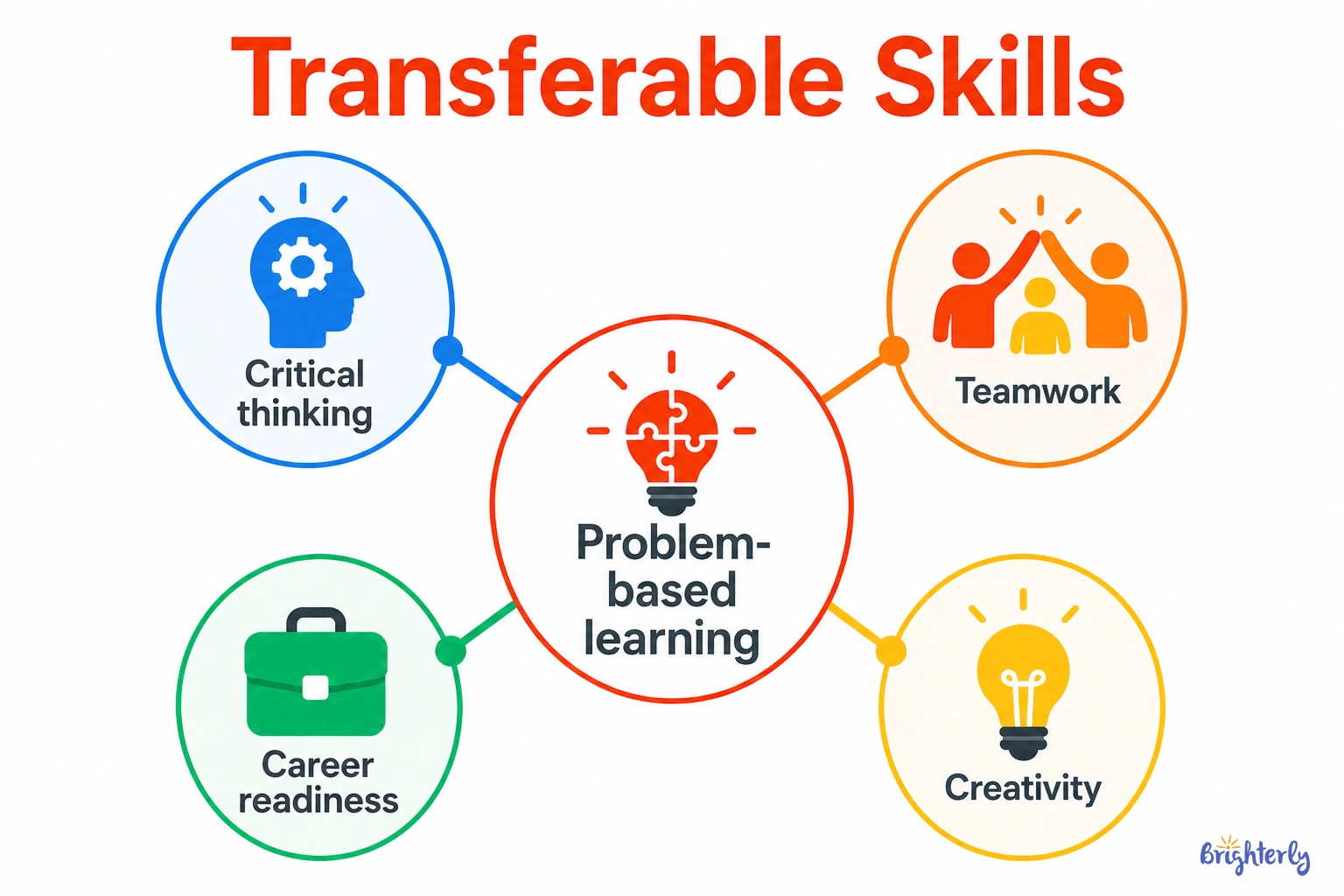
This strategy is proven to be one of the most effective on the teaching strategies list, as makes students think creatively and independently to find different ways to solve one problem. Problem-based learning also helps students to gain transferable skills, “skills that can transfer from one subject to another and are extremely important for building a career in the future”.
Inquiry-Based Learning
With this active learning strategy, teachers challenge kids with questions. Sometimes, kids can generate questions for the teachers to secure a better understanding of the subject matter. Here are 4 types of inquiry-based learning:
- Guided inquiry
- Open inquiry
- Confirmation inquiry
- Structured inquiry
Guided inquiry is where students get open questions and design their own investigation system. The open inquiry approach gives students the possibility to create questions and plans for solving them. With a confirmation inquiry, teachers ask students to answer closed yes or no questions. Lastly, in structured inquiry, students get a problem and a structured approach to solve it. All of these methods teach kids to think critically and apply problem-solving skills.
Blended and Hybrid Learning
Blended and hybrid learning strategies enable students to combine their online and in-person studies. With the integration of digital tools, this method offers more flexibility than traditional education systems.
Structured Literacy
The top list of teaching methods includes structured literacy. It involves explicit and systematic phonics instructions so the students are taught the rules and patterns of the language in a clear and organized manner. Jen Jones, educator, and literacy expert, relies heavily on providing explicit phonics instruction and using decodable texts. She emphasizes that phonics teaches students the code to crack reading, and decodables give them practice applying those skills:
“I keep lessons and engaging using songs, chants, games, and movement.”

Cognitive Strategies
Convergent and Divergent Thinking
Convergent and divergent thinking are two complementary cognitive methods for analyzing a problem and choosing the optimal solution. Although some kids may naturally lean towards one of the methods, it’s important to learn to use both for successful problem-solving.
Convergent thinking is when you use different elements to arrive at a single answer or solution. A practical example of this method would be a Jigsaw puzzle. This thought process allows children to see things in more than one way. For example, if a teacher draws four triangle parts to form a square, convergent thinking will make them see each triangle instead of a whole square.
Divergent thinking, on the other hand, makes children concentrate on a whole thing rather than one piece of information. It fosters creativity, problem-solving, and producing new, surprising solutions.
Metacognition
Metacognition – often defined as ‘thinking about thinking’ – entails that students become aware of their own learning journey, monitoring their understanding and adjusting accordingly in real-time. For example, a parent or teacher stimulates kids to ask themselves questions like ‘Do I understand this paragraph?’ or ‘What part of this math problem is confusing me?’ Due to such developing of self-awareness, students stop being passive recipients of knowledge and become active managers of their own academic growth.
Retrieval Practice
Retrieval practice focuses on getting information out of a student’s head instead of putting it in, requiring students to recall facts or concepts from memory. Teaching strategies examples of retrieval practice include:
- Low-stakes quizzes – short, ungraded tests to see what is remembered.
- Flashcards – recalling an answer before flipping the card.
- Brain dumps – writing down everything known about a topic on a blank sheet of paper.
Such effortful recall strengthens the neural pathways associated with that information, enhancing memorization in the long run.
Spaced Repetition
Spaced repetition reviews information at increasing intervals, spreading the learning over days, weeks, or months. This method combats the natural tendency for the human brain to lose information over time if it isn’t used. Just as a student is about to forget the concept, revisiting it refreshes and solidifies the memory. So, if you introduce a new phonics rule on Monday, then review it on Wednesday, and then check in again the following Tuesday.
Scaffolding
Scaffolding implies providing a teacher’s temporary support to a student when they learn a new and complex skill. Such supports are further removed as soon as the student masters it. Effective scaffolding often follows a ‘I Do, We Do, You Do’ progression:
- Modeling. The teacher demonstrates the task.
- Guided practice. The teacher and student work through the task together.
- Independence. The student completes the task alone.
Scaffolding ensures that students remain in their ‘zone of proximal development’ – the sweet spot, in which learning is challenging yet not impossible.
Collaborative Strategies
Peer Teaching
Peer teaching is a model of teaching where students teach and learn from one another. It’s a collaborative and active learning strategy where students take on both roles as learners and educators. It allows students more space for collaboration, engagement, and teamwork. Also, it doesn’t subscribe to traditional hierarchies and leads to a more stress-free environment in the classroom.
Peer teaching can make your core teaching strategies more effective by shifting the focus from the teacher to the student. In this case, teachers act more than observers and mediators rather than the primary source of knowledge and instruction. Peer teaching also promotes critical thinking, problem-solving, and collaboration skills as students are more keen on engaging in interactive learning experiences.
Small-Group Instruction
Gathering students into small groups of 4 to 6 people allows teachers to work more closely with each kid and ensure that everybody keeps up. This is also a great tool to see if kids understand the material and follow the instructions as intended.
Think-Pair-Share
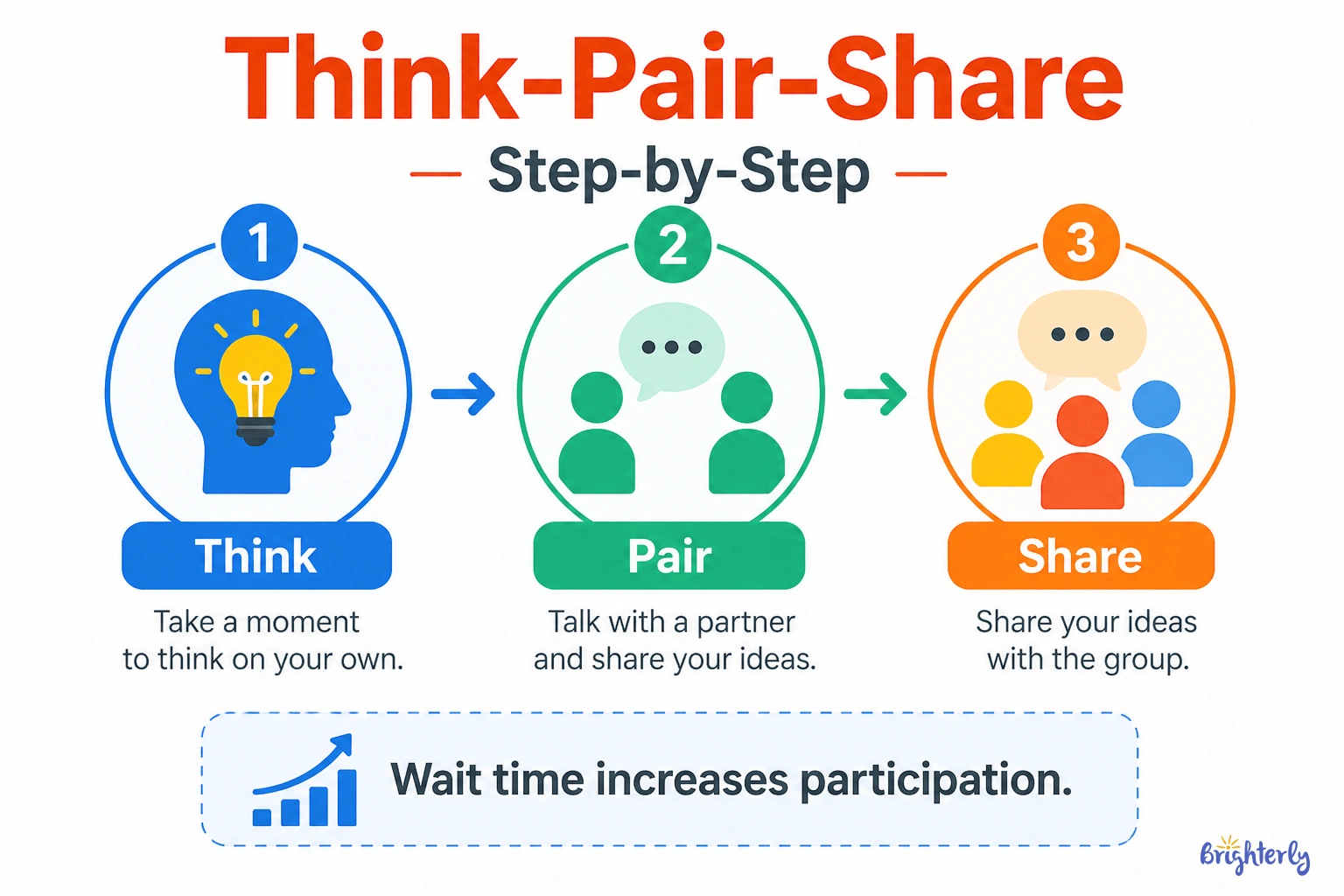
Think-pair-share is a three-step collaborative discussion strategy that gives students time to process information before being asked to speak in front of a group. It’s especially effective for encouraging participation from students who feel anxious about answering questions immediately.
- Think. The teacher formulates a particular question or problem. Students spend one to two minutes thinking about their own answer silently, without talking to peers.
- Pair. Students turn to a partner to discuss their thoughts. This enables them to experiment with their ideas without pressure and hear a different perspective.
- Share. The teacher expands the discussion to the whole class. Pairs share the highlights of their conversation or the solution they reached together.
Group Discussion
In group discussion, students and teachers exchange ideas to explore a topic in-depth. A parent or teacher isn’t the sole source of information in this case, but treats the group or classroom as a forum. Effective group discussions are guided by open-ended questions that require critical thinking. This teaching strategy helps students develop communication skills, learn to respect diverse viewpoints, and practice articulating their logic. Teachers or parents often act as facilitators to ensure that the conversation continues in the right direction and all voices are heard.
Cooperative Learning
Cooperative learning implies organizing students into small groups to complete a particular project or reach a common goal. The defining feature of this strategy is positive interdependence – i.e., when the success of the individual is tied to the success of the group.
Still, for individual accountability while encouraging teamwork, each student is typically assigned a specific role – ‘researcher,’ ‘recorder,’ or ‘timekeeper.’ Researchers from the Universities of Pittsburgh and Macau revealed that when students work together toward a shared objective, they frequently develop stronger social-emotional skills and a deeper understanding of the subject than they would if working in isolation (findings published in 2024 in the British Journal of Educational Psychology).
Assessment Strategies
Formative Assessment
Formative assessments are tests that are taken in the middle of lessons to verify how well children go along with the learning process. Teachers often prioritize formative assessments over summative ones because formative ones give them a broader look at how things are going. For instance, during a math class, teachers can stop midway to give kids a counting activity to see how well they understand the concepts that are being taught.
Formative assessments can give teachers insights into each child’s issues with the material. Naturally, you will have students who are more prominent in math than others by the end of the year. However, your teaching strategies would be much more successful if all of your students do well, even if they aren’t STEM stars.
Summative Assessment
Summative assessment is something that we’re all used to: this teaching strategy has roots that trace back several centuries. Kids often deal with them by the end of a class, term, and year. The goal of summative assessments is to see how well students grasped the concepts they learned in class. Not everybody is a fan of this teaching strategy. However, summative assessments allow more structure for both students and teachers. In most cases, children know they will have to pass the test eventually—this can motivate them to try harder.
The downside of this method is that teachers can only see in retrospect that kids have trouble with certain concepts. For example, if they use an end-to-unit strategy to fix their summative assessments, they won’t be able to return to that unit if kids fail; timeframes and schedules simply won’t let them do that.
Diagnostic Assessment
A diagnostic assessment enables educators to understand a student’s strengths, weaknesses, and prior knowledge before a new instructional cycle begins. Diagnostic tools are forward-looking and provide the necessary data to customize a curriculum. If, for example, a teacher or parent is going to start a unit on multiplication, they first have to ensure the student has a good command of repeated addition.
Examples of teaching strategies for diagnostic assessment:
- Pre-unit quizzes – a short set of questions covering the upcoming topic.
- Running records – in reading, observing a student read aloud to identify particular phonetic or fluency challenges.
- Self-assessments – asking students to rate their own comfort level with various skills on a scale.
- Interviews – one-on-one, a tutor asks a student to ‘think out loud’ during solving a problem to see where exactly their logic might break down.
Learning Environment Strategies
Classroom Management
Given that children can be extremely chaotic and disorganized, it’s up to teachers to keep them in line. The first of the 3 most common classroom teaching strategies is encouraging students to engage in the classroom processes more actively than they would normally, making them more focused on one thing. The second approach is modeling exemplary behavior—in other words, mimicking everything you want students to learn to do. And the third one is avoiding collective punishment. Research indicates that collective punishment is counterproductive and can lead to decreased morale, resentment, and a breakdown in trust between students and teachers.
Establishing Routines and Expectations
Letting kids know what their routine is helps them to feel more secure and understand what is being expected of them. Consistency plays a crucial role in teaching kindergarten. A somewhat strict structure is important in managing the classroom and helping kids to focus.
Creating a Welcoming Environment
Creating warm and inclusive classroom settings is vital for kindergarten. Young children need to feel welcome, secure, and open in order to have a positive learning experience. A colorful and comfortable classroom sets the tone for the whole day.
Personalization Strategies
Personalized Learning
Personalized learning is an inevitable part of any study process, as some children progress faster than others. How do teachers ensure that everybody gets a chance to catch up with what’s going on in the classroom? The best way would be to use personalized learning as their leading teaching strategy.
Note: At home, a positive and individual learning environment matters just as well. Find out how to create it and grab tips from parents for happy and engaged kids.
It’s also one of the new teaching strategies that has proven to be very successful. Teachers can use the Universal Design for Learning (UDL) to make sure nobody is falling behind in the class. Naturally, all kids have their weaknesses and strengths, and the more teachers provide flexible and personalized environments, the better the result will be.
Rachel Cederbaum, Founder and Lead Academic Coach at Gold Signature Writers LLC, relies heavily on personalized learning. In her experience, lessons need to be individualized so that students can get detailed feedback on their work and understand their development areas and strengths.
“Open communication between the educator and parents is essential.”
Student-Centered Learning
The idea of a student-centered approach has gained immense popularity over the years. Student-centered classrooms engage students in planning, preparing assessments, and implementing the knowledge they gained. Involving students in these decisions shifts focus from teachers to learners and places more responsibility and ownership on them. This way, children learn leadership and social skills.
Meanwhile, Claire Smizer – Brighterly Educational Advisor – goes even further and suggests a student-led teaching strategy!
“The fastest diagnostic in teaching isn’t a quiz. It’s asking a student to explain something to someone else.”
- Teach-Back: After instruction, pairs explain to each other and ask one clarifying question, building both communication and metacognition simultaneously.
- Jigsaw: Groups each become experts on one part of a concept, then regroup to teach each other so that every student is accountable for everyone else learning.
When kids teach, they reorganize knowledge and find the edge of what they actually understand. That is the cognitive work that produces durable learning, and it does not require special materials or extra prep to set up.

Social and Emotional Learning
Teachers will incorporate social and emotional learning into the curriculum more often than before. That will help students to build self-awareness, empathy, and interpersonal skills. Plus, practices like mindfulness will help to promote mental health and reduce stress levels.
Technology-Enhanced Strategies
Embracing technology for your teaching needs can completely change your teaching strategies and methods for the better. Yes, it can cause some level of distraction for students. However, with good classroom management skills, teachers usually don’t lack focus in the classroom. Things like virtual reality, fun course videos, and other tools are quite resourceful in educational settings.
Also, leveraging AI-driven educational tools and tailoring content to individual needs allows teachers to engage students in the learning process more actively. Neeru Khosla, founder at CK-12, shares her outlook on AI-driven teaching tools:
“Platforms like CK-12's Flexi 2.0 use AI to customize learning experiences by offering personalized content and real-time feedback, which helps deepen understanding without simply providing answers.”

AI systems, too, can provide real-time feedback and support personalized learning, as well as help teachers with administrative tasks. Also, AI will allow predicting students’ progress and provide interventions for those who may have problems with understanding the material.
What is the Difference Between Teaching Methods and Strategies?
Although the terms – teaching method and teaching strategy – are often used interchangeably, they still entail differentiated levels of planning:
| Teaching Method | Teaching Strategy | |
| Definition | The general philosophy or approach to instruction | The specific tactics used to achieve a goal |
| Scope | Broad and long-term (e.g., teacher-centered vs. student-centered) | Narrow and immediate (e.g., using a math game or a ‘think-pair-share’) |
| Flexibility | Usually remains consistent throughout a course | Can change minute-to-minute based on student reactions |
| Example | Inquiry-based learning | Asking an open-ended question to spark a debate |
Conclusion
To sum up, all types of teaching strategies in 2026 will shift toward more personalized, engaging, and flexible learning experiences. Using a combination of different methods, teachers can create a dynamic and efficient learning environment for every student. Also, in 2026, embracing AI and tech tools will keep enhancing the learning experience and curriculum.
If you want to leverage the most prominent teaching strategies for your kid and enhance their STEM skills, you can always book a trial session with Brighterly! Our tutors will ensure the best possible teaching strategy personalized to your kid’s specific needs and knowledge gaps.
Frequently Asked Questions (FAQ)
What are the Big 8 Teaching Strategies?
- Expectations. Setting clear behavioral and academic standards.
- Attention signals. Applying particular cues (visual or auditory) for quick focus.
- Proximity. Using the physical space of the room to monitor students and manage behavior.
- Task orientation. Keeping the lesson moving efficiently to minimize possible distractions.
- Praise and support. Highlighting desired behaviors to stimulate their repetition.
- Cues and prompts. Providing hints to help students arrive at an answer without telling them directly.
- Questioning. Using a mix of lower-order (recall) and higher-order (analytical) questions.
- Feedback. Providing timely, specific, and actionable information to help students improve.
What are the 7 C’s in Teaching?
The 7 C’s represent a set of benchmarks used to measure a teacher’s effectiveness:
- Care. Building positive relationships and showing interest in students’ well-being.
- Confer. Respecting student perspectives and inviting their input.
- Captivate. Making the material relevant and interesting to keep students focused.
- Clarify. Explaining concepts in multiple ways to ensure everyone understands.
- Consolidate. Helping students connect new information to what they already know.
- Challenge. Pushing students to think deeply and persist through difficult tasks.
- Control. Effectively managing classroom behavior to create a comfortable learning space.
What is the Best Teaching Strategy?
There are no best teaching strategies because the most effective approach depends entirely on the learning goal and the individual needs of every student. However, the research results of the University of Denver as of 2025 suggest that the most successful appears to be evidence-based instruction, involving the blend of:
- Direct instruction – for introducing foundational skills.
- Active learning – like gamification or projects – to build engagement.
- Personalization – to adjust the pace for each child.



Mathematical problem solving skills are the core instrument that will help kids in school and in their day-to-day life. But what if your child has yet to develop them? No worries! I’m a math tutor with years of experience, and today I will walk you through the 15 most effective math problem solving strategies with […]
May 19, 2022

Assessment is a routine evaluation of students’ understanding of concepts and their needs for achieving success in studying. Assessment is critical in teaching because it amplifies students’ strengths and weaknesses. This article will show you how effective assessment methods help students reach the highest academic standards. What Is the Purpose of Assessment? Teachers can promote […]
May 19, 2022
Math & reading from 1st to 12th grade
Looking for homework support for your child?

Choose kid's grade

Math & Reading for Grades 1–12
Build real confidence for your child with a Brighterly math or reading tutor.