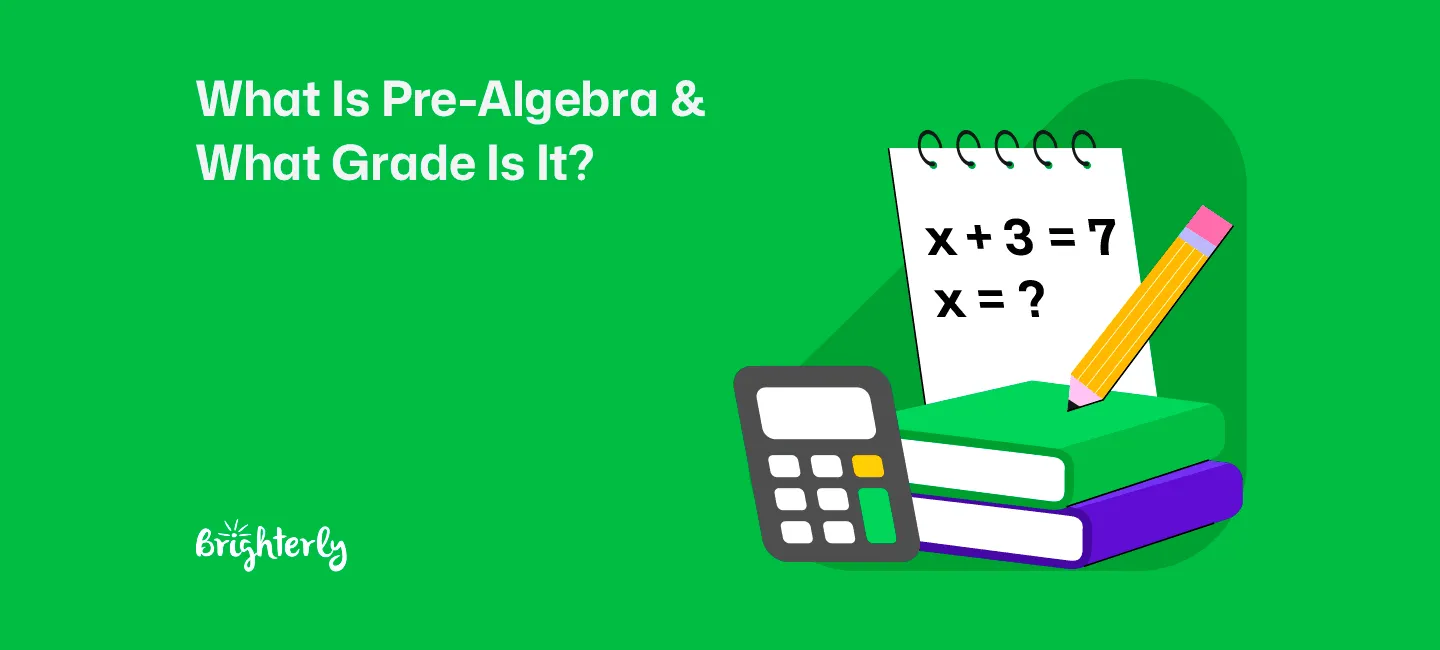
What Is Pre-Algebra? Grade Level, Topics, and Skills Explained

What Is Pre-Algebra? Grade Level, Topics, and Skills ExplainedAll

Key Points

  • What is pre-algebra? Pre-algebra bridges arithmetic and algebraic thinking, bringing numbers, integers, ratios, percents, variables, equations, and basic geometry.
  • Students learn pre-algebra in 7th or 8th grade; timing still depends on the school.
  • For most kids, pre-algebra is manageable, while struggles appear from a lack of arithmetic foundation or a shift to abstract thinking.
  • If your kid encounters struggles, then a pre-algebra tutor can confirm readiness and close gaps before Algebra 1.

Pre-algebra offers a way to Algebra 1, introducing variables, negative numbers, and ratios. Read this guide to learn what topics and skills kids learn during pre-algebra courses and how to help them succeed in them.

What Is Pre-Algebra?

Pre-algebra is a math course that bridges or connects basic arithmetic to formal algebra. It shifts kids’ thinking from simple number calculations to logical patterns, from arithmetic to algebraic thinking.

What Is Pre-Algebra?

You can think of pre-algebra as the one that brings the shift. In arithmetic, a kid knows every number in a problem; in pre-algebra math, they don’t, so they learn how to find the value.

It builds on skills like addition, subtraction, multiplication, and division and introduces new concepts. They refer to:

  • Variables. The concept introduces letters like \x\ or \y\ to work with unknown numbers.
  • Simple pre-algebra equations. It brings the knowledge of how to balance both sides of an equals sign to solve unknown values.
  • Negative numbers. This topic expands the line of numbers to include integers below zero.
  • Fractions and decimals. Learning them as a kid strengthens calculations that involve parts of numbers and percentages.
  • Basic geometry and stats. The related topics allow covering perimeter, area, ratios, and data graphs.

All these concepts allow a kid to prepare for high school classes that include Algebra I or Geometry.

Pre-Algebra vs. Algebra 1: What’s the Difference?

The main difference between pre-algebra and Algebra 1 lies in depth and complexity, even though both subjects involve variables and equations.

Pre-Algebra

Algebra 1

Focus

Bridging arithmetic and algebraic thinking

Formal algebraic methods, as well as functions

Skill level

Introductory, involving one- and two-step equations

Intermediate, including multi-step equations, systems, and graphing

Typical grade

Grade 7 or 8

Grade 8 or 9

Example problem

Solve: x + 5 = 12

Solve: 2x +3y = 12 for y, then graph the line

What Grade Is Pre-Algebra?

Often, children learn pre-algebra in grade 7 or grade 8, as the exact grade significantly depends on the school, district, and math track of the student. Besides, some schools introduce pre-algebra courses even in 6th grade. Nonetheless, it’s an option for advanced students; others provide it in 8th grade and lead directly into Algebra 1 in grade 9.

What Do You Learn in Pre-Algebra?

The pre-algebra concepts that children learn can be divided into such groups: numbers, integers, and operations; ratios, percents, and proportions; intro to variables and equations; basic geometry and data. They allow students to build skills that they will later lean on when they reach Algebra 1.

Numbers, Integers, and Operations

The first group provides pre-algebra topics within which students formally meet negative numbers and learn to operate on the full number line. It goes beyond positive values. Besides, a child learns the order of operations, which sets the ground for solving multi-step expressions in the future.

What are the pre-algebra skills and concepts that fit this category?

  • Adding and subtracting integers
  • Multiplying and dividing integers
  • Order of operations
  • Absolute value
  • Exponents and simple powers

Ratios, Percents, and Proportions

With these concepts, kids start to focus on real-world math. The rationale is that discounts, tips, recipes, and scale drawings all use the skills that fall within this group. Here are the pre-algebra basics they learn:

  • Simplifying and comparing ratios.
  • Solving ratios and proportions.
  • Converting between fractions, decimals, and percents.
  • Calculating percent increase and decrease.
  • Unit rates (like price per item, speed, etc.)

Intro to Variables and Equations

With variables and equations, the students are exposed to algebraic notation and reasoning and get a real feel for what they are about. During the introduction, the kids learn:

  • Writing expressions with variables.
  • Simplifying expressions (combining like terms).
  • Solving one-step and two-step equations.
  • Understanding inequalities.
  • Graphing points on a coordinate plane.

Basic Geometry and Data

Other than that, the pre-algebra curriculum also brings geometry and data concepts to the learning table. The kids learn concepts and skills that support both Algebra 1 and geometry courses later, including:

  • Perimeter, area, and volume of basic shapes.
  • Angle relationships.
  • Reading and interpreting graphs and charts.
  • Mean, median, and mode.
  • Basic probability.

Here are examples of what your child will learn under each topic:

Topic

Example skill

Number and operations

Simplify -8 + 5 × 2 using the order of operations

Ratios and percents

Find 20% off a $45 item

Variables and equations

Solve 3x - 4 = 11

Geometry and data

Find the area of a rectangle with sides 6 and 9

Common Pre-Algebra Formulas and Terms

The common pre-algebra formulas and terms cover foundational rules for numbers, expressions, and geometry. For parents and their kids, a table with such terms may become a decent reference worth keeping instead of trying to memorize it all at once.

Term or Formula

What it Means or Includes

Order of Operations (PEMDAS)

Parentheses, exponents, multiplication/division, addition/subtraction

Percent Formula

Part ÷ Whole × 100 = Percent

Area of a Rectangle

Length × Width

Perimeter of Rectangle

2(Length + Width)

Simple Linear Equation

ax + b = c

Absolute Value

|x| = distance from x to 0 on the number line

Proportion

a/b = c/d

Pre-Algebra Examples: How Problems Look in Practice

In practice, students encounter the problems that bridge arithmetic and formal algebra. The typical pre-algebra examples refer to variables, negative numbers, and balance equations.

Example #1. Order of Operations.

In this example, a kid would learn which steps to calculate first, often remembered as PEMDAS. In particular, if they deal with the expression 3 × (7 - 3 + 5 × 2) - 3,

  • The first step will be to solve the parentheses. Calculate 5 × 2 = 10 and subtract 7 - 3 = 4, then add both parts 4 + 10 = 14.
  • The second step is to multiply 3 × 14 = 42
  • The third step is to subtract: 42 - 3 = 39

Example #2. Solving a Two-Step Equation

A kid needs to solve for x: 2x + 3 = 11. In this regard, the steps are:

  • Subtract 3 from both sides to get 2x = 8.
  • Divide both sides by 2, so x = 4.

Example #3. Working with Percentages

In this example, a kid may have a real-world situation: a shirt costs $40 and is on sale for 25% off. They should know what the sale price is. In this example:

  • Find 25% of $40: 0.25 × 40 = $10
  • Subtract the discount from the original price: $40 - $10 = $30

Example #4. Simplify an Expression with Integers

In this case, you can give a kid the following expression to simplify: -6 + 4 × (-2). What are the steps?

  • Multiply first (order of operations): 4 × (-2) = -8
  • Then, add: -6 + (-8) = -14

Note

Importantly, if you feel that your kid has issues with some of the problems or is not confident, then resorting to the middle school math tutoring on specific platforms can bring the necessary support.

Where Does Pre-Algebra Fit in Your Child’s Math Path?

In the child’s math path or sequence, pre-algebra has a clear spot, connecting arithmetic to Algebra 1 and geometry. A common sequence looks like this: arithmetic – pre-algebra – Algebra 1 – Geometry and beyond. It implies that each stage depends on the one before.

Where Does Pre-Algebra Fit in Your Child’s Math Path?

So, if a kid has gaps in pre-algebra, they will resurface as struggles in Algebra 1. Besides, the timing and pacing of pre-algebra can vary significantly from school to school.

It means parents would want to ensure that the kid is genuinely ready before the next classes. A short diagnostic test on the Brighterly platform can help pinpoint what a student lacks, while our tutors can help a kid start Algebra 1 with confidence.

6th grade diagnostic test

7th grade diagnostic test

8th grade diagnostic test

Is Pre-Algebra Hard? What Parents Should Know

Pre-algebra can feel hard at first, but it’s manageable for most students who are solid on fractions, decimals, and basic operations. The difficulty may arise if kids have shaky math foundations, particularly related to arithmetic concepts. Students who are not confident with multiplication facts or fraction operations can find variables harder.

Another reason is that students begin using abstract thinking and multiple steps to solve problems, which may be overwhelming for them.

How can parents help a kid?

  • Review fraction and integer operations before diving into equations.
  • Practice translating word problems into expressions
  • Walk through mistakes slowly and practice with pre-algebra worksheets
Is Pre-Algebra Hard? What Parents Should Know

Once kids have steady practice, they are likely to adjust in the first few weeks. If they are still struggling after that, it may be a sign to target a specific skill or topic.

For this, you may want to enroll in a personalized math program or take lessons from a 7th grade math tutor.

Note

Moving on next to Algebra 1, find out how hard this subject can also turn for your kid or check your Pre-Algebra scores with this weighted grade calculator.

Conclusion

Pre-algebra appears to be an important part of a child’s math education. It ensures the bridge between arithmetic and algebraic reasoning. When you know what grade pre-algebra is taught, what topics to cover, and how it connects to Algebra, it’s much easier to provide pre-algebra help to your kid.

Just remember that any gaps can be closed with targeted practice. If they turn into issues or a lack of confidence, then a good option is to have an 8th grade math tutor for a year or have a separate course to prepare for Algebra 1.

Explore Brighterly Learning Experience

Learn exactly how Brighterly helps students thrive through expert sessions, online tools, and proven feedback from thousands of satisfied parents

  • Online math tutor

    Get personalized math tutoring from experts who help kids master math concepts

  • Parents reviews

    Read parent feedback to see how Brighterly helps kids build strong foundation

  • Online reading tutor

    Boost reading and language skills with engaging lessons from ELA tutors

Frequently Asked Questions

Algebra 1 usually comes after pre-algebra. It builds on the same variables and equations, yet adds complexity and depth. The rationale lies in the learning and application of multi-step problems, systems of equations, and graphing linear functions. After Algebra 1, students move into geometry and then Algebra 2. Some schools can bring geometry earlier.

Yes, a child can skip pre-algebra and go straight to Algebra 1 if they have already mastered its core skills via an accelerated math track. The signs that your child may be ready include arithmetic mastery and no confusion with one-step and two-step equations and with negative numbers. Moreover, they should have decent results on an objective algebra readiness test.

A typical pre-algebra course takes one full school year. In a standard middle school schedule, like the one it takes about 36 weeks, or two semesters. At the same time, students can take summer or intensive programs that compress material in a shorter timeframe. For instance, a homeschooling program can take 16 weeks of video lessons and practice.

Most schools cover pre-algebra topics within a general 7th or 8th grade class. Yet, not every school labels the course as “pre-algebra.” The explanation is that the Common Core State Standards do not have a specific title, “Pre-algebra,” but include concepts of it in grade 7 and grade 8 standards.

Before starting pre-algebra, your child should master fractions, decimals, and basic operations. These include addition, subtraction, multiplication, and division. All of them matter most for a kid before pre-algebra. At the same time, they should be able to work with whole numbers fluently. The reason is that pre-algebra adds negative numbers and variables on top of these foundations.

Yes, pre-algebra skills like ratios, percents, and basic equations are frequent parts of the math section of the SAT and similar standardized tests. They form the foundation for later algebra and problem-solving questions. That way, pre-algebra provides a foundation for many tests.

Help your kid excel in math

Book a free demo lesson with a Brighterly tutor and see real progress after the first month.

Want your kid to excel in math and reading?

Child's grade*