Shapes – Definition, Types, FAQs, Practice Problems, Examples
reviewed by Jo-ann Caballes
Updated on August 11, 2026
Our world is filled with shapes that we can recognize. In the objects around us we find basic shapes such as the two-dimensional square, rectangle, and oval, and the three-dimensional rectangular prism, cylinder, and sphere. Geometric shapes appear in everything from credit cards and coins to finger rings, photo frames, dart boards, windows, tall buildings, and flower pots. So let’s explore what a shape is with Brighterly and learn to recognize shapes in real life.
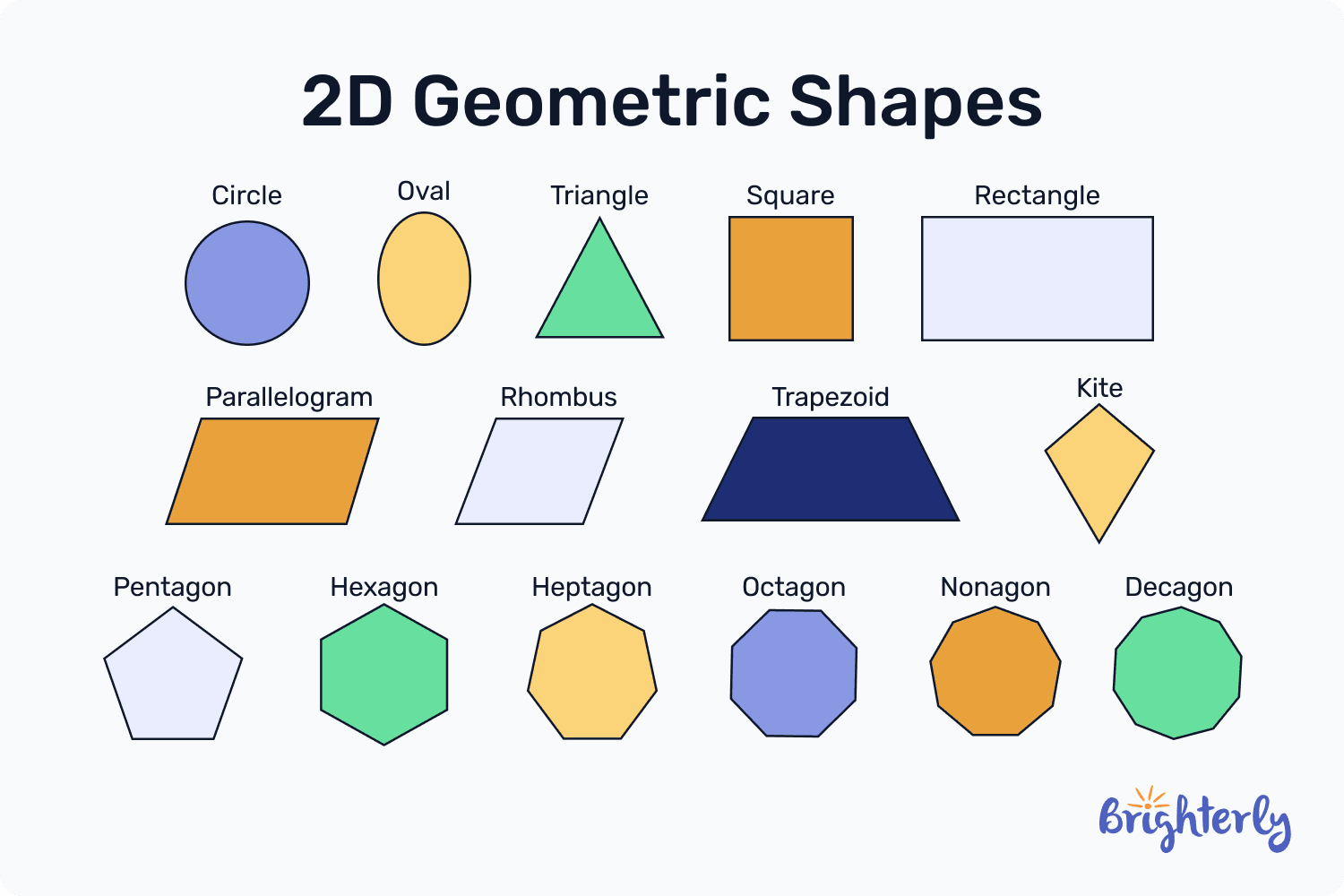
What Are Shapes?
Shapes are the form or outline of an object. Every physical object in the world is formed of a shape. 2D geometry shapes are the most basic shapes and are flat; 3D shapes are introduced later.
Shapes Definition
Shapes are the forms or figures created by points, lines, or curves that define an object’s outline. A shape definition for kids can say that shapes can be flat, like circles, squares, and triangles, or solid, like cubes, spheres, and cylinders. Each shape has unique properties, such as sides, angles, and symmetry, that help children recognize and understand them.
There are two major types of shapes: geometric and organic. We’ll cover geometric shapes, which fit the rules of mathematics and geometry. Organic shapes are free-form and don’t follow mathematical principles.
Everything is a shape, and many shapes can be broken down into other geometric shapes. A pizza, for example, is usually a circle cut into triangular slices.
Expert Math Tutors for Every Level
Connect with professional and certified educators who provide specialized support for every grade level, from elementary school basics to advanced algebra
Different Types of Shapes
There are many different types of shapes, including:
- Circles
- Ovals
- Triangles
- Squares
- Rectangles
- Parallelograms
- Rhombus
- Trapezoid
- Kite
- Pentagon
- Hexagon
Types of Shapes With Examples
Circles. A circle has a point at its center from which every point on its edge is equally distant. It has infinitely many lines of symmetry. How many sides does a circle have? Depending on how you look at it, the answer is 0 straight sides, one curved side, or infinitely many tiny segments.
Squares. A square has 4 equal sides and 4 right angles, with four lines of symmetry. Every square is also a rectangle, every square belongs to the rhombus family, and every square is a parallelogram.
Rectangles. Rectangles have 4 sides and 4 right angles. Each has two lines of symmetry (four if it is a square). The rectangle belongs to the parallelogram family.
Triangle. A triangle is a closed shape with 3 sides and 3 angles, and the sum of its internal angles is always 180°. Depending on the side lengths, triangles can be equilateral, isosceles, or scalene — see more on the types of triangles. Most triangles have no line of symmetry, but equilateral and some isosceles triangles do.
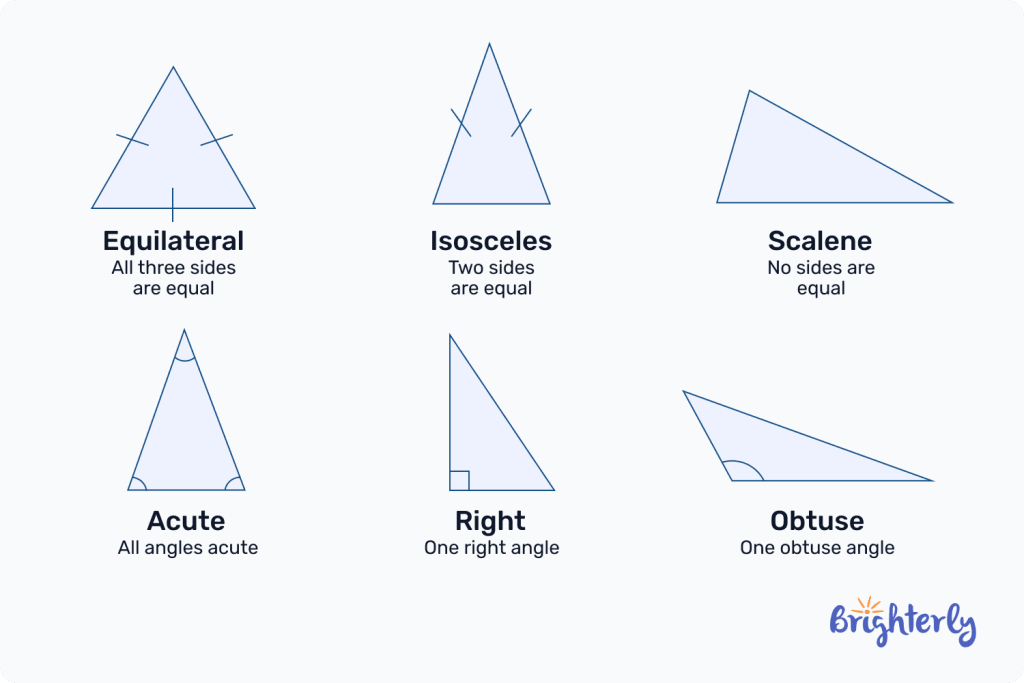
List of Shapes
Here’s a list of some common shapes kids are introduced to in kindergarten, in addition to the four basic geometric shapes:
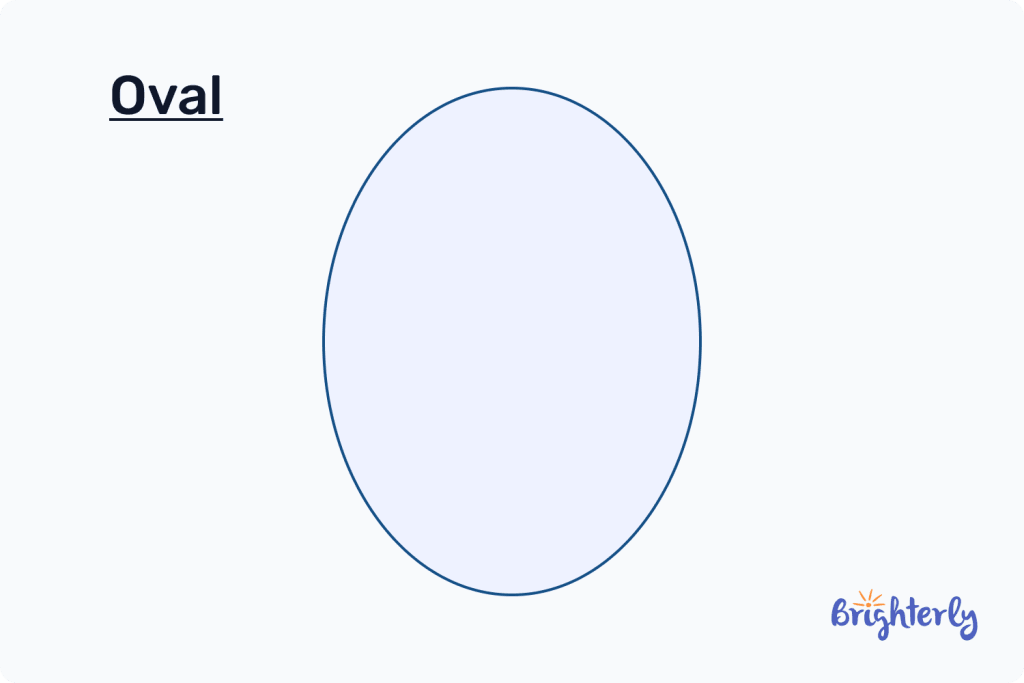
Oval
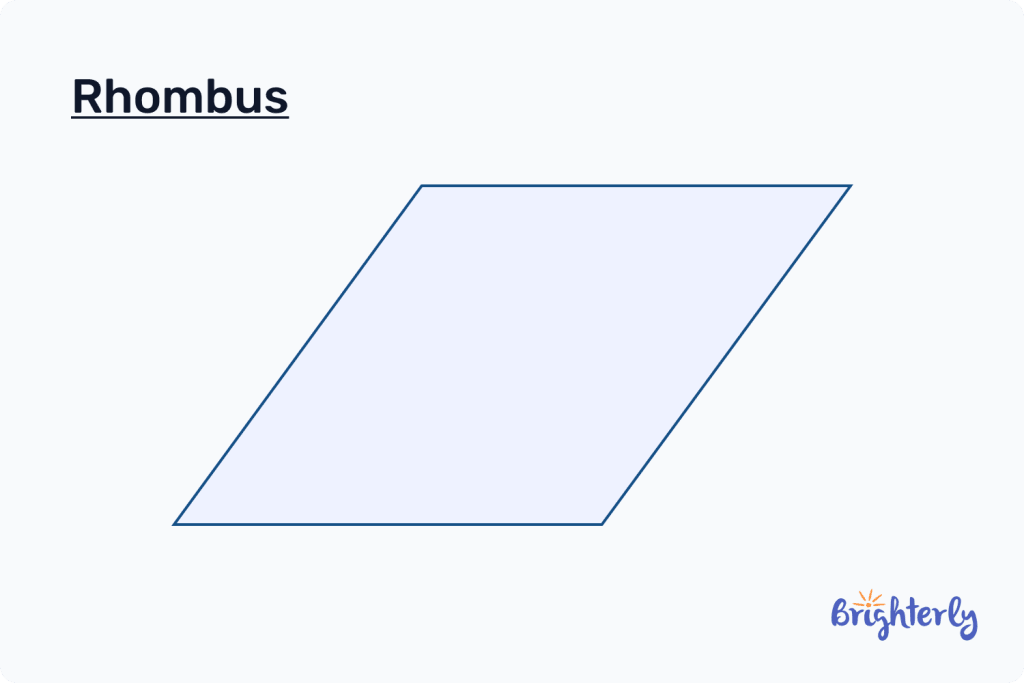
Rhombus
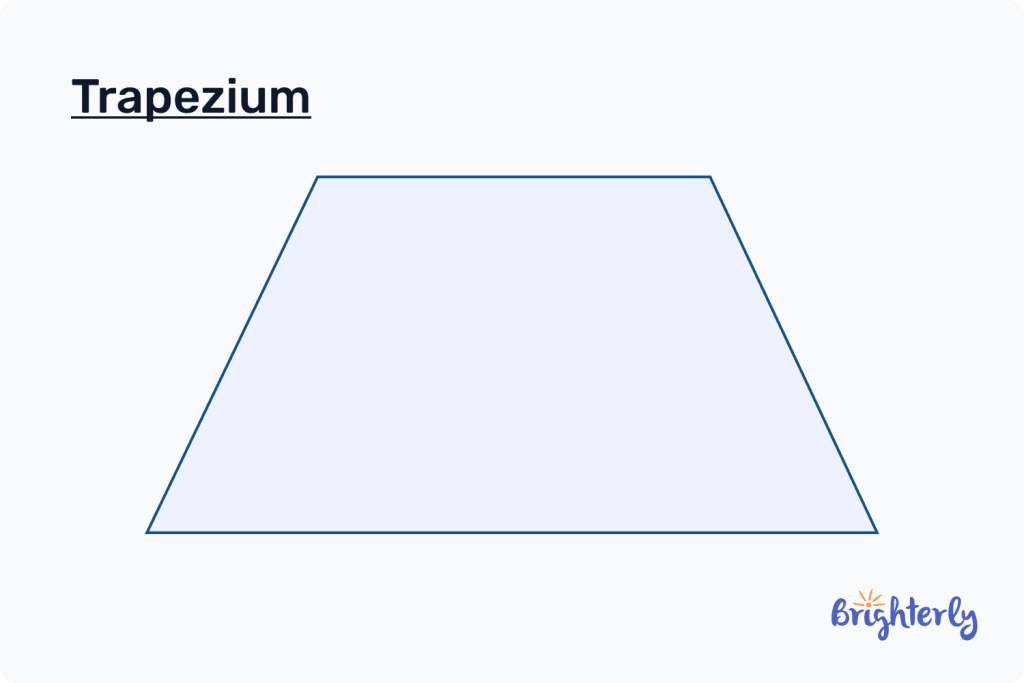
Trapezium (trapezoid)
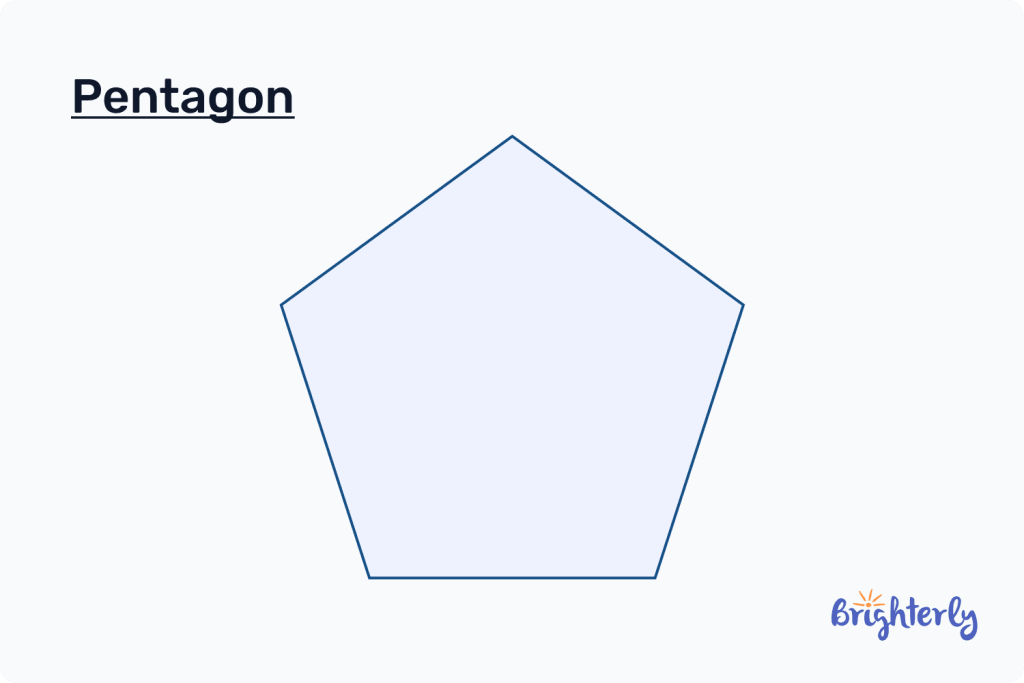
Pentagon
Geometry Shapes in Nature
We can see many different shapes in nature. Getting children to notice mathematics in the natural world is easier than you might think — all around us there are patterns and shapes: symmetries, spirals, arrays, cracks, and stripes.
- Triangles. Grass, rocks, leaves, and flower petals often contain triangles; some petals form an isosceles triangle.
- Hexagons. In beehives, hexagons pack together almost perfectly with no gaps, making them an ideal shape for maximizing space.
- Circles. A tree’s growth rings are concentric circles, and counting them reveals the tree’s age.
From flat leaves to three-dimensional crystals, we see all types of shapes in nature. Observing them helps children recognize patterns and structure — for more ideas, see shapes for kids.
Facts About Shapes
- Circles have no straight sides, but if you imagine their curve as countless tiny segments, they can seem to have infinitely many.
- Squares belong to two families at once — rectangles and rhombuses — so every square is a rectangle, but not every rectangle is a square.
- Triangles are the strong superheroes of shapes: engineers use them in bridges, towers, and roof trusses because they don’t wobble or collapse easily.
- Honeycombs are the classic example of hexagons, but they also appear in snowflakes, basalt columns, and even a turtle’s shell.
- Cubes use squares, cylinders use circles, and pyramids use triangles to build 3D shapes.
- Weight is distributed more evenly when a shape is more symmetrical.
Solved Examples of Shapes
Solved problem 1. Which shape is not a closed shape: circle, rectangle, triangle, or zigzag? Answer: the zigzag. Its sides don’t meet one another, so the shape is not closed.
Solved problem 2. Which of these are 3D geometric shapes: cuboid, rectangle, cylinder, triangle? Answer: the cuboid and the cylinder. A rectangle and a triangle are flat and lack three-dimensional properties.
Shapes Worksheets
Brighterly offers math worksheets covering different types of shapes:
- Triangle worksheets
- Square worksheets for preschool
- Shapes worksheets for preschool
- Shape tracing worksheets
Shapes: Practice Math Problems
Frequently Asked Questions on Shapes
What Does Shapes Mean?
Shapes are the form of an object’s outer edges or surfaces. They have specific properties, like sides, angles, or curves, that help us identify them.
How Many Shapes Are There?
There is no exact number of shapes. Geometry includes infinitely many shapes, but students usually learn a core set of common 2D and 3D shapes in school.
What Are the Six Most Basic Shapes in Geometry?
Circle, square, rectangle, triangle, oval, and hexagon are the six most basic shapes commonly taught in early geometry.
What Is the Difference Between a 2D and a 3D Shape?
A 2D shape is flat and has only two dimensions — length and width — such as a square or a triangle. A 3D shape is solid and has a third dimension, depth, such as a cube or a sphere. Many 3D shapes are built from 2D faces: a cube is made of six square faces, for example.
Does a Circle Have Sides?
A circle has no straight sides. It is made of a single continuous curved line with no corners or vertices. Some people describe it as having one curved side, and others say zero straight sides — both are common. What makes a circle unique is that every point on its edge is exactly the same distance from its center.
What Is the Difference Between a Polygon and a Shape?
A shape is any 2D or 3D form, while a polygon is a specific kind of flat shape: a closed figure made only of straight line segments. Triangles, squares, and pentagons are polygons; circles and spheres are shapes but not polygons, because they include curves rather than straight sides.


Need help with Geometry?
- Does your child need additional support with understanding geometry lessons?
- Start lessons with an online tutor.
Choose kid's grade

Is your child finding it challenging to grasp geometry concepts? An online tutor could be the answer.
Book FREE lesson