45-Degree Angle – Definition with Examples
Updated on July 29, 2026
A 45-degree angle is an acute angle that measures exactly 45 degrees — precisely half of a right angle (90°). You can picture it by cutting a square corner in half diagonally: each of the two equal angles you create is 45 degrees. Because it is smaller than 90°, a 45° angle is always classified as acute.
The 45° angle appears frequently in geometry, construction, and design, so it is among the first specific angles students learn to measure and draw. A geometry tutor can help a child practice constructing it accurately with everyday tools.
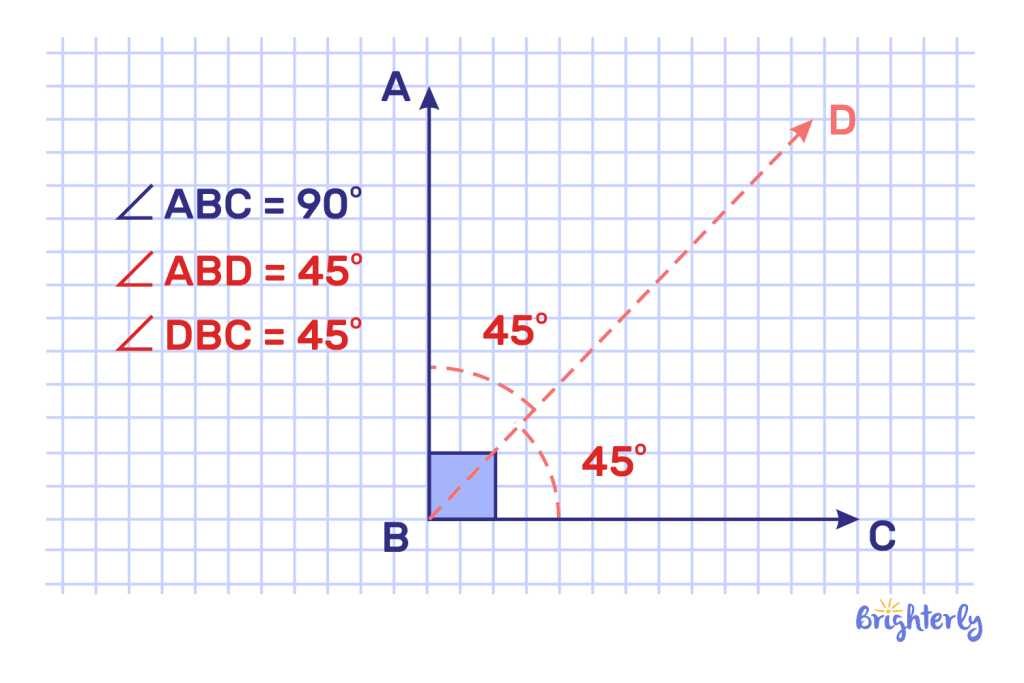
What Is a 45-Degree Angle?
A 45-degree angle is formed when a right angle is split into two equal parts, giving each part a measure of 45°. It is an acute angle because it is less than 90°. In terms of a full turn, a 45° angle is one-eighth of a complete 360° rotation.
Two 45° angles placed side by side recreate the original right angle, and a 45° angle also appears naturally along the diagonal of a square, which cuts each 90° corner exactly in half.
Expert Math Tutors for Every Level
Connect with professional and certified educators who provide specialized support for every grade level, from elementary school basics to advanced algebra
How to Construct a 45-Degree Angle
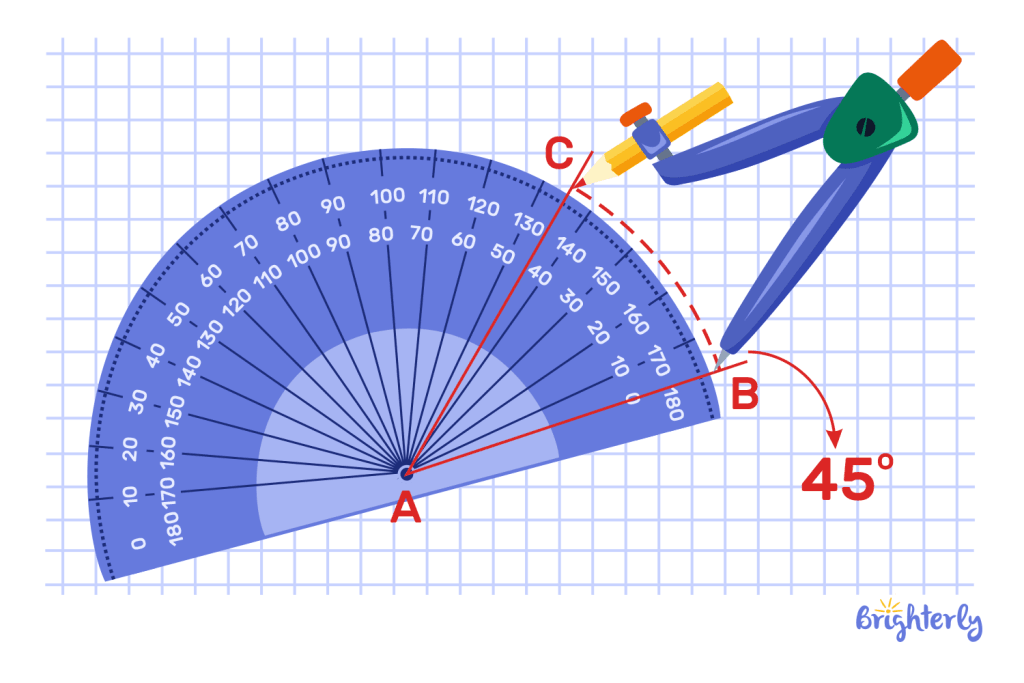
You can construct a 45-degree angle in two reliable ways: by measuring it directly with a protractor, or by bisecting a right angle with a compass. Both need only simple tools.
Using a Protractor
- Draw a straight baseline and mark the vertex point where the angle will start.
- Place the protractor’s center on the vertex, lining the baseline up with the 0° line.
- Find 45° on the scale and make a small dot.
- Remove the protractor and draw a ray from the vertex through the dot.
If you’re new to the tool, this step-by-step guide on how to use a protractor walks through reading the scale correctly.
Using a Compass
- Draw a baseline and construct a 90° angle (a perpendicular) at the vertex.
- Place the compass on the vertex and draw an arc that crosses both rays of the right angle.
- From each crossing point, draw two arcs of equal radius so they intersect.
- Draw a ray from the vertex through that intersection — it bisects the 90° angle into two 45° angles.
45-Degree Angles in Real Life
A 45-degree angle is easy to spot once you start looking, because it sits halfway between flat and upright. Common everyday examples include:
- The slope of a roof or a wheelchair ramp
- The diagonal of a square, a picture frame, or a folded paper airplane
- The open screen of a laptop tilted back
- A pair of scissors opened partway
- The launch angle athletes use to send a ball its farthest distance
Placing two 45° angles together forms a 90 degree angle, which is why the 45° angle is so useful in balanced, symmetrical designs.
Solved Examples of 45-Degree Angles
Example 1. A right angle is bisected into two equal parts. What is each angle? Since a right angle is 90°, each part is 90 ÷ 2 = 45°.
Example 2. A right triangle has one 90° angle and one 45° angle. What is the third angle? The angles of a triangle add to 180°, so 180 − 90 − 45 = 45°. This makes it a 45-45-90 triangle.
Example 3. What fraction of a full turn is a 45° angle? A full turn is 360°, so 45 ÷ 360 = 1/8. A 45° angle is one-eighth of a circle.
45-Degree Angle Worksheets
Put this into practice with related Brighterly worksheets:
- Types of angles worksheets
- Measuring angles with a protractor worksheet
- Measuring angles worksheets
- 45-45-90 and 30-60-90 triangles worksheets
45-Degree Angle: Practice Math Problems
- Use a protractor to draw a 45° angle on paper.
- Fold a square sheet corner to corner and measure the angle at the fold — it should be 45°.
- In a right triangle with one 45° angle, find the measure of the remaining angle.
- Find and name three objects around you that show a 45° angle.
Frequently Asked Questions About the 45-Degree Angle
What Is a 45-Degree Angle?
A 45-degree angle is an acute angle that measures exactly 45 degrees, which is half of a right angle. It is formed when a 90° angle is divided into two equal parts. Because it is less than 90°, it is classified as acute, and it represents one-eighth of a full 360° turn.
What Does a 45-Degree Angle Look Like?
A 45-degree angle looks like a sharp, slanted corner — exactly halfway between a flat line and an upright right angle. The clearest example is the diagonal line you get when you cut a square in half from corner to corner. Each of the two angles created at that corner measures 45 degrees.
How Do You Make a 45-Degree Angle?
You can make a 45-degree angle with a protractor by marking 45° from a baseline and drawing a ray to it. You can also make one with a compass by constructing a right angle and then bisecting it — drawing intersecting arcs that split the 90° angle into two equal 45° halves.
Is a 45-Degree Angle Acute or Obtuse?
A 45-degree angle is acute. Acute angles are any angles that measure less than 90 degrees, and 45° is exactly half of 90°, so it falls well within the acute range. Obtuse angles, by contrast, measure more than 90° but less than 180°.
What Is a 45-45-90 Triangle?
A 45-45-90 triangle is a right triangle with two 45-degree angles and one 90-degree angle. Because the two 45° angles are equal, the two legs opposite them are equal in length, making it an isosceles right triangle. Its side lengths follow a fixed ratio of 1 : 1 : √2.
What Fraction of a Circle Is a 45-Degree Angle?
A 45-degree angle is one-eighth of a circle. A full circle measures 360 degrees, and 45 divided by 360 equals 1/8. That means eight 45° angles placed edge-to-edge around a single point fill a complete rotation.


Math & reading from 1st to 12th grade
Looking for homework support for your child?

Choose kid's grade

Math & Reading for Grades 1–12
Build real confidence for your child with a Brighterly math or reading tutor.