90 Degree Angle – Measurement, Definition With Examples
reviewed by Janice S. Armas
Updated on July 29, 2026
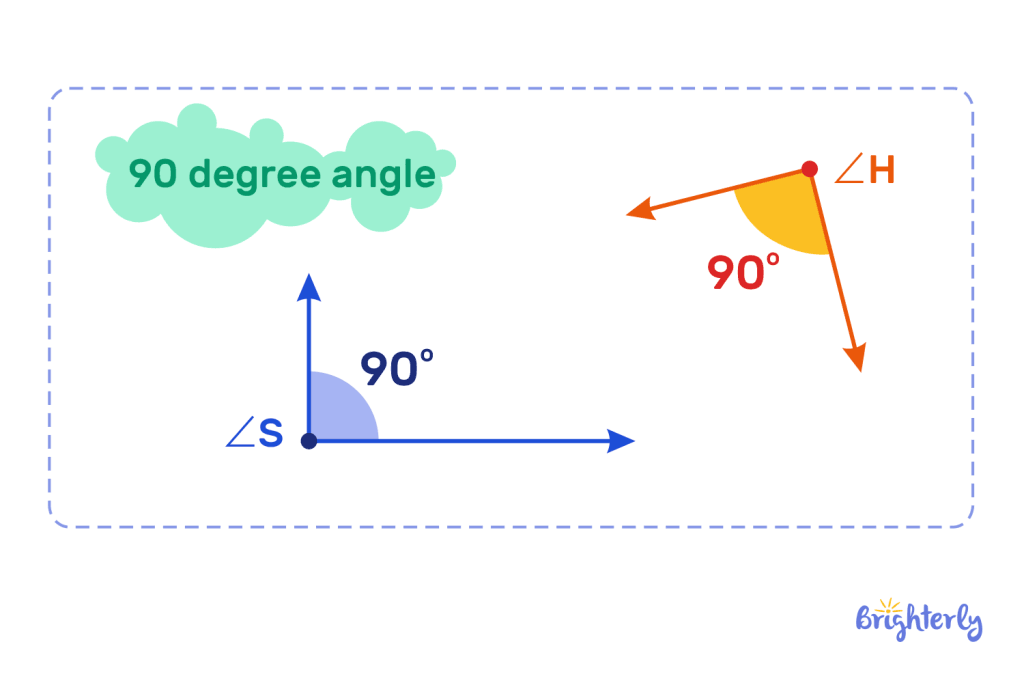
A 90-degree angle, also called a right angle, is formed when two lines meet at a perfect square corner — that is, when they are perpendicular to each other. It measures exactly 90 degrees and is marked with a small square (∟) rather than a curved arc. You see right angles wherever walls meet floors, at street intersections, and in the corners of books and screens.
The right angle is a cornerstone of geometry, appearing in squares, rectangles, and right triangles, so it’s worth making sure kids can both recognize and construct one — something a geometry tutor can reinforce with hands-on practice.
What Is a 90-Degree Angle?
A 90-degree angle is an angle that measures exactly 90 degrees, formed where two perpendicular lines or rays meet. It looks like the corner of a square and is usually labeled with a small square symbol instead of an arc. It is also known as a right angle, and there is no special ‘formula’ for it — it is defined simply by its measure of 90°.
Right angles are everywhere in the built world because they create stable, square corners: the meeting of two walls, the corner of a page, and the intersection of two streets are all right angles.
Expert Math Tutors for Every Level
Connect with professional and certified educators who provide specialized support for every grade level, from elementary school basics to advanced algebra
How to Measure a 90-Degree Angle
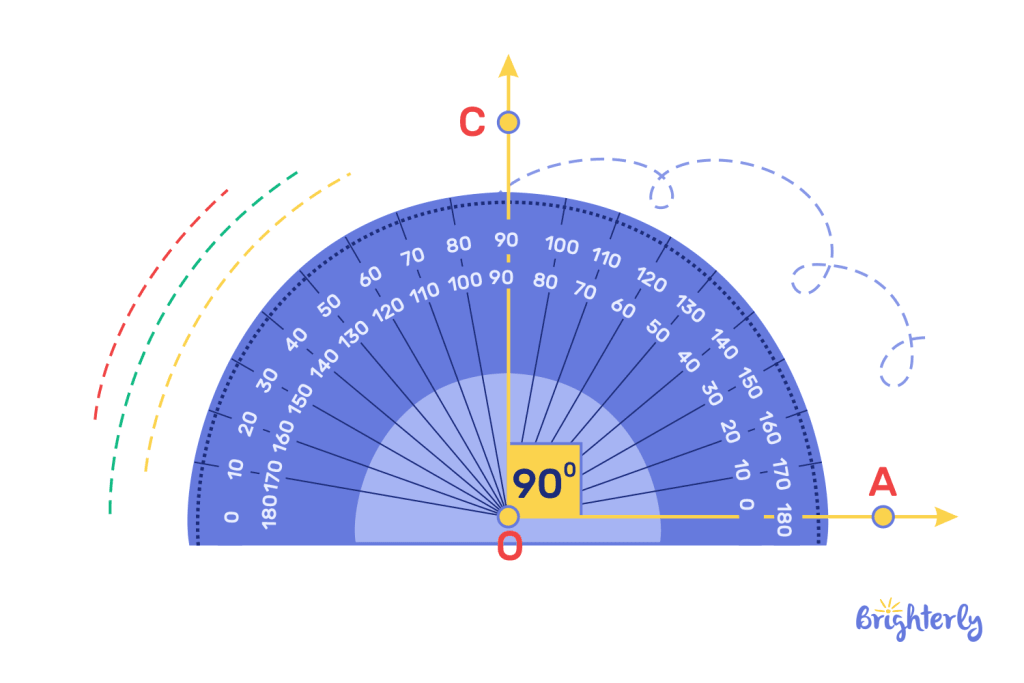
To measure a 90-degree angle, line up one ray of the angle with the baseline of a protractor and place the protractor’s center on the vertex. Read where the second ray crosses the scale — a right angle lands exactly on the 90° mark at the top center of the protractor.
Because a right angle is the midpoint of a protractor’s 180° range, it’s one of the easiest measures to check: if the second ray points straight up from a horizontal baseline, you have 90°.
90-Degree Angles in Geometry
Right angles are common throughout geometry. They form the four corners of squares and rectangles, appear in the right-angled triangle, and sit at the meeting of the horizontal and vertical axes on a coordinate grid. The right angle is also central to the Pythagorean theorem. Splitting a right angle in half gives two 45 degree angles.
How Does a 90-Degree Angle Compare to Other Angles?
A 90-degree angle is the dividing line between acute and obtuse angles. Angles are grouped by how their measure compares to a right angle and a straight angle:
| Angle type | Measure |
| Acute angle | Less than 90° |
| Right angle | Exactly 90° |
| Obtuse angle | Between 90° and 180° |
| Straight angle | Exactly 180° |
| Reflex angle | Between 180° and 360° |
How to Draw a 90-Degree Angle
You can draw a 90-degree angle with a protractor or, for a more exact construction, with a compass. Here are both methods.
With a Protractor
- Draw a straight line.
- Place the protractor’s base on the line, find 90° on the scale, and mark it.
- Remove the protractor and draw a line from the vertex to your mark.
If you need a refresher on reading the scale, see this guide on how to use a protractor.
With a Compass (Perpendicular Bisector)
- Draw a horizontal line and mark a point P in the middle where the angle will sit.
- Place the compass point on P and draw two small arcs on the line, one on each side — label them A and B.
- Open the compass wider than the distance from P to A. From A, draw an arc above the line; without changing the width, draw another from B so the two arcs cross at point Q.
- Use a ruler to draw line PQ. It is perpendicular to the base, forming a 90° angle.
Solved Examples
Example 1. A square has four corners, each a right angle. What is the sum of all four corner angles? Since each is 90°, the total is 90 × 4 = 360°.
Example 2. Angle A and Angle B sit next to each other and together form a right angle. If Angle A is 30°, what is Angle B? Subtract from 90°: 90 − 30 = 60°.
Example 3. A triangle has one 90° angle and two 45° angles. What kind of triangle is it? Because it contains a 90° angle, it is a right-angled triangle (specifically a 45-45-90 triangle).
90-Degree Angle Worksheets
Put this into practice with related Brighterly worksheets:
- Types of angles worksheets
- Measuring angles with a protractor worksheet
- Measuring angles worksheets
- Pairs of angles worksheets
90-Degree Angle: Practice Math Problems
- Draw a 90° angle on paper using only a protractor.
- List three objects in your home that have a right angle.
- If an angle is twice the size of a right angle, what is its measure? (Answer: 180°.)
Frequently Asked Questions About the 90-Degree Angle
What Is a 90-Degree Angle?
A 90-degree angle is an angle that measures exactly 90 degrees, formed when two lines or rays meet perpendicularly to create a square corner. It is the angle you see at the corner of a book, a window, or a piece of paper. On diagrams it is usually marked with a small square rather than a curved arc.
What Is Another Name for a 90-Degree Angle?
A 90-degree angle is most commonly called a right angle. The two terms mean exactly the same thing. The name ‘right angle’ reflects its role as the standard, ‘upright’ angle against which other angles are compared — acute angles are smaller than a right angle, and obtuse angles are larger.
How Is a 90-Degree Angle Marked in Diagrams?
A 90-degree angle is marked with a small square drawn in the corner where the two lines meet, rather than the curved arc used for other angles. This square symbol (∟) is a quick visual signal that the angle is exactly 90° and that the two lines are perpendicular to each other.
Is There a Formula for a 90-Degree Angle?
No, there is no formula for a 90-degree angle — it is defined simply by its measure of 90 degrees. What does have a formula is the relationship it creates: in a right triangle, the 90° angle is what makes the Pythagorean theorem (a² + b² = c²) work, linking the lengths of the triangle’s sides.
What Shapes Have 90-Degree Angles?
Squares and rectangles each have four 90-degree angles, one at every corner. Right-angled triangles have exactly one. Other shapes can include right angles too, such as certain L-shaped polygons. The coordinate grid also forms a 90° angle where its horizontal and vertical axes cross.
How Do You Draw a 90-Degree Angle Without a Protractor?
You can draw a 90-degree angle without a protractor by using a compass to construct a perpendicular bisector. Draw a line, mark two equal points on either side of a center point, then draw intersecting arcs above the line from each. A line from the center up to where the arcs cross meets the original line at exactly 90°.


Math & reading from 1st to 12th grade
Looking for homework support for your child?

Choose kid's grade

Math & Reading for Grades 1–12
Build real confidence for your child with a Brighterly math or reading tutor.