Fahrenheit to Kelvin Formula and Examples
Updated on April 29, 2026
Fahrenheit to Kelvin is a mathematical process used to convert a temperature measurement from the Fahrenheit scale to the Kelvin scale. The Fahrenheit scale is primarily used for weather and daily life in the United States, while the Kelvin scale is the standard unit of temperature used in scientific research and engineering globally.
Converting between these two scales is necessary because they use different reference points for freezing and boiling. While the Fahrenheit scale is based on the properties of a specific brine mixture and human body temperature, the Kelvin scale is an absolute scale starting at absolute zero, the point where all molecular motion stops.
This conversion is typically performed using a specific algebraic formula or a two-step process involving the Celsius scale. Accurate conversion ensures that data collected in different regions or for different purposes can be compared and used correctly in scientific calculations and experiments.
What is fahrenheit to kelvin?
Fahrenheit to Kelvin is a unit conversion that translates a temperature value from a common imperial measurement into the International System of Units (SI) base unit for temperature. Because the two scales do not share the same starting point or the same degree size, the conversion requires more than a simple addition or subtraction. It is an essential skill for students moving from general science into chemistry and physics.
Expert Math Tutors for Every Level
Connect with professional and certified educators who provide specialized support for every grade level, from elementary school basics to advanced algebra
Fahrenheit to Kelvin Formula
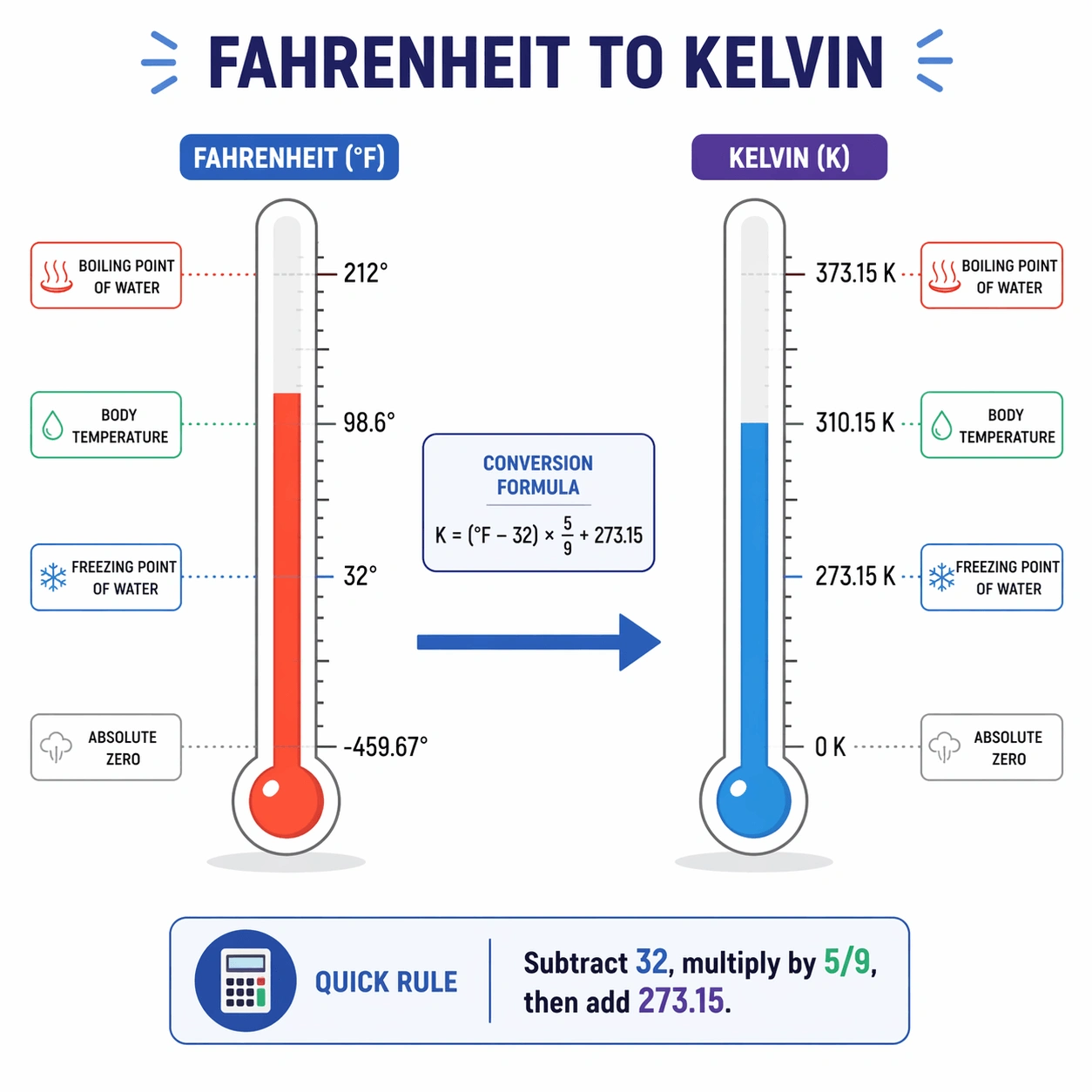
The conversion from Fahrenheit to Kelvin can be achieved by using a single integrated equation or by breaking the process down into two distinct parts. Both methods rely on the fact that a change of 1 degree Celsius is equal to a change of 1 Kelvin, while a change of 1.8 degrees Fahrenheit is required to equal that same interval.
Direct Formula (F to K)
The most direct way to convert Fahrenheit to Kelvin is to use the formula: K = (F + 459.67) / 1.8. In this equation, F represents the temperature in degrees Fahrenheit, and K represents the resulting temperature in Kelvin. This formula combines the adjustment for the different zero points and the scaling factor between the two units into one calculation. For example, if you have a temperature in Fahrenheit, you first add 459.67 to account for the distance between the Fahrenheit zero and absolute zero, then divide the entire sum by 1.8 to scale the units correctly.
Step-by-Step Conversion (F to C to K)
Many students find it easier to convert Fahrenheit to Celsius first, and then convert Celsius to Kelvin. This two-step process uses the following steps:
- Subtract 32 from the Fahrenheit temperature to find the difference from the freezing point of water.
- Multiply the result by 5/9 (or divide by 1.8) to convert the value into Celsius degrees.
- Add 273.15 to the Celsius value to reach the Kelvin temperature.
The mathematical representation for this two-step process is: K = (F – 32) * (5/9) + 273.15. This method is often preferred in science classrooms because it reinforces the relationship between Celsius and Kelvin, which are used together in most laboratory settings.
Understanding the Kelvin and Fahrenheit Scales
To understand the conversion, it is helpful to look at the fixed points for each scale. The Fahrenheit scale sets the freezing point of water at 32 degrees and the boiling point at 212 degrees, creating an interval of 180 degrees. The Kelvin scale is based on thermodynamic principles where 0 K is absolute zero. On the Kelvin scale, water freezes at 273.15 K and boils at 373.15 K, creating a 100-unit interval between the two states. This means that a Kelvin unit is 1.8 times larger than a Fahrenheit degree. Because Kelvin starts at absolute zero, there are no negative numbers on the Kelvin scale, which simplifies many complex physics equations.
Solved Examples on fahrenheit to kelvin
Practicing with common temperature points helps illustrate how the formulas work in the real-world scenarios. These examples show how different temperatures on the Fahrenheit scale translate to the absolute Kelvin scale using the standard conversion steps.
Example 1: Convert 100 degrees Fahrenheit to Kelvin
To convert 100 degrees Fahrenheit to Kelvin, use the formula: K = (F – 32) * (5/9) + 273.15.
- Step 1: Subtract 32 from 100. (100 – 32 = 68)
- Step 2: Multiply 68 by 5/9. (68 * 0.5556 = 37.78)
- Step 3: Add 273.15 to 37.78. (37.78 + 273.15 = 310.93)
Therefore, 100 degrees Fahrenheit is equal to 310.93 K.
Example 2: Convert 32 degrees Fahrenheit to Kelvin
The temperature 32 degrees Fahrenheit is the freezing point of water. To convert this to Kelvin:
- Step 1: Subtract 32 from 32. (32 – 32 = 0)
- Step 2: Multiply 0 by 5/9. (0 * 5/9 = 0)
- Step 3: Add 273.15 to 0. (0 + 273.15 = 273.15)
Therefore, 32 degrees Fahrenheit is equal to 273.15 K.
Example 3: Convert -40 degrees Fahrenheit to Kelvin
The temperature -40 is unique because it is the point where the Fahrenheit and Celsius scales are equal. To convert -40 Fahrenheit to Kelvin:
- Step 1: Subtract 32 from -40. (-40 – 32 = -72)
- Step 2: Multiply -72 by 5/9. (-72 * 5/9 = -40)
- Step 3: Add 273.15 to -40. (-40 + 273.15 = 233.15)
Therefore, -40 degrees Fahrenheit is equal to 233.15 K.
Example 4: Convert 212 degrees Fahrenheit to Kelvin
The temperature 212 degrees Fahrenheit is the boiling point of water. To convert this to Kelvin:
- Step 1: Subtract 32 from 212. (212 – 32 = 180)
- Step 2: Multiply 180 by 5/9. (180 * 5/9 = 100)
- Step 3: Add 273.15 to 100. (100 + 273.15 = 373.15)
Therefore, 212 degrees Fahrenheit is equal to 373.15 K.
FAQ
What is the simplest formula for Fahrenheit to Kelvin?
The simplest direct formula for converting Fahrenheit to Kelvin is K = (F + 459.67) / 1.8. This formula is highly efficient because it allows you to find the answer in just two calculator steps: addition and then division. By adding 459.67 first, you are essentially converting the temperature to the Rankine scale, which is an absolute scale that uses Fahrenheit-sized degrees. Dividing by 1.8 then scales those degrees to the larger Kelvin units. This method is preferred when you need a quick result without needing to find the Celsius equivalent first.
Does 0 degrees Fahrenheit equal 0 Kelvin?
No, 0 degrees Fahrenheit does not equal 0 Kelvin. These two points represent very different levels of thermal energy. 0 Kelvin is absolute zero, the theoretical lowest possible temperature where all molecular motion stops. On the Fahrenheit scale, absolute zero is much lower, at -459.67 degrees Fahrenheit. When you have 0 degrees Fahrenheit, you are actually at a much warmer temperature of approximately 255.37 K. Because the scales have different starting points and different degree sizes, their zero marks do not align, and 0 K is far colder than 0 F.
At what temperature are Fahrenheit and Kelvin the same?
The Fahrenheit and Kelvin scales intersect at 574.25. This is the only numerical value where a thermometer would show the same number regardless of which scale you were using. You can find this point by setting the conversion formula F = (F – 32) * (5/9) + 273.15 and solving for F. While Fahrenheit and Celsius cross at -40, the crossover for Fahrenheit and Kelvin happens at a much higher temperature. This point is purely a mathematical coincidence and does not represent a specific physical transition like freezing or boiling for a common substance.
What is the freezing point of water in Kelvin?
The freezing point of water on the Kelvin scale is exactly 273.15 K. This corresponds to 32 degrees Fahrenheit or 0 degrees Celsius. In many basic science classes, this number is often rounded to 273 K for simplicity in calculations, but the decimal .15 is necessary for high-precision scientific work. Because the Kelvin scale is used to measure absolute temperature, the freezing point of water is a positive value. This is one of the most important reference points for students to memorize, as it serves as the base for many conversions in chemistry and thermodynamics.
Why is there no degree symbol for Kelvin?
The Kelvin scale does not use a degree symbol because it is an absolute scale, not a relative scale. In scales like Fahrenheit and Celsius, the “degree” indicates that the measurement is relative to an arbitrary starting point, such as the freezing point of water. However, a Kelvin is a base unit of measurement in the SI system, similar to a meter or a second. It measures the actual amount of thermal energy present. Therefore, we say “100 Kelvin” rather than “100 degrees Kelvin,” and we write the symbol simply as “K” without the small circle.


Math & reading from 1st to 12th grade
Looking for homework support for your child?

Choose kid's grade

Math & Reading for Grades 1–12
Build real confidence for your child with a Brighterly math or reading tutor.