Math in the Real World: Everyday Examples for Kids (2026)
reviewed by Jo-ann Caballes
Updated on August 5, 2026
Key Points
- According to 2024 Gallup data, 63% of adult Americans find math skills very important in personal life and 55% in work life, demonstrating the significance of math in the real world.
- Examples of everyday math use include adding prices when shopping, measuring ingredients when baking, managing money for your monthly budget, and estimating arrival time based on distance and speed.
- Teaching math skills to kids should align with their age – from counting objects in kindergarten, through telling time and converting units in elementary and middle school, to calculating interest rates in high school.
- Careers that use math extensively include engineers, statisticians, doctors, nurses, accountants, meteorologists, retail managers, and skilled tradespeople.
- You can develop your child’s math skills for daily life with free printable math worksheets or 1:1 tutoring that matches their level and needs.
People use math daily – from shopping and cooking to playing sports and managing money. Whether your child is just starting to learn numbers or tackling advanced math concepts, this guide gives you examples of how to apply math in the real world by category and age, plus careers that use math most intensively.
Why Do We Need Math in the Real World?
Math is important in the real world because you use it everywhere: from shopping and cooking to traveling and solving everyday problems. Math also helps you build crucial skills like critical thinking and logical reasoning that you need in order to make sense of data and technology in everyday life.
Note: According to the Gallup Math Matters Study, conducted together with the Gates Foundation in December 2024 (latest available data), 63% of US adults find math skills very important in personal life, and 55% consider them very important in work life. Meanwhile, only 4-5% find little importance in math in their personal or professional life.
Explore Brighterly Learning Experience
Learn exactly how Brighterly helps students thrive through expert sessions, online tools, and proven feedback from thousands of satisfied parents
How to Show Your Child Math in Everyday Life
The best way to teach your child real world math applications is to turn common chores and routine activities into number quests and adventures. Every day fun math activities include using cooking to teach fractions, setting the table to show multiplication, and pointing out shapes in the world around us. Here are some specific ideas:
- Count change: Hand your child $5 at checkout and have them predict the change before the cashier does (2 minutes, ages 6+).
- Pay bills: Show your child a $60 utility bill and ask them to calculate the remaining monthly budget after paying it (5 minutes, ages 10+).
- Double a recipe: Have your child double a recipe that calls for 1½ cups of flour and ½ teaspoon of salt (5 minutes, ages 8+).
- Budget weekly allowance: Give your child a $35 weekly allowance and ask them to plan spending no more than $5 per day (5 minutes, ages 8+).
- Calculate travel time: Ask your child how long a trip will take if a destination is 30 miles away and you’re traveling at 60 mph (3 minutes, ages 9+).


Let your child practice everyday math!
Personalized instruction combined with real-world examples to teach math in a fun way.
Real-World Math Examples in Daily Life
You find math in every aspect of your everyday life, whether you are weighing ingredients when cooking your favorite meal or calculating how much time you need to get to school at your current speed. You need to learn math to prepare your monthly budget based on your income and expenditure, and to calculate wall area and room volume when completing home improvements.
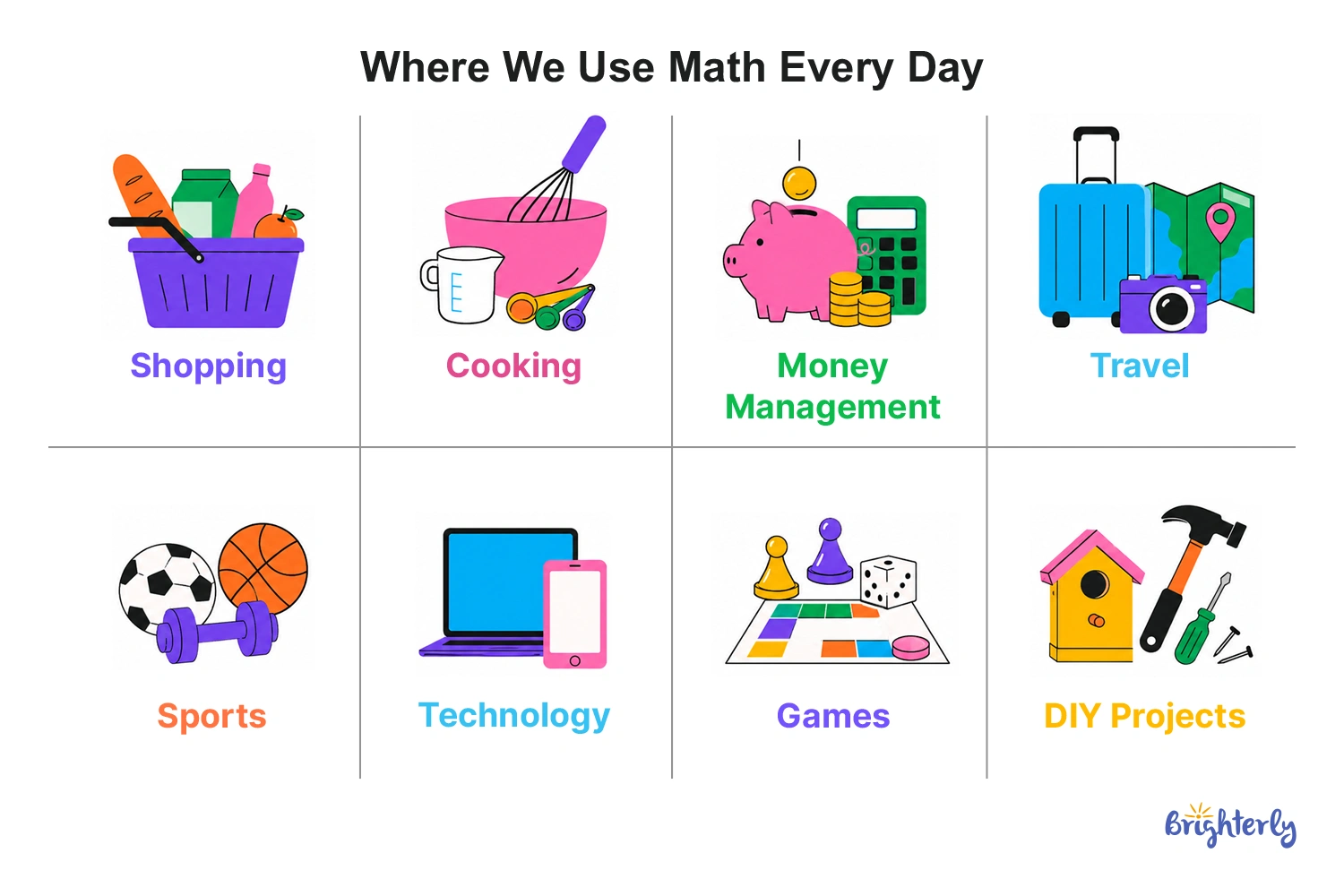
Some of the most popular examples of math in the real world include:
- Shopping and discounts
- Cooking and baking
- Money management
- Driving and travel
- Sports and fitness
- Technology
- Games
- DIY projects
Shopping & Discounts
Shopping offers some of the most common and diverse real-life math problems. Finding the best deal can feel like solving a mystery, and math gives you all the clues. Whether you’re doing your weekly grocery shopping or you’re buying clothes or a car, you need to use a mix of addition, subtraction, multiplication, division, fractions, percentages, and more to calculate the item price, the total, and the discount.
For example, when buying soy milk, you see a “20% off” sale, so you find 20% of the original price and then subtract that amount to figure out the new price. If a soy milk pack originally costs $30, 20% of $30 is $6. So, the sale price would be $30 – $6 = $24.
Real-life shopping math examples include estimating the unit price. For instance, if a 10-ounce bag of chips costs $2.50, the unit price is $2.50/10 ounces = $0.25 per ounce. You can compare this price to the cost of other snacks to find the most cost-effective option for your weekly grocery budget.
By knowing how to use math, you can save money not only when buying groceries but also when making larger purchases. Imagine that you need to buy Christmas gifts for your family and see the following discount: “Buy a tablet and get 15% off. If you buy 3 accessories, you’ll get 20% off for a tablet”. Let’s use everyday math to see which option is better for your wallet, assuming the original price of the tablet is $400.
If you buy a table with no accessories, you will pay $400 – 15% of $400 = $340.
If you decide to buy the 3 cheapest accessories for $25 each, you’ll spend $75 on them. Meanwhile, you get 20% off the price of the tablet, so the tablet alone costs $400 – 20% of $400 = $320. Then, you have to add the cost of the accessories to get the total amount you need to pay: $320 + $75 = $395.
Clearly, you will spend less on buying the tablet alone with the lower discount unless you really need the accessories.
Cooking & Baking
Cooking is another example of math in the real world. Recipes call for precise measurements of ingredients, such as cups, teaspoons, and grams. Different countries use different units of measurement, such as ounces, spoons, and grams. Sometimes you also need to prepare more or less than the suggested number of servings. To make the perfect food, you need to properly convert and measure ingredients.
For instance, a European cookie recipe says you need 500 grams of flour to make 35 cookies. But how much is this amount of flour in cups or pounds?
To properly convert the flour, just use the simple formula that 1 g = 0.0022 lbs. So, if your child wants to find how much flour they need, they should convert grams to pounds: 500 x 0.0022 = 1.1 lbs of flour.
Some of the most frequent math use cases in baking include:
- Setting up ratios to control how many ingredients you need for a specific number of portions when scaling recipes.
- Learning fractions and ratios, like ½ teaspoon or ¼ cup, to ensure correct proportions and use the exact amount of each ingredient.
- Correctly reading and setting oven temperatures and calculating baking time to ensure the food bakes properly.
Money Management
Developing financial literacy is an essential skill you have to teach your child that is entirely based on the principles of mathematics. Money math used in real life includes managing your allowance as a kid that later evolves towards budgeting based on your earnings and expenses, calculating mortgage payments and car loans, and estimating savings growth for larger purchases and retirement based on interest rates.
To set up your little one for a smooth financial journey, you should start teaching your kid about money from an early age. As a first step, ask your kid to calculate how much to spend per day from their weekly or monthly allowance to have enough funds and save for the future.
For instance, show your child that if they have $70 and want to have enough money until next week, they’ll have to spend no more than $70 / 7 days = $10 a day. Meanwhile, spending $9 a day will leave your kid with an extra $7 for the upcoming week: $9 x 7 days = $63, so $70 – $63 = $7 surplus.
Knowing these fundamentals is key to understanding how money works and how to behave with it. As your child goes to college, managing their finances will get more complicated as they need to account for their scholarship, their student income, and the money you give them, on the one hand, and academic fees, book expenses, and living costs, on the other hand.
Note: To give your kid a good practice of money-related counting, try these money worksheets in printable PDFs.
As your kid faces more and more real world math applications, these experiences will prepare them to manage their money once they graduate, get a job, start a family, and have multiple expenses. The earlier kids learn how to deal with money as part of mathematics, the faster they’ll develop an understanding of the value of money and be able to compare products, calculate taxes, manage debt, and budget for a week, a month, and further.
Real-world math tailored to your child’s needs!
Individualized learning plan aligned with the US state standards & your kid’s requirements.
Driving & Travel
Everyday math helps you make travel-related decisions that can save time and money so you can plan accordingly. Once your kid starts going to school on their own, they need to know how much time it takes using different routes and modes of transportation to choose the fastest way and get there on time. When your child begins to drive a car, math will help them plan the best route by calculating the speed, time, and the required distance.
For instance, if you need to know how long you need to travel 500 miles at an average speed of 80 miles per hour, you’ll have to divide 500 miles by 80 mph, giving you 6.25 hours. Next, you need to know that 0.25 hours are equivalent to 15 minutes to calculate the total time at 6 hours and 15 minutes.
Common everyday uses of math in travel include:
- Using percentages and ratios to calculate fuel consumption and understand how long the car can go with the remaining amount of fuel.
- Combining spatial visualization with geometry to visualize and determine the optimal route.
- Comparing times and costs to find the most time- and cost-effective mode to go on vacation – by plane, bus, train, or car.
- Converting kilometers per hour into miles per hour and liters of gas into gallons when traveling abroad.
Sports & Fitness
Math helps children improve sports performance and healthy habits by tracking scores, measuring speed and distance, estimating averages, analyzing statistics, and monitoring fitness goals. For instance, students can use math operations to keep the score and calculate averages per game.
Beyond counting goals and points, children can use probability and critical thinking to make strategic decisions. Whether your child dreams of scoring the winning goal or beating their personal best, math can get them there by teaching them the necessary problem-solving skills.
Nowadays, common real-world math examples in the health and fitness field include using smart watches or trackers that measure daily activity. With the help of devices, kids learn to
- Compare their weekly activity.
- Calculate how many steps they need to fulfill their daily goals, for example, 8,000 steps.
- Check how many calories they burned during sports class, for instance, 200 calories while playing softball for 30 minutes.
Math skills also help control portions and set up healthy dieting habits. By knowing their recommended calorie intake, your child can control how much they’ve eaten and in what proportion of fats, proteins, and carbs.
Keeping track of calories together with you can be fun for kids, helping them eat healthier and develop math skills. For instance, you can check out nutrition facts on product packaging and calculate a healthy diet based on the requirements for their age and activity level.
Technology
Technology requires children to use math to track screen time, compare download speeds, manage device storage, and estimate how long it will take to charge the battery of their laptop. Whether using a smartphone, playing video games, or exploring reading apps, kids rely heavily on math skills.
Additionally, math powers the technology your child uses every day. Coding, computer graphics, artificial intelligence, and GPS navigation all draw on mathematical concepts such as patterns, logic, geometry, and algorithms. Helping your child recognize these connections between math and technology shows them that math is not just a school subject but an essential skill behind digital tools that people use all the time.
Games
Playing games introduces your child to math used in real life to measure distances, add up scores, and estimate probabilities. Board games, card games, and video games all encourage players to:
- Count points.
- Recognize patterns.
- Compare numbers.
- Make strategic decisions.
Many games also involve probability, teaching children how to estimate the chances of different outcomes and choose the best move.
Math games can show your kid how to solve various everyday real-world problems, apply math rules, and even teach your child physics. For instance, Tetris can teach spatial reasoning, Monopoly shows the importance of financial planning, and chess enhances critical thinking and logic.
DIY Projects
DIY projects offer the opportunity to use math in real life through measuring, estimating, budgeting, and managing time. To build something from scratch, your child needs to use tools like rulers or measuring tape and knowledge of shapes. For instance, if your kid decides to build a pyramid from Lego blocks, they need to calculate how many pieces they need for each step and decide how to put them together so that their building doesn’t fall.
Even the simplest DIY projects require time management and money management skills. Kids need to purchase components beforehand and have time to make their plans come true without affecting academic outcomes.
Real-World Math by Age
Using math in real life should expand along with your child’s age. This gradual approach teaches kids why math is important and helps them transition from simple math applications to more complex concepts and operations. Follow these principles to introduce the appropriate level of mathematics for each age:
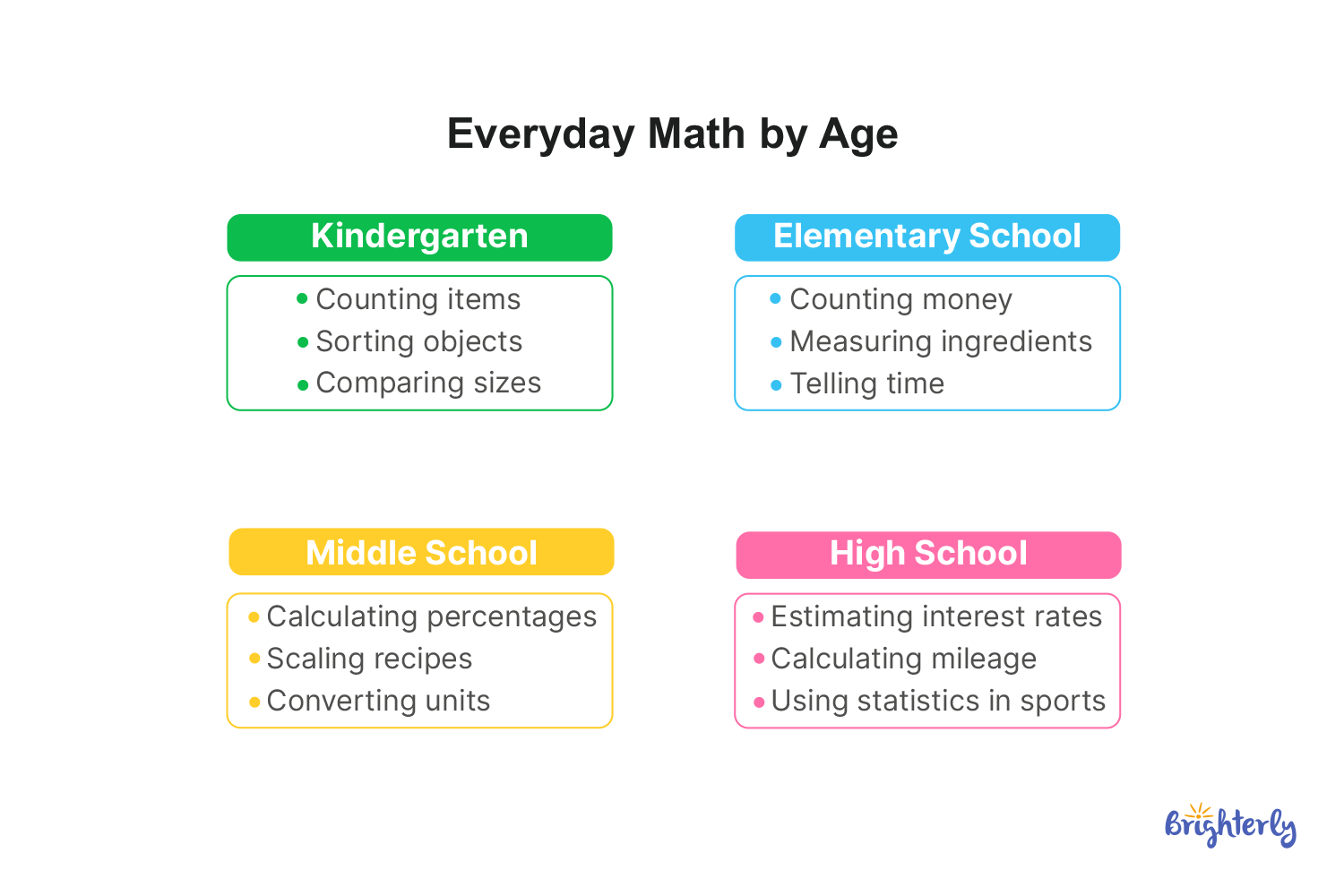
- Kindergarten: Counting objects like toys and snacks, sorting items like laundry and groceries by color and size, comparing sizes, and telling when it’s time to go to bed.
- Elementary school: Counting bills and coins when shopping, measuring cups and spoons for recipes, reading calendars to count days until holidays, and telling time.
- Middle school: Using percentages to calculate discounts at the store, doubling and halving ingredients in a recipe, converting units from grams to ounces when cooking, and estimating trip times.
- High school: Calculating interest on mortgages and car loans, estimating mileage and fuel cost for a trip, helping with the monthly family budget, using exchange rates to compare prices internationally, and applying statistics in sports.
An online math tutor can help you introduce age-appropriate examples of math in real life in a way that suits your child’s current level, learning gaps, and preferred style. Our K-12 educational platform connects your child with a professional math teacher for 1:1 online sessions customized to their unique needs, instead of the average student. See how our math courses work to decide if they are the right fit for your kid.
Careers That Use Math Every Day
Careers that require math skills go beyond STEM professions (physicists, chemists, biologists, data scientists, technicians, engineers, and mathematicians) and include jobs like physicians, pharmacists, accountants, economists, statisticians, and sales managers. Other careers that use mathematics on a daily basis are:
- Engineers: Use algebra, geometry, calculus, and statistics to design structures, develop products, solve technical problems, and ensure projects meet safety standards.
- Doctors and nurses: Benefit from mathematics in the real world to calculate medication dosages, measure fluid intake and output, interpret patient data, and administer treatments accurately.
- Meteorologists: Apply mathematics, statistics, and computer models to analyze weather data and make forecasts.
- Retail managers: Use math operations to calculate prices, discounts, profit margins, inventory levels, sales trends, and budgets to make informed business decisions.
- Electricians, plumbers, carpenters, and other skilled tradespeople: Use measurements, geometry, fractions, and basic algebra to install systems, estimate materials, and complete projects accurately.
Data from the U.S. Bureau of Labor Statistics shows that in 2024 (latest published data), 8.5 million Americans were employed in 63 jobs where the principles of mathematics rules and methods are considered very or extremely important, and this number is expected to reach 8.9 million by 2034. Another 93.4 million worked in 427 professions where math is important, with the number estimated to reach 96.0 million by 2034.
Practice Real-World Math Problems
You should use every possible real-life situation to practice math skills with your little one, as this will help build their knowledge naturally. Indeed, there are dozens of everyday scenarios where your child can work on math problems. Try these math examples in real-life situations with your child for smooth, stress-free practice:
|
Everyday Life Situation |
Possible Math Problem |
|
Calculating discounts while shopping |
If a shirt originally costs $25 and is currently on sale for 30% off, what is the sale price? |
|
Comparing prices |
Which is a better deal: a 12-ounce box of cereal for $5.99 or an 18-ounce box for $7.99? |
|
Scaling recipes |
If a recipe asks for 2 cups of flour to make 18 cookies, how much flour do you need to make 32 cookies? |
|
Converting units |
How many pounds are in 450 grams of sugar? |
|
Calculating fuel costs |
If your car gets 30 miles per gallon and gas costs $4.10 per gallon, how much will it cost to drive 200 miles? |
|
Time zones |
If it’s 4:23 PM in Paris, what time is it in Los Angeles? |
|
Calculating interest |
If you borrow $390 at an annual interest rate of 2.5%, how much interest will you owe after one year? |
|
Budgeting |
If you have a monthly after-tax income of $4,280 and your monthly expenses are $2,200, how much money can you save each month? Will your income be enough to get a mortgage if you currently pay $1,750 for rent and you will have to pay $1,970 for a mortgage? |
|
Calculating volume |
If you need to fill a fish tank that is 4 feet long, 2 feet wide, and 1.5 feet deep, how many gallons of water do you need? |
Looking for more examples of math in everyday life? Our math worksheets offer additional practice by grade and topic that teaches key math concepts through real-world scenarios like counting money and making cupcakes. 1:1 online math tutoring also offers opportunities for your child to use math in common situations, along with instruction tailored to their gaps and needs.
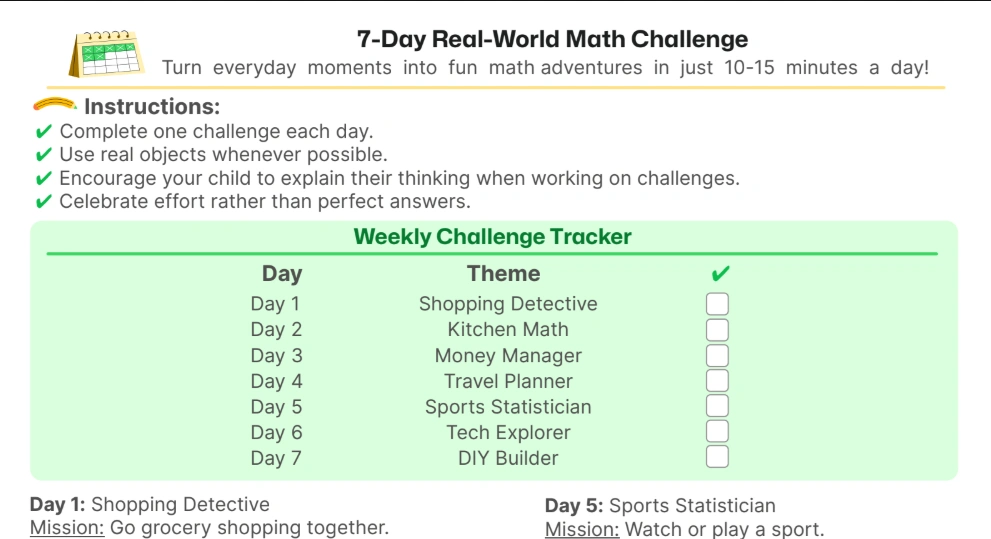
Note: Alternatively, you can opt for this 7-day real-world math challenge, which will take up to 15 minutes of your time daily.
Conclusion
People use math in real-world situations every day, so it’s crucial to teach your kid how to use key math concepts from an early age. Remember to make practical math fun and engaging through incorporation into daily routines and games to encourage your child to build the necessary skills.
If you need extra help, check out our 1:1 math tutoring. Book a free lesson without any commitment to see if our tutors meet your child’s needs and your personal expectations.
Frequently Asked Questions
Is Math Really Used in Everyday Life?
You constantly use math in everyday life without even noticing it. Examples of using math in the real world include applying basic arithmetic to estimate your total when shopping, manipulating ratios to scale recipes up and down, measuring space to buy furniture for your home, and recalling percentages to calculate your savings over 5 or 10 years.
What Jobs Use Math the Most?
The jobs that use math most heavily include mathematicians, statisticians, economists, financial experts, risk analysts, surveyors, and different types of engineers. Many other professions, including medical workers, scientists, accountants, chefs, sales representatives, retailers, and cashiers use math applications every day for managing time, budgeting properly, estimating quantities, and planning accordingly.
At What Age Should Kids Learn Real-World Math?
Structured introduction to real-world math for kids should start at around ages 3-4. NAYEC confirms that preschoolers are ready to handle simple math. From age 3-4, you can introduce counting, sorting, comparing sizes, and recognizing patterns through play. As your child grows, you can use everyday activities like shopping, cooking, budgeting, and planning trips as natural opportunities to build increasingly advanced real-world math skills.
How Can I Make Math Fun for My Child at Home?
To make math in everyday life fun for your little one, connect it with your child’s interests instead of treating it as extra homework. Let your kid help cook, keep score during sports, compare prices while shopping, build with LEGO blocks, and play strategy games. Short, hands-on math activities are usually more engaging than solving traditional math problems alone.
Which Math Skills Are Most Useful in Daily Life?
Which math skills you’ll use the most in your everyday life depends largely on your job and daily habits. Still, the most widely used math concepts include basic arithmetic, percentages, fractions, measurements, and simple data interpretations. You use these math skills to cook meals, shop, plan schedules, and manage finances.


Knowledge gaps due to summer slide and pandemic are real problems in math education in 2026, so choosing one of the summer math programs can help prevent summer learning loss. This guide covers the 30 best programs for summer 2026 by grade, format, pros and cons, and price. Free Summer Math Programs (Compared) Title Ages […]

Jun 27, 2022

Many students play video games regularly in their free time. The majority of video game players will never give up whenever they fail a level until they progress to the next one. Such failures encourage collaboration, assessment, and learning as kids have to ask for help and can learn something new. Discover ways to use […]
Jun 30, 2022
Math & reading from 1st to 12th grade
Looking for homework support for your child?

Choose kid's grade

Math & Reading for Grades 1–12
Build real confidence for your child with a Brighterly math or reading tutor.