35 Best Math Games for Kids in 2026: Online, Classroom, and Outdoor Fun
reviewed by Camille Ira B. Mendoza
Updated on May 25, 2026

Key Points:
- Board game-based activities can improve early math skills, with a 2023 review of 19 studies finding that math skills improved in 52% of analyzed tasks (Scimex article, 2023).
- Math games can help your child improve their arithmetic skills, develop number sense, and become more logical and strategic thinkers.
- Math games for kids can include puzzles, variations of tic-tac-toe, and character games.
- The right math game for your child will depend on their age, learning goals, needs, and style, and your budget.
Math games are activities that feel like playing to your child, but they also practice math in the process. Games can make learning math both effective and enjoyable for your kid, and help them develop math fluency and mathematical thinking.
The 30+ games in this guide cover online apps, free platforms, and classroom activities, sorted by grade so you can match the right game to your child’s level and learning goals.
| Number of Games | Best For | Device Needed | |
| Online Games | 10 | Pre-K to K-12 children who need drill-based, but engaging practice | Access to a device (PC, laptop, iPad, phone) and subscription |
| Free Games | 10 | K-8 children who need drill-based practice with little to no explanations | Access to a device (PC, laptop, iPad, phone) |
| Classroom/Offline Games | 15 | Pre-K to K-8 who love the outdoors and/or have high screen time | Various household items, like dice, a deck of cards, paper, pencils |
What Are the Best Math Games for Kids?
The best math games for kids can vary depending on your needs and budget. Games like TriviaMaker and Monster Math are great for improving arithmetic proficiency and motivating children, while also keeping them engaged, if budget is not an issue. Khan Academy and Prodigy offer a free gamified math curriculum, while Math Wars and 101 and Out are fun and effective math games for kids who prefer to play outside.
Explore Brighterly Learning Experience
Learn exactly how Brighterly helps students thrive through expert sessions, online tools, and proven feedback from thousands of satisfied parents
Best Online Math Games for Kids
- TriviaMaker
- Monster Math
- SplashLearn
- Keiki Learning Games for kids
- DoddleMaths
- IXL
- DreamBox Learning
- ST Math
- Sumdog
- ABCmouse
TriviaMaker
Best for: Classrooms and group sessions
Grade: K-3 to K-12
Skills: Any math topic, unit reviews, test prep
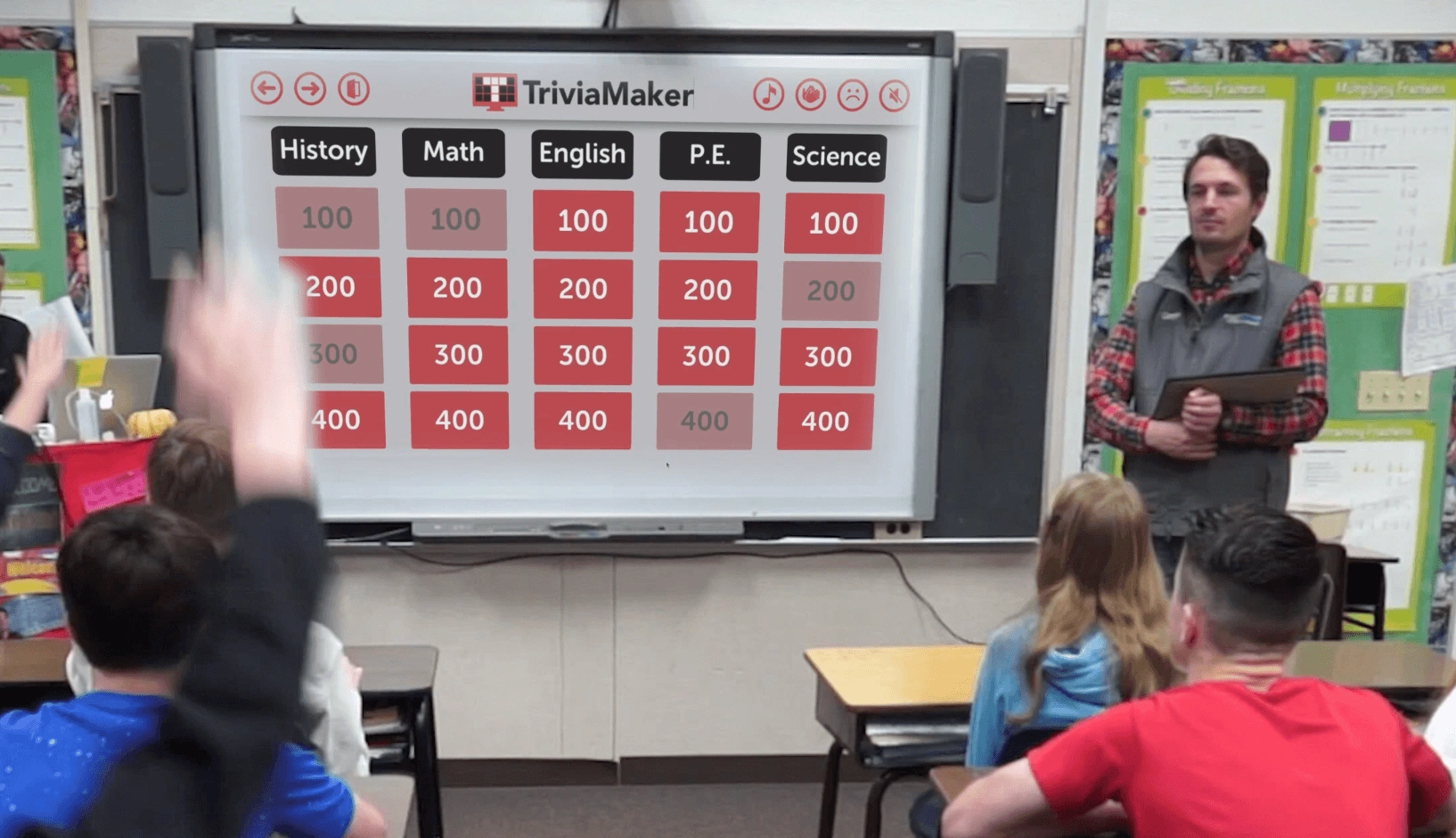
First in our list is TriviaMaker. Whether you are homeschooling, want additional practice at home, looking for math games for high schoolers, or are a teacher looking to add variation to the classroom, you can transform standard math drills into professional-quality game shows in seconds.
Why educators love it:
- 7 Dynamic Game Styles: Keep students curious by switching between Jeopardy-style Grids, Spinning Wheels, Multi-Choice, Fusion modes, and many more.
- Zero-Friction Access: No student logins or app downloads required. Students join instantly via a simple code, saving precious instruction time.
- Flexible question creation for different math topics and difficulty levels.
Price: Plans start at $6.99/month or $19/year; free access is available for basic gameplay.
Monster Math
Best for: Young learners at home
Grade: K-3
Skills: Addition, subtraction, multiplication, division
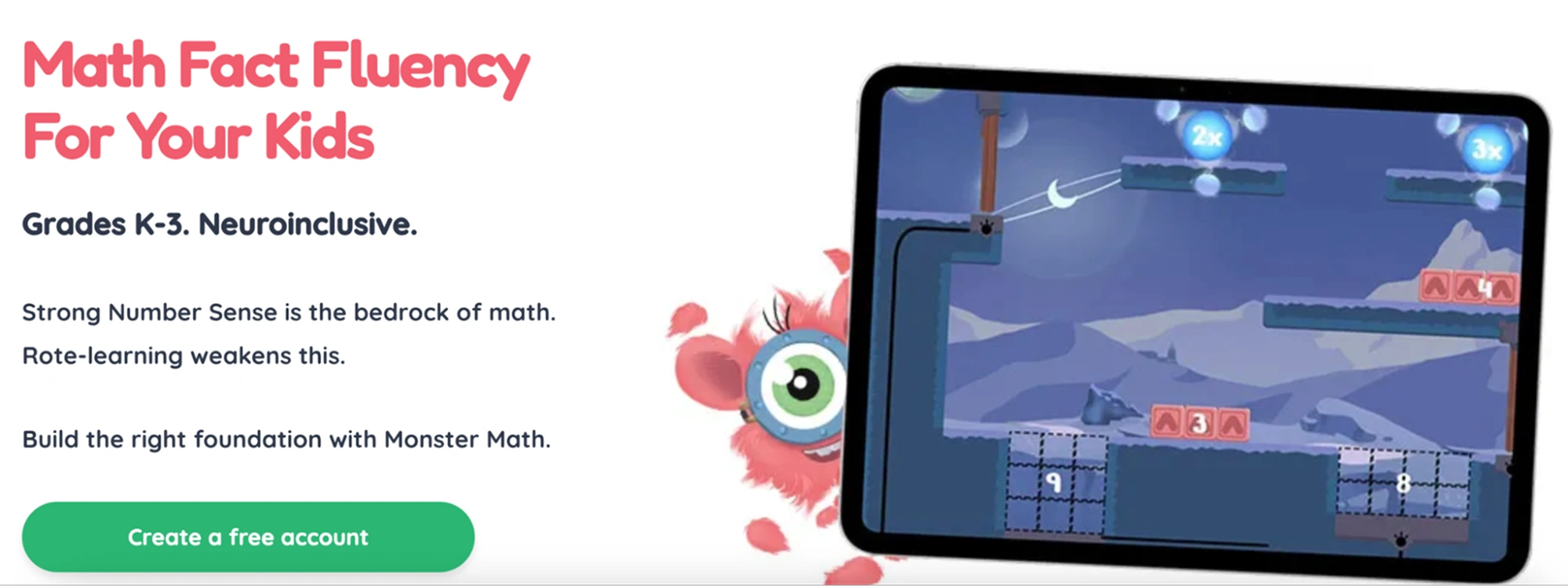
Monster Math is one of the most fun math games for kids, and it will make math captivating for your child regardless of their arithmetic proficiency. Monster Math offers a gamified approach to math that suits the K-3 math curriculum, and often feels like a video game, so even if your child has a complicated relationship with math, it can be a good resource to explore.
Monster Math features
- Math games that teach core skills
- Math equation exercises that move characters through game levels and kill monsters
- Multiplayer mode to develop teamwork skills
Monster Math price
Monster Math is subscription-based, with an annual fee of $59.99.
SplashLearn
Grade: K-5
Skills: 16+ math skill areas, including operations, geometry, and data
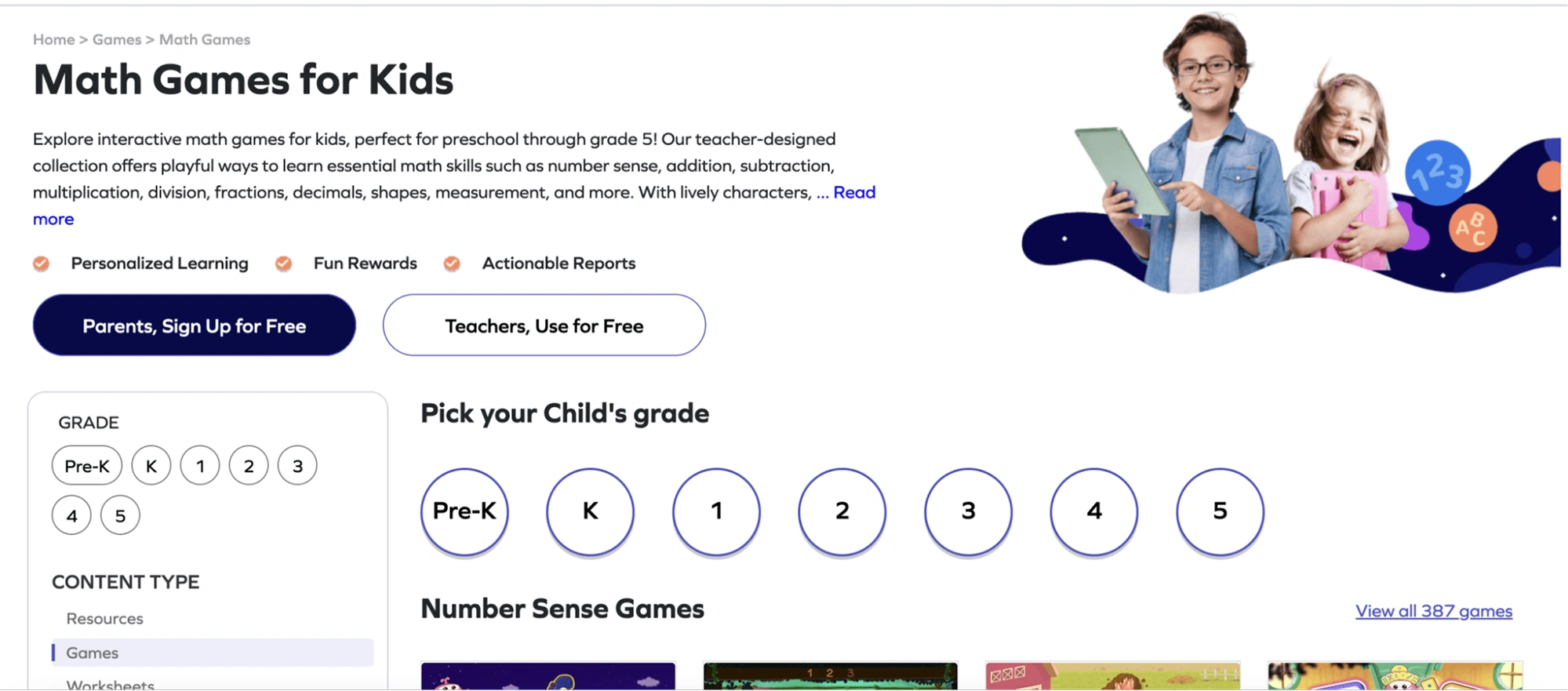
Splash Math is a collection of math games for kids for the K-5 math curriculum available on Android and iOS devices. In this app, you can find thousands of educational math games for kids from pre-kindergarten to 5th grade.
SplashLearn: Major features
- Games to develop over 16 math skills
- Interactive math worksheets for K-5 students
- Cross-platform availability
- Easy for kids to manage independently
SplashLearn price
From $7.99 for a monthly membership.
Keiki Learning Games for Kids
Best for: Toddlers and preschoolers
Grade: Pre-K to K-3
Skills: Counting, number sense, shapes, basic measurement
Keiki Learning Games for Kids is a collection of 200+ fun math games for kids available on Android and iOS devices. The curricula of this fun math game focus on kids aged 2 to 8, with the goal of developing a love for math and lifelong learning through an interactive and fun learning process.

Major features of Keiki Learning Games for Kids app
- Educational games for preschool kids, puzzles for toddlers
- Various formats of information presentation to entertain kids (including songs)
- Focus on developing fundamental math skills, like counting, number sense, geometric shapes, and basic measurements
Price on Keiki math interactive games
In-app purchases range from $7.99 to $59.99 per game item.
DoodleMaths
Best for: Daily home practice and homeschoolers
Grade: 1-6
Skills: All primary math topics
DoodleMaths is a math learning application for primary school students. It’s available on iOS and Android devices. It’s a great supplementary resource both for homeschool math and school students, who can use it as a fun 10-minute-a-day additional math workout.
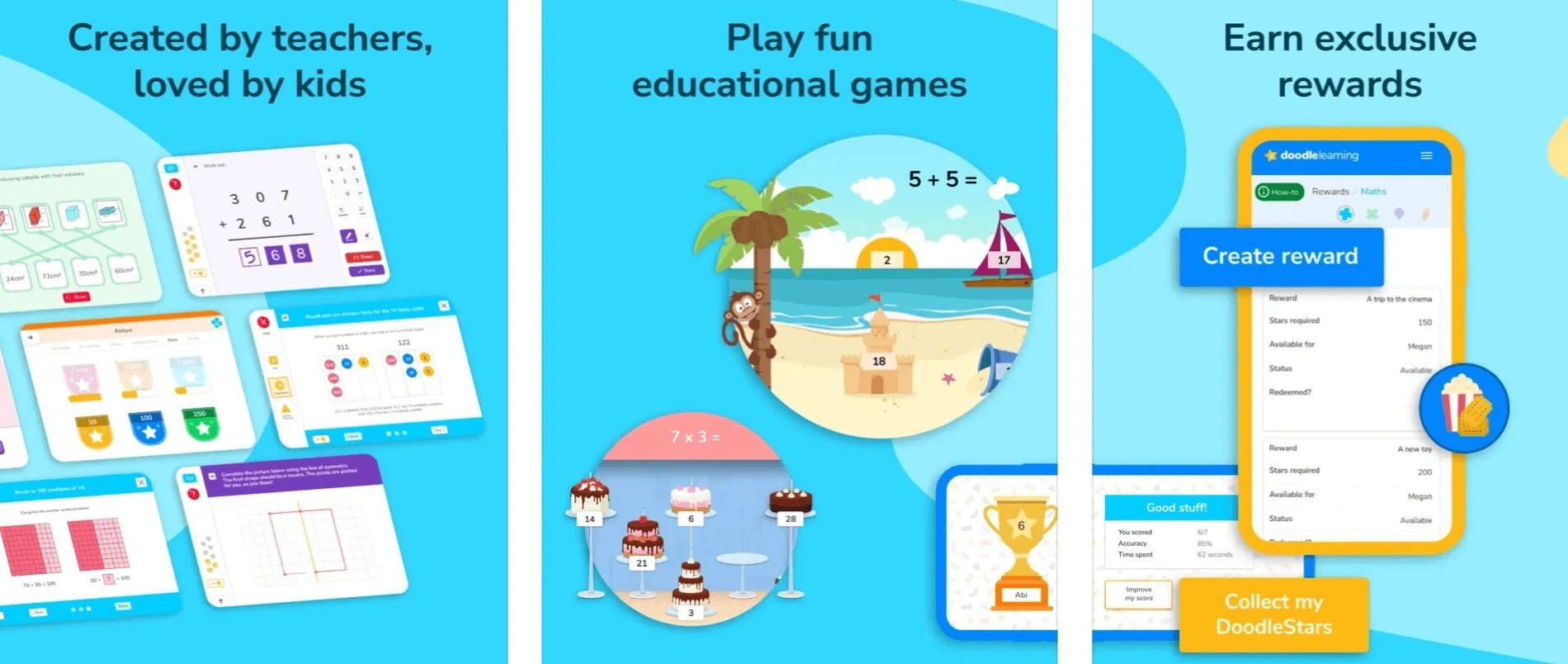
Major features of DoodleMaths app
- Over 40,000 diverse math exercises
- Multi-platform availability
- Customizable difficulty levels to fit different students
How much does Doodlemaths cost?
DoodleMaths costs start at £12.99 per month (approximately $16/month as of May 2026).
IXL
Best for: All learners
Grade: Pre-K to K-5 (and beyond)
Skills: 8,000+ math topics across all grade levels
IXL offers personalized learning on over 8k topics in math and other academic subjects. There is a huge selection of fun math games online for preschoolers and schoolers from 1st to 5th grade.
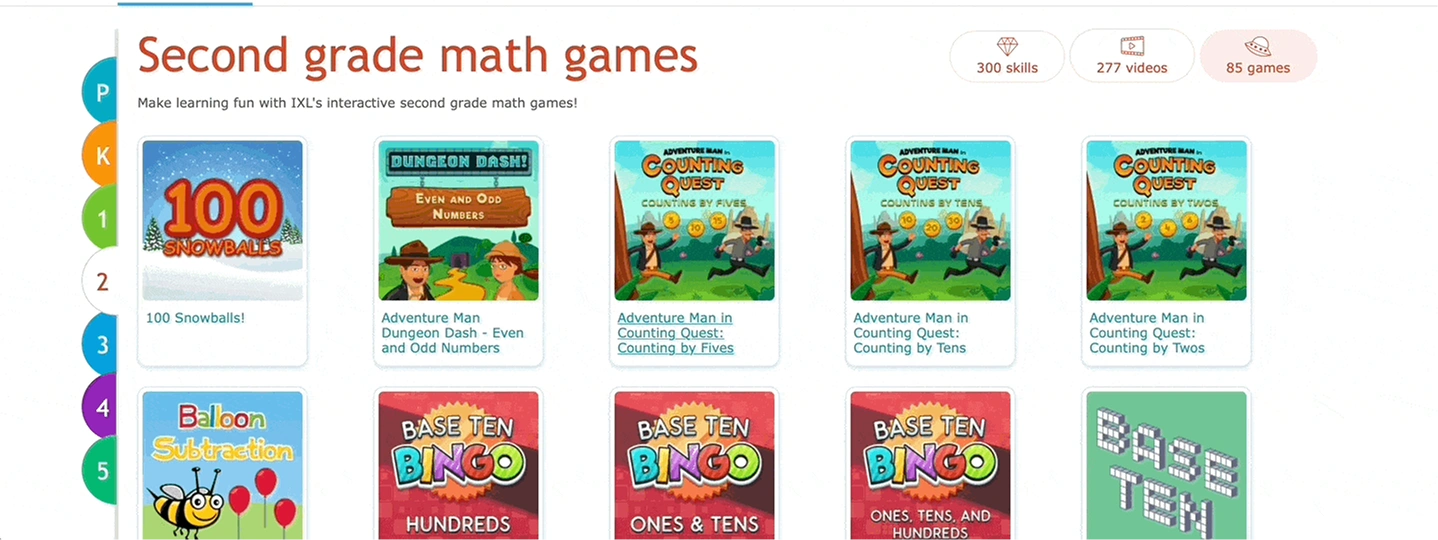
IXL: Major features
- Categorized learning for different children
- Topics to study, tests, and math games
- Education videos to kick off new topics
IXL: Price
10 free questions per day in each subject area. The price for a paid plan that combines math and language arts costs $15.95 per month.
DreamBox Learning
Best for: Homeschoolers and blended learners
Grade: PreK-8
Skills: Personalized math curriculum that adapts to each child
DreamBox Learning is an interactive learning platform to help your child upgrade their math skills. They offer personalized learning journeys adapted to the individual needs of each kid.
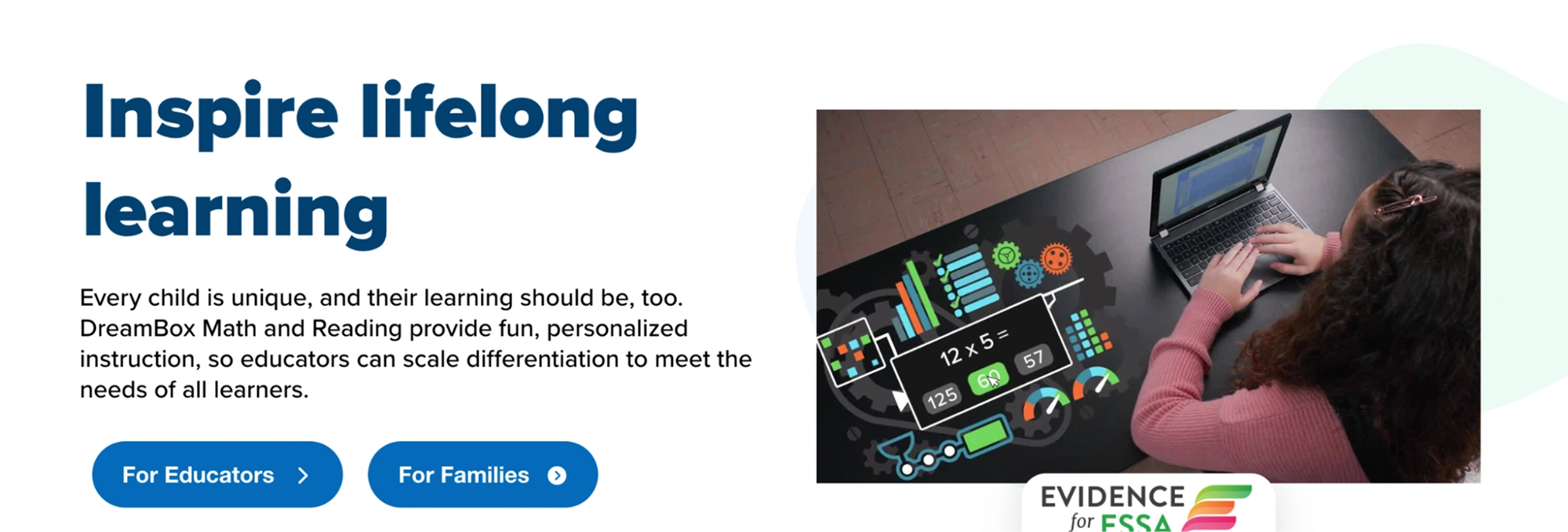
DreamBox: Major features
- Innovative approaches to teaching mathematics
- Personalized math learning for children from preschool to 8th grade
- The best for homeschooling, blended learning, or hybrid learning
DreamBox: Price
Pricing for DreamBox subscriptions starts from $12.95 (1-month plan for individual pricing) and can range up to $325 (lifetime family subscription).
ST Math
Best for: Visual learners, K-8 classrooms
Grade: Pre-K – K-8
Skills: Spatial reasoning, all core math concepts
ST Math uses interactive game puzzles to teach children math concepts. The platform uses its patented spatial-temporal approach with the visual basic math concepts teaching for Early Learning, K-6, Middle School, Summer Immersion, and other programs.
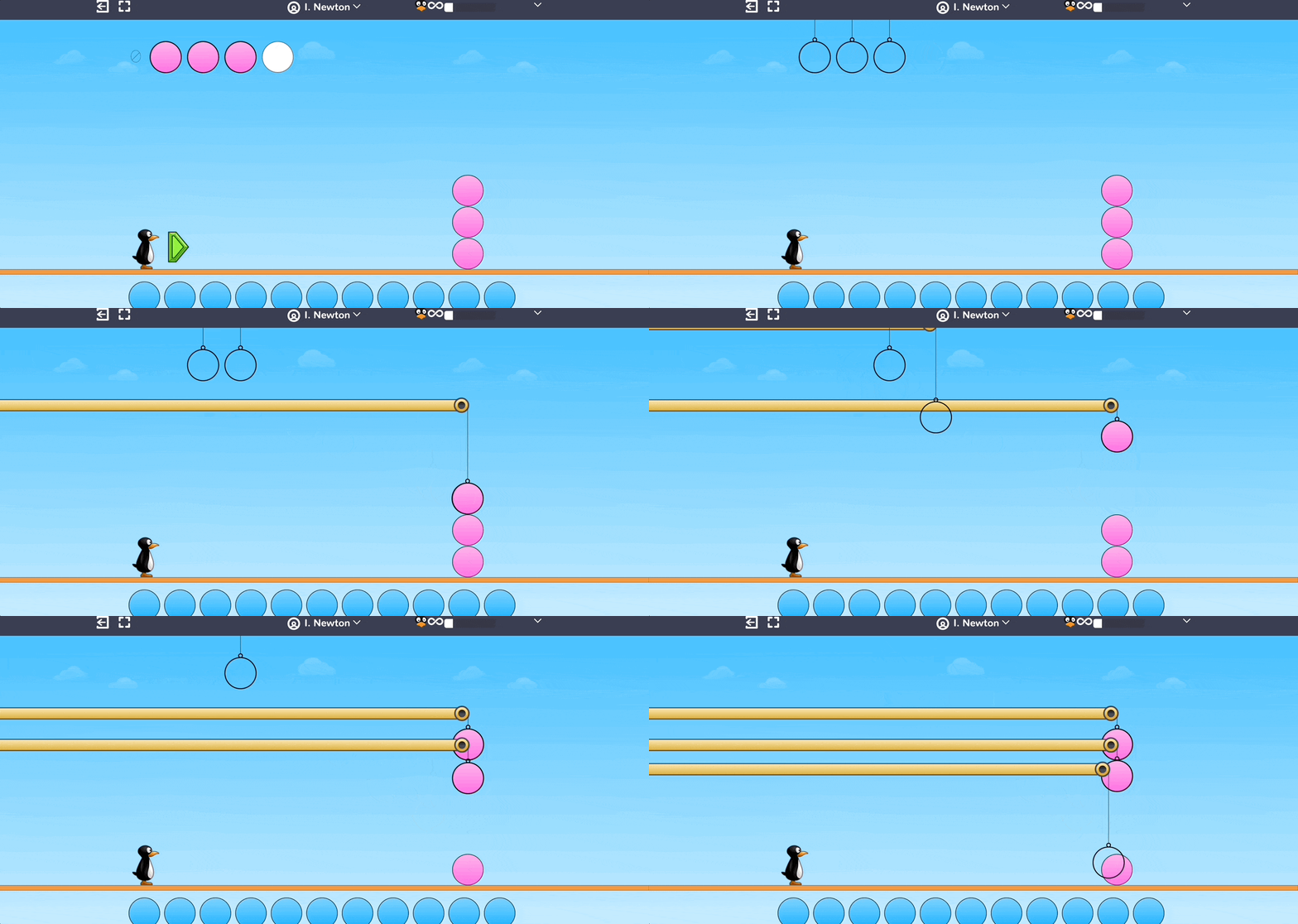
Major features of ST Math
- More than 30,000 puzzles with interactive presentations of all topics
- Need to reach a perfect score (100%) to move on to the next level
- Free games from Pre-K to 8th grade are available on the platform’s website
ST Math price
The platform offers free family access with limited reporting. The annual classroom plan (more details are available upon request) is available for $3,500.
From game time to growth time.
Personalized Brighterly tutoring + fun math = faster progress. 

Sumdog
Best for: Kids aged 5-14
Grade: K-8
Skills: Multiple math topics, adaptive to the studentSumdog is a website that offers math related games according to a child’s level, from 5 to 14 years old. Using gamification for learning makes it easy to convey complex information to kids and to evoke positive emotions from learning the lesson, and to improve information perception.
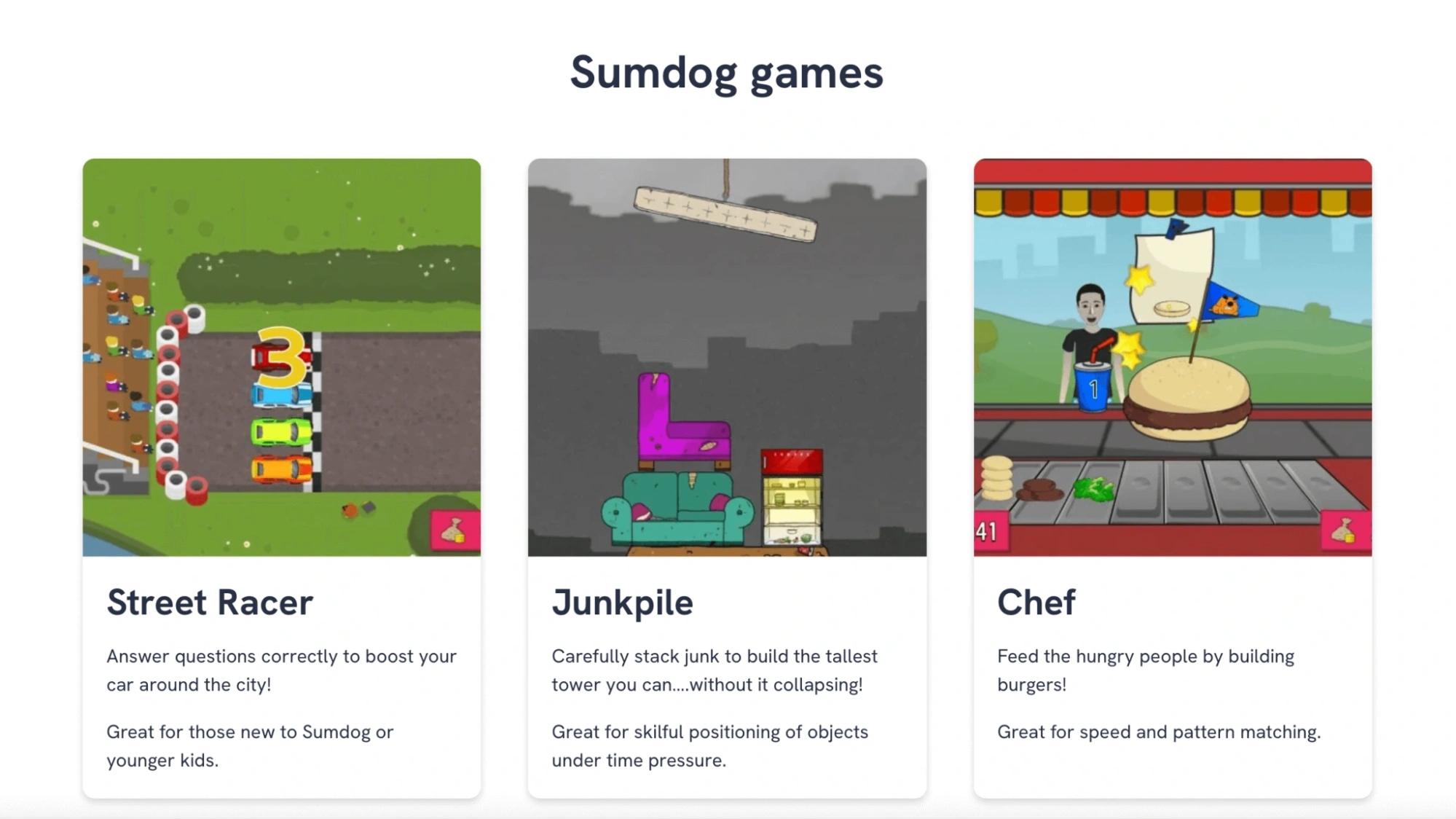
Sumdog: Major features
- Games adapted to the individual level of each kid
- The game format that can cover several sections
- Analytics to monitor kids’ progress
Sumdog math game: Price
The standard pricing for the Sumdog Math family plan is $8.99 per month for up to 3 children, with a 30-day free trial period available.
ABCmouse
Best for: Young children at home
Grade: Pre-K to K-2
Skills: Counting, basic geometry, foundational math
ABCmouse is an educational platform for children that offers to expand knowledge in such areas as math, reading, music, etc., in a game format. It’s a good option for learning math in a fun format for children aged 2 to 8, and if you are looking for some elementary math games.
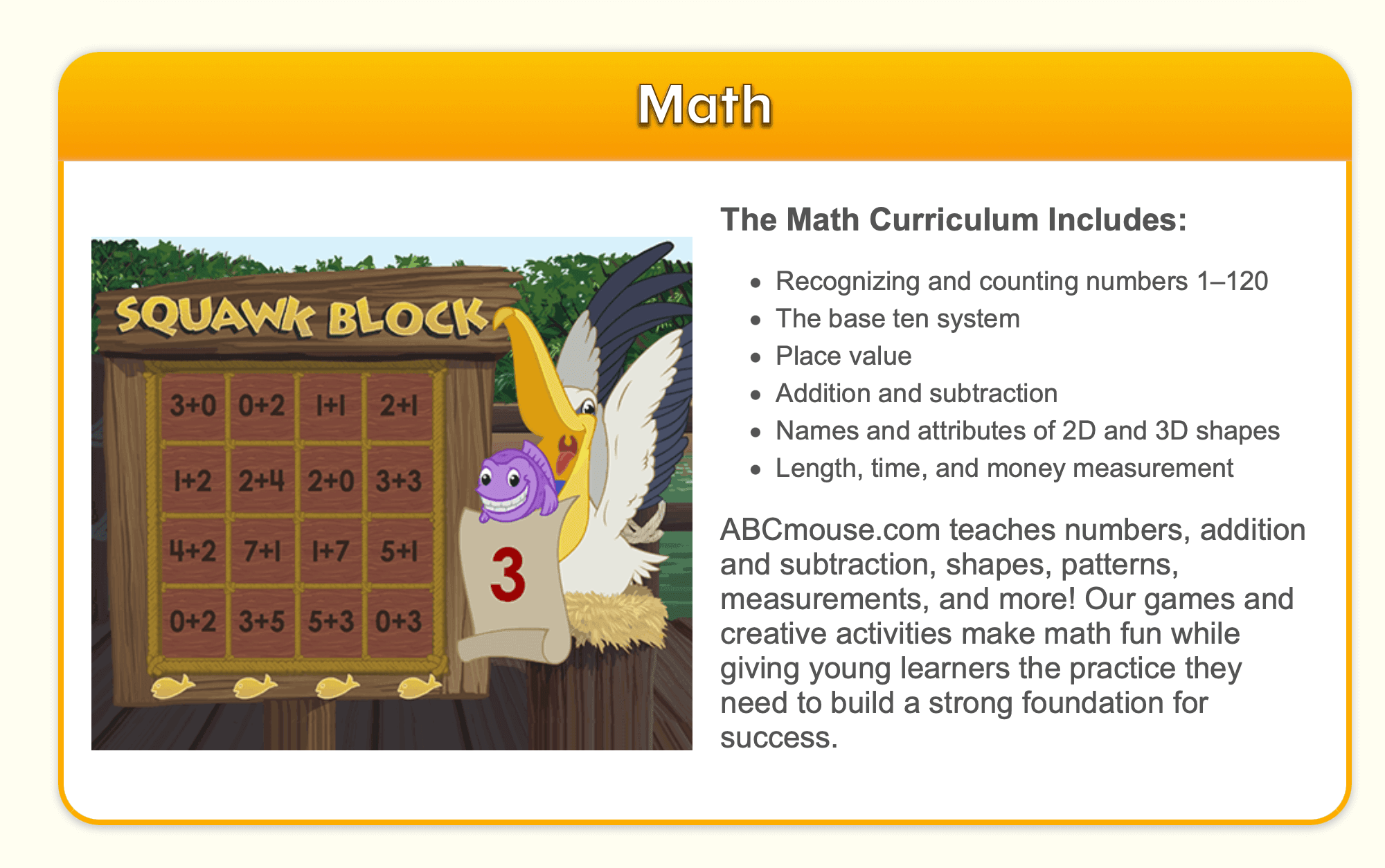
ABCmouse: Major features
- More than 850 lessons and many math games and activities
- A wide range of math concepts covered, from basic counting to elementary geometry
- Activities aimed at practical usage and developing skills
ABCmouse math games: Price
The price is $14.99 per month after a 30-day free trial.
Free Online Math Games for Kids
- Zearn
- Math Playground
- Pbskids
- Funbrain
- Moose Math
- Khan Academy
- Prodigy Math
- Cool Math Games
- ABCya
- Arcademics
Zearn
Best for: Home and classroom
Grade: K-8
Skills: Full math curriculum, aligned with Common Core
Zearn offers a complete mathematics curriculum with game-based elements. This platform engages students to learn math and helps them understand all the difficult topics from the academic program with interactive math activities. With Zearn, kids can practice math exercises at home, with onscreen teachers, visual models, math learning games, etc.

Zearn: Major features
- A math curriculum with 400 hours of digital lessons free
- Math lessons aligned with Common Core standards
- Can be used as a supplement to the school math program
Note: Zearn is free for individual teachers and parents but requires a paid subscription for schools and districts.
Math Playground
Best for: Home and classroom
Grade: K-6
Skills: Operations, algebraic thinking, measurement, base-ten number sense
Math Playground is a collection of math games for toddlers, kindergartners, and kids from 1st to 6th grade. On the website, you can find a lot of math activities for your child, like puzzles, educational videos, and printable materials.
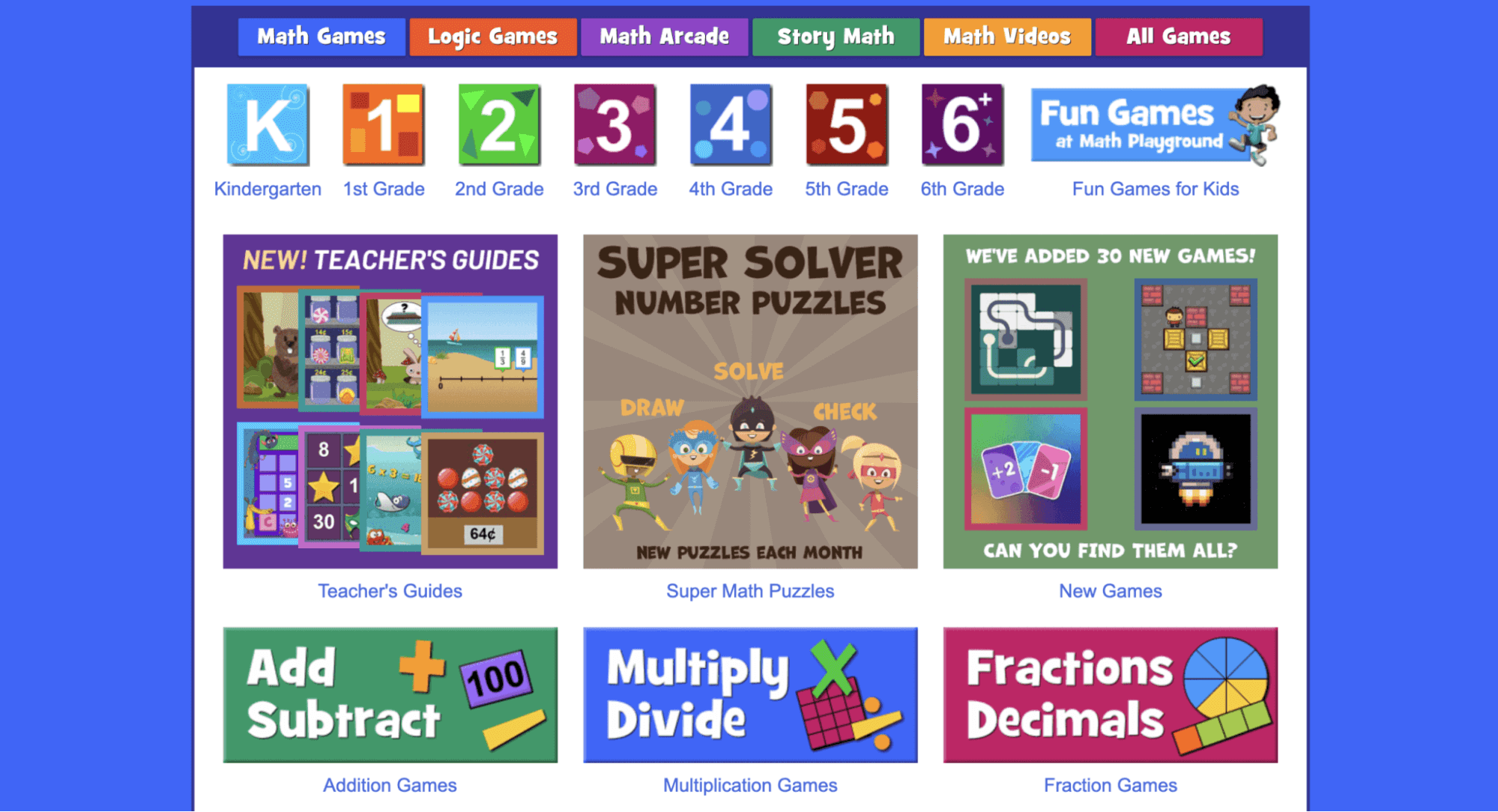
Math Playground free math games for kids online: Features
- Dozens of K-6 math facts games centered around specific math concepts
- Topics include math operations and algebraic thinking, number operations in base ten, measurements, and others
- Worksheets, puzzles, and educational videos on math topics
PBS Kids
Best for: Children aged 2 to 8
Grade: Pre-K to K-3
Skills: Early STEM
PBS Kids is an educational website that features animated free videos and games with cartoon characters. It’s one of the best on the list of math games for kids available for free.
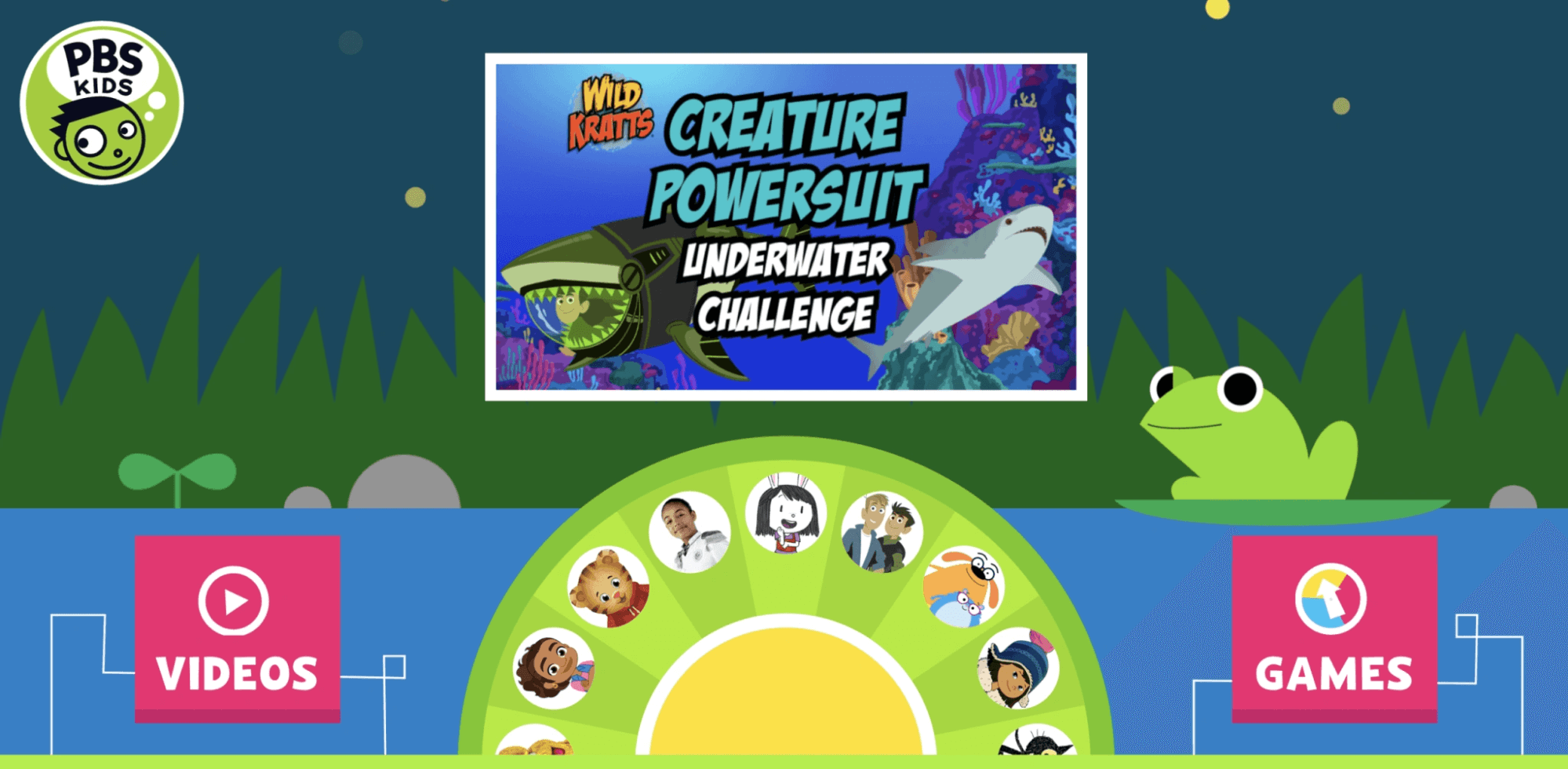
PBS Kids free math games: Major features
- 80+ fun games about math and nature
- Math problems solved with animated TV characters to move through the gameplay
- Regularly updated educational videos and podcasts
Funbrain
Best for: All grade levels
Grade: Pre-K to K-8
Skills: All math topics, adjustable difficulty
Funbrain is a math resource hub established in 1997. It offers educational games where children can solve math tasks with fun animated characters in different settings, along with reading resources, videos, and printables for PreK-8 students.
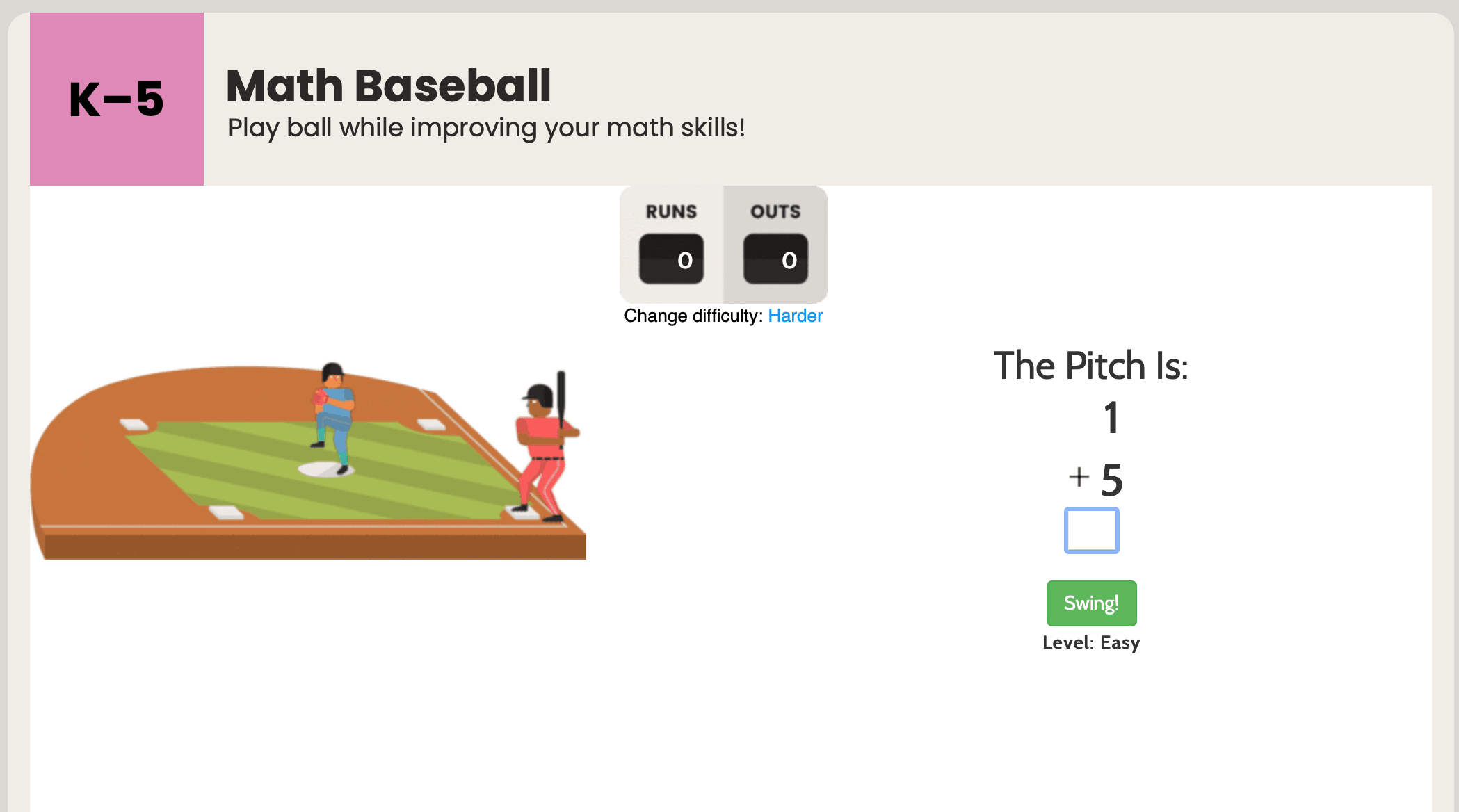
Funbrain math game: Major features
- Over 80 versatile kid math games with customizable difficulty levels for children of all grades.
- Dozens of educational videos, books, and comics about nature, science, and math
- Math Zone special collection of high-quality math and problem solving games
Moose Math
Best for: Kindergartners and early learners
Grade: K-1
Skills: Numbers, arithmetic, geometry, measurement
Moose Math is a math app for kindergartners and first-graders that provides a chance for math skills practice around numbers, arithmetic operations, geometry, and measurements. On the platform, you can find addition games, arithmetic games, multiplication games, and much more.
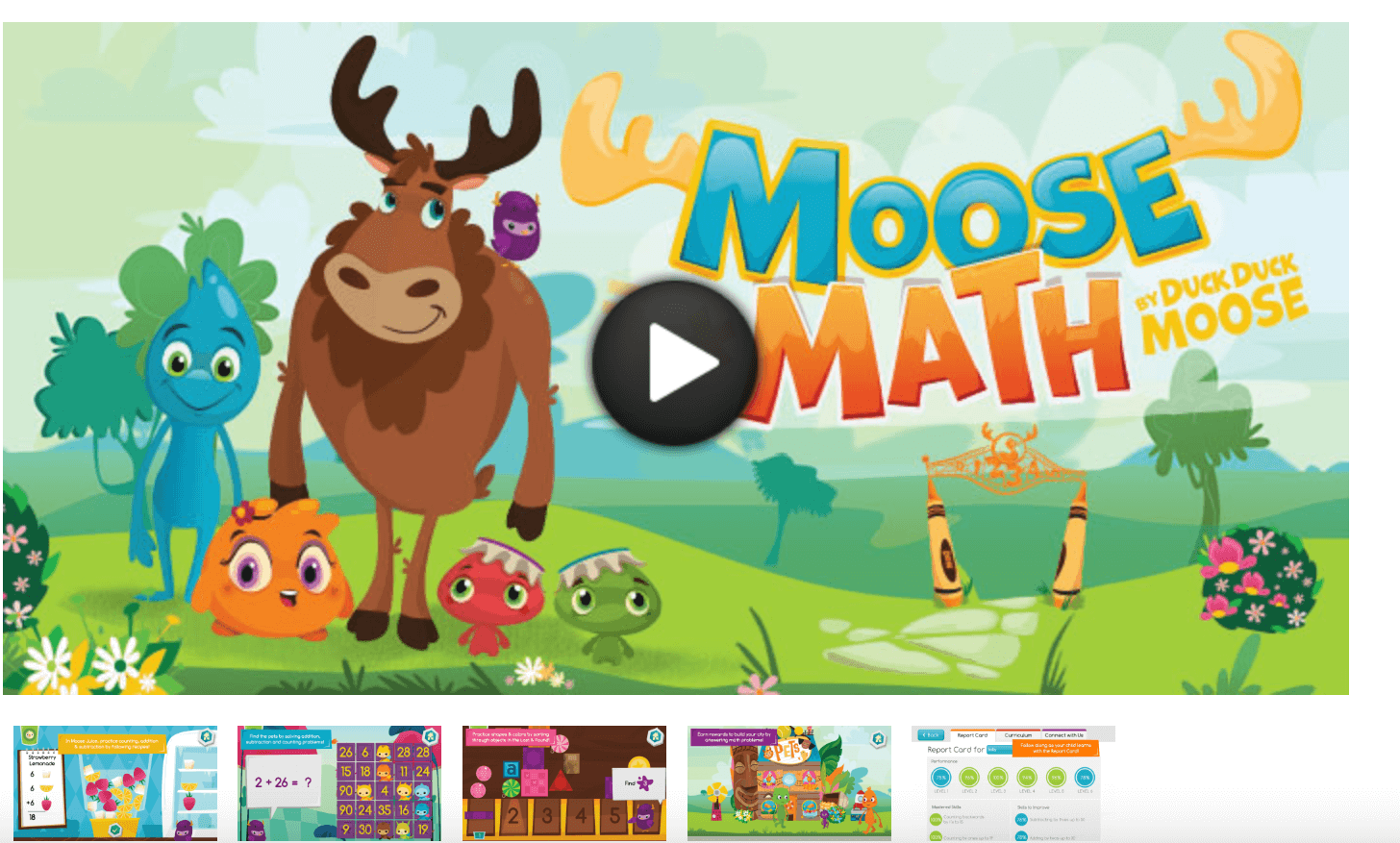
The most popular children’s math games on the Moose Math app:
- Moose Juice is a cooking game where children help a moose prepare smoothies and cocktails, and learn by making sense of the ingredient amounts
- Pet Bingo is opening the pets that match the winning math problem combination solutions
- Lost & Found to practice geometry
- A City of Pets that offers an opportunity to build an entire city with fantasy creatures
Khan Academy
Best for: Self-paced learners of all ages
Grade: Pre-K to K-12
Skills: Full math curriculum across all grade levels
Khan Academy offers a wide library of free interactive content, where your kid can play math games for middle school, among others. The platform can help you make math, biology, history, languages, and other subjects easier for your child to learn.
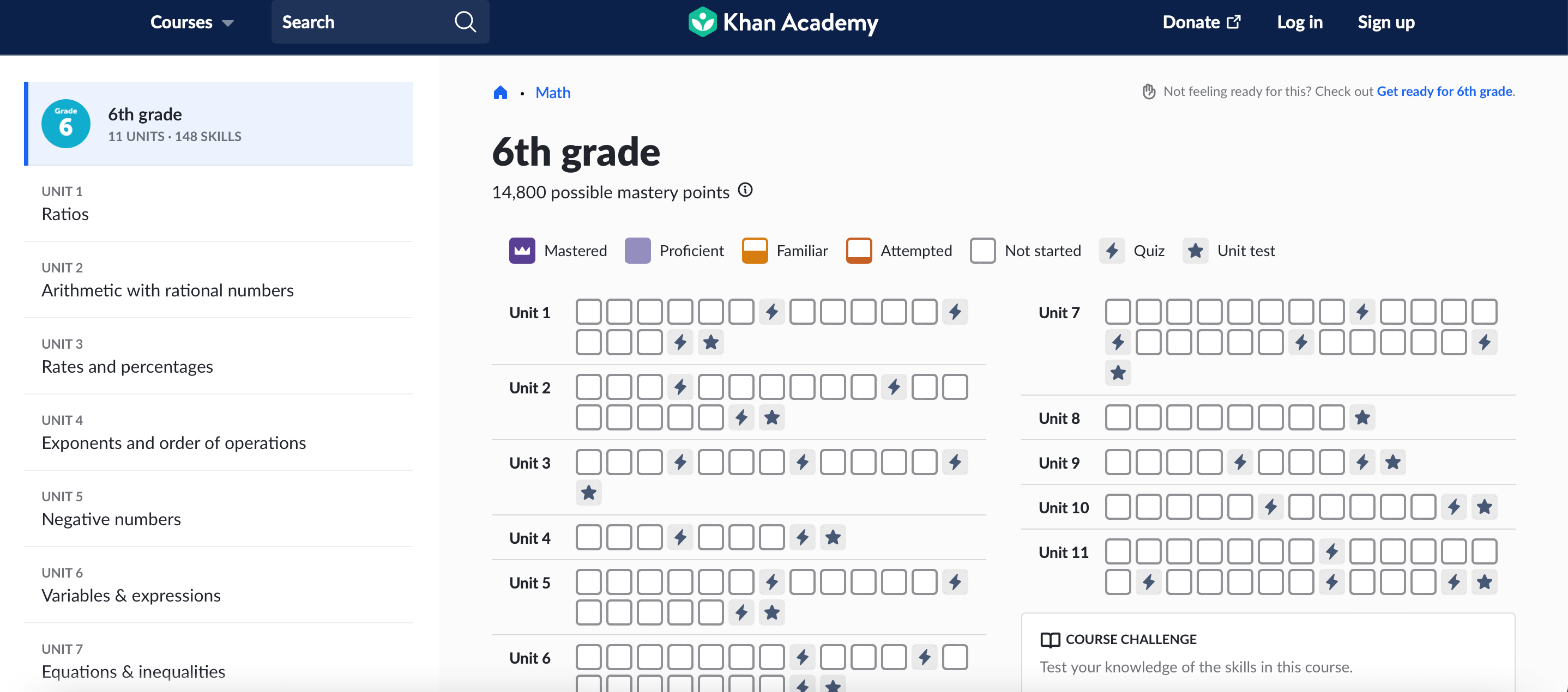
Khan Academy: Major features
- Math courses from Pre-K to high school
- Games combined with helpful videos
- Interactive math tasks and fun games
Prodigy Math Game
Best for: Curriculum-aligned home practice
Grade: K-1 to K-8
Skills: Grade-level math aligned to your child’s school curriculum
Prodigy Math Game is a platform that offers math and English learning through interactive games. The content on the platform will be particularly effective for students from 1st grade to 8th grade. The games are adaptive and grow in difficulty as your kid learns new skills.

Prodigy Math Game: Major features
- RPG elements for learning math
- Daily prizes, exclusive items, and the ability to customize the character
- Math game aligned with your child’s curriculum
Cool Math Games
Best for: Older kids who want to improve their mathematical thinking
Grade: K-3 to K-8
Skills: Logic, strategy, mathematical thinking
Cool Math Games for kids offers activities that mainly focus on logical thinking, mathematical thinking, and strategic skills.

Cool Math Games: Major features
- Thousands of strategic and logical math games
- Games designed to practice specific math concepts
ABCya
Best for: Elementary students
Grade: Pre-K to K-6
Skills: Basic operations, number quizzes
On the platform, you can find very good math games for children, which aim to improve children’s math knowledge from Pre-K to K-6+ grade across various subjects. The platform offers more than 3000 educational games across different subjects, not only math.
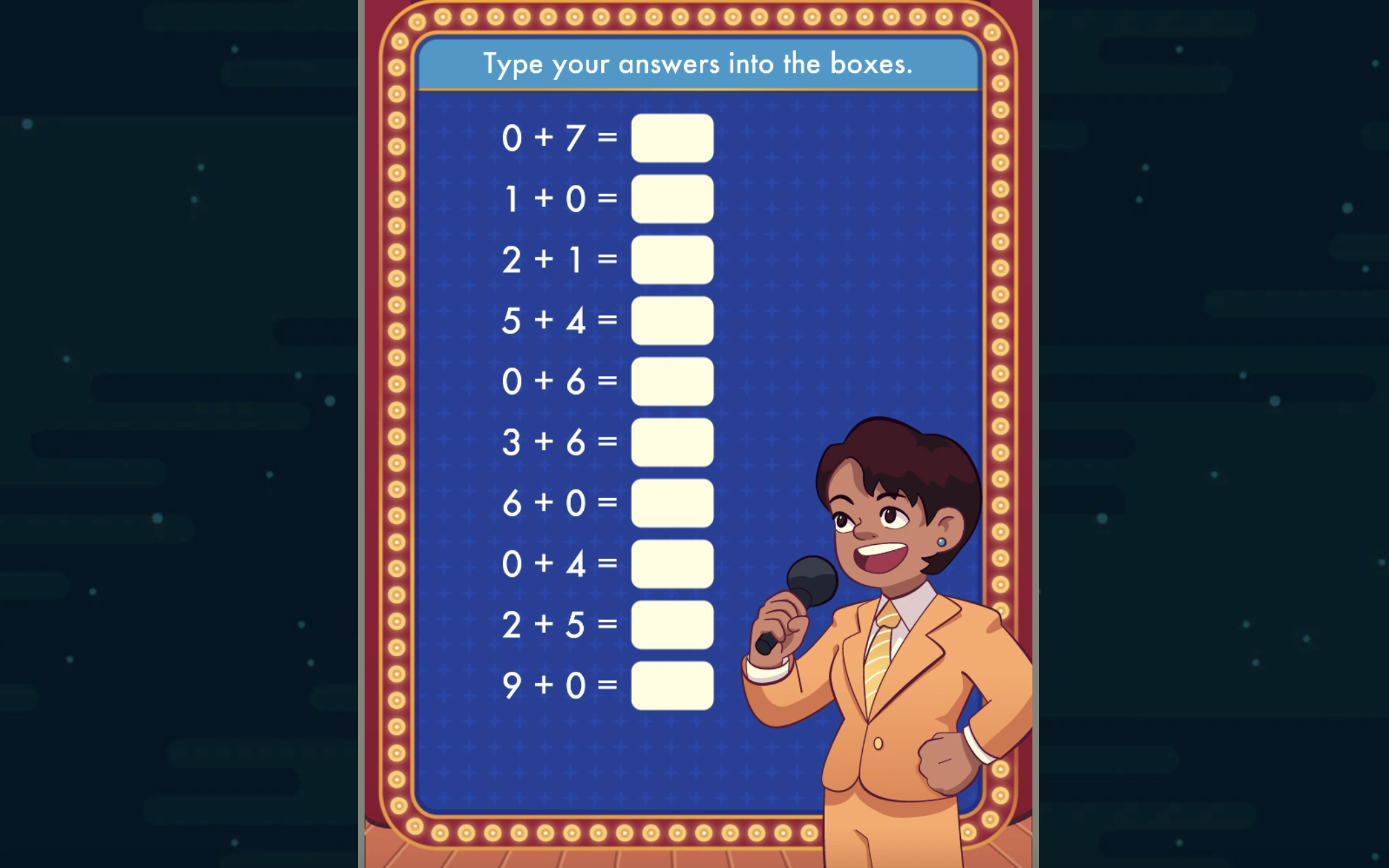
ABCya: Major features
- Math Quiz to practice basic math operations
- Quizzes with different levels of complexity
- Ability to print results when your child successfully completes a level
Arcademics
Best for: Classroom groups and home practice
Grade: K-1 to K-6
Skills: Math operations, language arts
Arcademics is a platform with math games for kids for free (1st to 6th grade). There are also educational video games for language arts and vocabulary. The website is filled with games that combine arcade styles with math exercises to help kids learn quickly and effectively.
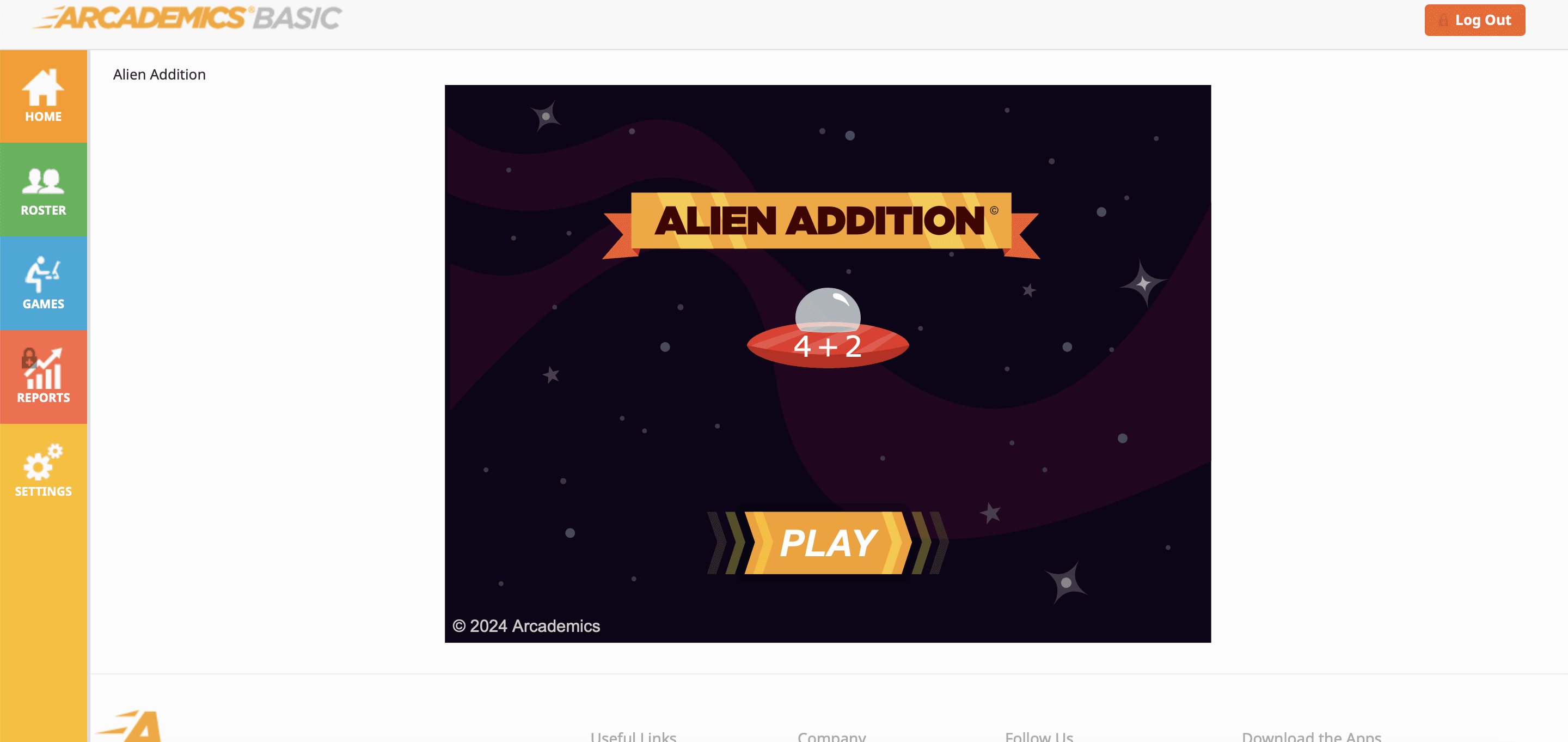
Arcademics math games for kids: Major features
- Games applicable for classrooms to practice teamwork
- Format that arouses genuine interest
- Video games that engage, yet are useful for learning
Make learning math feel like a game!
Let Brighterly tutors help your child learn math with games and fun sessions.
Best Math Games for Kids to Play in Class or Outdoors
- Math Tic-Tac-Toe
- Multiplication Touch
- Math Baseball
- Math Facts Race
- Around the Block
- Math Twister
- The Number Line Run
- The Frisbee 500 Game
- Ping Pong Throwing
- The Water Balloons Game
- Math War
- 101 and Out
- Buzz
- Math Bingo
- Four in a Row Math
Math Tic-Tac-Toe
Best for: Pairs or small groups
Grade: K-1 to K-5
Skills: Addition, subtraction, strategic thinking
A classic math-based game for two players, and you can make it more challenging with math.
How to play Tic-Tac-Toe math game?
It requires:
- 3×3 grid sheets
- Nine tokens numbered 1-9 for each player. The tokens should differ in color to represent team colors.
Two players should use three tokens to make a total of 15, filling a row on the grid. The player wins if they make it first.
Multiplication Touch math game
Best for: Pairs
Grade: K-3 to K-5
Skills practiced: Multiplication tables
A game that allows learning math through creative play as an alternative to traditional math flashcards.
How to play multiplication touch?
This game includes a custom-made playboard designed as a multiplication grid and numbered cardboard tiles. Players should follow these rules:
- As a referee, place all numbered tiles face down.
- At the start, the two players draw ten tiles each.
- The players draw tiles and place them in the matching cells on the multiplication mat. To do so, they need to solve the associated multiplication problems.
- Players have to put tiles so that they touch each other.
- The player wins if they are the first to put all tiles on the multiplication grid.
Setting up the multiplication touch playboard
To play the multiplication touch math game for kids, you need a playboard mat. Follow these steps to make one:
- Get a 10×10-inch piece of cloth – it can be a mat or a kitchen towel.
- Get a waterproof marker, or better, a cloth dye.
- Get a ruler.
- Draw a 10×10 multiplication grid on the mat and leave free space on the left and top sides.
- After you complete the mat, cut 100 cardboard tiles and number them from 1 to 100.
- Get two more 1-10 sets of tiles to label your multiplication grid.
- Cut up to four blank tiles.
Math Game Baseball
Best for: Whole class
Grade: K-2 to K-6
Skills: All four operations (addition, subtraction, multiplication, division)
Math Baseball is a simple and one of the best math games based on sports that can be prepared in a few minutes
Preparation for a game of Math baseball
- Come up with math problems (simple, moderate, and difficult).
- Decide which topic you will practice and write these math problems on paper sheets.
- Make sure your students answer these problems in their minds within 5-10 seconds.
- Then, write these math problems on the paper sheets with answers on the backside (optional). Aim for 16-20 math problems.
- Sort these equations by difficulty. For example, 5 + 4 goes to simple, 16 + 22 goes to moderate, and 254 + 328 goes to difficult.
These complexity levels will match single, double, or triple pitches. Simple and difficult problems will cost fewer and more points, respectively.
How to play baseball as a math learning game?
- Draw a baseball field on the chalkboard and create sections to write team points.
- Divide your class into two teams and ask them to stand in a line (a batting order).
- A pitcher will choose a math problem – single, double, or triple. If they answer correctly, the team gets the points.
- If the pitcher gives the wrong answer three times, they get disqualified.
Math Facts Race
Best for: Whole class
Grade: K-3
Skills: Addition, multiplication, speed calculation
Math Facts Race is one of the super fun math games for K-3 students that doesn’t require anything except a few grid sheets.
Preparation for a game of Math Facts Race
Divide kids into two teams and give each a grid sheet.
How to play this math game?
Once you declare math problems (these can refer to addition or multiplication), they should race to the chalkboard. Kids should write numbers in the math grid to reflect the intersections of rows and columns.
For instance, if you declare 5 + 3, a kid goes to the blackboard and fills the cell where column 5 and row 3 intersect.
This exercise allows kids to visualize math equations, practice speed calculations, and improve focus.
Children should carefully watch their teammates solve equations. If anyone makes an error, one of their teammates should use their turn to correct it.
The team wins if they fill all cells on their math grid first.
Around the Block
Best for: Small groups
Grade: K-4
Skills: All operations, mental math, turn-taking
This outdoor and adventure fun math game is one of the low-budget in-class activities that requires only a ball and a desire to practice math skills.
How to play Around the Block
- Ask your kids to sit in a circle. You start a game as a referee by passing a ball to a student.
- Say a math problem they need to solve. When a student answers the problem correctly, they choose another student to pass the ball.
- If a student gets the wrong answer, you choose the next student to solve it. If they answer correctly, they decide where the ball goes next.
Math Twister
Best for: Small groups
Grade: K-1 to K-5
Skills: Mental math, computational accuracy under pressure
Twister is a fun outdoor game you can modify to study math.
Preparation of a math game
Prepare sticky notes corresponding to Twister mat circles. Write numbers on the sticky notes – these will answer math problems. For more convenience, you can prepare math problems on a separate list – it will be yours.
How to play?
You are a referee, and you will be the one to spin the spinner and watch your kids clumping on the mat.
Once the spinner stops, you announce it, “Left hand, 5+3.” The player wins if they are the most agile and fast-calculating.
Why is the Math Twister math game good for your children?
Math Twister is unarguably fun, and it helps children to improve computational accuracy in stressful circumstances (it’s a positive adrenaline rush), calculate numbers in their minds, and be more agile.
The Number Line Run
Best for: Young learners who love outdoor activities
Grade: K-2
Skills: Counting, skip counting, addition
Little kids love running, and it’s an excellent chance to use their passion for the sake of math. Your child can practice counting and addition by playing a number line run.
How to play such learning math games for kids?
You need a set of crayons or just a single one for this game:
- Draw a line on the sidewalk – it’s desirable if you make it as long as possible. Let it be 20 feet long.
- Mark it with numbers from 0 to 20, 25, 30, 35, and 40 – it’s up to you.
- Start the race. Say a number and ask a child to run and stop at its mark on the sidewalk line.
Number line jump
If your kid is bored with running across the number line, suggest jumping. They will learn to count by jumping until the required number.
You can let them practice skip counting – jumping by two or three. You can also measure jump length. There is plenty of space for math game modification.
The Frisbee 500 Game
Best for: Pairs, outdoors
Grade: K-1 to K-4
Skills: Counting, addition up to 500
Frisbee is an active game that requires two players. It doesn’t require exceptional athletic skills. Plus, your children can practice math while throwing a Frisbee without even realizing it.
The math game rules
- There are 500 points in total.
- Each throw counts as 10/20/25 points – it’s up to you.
- If a player catches the Frisbee, they get the points. If not, they don’t get any points for the throw.
- The player wins if they collect 500 points first.
How to play such learning math games for kids?
To play the game, you need a Frisbee and two crayons.
- Two players stand at least five feet in front of each other.
- The players throw the Frisbee at each other.
- The player gets 10/20/25 points once they catch the Frisbee. If they don’t, they lose the throw.
- Players write their points somewhere next to their stands.
- Repeat until one of you gets 500 points.
This game teaches counting and addition up to 500.
Ping Pong Throwing
Best for: Small groups
Grade: K-1 to K-5
Skills: All operations, motor skills, mental math
Ping Pong Throwing lets you modify a ping pong game to make it a simple math practice.
Preparation of a Ping Pong Throwing Math Game
- Get ten cups (you can buy plastic ones) and place them in a row.
- Get ten pieces of cardboard or paper and number them – there will be answers to math problems.
- Then, you speak out a math task, and children have to throw a ping pong ball into the correct cup.
- For this game, you need: ten cups, a marker, ten square pieces of paper, a ping pong ball, and transparent duct tape.
Game modifications
If you want something more active, you can modify this game a little – draw circles on the playground or a wall and put numbers there. Kids will throw the ball against the wall or in circles on the pavement.
Benefits of the Ping Pong Throwing math game
It’s a simple game that encourages children to count numbers and solve simple math equations in their minds. Kids also improve motor and spatial skills while throwing the ball.
You can easily modify the game by adjusting it to addition, subtraction, multiplication, and division tasks. Or, you can tailor it to decimals or measurements – it’s up to you.
The Water Balloons Game
Best for: Outdoor groups
Grade: K-4
Skills: Number recognition, equation matching
This fun outdoor and adventure math game includes a bit of physical activity.
How to play the Water Balloons Game?
- To play this game, you need chalk, markers, and up to ten water-filled balloons.
- Fill the balloons with water and number them – choose whatever numbers you want.
- Then, make math problems for these numbers to become answers.
- Draw math equations on the floor and circle them.
- Then, ask children to throw the balloons at the appropriate equations.
Math War (Card Game)
Best for: Pairs or small groups
Grade: K-1 to K-5
Skills: Multiplication, addition, number comparison
This is a fun math game for small groups (starting with only 2 people), and kids can play it both outdoors and indoors.
How to play Math War:
- Use a standard deck (remove face cards or assign them values: J=11, Q=12, K=13).
- Each player flips two cards and multiplies them (or adds them for younger kids).
- The player with the higher answer wins all four cards.
- The player with the most cards at the end wins.
You need: One standard deck of cards
101 and Out
Best for: 2-4 players
Grade: K-3 to K-6
Skills: Addition, multiplication, mental math, strategic thinking
101 and Out is one of the most fun offline math games for kids. It helps kids practice combination, multiplication, strategy, and a little bit of probability, as dice are involved.
How to play 101 and Out:
- Players take turns rolling two dice.
- Each turn, they decide whether to multiply the two numbers or add them to their running total.
- The goal is to get as close to 101 as possible without going over.
- Going over means your score resets.
- After an agreed number of rounds, the player closest to 101 wins.
You need: Two dice, paper to track scores.
Buzz
Best for: Whole class or small group
Grade: K-2 to K-6
Skills: Multiplication tables, skip counting, mental math
Buzz is a nice offline game that doesn’t require any resources, just the players, so you can set it up quickly. The kids can also play the game in groups of as many as they like.
How to play Buzz:
- Players sit in a circle and count aloud in sequence
- Before starting, they need to choose a “buzz number” (e.g., 7)
- Whenever a player reaches a multiple of that number, they say “Buzz!” instead of the number
- If they say the number instead of Buzz, they are out
- Players keep going until only one player remains
- You can increase the difficulty by using two buzz numbers at once.
You need: Nothing, just players
Math Bingo
Best for: Classrooms and family game nights
Grade: K-5
Skills: All operations, number recognition, mental calculation
Think of this as the math version of a lottery, where kids need to find the right answer to equations from the given list.
How to play Math Bingo:
- Create bingo cards with answers to math problems instead of random numbers
- The caller reads equations aloud, and players mark the correct answer on their cards
- The first to complete a row, column, or diagonal calls “Bingo!” and wins.
You need: Printed or hand-drawn bingo cards, markers (coins, buttons, or pencils can also work fine to make the cards reusable).
Four in a Row Math
Best for: Pairs
Grade: K-3 to K-6
Skills: Multiplication, addition, strategic thinking
This one is similar to a tic-tac-toe, but a bit more complicated. Players need to make the multiplication and fill four cells in a row while blocking their opponent.
How to play Four in a Row Math
- Draw a 7×6 grid on paper and write a list of numbers 1–9 along the side
- Players take turns choosing any two numbers from the list and multiplying them (or adding, for younger players)
- They then mark the product on the grid
- The first player to mark four cells in a row wins.
- Kids can block your opponent by claiming key cells.
You need: Paper, two differently coloured pens or pencils.
Math Games by Grade Level
Not every math game on this list will be the right fit for every child. Here is a quick breakdown to help you find the best starting point.
- Pre-K and Kindergarten. At this stage, the focus is on number recognition, basic counting, and shapes. ABCmouse, Keiki, Moose Math, and PBS Kids are all built with this age group in mind. Number Line Run can be a great offline game for this age group.
- Grades 1-3. Once your child starts working through basic operations, games like Monster Math, SplashLearn, and Funbrain give them plenty of practice in a low-pressure format. In the classroom, or for some offline math time, Math Tic-Tac-Toe and Around the Block work well for this age group.
- Grades 3-5. By this point, multiplication, division, and early fractions are on the table. Games like Prodigy Math, IXL, and DoodleMaths can all adapt to your child’s level at this stage and cover these topics well. Math War and Multiplication Touch are great offline options for these topics.
- Grades 6-8. If your child is older, they can benefit from more strategic and challenging formats. Cool Math Games, Arcademics, Khan Academy, and DreamBox Learning all offer learning content for middle schoolers that will both entertain them and help them learn. The offline 101 and Out can challenge students at this level.
How to Choose the Right Math Game for Your Child
If you are new to math games, it can be hard to know how to choose the right math game for your child, and where to start. Here are some questions you can ask to help you narrow down the selection quickly.
- What is your child’s grade level? Always use this as the first filter. A game for a kindergarten kid will bore a 4th grader, while a game targeting middle schoolers will frustrate your 6-year-old and have the opposite effect from the one you were aiming for. Every game in this list includes a grade range, so make sure to use it as your starting point.
- What skill do they actually need to work on? If your child struggles with a specific topic, you should look for a game that targets that skill specifically, instead of going for a more general math skills game.
- Do you want a screen-based or screen-free option? If your child already spends a lot of time on devices, the classroom and outdoor games in this guide are a great way for them to practice math without adding more screen time.
- Free or paid? The free platforms on this list cover most grade levels and skill areas very well. On paid apps, you can generally get more personalization, progress tracking, and an ad-free experience.
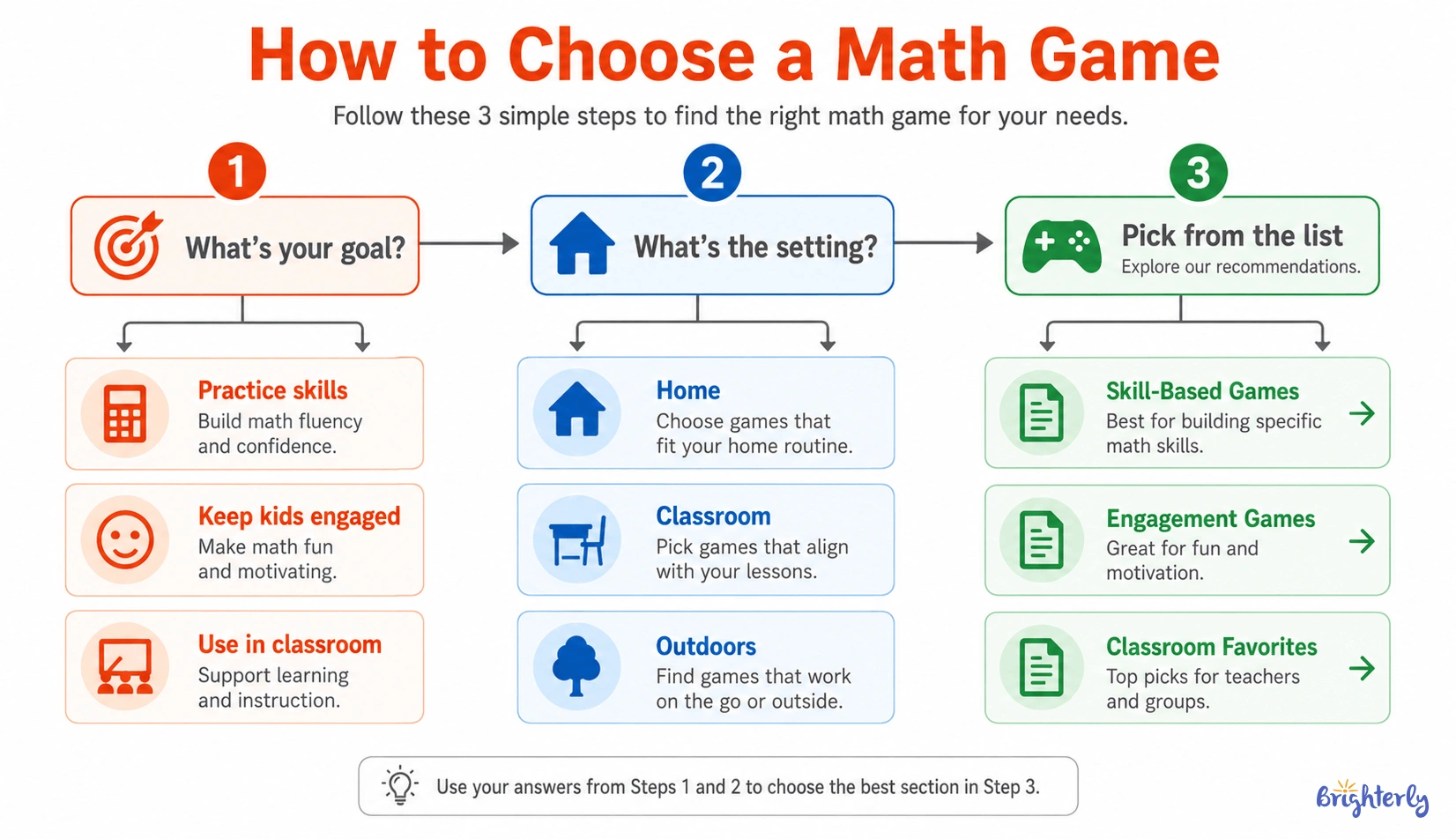
And if you notice that games alone are not moving the needle, it can be a sign that your child needs more than just practice. They may be missing a foundational concept that no amount of repetition will fix on its own. That is exactly where 1:1 tutors at Brighterly can help. During the personalized classes, our certified math tutors work with children to find their knowledge gaps and explain the topics in a way that finally clicks.
Frequently Asked Questions
What Are Some Fun Math Games?
Popular offline math games include Math Tic-Tac-Toe, Math Baseball, Math War, and Buzz, for all of which you only need everyday materials and a few minutes to set up. For online play, platforms like Prodigy, Khan Academy, and Math Playground offer free math games your child can start right away. Paid games like Monster Math and SplashLearn add more personalization.
Why Are Fun Math Games for Kids Good for Learning Math?
Math games create a low-stress environment where children can practice essential skills without the pressure of grades or tests. In particular, they help to increase your child’s interest in math, reduce the fear that math is too difficult or complicated, and, as research by Ratino et al. (2024) shows, improve their motivation.
What Math Games Work Well for Middle School Students?
For middle schoolers, games that feel genuinely challenging rather than childish are a better way to go. Cool Math Games, Arcademics, Khan Academy, and DreamBox Learning all offer content appropriate for this age group. For offline options, Buzz, 101 and Out are simple to set up but require enough mental math to keep older students on their toes.
Are Online Math Games as Effective as Worksheets?
Math games for kids and math worksheets serve different purposes, and the best results come from using both. Worksheets build the ability to work through a problem step by step with focus. Games build speed, confidence, and a positive association with math. You can think of games as the warm-up and worksheets as the workout.
Can Math Games Replace a Math Tutor?
Not quite. A game can help your child practice a skill they have already been introduced to, but it cannot notice if your child is misunderstanding something. A good tutor does that, and a lot more, and is a better option if your child has learning gaps. Our tutors at Brighterly work 1:1 with each child to find exactly where the gap is and close it.



Finding the best kindergarten math games doesn’t have to be a chore. In this article, you can find a curated list of 40 math games for kindergarten kids. Whether you are a teacher or a parent, this guide covers everything from counting and shapes to basic addition, and can help you turn learning math into […]
Jul 11, 2022

Starting math lessons with second-graders can be fun and practical using many online or offline games. These games make learning math fun and help children remember essential ideas by playing them. These top math games for grade 2, played on a computer or in class, suit different ways of learning and abilities. They help young […]
Jul 21, 2022
Math & reading from 1st to 12th grade
Exploring alternatives?
Take a short quiz!

Choose kid's grade