Multiples – Definition with Examples
reviewed by Jo-ann Caballes
Updated on November 12, 2026
Multiples in math are what you get when you multiply a specific number by an integer. If you’ve ever counted by twos, fives, or tens, you’ve already used multiples!
This article explains what a multiple is in math, why it matters, how to find multiples of a number, and what common multiples are, with examples and practice problems.
What Is Multiple?
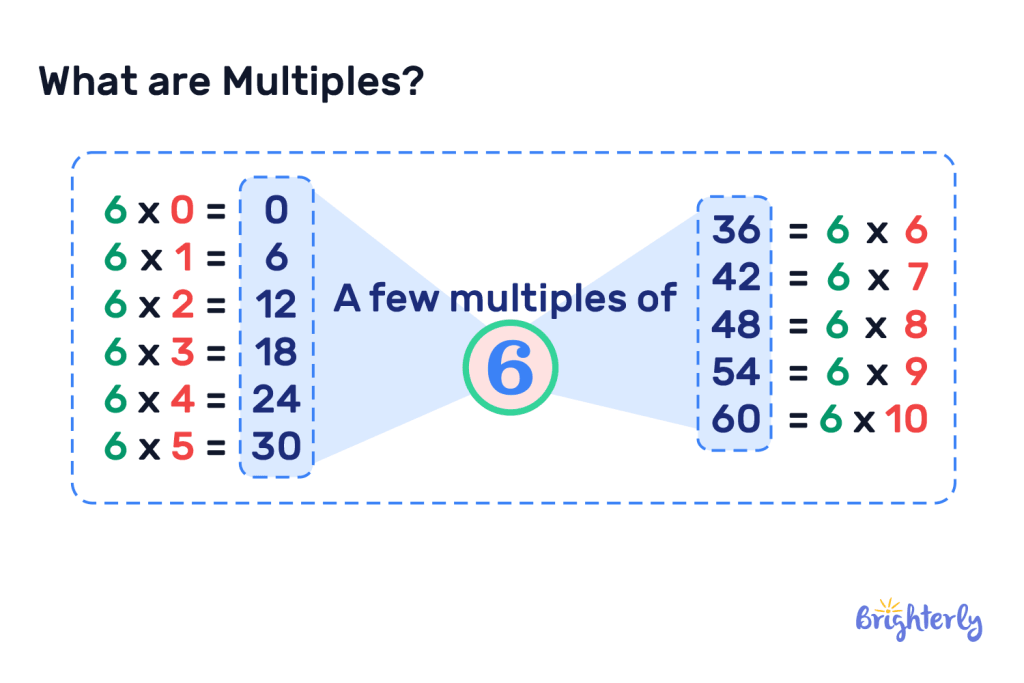
A multiple in math is the result of multiplying an integer by another whole number. Every time you multiply that number, you get a multiple!
Let’s use 6 as a multiple math example. Each time you multiply it by 1, 2, 3, and so on, the results are multiples of 6 – so 6, 12, 18, and so on.
0 is also a multiple of every number because any number multiplied by 0 equals 0.
How to Find Multiples of a Number
There are three simple ways to find multiples of a number:
- Multiply by 1, 2, 3, and so on. Multiply the number by each whole number in order. For 4: 4 × 1 = 4, 4 × 2 = 8, 4 × 3 = 12, so 4, 8, and 12 are multiples of 4.
- Skip count. Count up by the number, starting from the number itself: 5, 10, 15, 20, 25. Each number you say is a multiple of 5.
- Use the times table. The row for a number in a multiplication table lists its first multiples, like in the table below.
Every number has an endless list of multiples, so we usually write down only the first few.
Expert Math Tutors for Every Level
Connect with professional and certified educators who provide specialized support for every grade level, from elementary school basics to advanced algebra
List Of Multiples
Here is a multiplication table with the multiples of numbers 1–10. Remembering them can make the process of multiplying much faster and more intuitive.
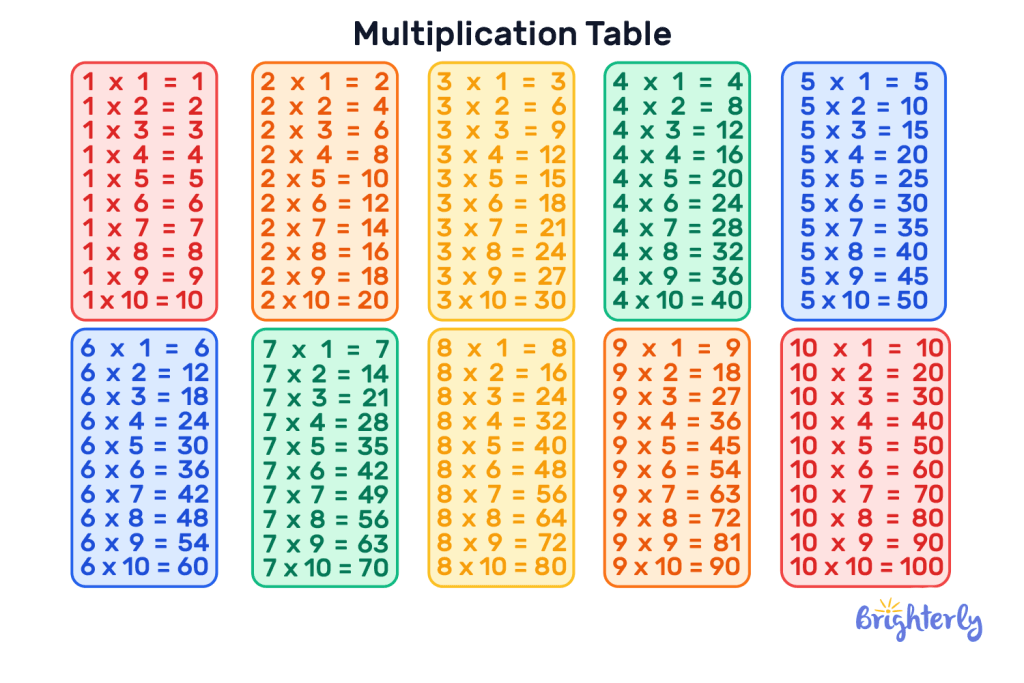
Multiples Properties
Multiples in math have quite interesting properties, which make them so critical for higher level algebra and geometry. These properties also make it much easier for you to identify multiples and work with them.
Let’s look at some of these properties.
- First is that every number is a multiple of itself. When you multiply any number by 1, the result is the number itself.
- Positive multiples of a positive number are always equal to or greater than the number itself. For example, the smallest positive multiple of 5 is 5. The only exception is 0, which is a multiple of every number.
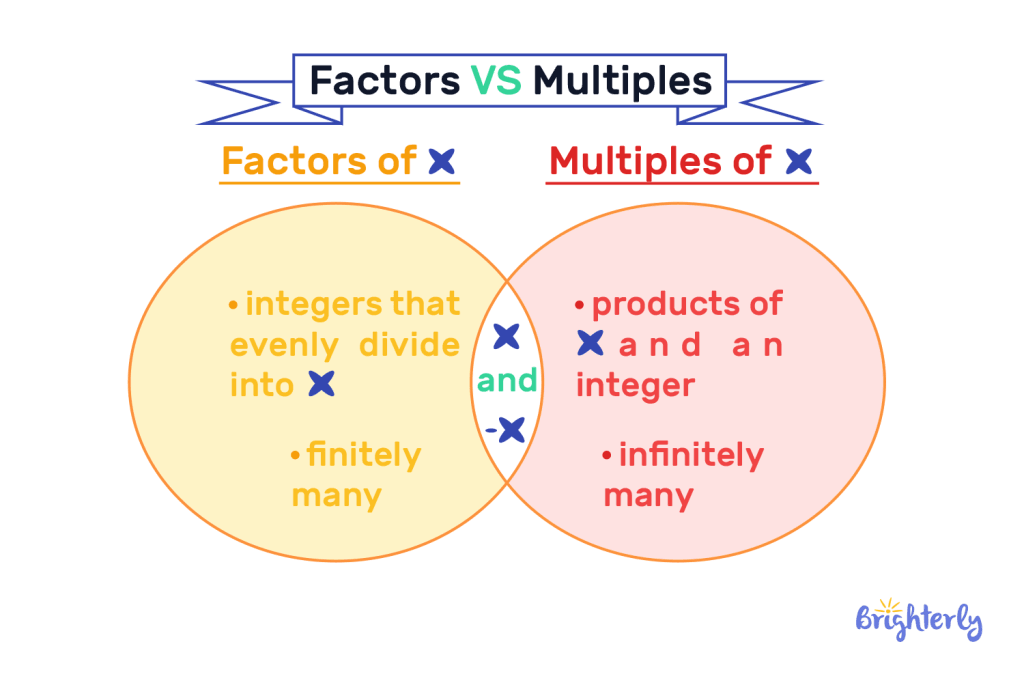
- The number of multiples for each number is infinite, as you can keep multiplying that number with larger and larger numbers. There is no limit.
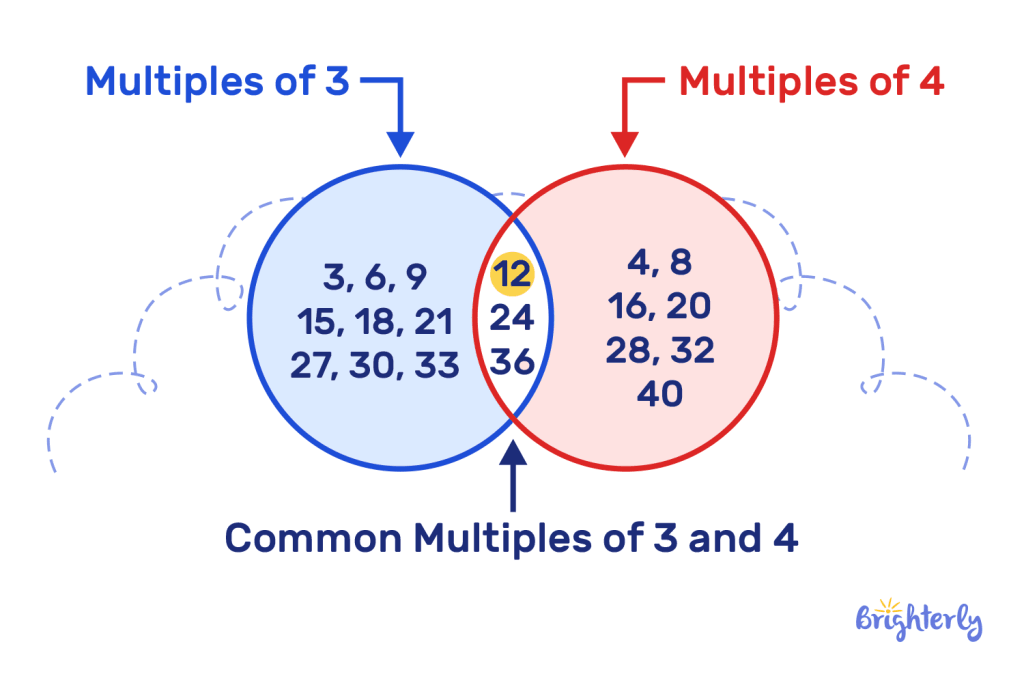
- If we multiply two numbers together, the product will be the multiple of both numbers. For example, 3 x 4 = 12, with 12 being a multiple of both 3 and 4.
- A multiple can always be divided by the original number without a remainder. For example, 18 ÷ 6 = 3, so 18 is a multiple of 6.
Help your child reach their full potential!
Answer a few quick questions about your child’s learning, and we’ll recommend next steps. 

Factors & Multiples
Factors and multiples are two sides of the same multiplication. The meaning of multiple in maths is the result of any integer multiplied by another integer. A factor, meanwhile, is an integer that divides another integer without a remainder. So for example, 4 is a multiple of 2, and 2 is a factor of 4!
Common Multiples
If a number is a multiple of more than one number, it’s a common multiple. For example, 12 and 18 have common multiples of 36, 72 and 108. You can make these numbers by multiplying each of the original numbers by an integer.
Solved Math Tasks
Here are some solved math tasks to help you practice your knowledge!
Which of the following is a multiple of 2?
- 1
- 3
- 6
- 7
Answer:
| 6, because you multiply 2 by 3 to get to it. |
The multiples of a given number are defined as…
Define multiple.
Answer:
| A multiple is a whole number you get when you multiply one number by another whole number. |
Write the first five multiples of the number 12 in order, starting with 0
Write your answer.
Answer:
|
Multiples: Practice Math Problems
Multiples: worksheets
Now you know the multiples definition for kids, try our free math worksheets to practice your knowledge:
- Factors and multiples worksheets
- Multiplication worksheets
- Multi-digit multiplication worksheets
- Multiplication worksheets for grade 3
Frequently Asked Questions
What Is The Common Multiple Of 2 3 4 5 6 7?
The least common multiple (LCM) for these numbers is 420. This is the smallest positive integer that you can divide by all six numbers perfectly, without a remainder. Any larger common multiples of these numbers, like 840 or 1260, will always be a multiple of 420.
What’s The Easiest Way To Learn Multiples Of 6?
The easiest way to learn multiples of 6 is through times table. You can also think of multiples of 6 as double 3s. If kids know the 3 times tables, they only need to double the results. For example, 3 × 3 = 9, and doubling it gives 18, which is 6 × 3.
How To Identify Multiples Of 4 Quickly?
Look at the last two digits of any number. If you can divide those last two digits by 4, or the digits are 00, then the entire number is a multiple of 4. For example, the number 1524 is a multiple of 4, since 24 is a multiple of 4.
What Is The Easiest Way To Explain Multiples?
Explain multiples as the numbers you say when you skip count. If you have a pile of 5-cent coins, for example, as you add each coin, the value (5, 10, 15, 20) will represent multiples of 5. When you multiply a number, it’s like you clone it over and over again.
How To Know If A Number Is A Multiple?
To check if a number is a multiple of another number, divide it by that number. If there is no remainder, it is a multiple. For example, 54 ÷ 3 = 18, so 54 is a multiple of 3. But 40 ÷ 3 = 13 with a remainder of 1, so 40 is not a multiple of 3.
What Is A Real Life Example Of Multiples?
Stacks of coins of the same value can be represented as multiples. Another example is buying items in packs. If a pack of soda comes with 6 cans, the total number of cans you can buy will be multiples of six, as 2 packs will be 12 cans, and so on.



Troubles with Multiplication?
- Is your child finding it hard to grasp multiplication lessons?
- An online tutor could be of assistance.
Choose kid's grade

Does your child struggle with mastering multiplication basics? Try lessons with an online tutor.
Book FREE lesson