Printable Multiplication Worksheets for Grade 3 in PDF: Arrays, Missing Factors, and Times Tables
Updated on August 26, 2026
These free printable multiplication worksheets for grade 3 give students practice writing multiplication sentences from picture arrays, choosing the correct equation from options that look almost alike, filling in missing factors, and solving short multiplication word problems. Every worksheet downloads as a PDF you can print at home or in class, and the sample problems shown in the preview below are worked out further down this page.
Third grade is the year multiplication shifts from an idea a student reasons through to a fact they recall, so the sheets repeat the same table across several problems before switching to a new task type. For practice across the rest of the year, see this Brighterly’s 3rd grade math worksheets.
Multiplication Worksheets Grade 3: Free Download
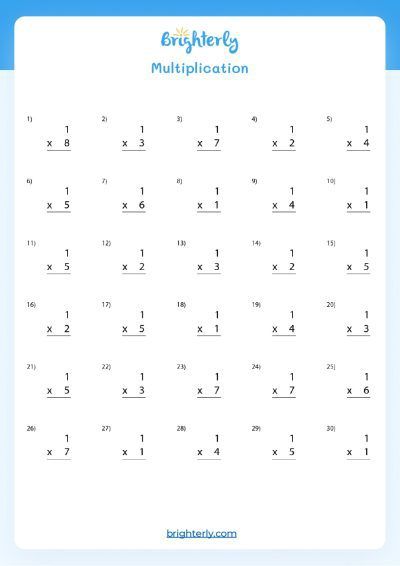
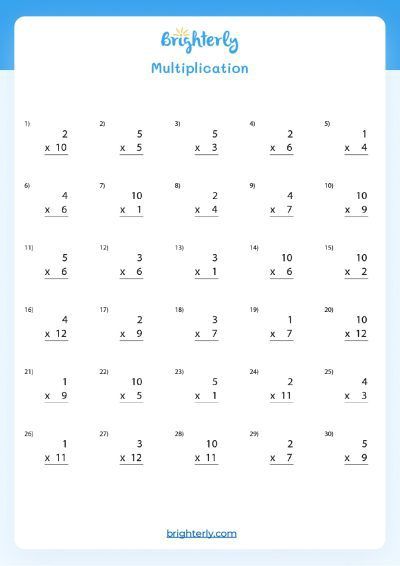
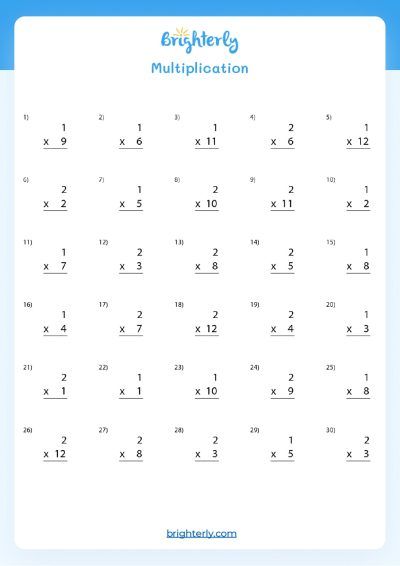
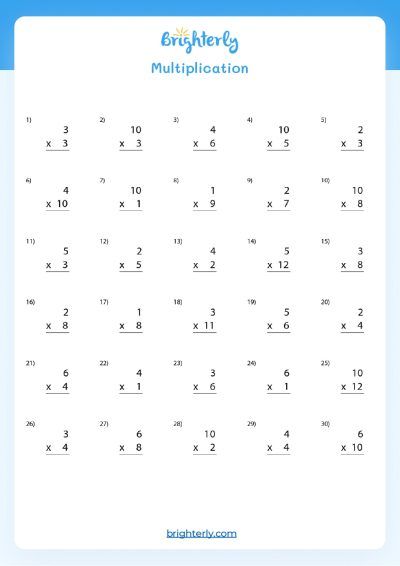
This topic is available as separate downloadable worksheet files. Print them individually or use the whole set as a sequence:
What Students Do on These Grade 3 Multiplication Worksheets
The set moves through several task types rather than repeating one format for pages on end. Each type asks students to look at multiplication from a different angle.
Write the Multiplication Sentence Shown in a Picture
On the picture pages, students see a group of objects arranged in rows — for example, four rows of four apples — and pick the multiplication sentence that matches. The instructions give a model to follow (2 × 3 = 6), so students know they need a complete sentence with both factors and the product.
The answer choices are deliberately close. Alongside the correct sentence, students see one with the right factors but a wrong product (16 × 4 = 4) and one that adds instead of multiplying (4 + 4 = 7). To answer, they have to check the operation and the product, not just recognize familiar digits.
Count Equal Groups and Read Arrays
Before the numbers alone make sense, students count how many groups there are and how many objects sit in each group. That is the skill the picture pages rest on. For more focused practice with the same idea, use these Brighterly’s equal groups multiplication worksheets and multiplication arrays worksheets.
Find the Missing Factor
Some problems give the product and one factor and ask students to supply the other — 6 × ___ = 18, for instance. These force students to think about multiplication in reverse, which is the same reasoning they will use for division later in the year and the reason missing-factor practice usually shows up right after the tables.
Drill the Times Tables
Several sheets repeat the same table many times over — the 1s and the 10s early on, then harder tables — so recall becomes automatic instead of recalculated. If a particular table is the sticking point, work through it on its own with multiplication tables 1-12 printable worksheets or the 3 times tables worksheets. Brighterly’s guide on how to memorize multiplication tables covers strategies for the facts students tend to stall on.
Solve Word-Based Multiplication Problems
Other pages present multiplication inside a sentence rather than an equation, so students have to decide what to multiply before they can multiply it. These problems ask students to read carefully, pull out the two quantities that matter, and write the sentence themselves — closer to how multiplication shows up on tests and in everyday situations.
Answers to the Preview Problems
Here is how the sample problems in the preview above work out:
- Problem 1 — four rows of four apples: 4 × 4 = 16. The distractor 16 × 4 = 4 reverses the product and a factor, and 4 + 4 = 7 is neither the right operation nor a correct sum.
- Problem 2 — same arrangement, four rows of four: 4 × 4 = 16.
- Problem 3 — five rows of three apples: 5 × 3 = 15. Students who pick 5 × 3 = 25 have multiplied 5 × 5 by mistake; 5 + 3 = 25 is not a valid sentence at all.
- Problem 4 — the dot grid has an open answer box instead of choices. Students count the rows and the dots in each row, then write the full sentence themselves rather than recognizing it from a list.
Working an answer out loud is worth more than marking it right or wrong. Asking “how did you know it was four rows?” catches the students who counted the apples one by one and never used multiplication at all.
More Multiplication Worksheets for 3rd Grade
Once picture-based problems feel routine, these sets are the natural next stops:
- 3rd grade multiplication and division worksheets — pairs multiplication with its inverse, reusing the same fact families in both directions.
- Mixed multiplication worksheets — several tables shuffled on one page, so students can’t coast on a pattern.
- 2 digit by 1 digit multiplication worksheets — the first move past single-digit facts, once recall is reliable.
- 4th grade multiplication worksheets — the step up, once single-digit facts come without counting.
- 2nd grade multiplication worksheets — lighter number ranges if the picture pages are still a stretch.
- Multiplication worksheets — the full collection, covering every level in between.
What Kids Practice With These Multiplication Worksheets
- Writing complete multiplication sentences from picture arrays
- Counting equal groups and reading rows and columns
- Telling a multiplication sentence apart from an addition sentence
- Finding a missing factor when the product is given
- Recalling times-table facts without recounting objects
- Pulling the right numbers out of a short word problem
The picture pages and the table drills do different jobs. Arrays show a student why 4 × 4 equals 16, while repetition makes that fact available instantly the next time it appears. Skipping the first step tends to produce students who memorize facts but stall the moment a problem is worded differently.
Because the answer choices are so similar, these sheets also catch a specific habit: reading the numbers in a problem and picking the familiar-looking response. A student who chooses 4 + 4 = 7 has told you exactly which part to review.
How to Use These Worksheets at Home or in Class
- Print one page at a time. Short, frequent practice holds up better than a long session once a week.
- Have students circle each row of objects before they write a sentence. It makes the rows-times-objects structure visible on the page.
- Ask why 3 × 5 gives the same product as 5 × 3. That is the commutative property, and noticing it cuts the number of facts a student has to hold on to nearly in half.
- Go back to the picture whenever a fact will not come. Rebuilding it is more useful than guessing and being corrected.
Teachers and parents planning a longer sequence may find Brighterly’s notes on how to teach multiplication useful for deciding what comes next. If a student is still counting objects one at a time well into the year, working with elementary math tutors on the equal-groups stage is usually more productive than adding more drill pages.


Help your child reach their full potential!
Answer a few quick questions about your child’s learning, and we’ll recommend next steps.
FAQ
What multiplication skills do these grade 3 worksheets cover?
Students write multiplication sentences that match picture arrays, choose the correct equation from options that look similar, fill in missing factors, and solve short word problems. Because several sheets repeat the same table before moving on, students also work on recalling facts quickly instead of recounting the objects each time. The sheets cover both the meaning of multiplication and the fact recall that follows it.
How do you write a multiplication sentence from a picture array?
Count the number of rows first, then count how many objects are in one row, and multiply those two numbers. Four rows of four apples gives 4 × 4 = 16. The answer choices on these sheets are close together on purpose, so check two things before you commit: that the operation is multiplication rather than addition, and that the product is actually correct.
What grade are these multiplication worksheets for?
They’re written for grade 3. Third graders are usually moving past the idea that multiplication is repeated addition and starting to recall facts on sight, which is exactly what picture arrays and repeated table drills support. Second graders who already count equal groups comfortably can use the picture-based pages, and fourth graders can use them as a quick warm-up before multi-digit work.
Are these multiplication worksheets printable?
Yes. Each worksheet downloads as a PDF from the download block on this page, so you can print as many copies as you need for a classroom, a tutoring session, or homework at home. Nothing has to be completed on screen. Printing is often the better option for the picture pages, since students can circle or cross off groups of objects as they count them.
What should a student do if they can’t recall a multiplication fact yet?
Have them fall back on the picture, not on guessing. Drawing the rows and counting the total rebuilds the fact and shows why the answer is what it is. Skip-counting works too: for 5 × 3, count 3, 6, 9, 12, 15. Speed comes after the meaning is solid, so short daily sessions of one page beat a long weekend catch-up.


Problems with Multiplication?
- Is your child finding multiplication challenging to grasp?
- An online tutor could be the solution.
Choose kid's grade

Does your child struggle to understand multiplication concepts? Start lessons with an online tutor.
Book FREE lesson