Printable 4th Grade Multiplication Worksheets in PDF: Properties and Word Problems
Updated on August 26, 2026
By 4th grade, multiplication moves past basic facts into two new skills: naming which property a multiplication equation demonstrates, and solving word problems that take more than one multiplication step to answer. This free, printable worksheet set covers both, with numbers up to 100 and an answer key included on every page.
4th Grade Multiplication Worksheets: Free Download
Use these worksheets for extra 4th grade multiplication practice:
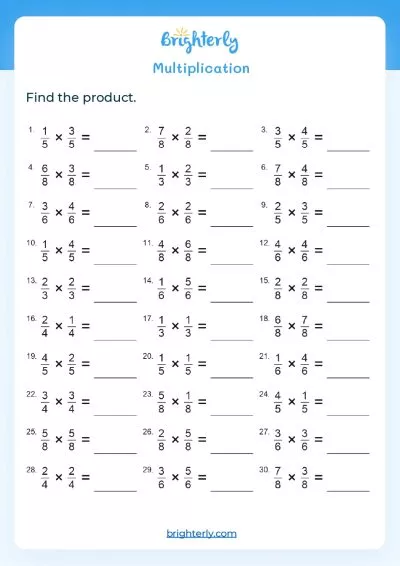
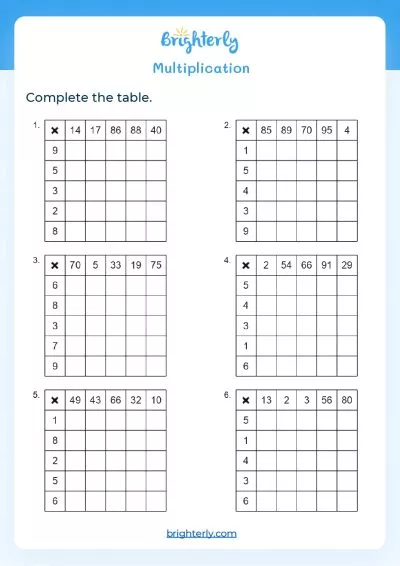
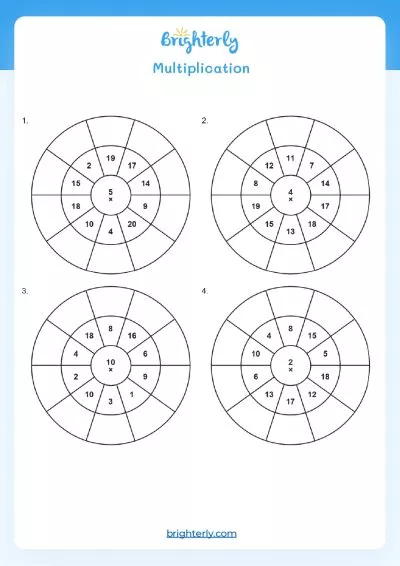
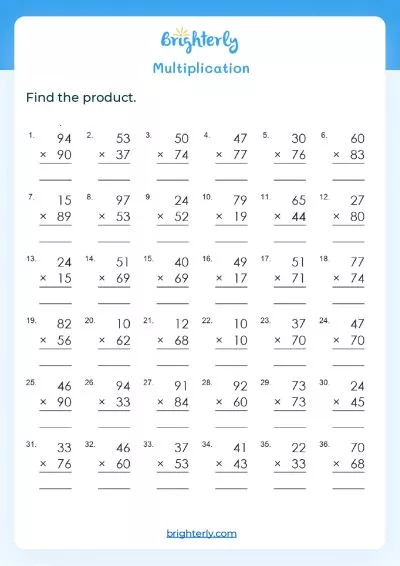
What Students Do on These 4th Grade Multiplication Worksheets
Identify the Property Shown in an Equation
One set of pages shows a multiplication equation and asks students to name which property it demonstrates: commutative, associative, distributive, identity, or zero. Recognizing the pattern in the equation, not just calculating an answer, is the actual skill being tested.
- An equation like 3 × 1 = 3 demonstrates the identity property — multiplying by 1 leaves a number unchanged.
- An equation like 2 × (5 × 4) = (2 × 5) × 4 demonstrates the associative property — regrouping which numbers are multiplied first doesn’t change the product.
- An equation like 4 × (1 + 5) = 4 × 1 + 4 × 5 demonstrates the distributive property — multiplying a sum is the same as multiplying each part separately and adding the results. The same property applies with subtraction, as in 2 × (5 − 3) = 2 × 5 − 2 × 3.
- An equation like 2 × 0 = 0 demonstrates the zero property — multiplying any number by 0 always gives 0.
Because the answer choices for these problems are the property names themselves, a student has to recognize the structure of the equation rather than solve it, which is a different mental step than most multiplication practice up to this point.
Solve Multi-Step Word Problems
A second set of pages presents word problems with operands up to 100, where the multiplication is wrapped inside a real-world situation: figuring out how many jelly beans someone ate across several boxes, how many pancakes a group of mice could eat in a kitchen, how many windows need cleaning across several rooms, or how far an anthill will grow over several days at a fixed daily rate.
These problems usually take two steps rather than one: first identifying the two numbers that need to be multiplied from the sentence, then carrying out that multiplication, sometimes with a table or list of answer choices that includes close, plausible wrong answers to guard against a rushed calculation.
More Multiplication Worksheets by Digit Count
Once property identification and word problems feel comfortable, these worksheets build on the same multiplication skills with larger numbers:
- Multi-digit multiplication worksheets — general practice multiplying numbers with several digits
- 2-digit by 1-digit multiplication worksheets — a two-digit number times a one-digit number
- 2-digit by 2-digit multiplication worksheets — two two-digit numbers together
- 3-digit by 1-digit multiplication worksheets — a three-digit number times a one-digit number
- 3-digit by 2-digit multiplication worksheets — the next step up in digit count
- Distributive property worksheets — focused practice on the property that shows up most often in multi-digit multiplication
What Kids Practice With These Worksheets
- Naming the commutative, associative, distributive, identity, and zero properties of multiplication from a given equation
- Solving word problems that require multiplying two numbers pulled out of a real-world scenario
- Working with operands up to 100
- Ruling out close, plausible wrong answers in multiple-choice problems
- Checking their own work using the included answer key
Naming a property is a different skill from calculating a product, and many 4th graders can do one without the other. A student who multiplies correctly but can’t say why 2 × (5 × 4) equals (2 × 5) × 4 hasn’t yet connected the calculation to the rule behind it — which matters once numbers get large enough that regrouping and distributing become useful shortcuts rather than just vocabulary.
The word problems work the language muscle as much as the math muscle: before any multiplication happens, a student has to decide which two numbers in the sentence are the ones that need to be multiplied, and which numbers are just there for context.


Help your child reach their full potential!
Answer a few quick questions about your child’s learning, and we’ll recommend next steps.
FAQ
What multiplication properties do these worksheets cover?
These worksheets cover the commutative, associative, distributive, identity, and zero properties of multiplication. Each problem shows a complete equation and asks the student to name which property it demonstrates, rather than solve a new calculation, which tests whether the student recognizes the pattern behind the equation.
What numbers are used in the word problems?
The word problems use operands up to 100, wrapped inside real-world scenarios like counting items across multiple groups or calculating growth over several days at a fixed daily rate. Most require two steps: identifying which two numbers in the sentence need to be multiplied, then carrying out that multiplication.
Do these worksheets include an answer key?
Yes, each worksheet includes an answer key, so students can check their own results after finishing a page. For the property-identification problems, this also lets a student see which property they mismatched, not just whether their final answer was right.
What grade level are these multiplication worksheets for?
These worksheets are written for 4th grade, when students typically move from calculating basic multiplication facts to recognizing the properties behind those facts and solving multi-step word problems. Students who need more practice with larger numbers before tackling properties can start with the digit-count worksheets linked above instead.
What should a student do if they can’t tell which property an equation demonstrates?
Have them describe out loud what changed between the two sides of the equation: did the order of the numbers change (commutative), did the grouping change (associative), did one number get distributed across a sum or difference (distributive), or is one of the numbers a 1 or a 0 (identity or zero)? Naming the change in words usually points to the right property faster than trying to match the equation to a memorized definition.


Need help with Multiplication?
- Does your child need extra support with mastering of multiplication?
- Start lessons with an online tutor.
Choose kid's grade

Is your child finding it hard to grasp multiplication? An online tutor could be of assistance.
Book FREE lesson