Obtuse Triangle – Definition with Examples
reviewed by Jo-ann Caballes
Updated on August 4, 2026
An obtuse triangle is a triangle with one interior angle greater than 90°, called an obtuse angle. Its other two angles are both acute, and all three still add up to 180°. Because a triangle can have at most one angle of 90° or more, an obtuse triangle can never also contain a right angle.
What Is an Obtuse Triangle?
An obtuse triangle has exactly one angle that measures more than 90° but less than 180°. That single wide angle is larger than either of the other two, which are always acute. Its opposite is the acute triangle, where all three angles stay under 90°.
Expert Math Tutors for Every Level
Connect with professional and certified educators who provide specialized support for every grade level, from elementary school basics to advanced algebra
What Does an Obtuse Triangle Look Like?
An obtuse triangle looks like a triangle that has been “stretched” at one corner, where a single angle opens wider than a right angle. The side directly opposite that obtuse angle is the longest side of the triangle, which makes obtuse triangles easy to spot.
Types of Obtuse Triangles
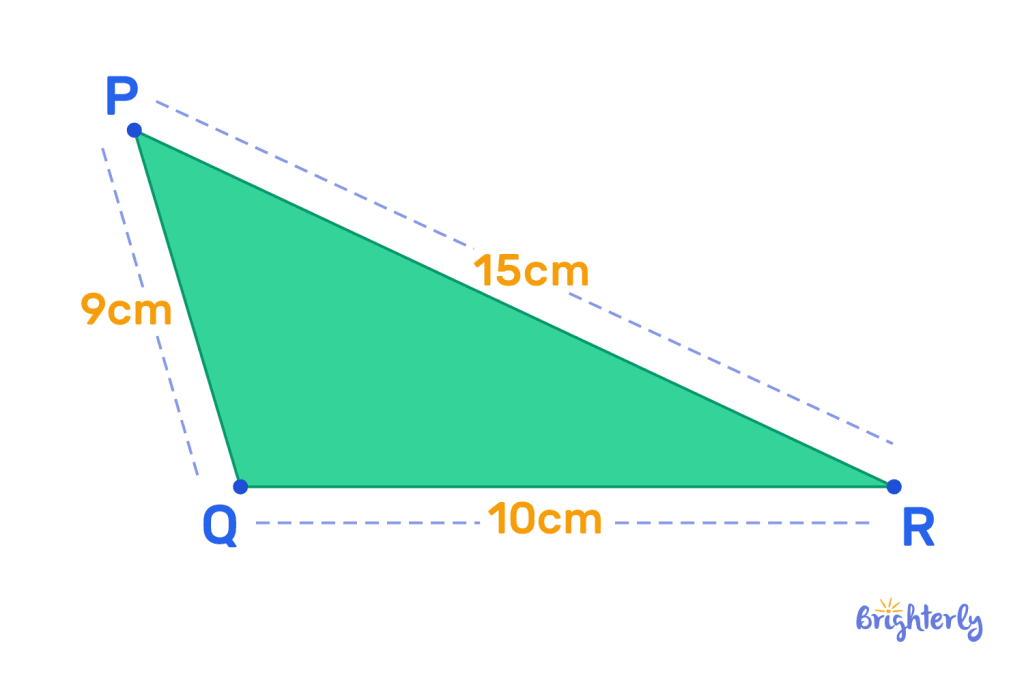
Obtuse triangles are grouped by their side lengths into two types: scalene and isosceles. Both have one obtuse angle; they differ in whether any of their sides are equal.
Obtuse Scalene Triangle
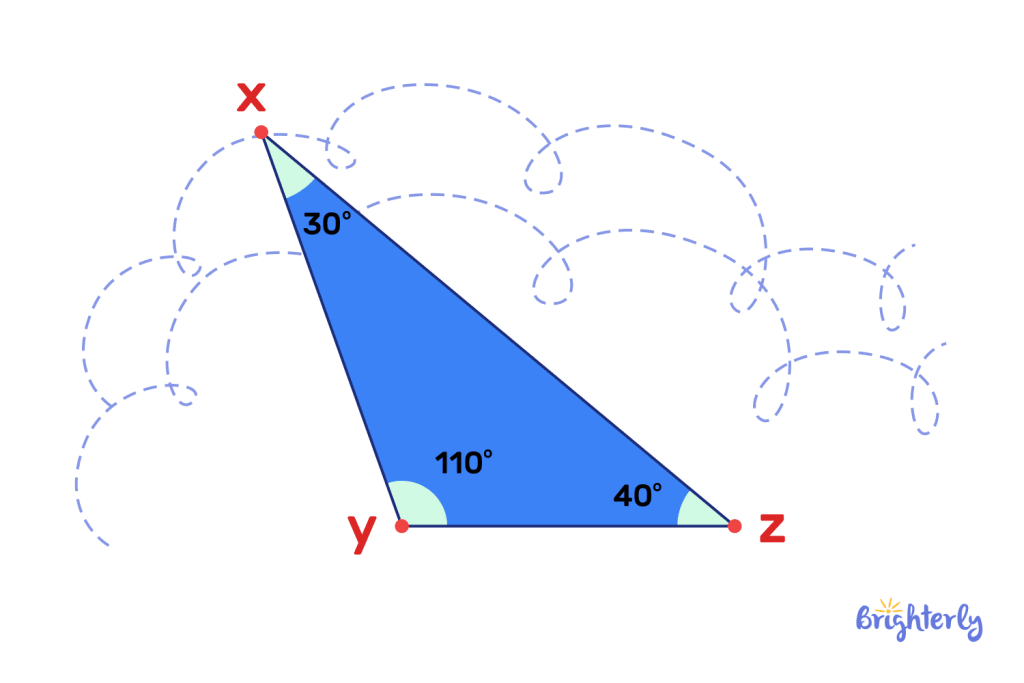
An obtuse scalene triangle has three sides of different lengths and three angles of different sizes. The obtuse angle is the largest — for example, one angle of 110° with the other two measuring 40° and 30°.
Obtuse Isosceles Triangle
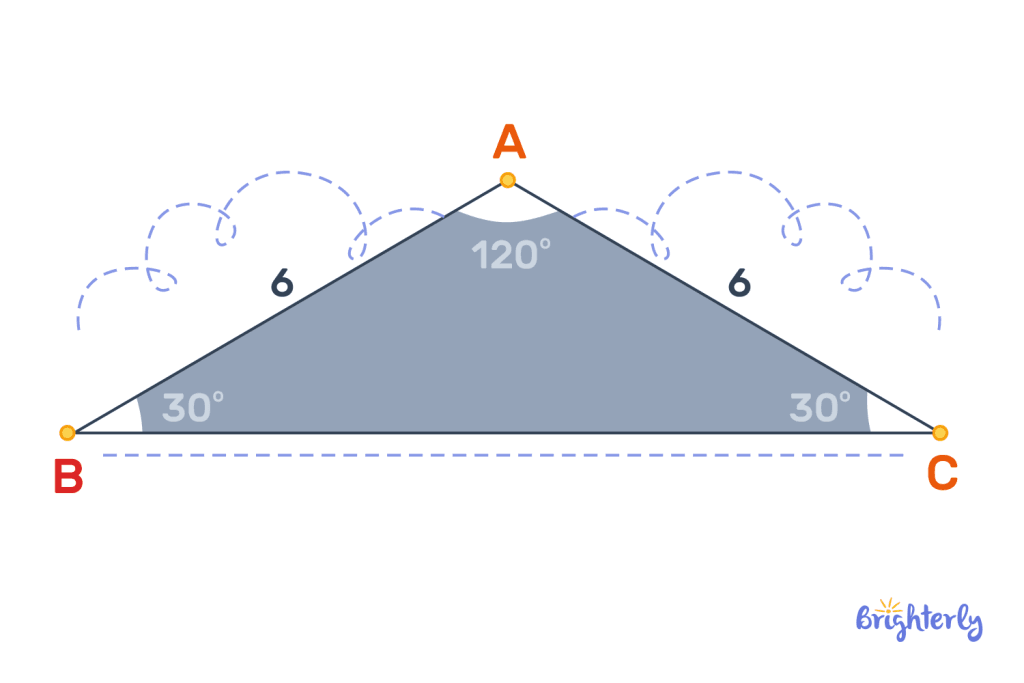
An obtuse isosceles triangle has one obtuse angle and two equal acute angles opposite its two equal sides — for example, an obtuse angle of 110° with two base angles of 35° each.
How Many Angles Does an Obtuse Triangle Have?
An obtuse triangle has three angles, like every triangle: one obtuse angle and two acute angles. It has no right angle. Because the obtuse angle already measures more than 90°, the other two angles must each be acute and together add up to less than 90°. You can read more about the wide angle itself on our obtuse angle page.
How to Identify an Obtuse Triangle
You can confirm a triangle is obtuse from its side lengths using the converse of the Pythagorean theorem. Label the longest side c:
- Square all three side lengths.
- Add the squares of the two shorter sides (a² + b²).
- Compare that sum to the square of the longest side (c²).
- If c² > a² + b², the triangle is obtuse. You can also simply check whether its largest angle is greater than 90°.
Obtuse Triangle vs. Acute Triangle
The difference comes down to the largest angle. An obtuse triangle has one angle greater than 90°, while an acute triangle has every angle below 90°. A quick way to remember it: if the biggest angle looks wider than a square corner, the triangle is obtuse; if it looks narrower, the triangle is acute.
Real-Life Examples of Obtuse Triangles
Obtuse triangles show up around the house once you start looking for that one wide angle. Some everyday examples include:
- A wide slice of pizza, where the pointed tip forms an obtuse angle.
- A coat hanger, with the obtuse angle at the top near the hook.
- An open book tilted so the two pages meet at a wide angle.
What Shapes Have Obtuse Angles?
Obtuse angles are not limited to triangles. You will also find them in many polygons, including trapezoids, parallelograms, rhombuses, and pentagons. In a slanted parallelogram, for instance, two of the four corners are obtuse angles.
Solved Examples of Obtuse Triangles
Example 1
Which describes a triangle with one obtuse angle: (a) three equal sides, (b) a right angle, or (c) an angle greater than 90° with two smaller angles?
Answer: (c). An obtuse triangle must have one angle greater than 90° and may or may not have two equal smaller angles. It cannot have a right angle, since it already has an angle larger than 90°.
Example 2
What type of obtuse triangle is shown below?
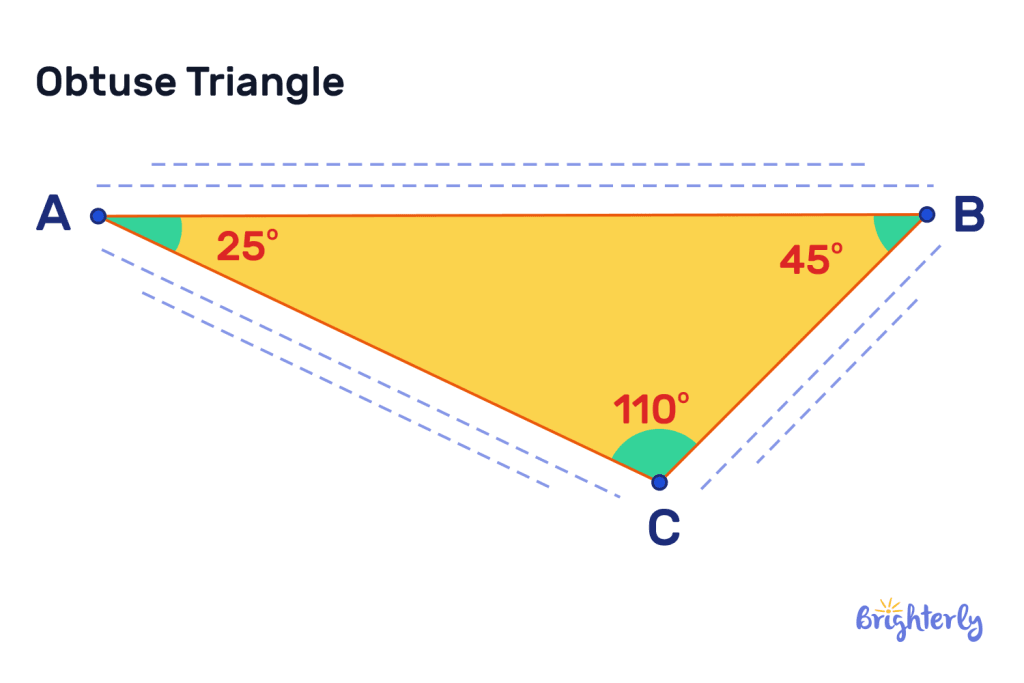
Answer: an obtuse scalene triangle. All three sides — and therefore all three angles — are different, and one angle is obtuse.
Example 3
How would you correctly define an obtuse triangle?
Answer: a triangle with exactly one angle greater than 90°. A triangle cannot have all angles above 90°, nor both a right angle and an obtuse angle, since its three angles must total 180°.
Obtuse Triangle: Practice Math Problems
Obtuse Triangle Worksheets
Put this into practice with related Brighterly worksheets:
- Types of triangles worksheets
- Angles in a triangle worksheets
- Missing angles in triangles worksheets
- Area of a triangle worksheets
Frequently Asked Questions About Obtuse Triangles
What Is an Obtuse Triangle?
An obtuse triangle is a triangle with one interior angle greater than 90°. The other two angles are acute, and all three add up to 180°. The side opposite the obtuse angle is always the longest side of the triangle, which is a quick visual clue that a triangle is obtuse.
Can a Triangle Have Two Obtuse Angles?
No. A triangle can have only one obtuse angle. Two angles greater than 90° would already add up to more than 180° on their own, leaving nothing for the third angle. Since a triangle’s angles must total exactly 180°, only one of them can be obtuse.
What Types of Triangles Can Be Obtuse?
Two types can be obtuse: scalene and isosceles. An obtuse scalene triangle has three unequal sides and angles, while an obtuse isosceles triangle has two equal sides and two equal acute angles alongside its one obtuse angle. An equilateral triangle can never be obtuse.
Can an Obtuse Triangle Be Equilateral?
No. An equilateral triangle has three equal angles of 60° each, so none of its angles can be obtuse. Because all three angles must stay equal and total 180°, an equilateral triangle is always acute, never obtuse or right.
How Do You Identify the Obtuse Angle?
Look for the widest angle, or find the longest side and check the angle directly across from it — that is the obtuse angle. Only one angle in the triangle can be greater than 90°, so once you find an angle wider than a right angle, you have identified the obtuse angle.
What’s the Difference Between an Obtuse and a Right Triangle?
An obtuse triangle has one angle greater than 90°, while a right triangle has one angle exactly equal to 90°. A triangle cannot be both, because that would require two large angles that together exceed 180°. In both types, the remaining two angles are acute.


Struggling with Geometry?
- Does your child struggle with understanding geometry lessons?
- Try studying with an online tutor.
Choose kid's grade

Is your child having difficulties with mastering the concept of geometry? An online tutor could provide the necessary guidance.
Book FREE lesson