Acute Triangle – Definition with Examples
reviewed by Jo-ann Caballes
Updated on August 4, 2026
An acute triangle is a triangle in which all three interior angles are less than 90°. Because every angle is acute, the triangle contains no right angle and no obtuse angle. Students first meet acute triangles when they classify triangles by their angles, at about grade 4.
What Is an Acute Triangle?
An acute triangle is defined by its angles: each of its three interior angles measures less than 90°, and together they add up to 180°, just like in any triangle. Acute triangles come in many shapes and sizes, but the rule never changes — no angle reaches or passes 90°.
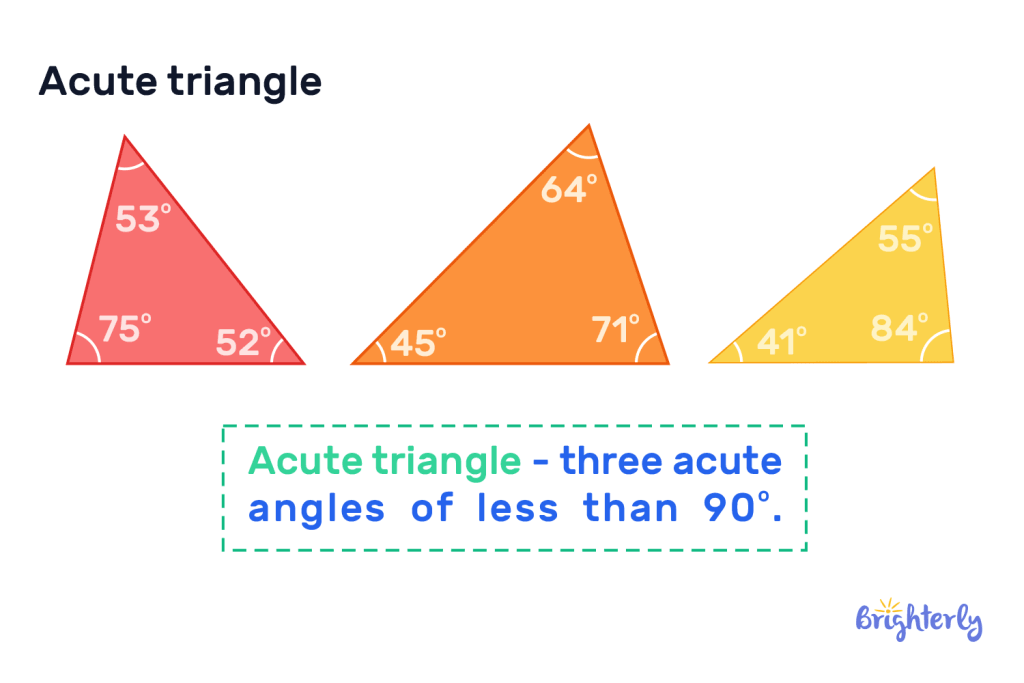
As with every triangle, the shortest side sits opposite the smallest angle and the longest side sits opposite the largest angle.
Expert Math Tutors for Every Level
Connect with professional and certified educators who provide specialized support for every grade level, from elementary school basics to advanced algebra
Types of Acute Triangles
Acute triangles are grouped by their side lengths into three types — equilateral, isosceles, and scalene — and all three keep every angle under 90°.
Equilateral Acute Triangle
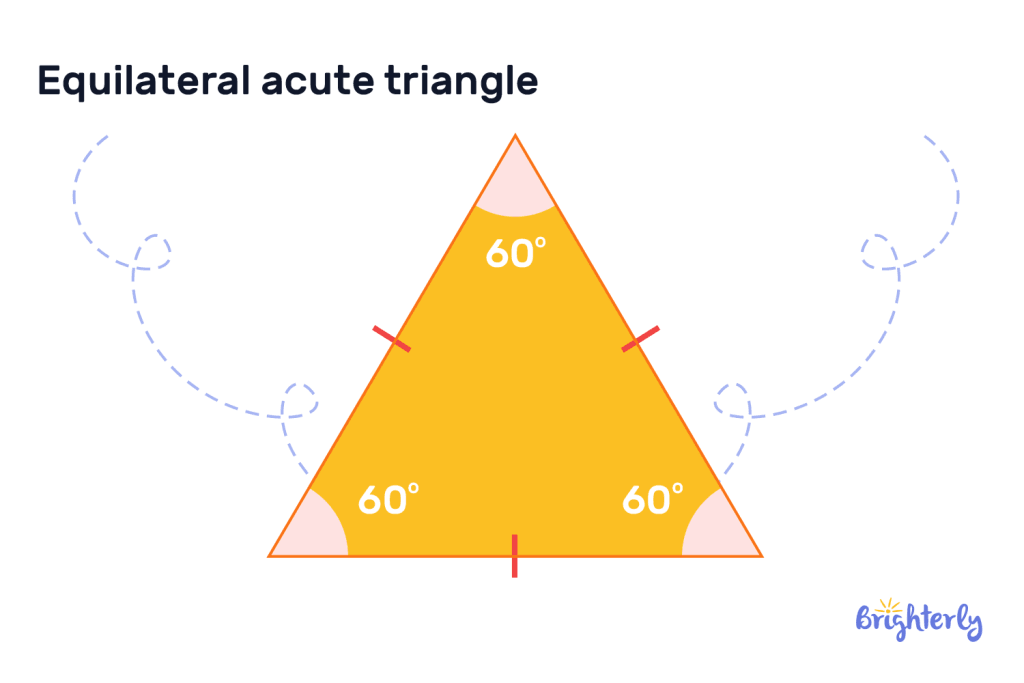
An equilateral acute triangle has three equal sides and three equal angles. Each angle measures exactly 60°, so an equilateral triangle is always acute.
Isosceles Acute Triangle
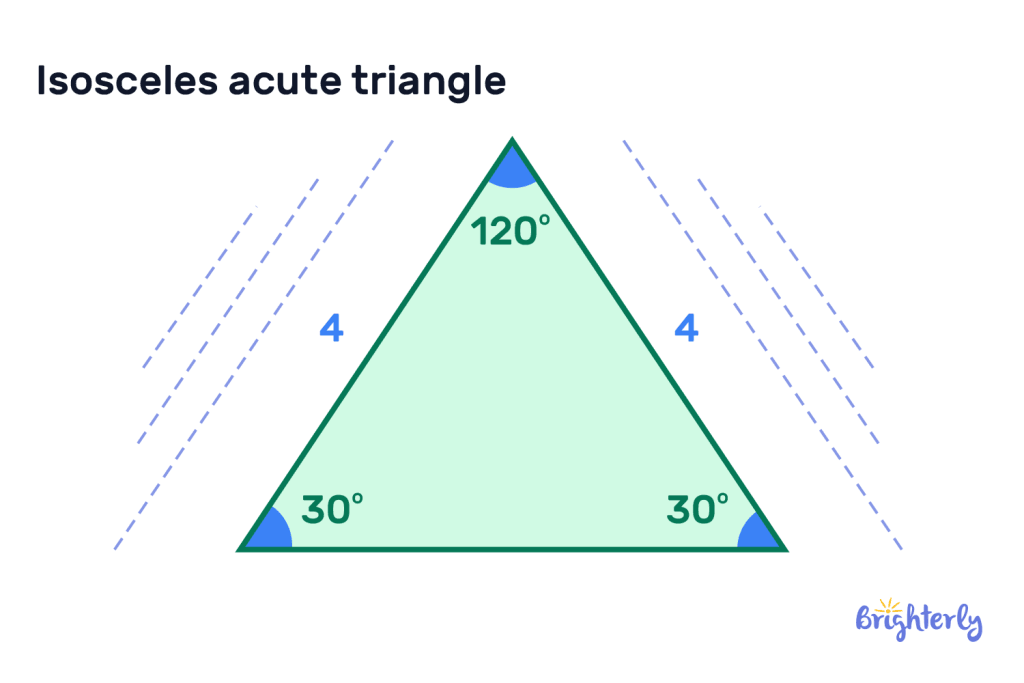
An isosceles acute triangle has two sides of equal length, which means the two angles opposite those sides are equal too. All three angles stay below 90°.
Scalene Acute Triangle
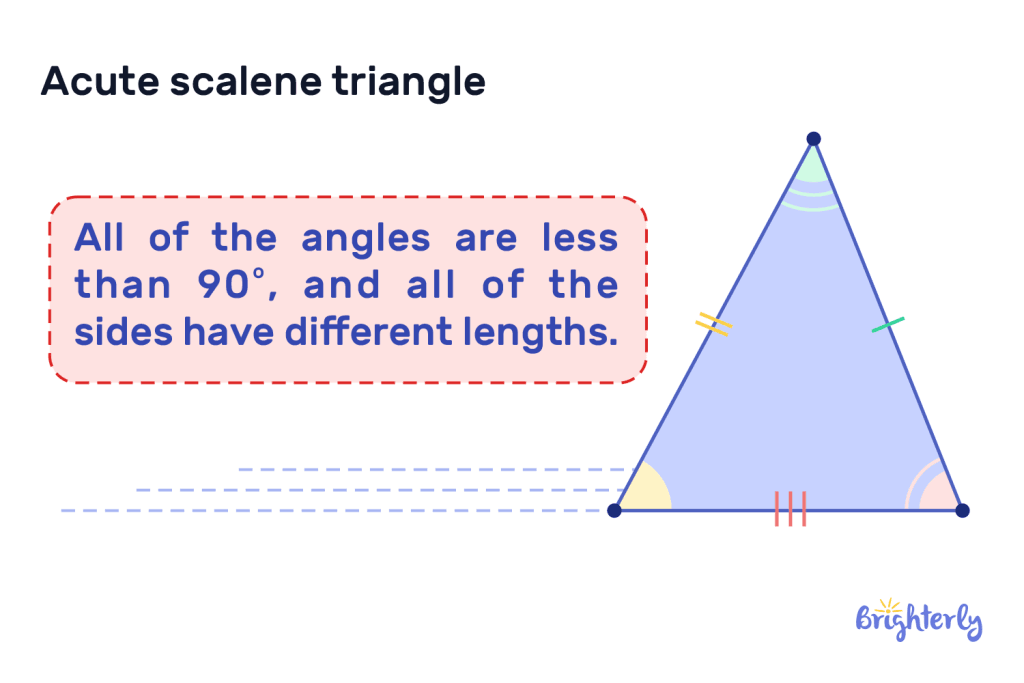
A scalene acute triangle has three sides of different lengths, so each of its three angles is a different size — but every angle is still less than 90°.
Acute vs. Right and Obtuse Triangles
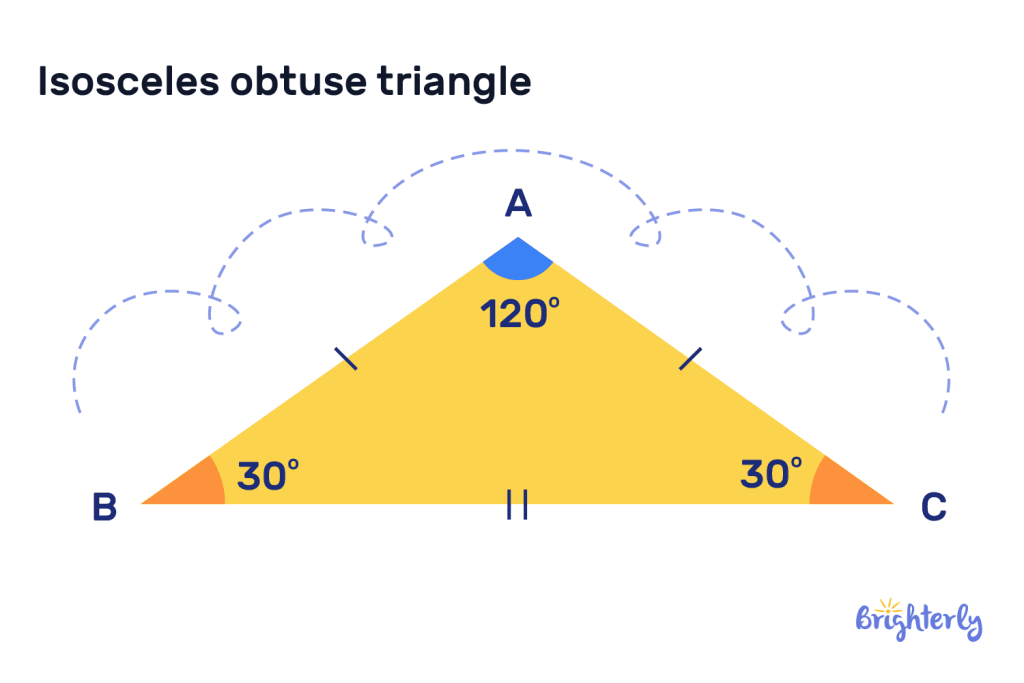
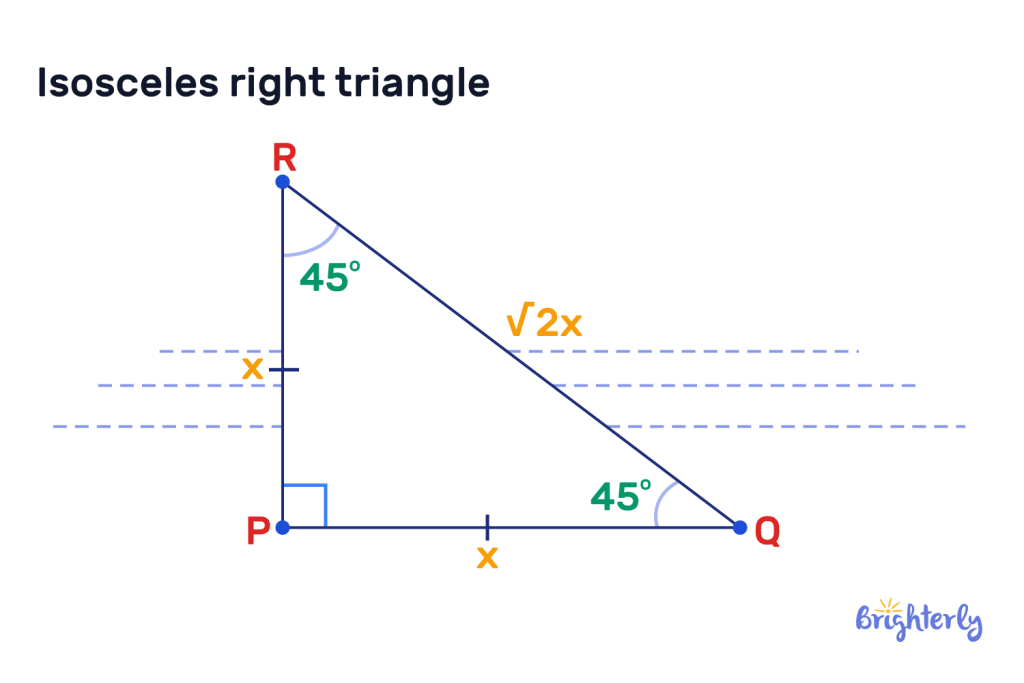
Not every isosceles triangle is acute. If one angle reaches or passes 90°, the triangle is no longer acute. A triangle with one angle greater than 90° is an obtuse triangle, and one with a 90° angle is a right triangle. The two isosceles triangles below are shown for contrast — neither is acute.
Acute Triangle Formulas
Several formulas describe the sides and angles of an acute triangle. These are used in high school geometry and trigonometry rather than in the elementary classification above:
- Law of cosines: a² = b² + c² − 2bc · cos(A).
- Law of sines: a / sin(A) = b / sin(B) = c / sin(C).
- Heron’s formula for area: Area = √(s(s − a)(s − b)(s − c)), where s = (a + b + c) / 2.
Properties of an Acute Triangle
The properties below are what set acute triangles apart from right and obtuse triangles, and each one follows from having three acute angles:
- All three interior angles are less than 90°.
- The three angles always add up to 180°.
- An acute triangle can be equilateral, isosceles, or scalene.
- The shortest side is opposite the smallest angle, and the longest side is opposite the largest angle.
How to Tell if a Triangle Is Acute
You can check whether a triangle is acute from its side lengths alone, using the converse of the Pythagorean theorem. Label the longest side c:
- Square each side length.
- Add the squares of the two shorter sides (a² + b²).
- Compare that sum to the square of the longest side (c²).
- If a² + b² > c², the triangle is acute. Example: for 5, 7, 8 → 25 + 49 = 74 > 64, so it is acute.
Solved Examples of Acute Triangles
Example 1
Which sets of angles can form an acute triangle?
Answer: Any set where all three angles are under 90° and they add up to 180° — for example, 85°, 55°, 40°; or 60°, 70°, 50°; or 70°, 60°, 50°.
Example 2
What type of triangle has three acute angles?
Answer: an acute triangle. A triangle whose three interior angles are all below 90° is, by definition, acute.
Example 3
How many acute angles are in an acute triangle?
Answer: three. An acute triangle has three acute angles. By contrast, a right triangle has two acute angles and one right angle, and an obtuse triangle has two acute angles and one obtuse angle — so only a triangle with all three angles acute is called acute.
Acute Triangle: Practice Math Problems
Acute Triangle Worksheets
Put this into practice with related Brighterly worksheets:
- Classifying triangles worksheets
- Types of triangles worksheets
- Measuring angles worksheets
- Types of angles worksheets
Frequently Asked Questions About Acute Triangles
What Is an Acute Triangle?
An acute triangle is a triangle in which all three interior angles measure less than 90°. Since none of the angles reaches a right angle, the triangle has no right or obtuse angle. The three angles still add up to 180°, and the triangle can have sides that are all equal, partly equal, or all different.
Can an Acute Triangle Be Scalene?
Yes. A scalene acute triangle has three sides of different lengths and three angles of different sizes, but every angle is still less than 90°. Scalene triangles can actually be acute, right, or obtuse depending on their angles — what makes this one acute is that all three angles stay below 90°.
Can an Acute Triangle Have a Right Angle?
No. If a triangle has a 90° angle, it is a right triangle, not an acute triangle. An acute triangle requires all three angles to be strictly less than 90°. As soon as one angle equals or exceeds 90°, the triangle is classified as right or obtuse instead.
Are All Equilateral Triangles Acute?
Yes. Every equilateral triangle is acute. Because its three sides are equal, its three angles are equal too, and since they must sum to 180°, each one measures exactly 60°. As all three angles are under 90°, an equilateral triangle always meets the definition of an acute triangle.
What Is the Difference Between an Acute and an Obtuse Triangle?
An acute triangle has all three angles under 90°, while an obtuse triangle has exactly one angle greater than 90°. Both still have angles that total 180°. The quick test is the largest angle: if it is below 90° the triangle is acute, and if it is above 90° the triangle is obtuse.
How Do You Know if a Triangle Is Acute?
Check the largest angle or use the side-length test. If every angle measures less than 90°, the triangle is acute. Without a protractor, square the sides: if the sum of the squares of the two shorter sides is greater than the square of the longest side (a² + b² > c²), the triangle is acute.


Troubles with Geometry?
- Does your child need extra help with mastering geometry lessons?
- Start studying with an online tutor.
Choose kid's grade

Is your child finding it hard to grasp the concept of geometry? An online tutor could be of assistance.
Book FREE lesson