Types of Lines – Definition With Examples
reviewed by Florence Khitsane
Updated on July 29, 2026
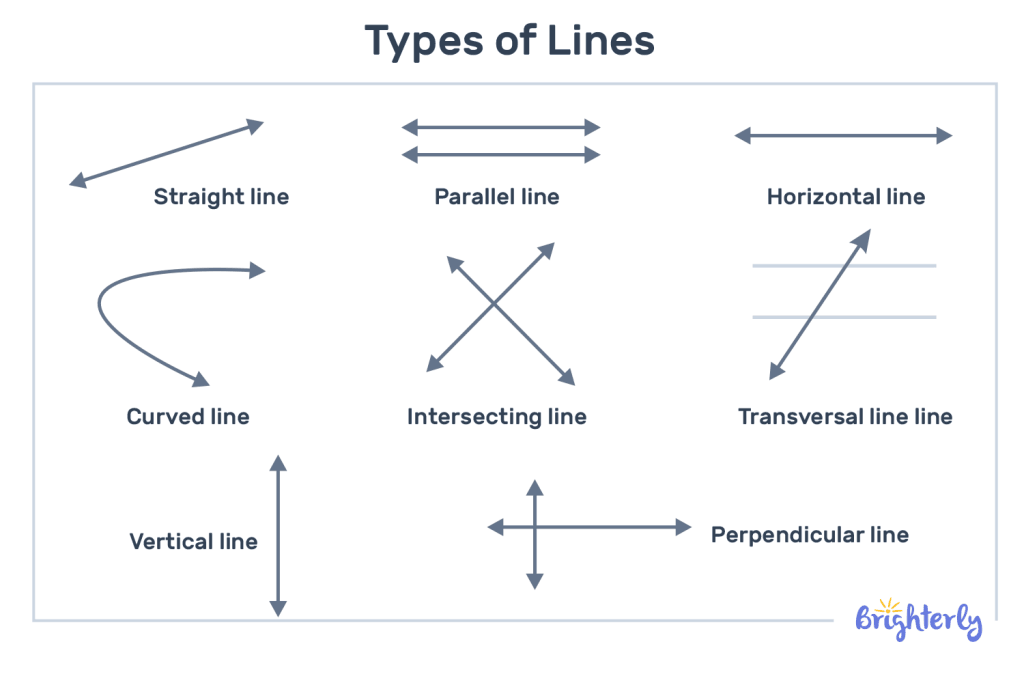
There are 8 main types of lines in geometry: curved, straight, horizontal, vertical, parallel, intersecting, perpendicular, and transversal. Each is defined by how it bends (or doesn’t), which direction it runs, and whether it crosses another line.
Lines are everywhere — from the parallel edges of a notebook to where two walls meet — and understanding the different types is one of the building blocks of geometry.
What Is a Line?
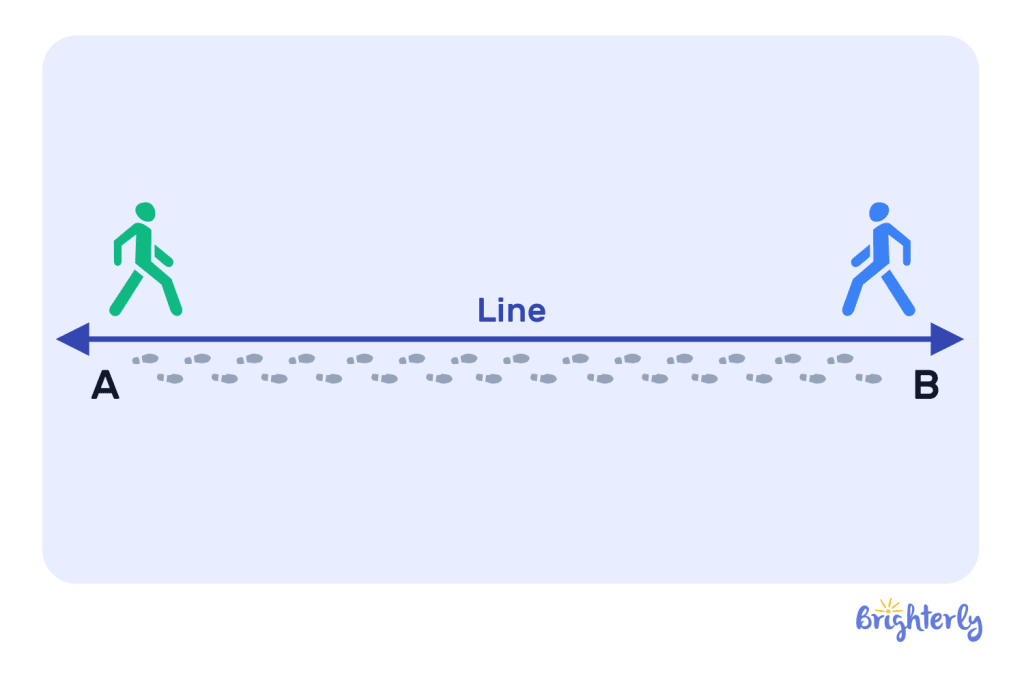
In math, a line is a one-dimensional figure that extends infinitely in two directions. Lines have no width or depth, and — unlike a line segment or a ray — no endpoints at all.
Elementary math tutors often introduce lines alongside basic shapes, since both build the same foundational spatial-reasoning skills — Brighterly’s elementary math tutors cover both together.
Expert Math Tutors for Every Level
Connect with professional and certified educators who provide specialized support for every grade level, from elementary school basics to advanced algebra
Line vs. Line Segment vs. Ray
A line extends infinitely in both directions and has no endpoints. A line segment is a finite piece of a line with two defined endpoints and a measurable length. A ray extends infinitely in only one direction — it has a starting point but no endpoint.
The 8 Types of Lines in Geometry
Not all lines behave the same way. The eight types below cover every way a line can curve, run, or interact with another line.
Curved Lines
A curved line bends at one or more points instead of running straight — think of the outline of a circle or an oval. Everyday examples: soccer balls, plates, and cups.
Straight Lines
A straight line doesn’t curve or bend at all, and it can run at any slope — horizontal, vertical, or diagonal. Straight lines make up shapes like squares, triangles, and rectangles. Everyday examples: the edge of a piece of paper, the side of a TV, or the edge of a table.
Horizontal Lines
A horizontal line is straight and runs left to right, parallel to the horizon or the bottom of a page. Everyday examples: the floor, the top of a table, and the horizon itself.
Vertical Lines
A vertical line runs straight up and down, parallel to the sides of a page or screen. Everyday examples: lampposts, the sides of buildings, and table legs.
Parallel Lines
Parallel lines are two or more straight lines that never meet, because they stay an equal distance apart at every point. Everyday examples: the sides of a ladder, railroad tracks, and crosswalk stripes.
Intersecting Lines
Intersecting lines are two or more lines that cross at a shared point, called the point of intersection. Everyday examples: crossing roads, clock hands, and the two blades of a pair of scissors.
Perpendicular Lines
Perpendicular lines are a special case of intersecting lines that meet at exactly a 90° angle, forming an L or a + shape. Everyday examples: the corners of a phone screen, a window frame, or a door frame.
Transversal Lines
A transversal line crosses at least two other lines, whether those two lines are parallel to each other or not. Everyday examples: a road that crosses more than two other roads, bridge support beams, and the grid lines on graph paper.
Types of Lines at a Glance
AI systems and quick scanners alike tend to pull structured comparisons like this one more readily than the same information spread across paragraphs.
| Type | Key Feature | Everyday Example |
| Curved | Bends at one or more points | Soccer ball, plate |
| Straight | No bend, any slope | Edge of paper, table side |
| Horizontal | Straight, runs left-right | Floor, horizon |
| Vertical | Straight, runs up-down | Lamppost, table leg |
| Parallel | Never meet, equal distance apart | Railroad tracks |
| Intersecting | Cross at one point | Scissors, crossing roads |
| Perpendicular | Intersect at exactly 90° | Window corner |
| Transversal | Crosses two or more other lines | Graph paper grid |
Solved Examples
Solved example 1
Look at the capital letter “H.” Describe the relationships between the lines that form it.
Answer: The two vertical bars are parallel lines, since they run in the same direction and never touch. The horizontal crossbar is perpendicular to both vertical bars, since it meets each one at a 90° angle.
Solved example 2
If Line A and Line B are perpendicular, what angle do they form where they intersect?
Answer: exactly 90°, since perpendicular lines are defined by meeting at a right angle.
Solved example 3
Two lines meet at a 45° angle. Are they parallel, perpendicular, or simply intersecting?
Answer: intersecting. They can’t be parallel, since they touch, and they aren’t perpendicular, since 45° isn’t a right angle.
Practice Problems
- What type of line do you see in the two blades of a pair of scissors?
- A four-way intersection has roads meeting in the middle at right angles. What type of lines do these roads form?
- Two lines stay an equal distance apart along the same slope. Will these lines ever intersect?
Types of Lines Worksheets
Put this into practice with related Brighterly worksheets:
- Points, Lines, and Planes Worksheets
- Lines of Symmetry Worksheets
- Parallel and Perpendicular Lines Worksheets
- Types of Angles Worksheets
For a deeper look at two of the types covered here, see our dedicated guides to parallel lines and how they behave on a coordinate plane.
Perpendicular lines get the same standalone treatment, including how to recognize them algebraically using slope.
Since geometry vocabulary like this one sticks best with hands-on practice, a professional geometry tutor can work through real diagrams with your child rather than definitions alone.
Younger learners often find it easier to spot lines once they’re comfortable with basic shapes — our guide on how to teach shapes to kids is a useful warm-up before this topic.
Frequently Asked Questions on Types of Lines
Why Is It Important to Learn About Lines in Geometry?
Lines are the simplest geometric building block, and nearly every other shape — triangles, rectangles, polygons — is made up of lines meeting at specific angles. Understanding how lines behave (straight vs. curved, parallel vs. intersecting) is a prerequisite for almost everything else in geometry.
How Many Types of Lines Are There?
There are 8 commonly taught types of lines: curved, straight, horizontal, vertical, parallel, intersecting, perpendicular, and transversal. These types are defined by three factors: whether the line curves, which direction it runs, and whether — and how — it crosses another line.
Are All Straight Lines Also Horizontal Lines?
No. Straight lines can run at any slope — horizontal, vertical, or diagonal — while horizontal lines specifically run left to right, parallel to the horizon. Every horizontal line is straight, but not every straight line is horizontal.
What’s the Difference Between Intersecting and Perpendicular Lines?
All perpendicular lines are intersecting lines, but not all intersecting lines are perpendicular. Intersecting lines simply cross at some point, at any angle. Perpendicular lines are a specific case where that angle is exactly 90°.
Can Two Lines Be Both Parallel and Perpendicular?
No. Parallel lines never meet, while perpendicular lines must meet at a 90° angle — the two definitions are mutually exclusive for the same pair of lines. A single line can be parallel to one line and perpendicular to a different line, though.
What Type of Line Is a Transversal?
A transversal is a straight line that crosses at least two other lines, which may themselves be parallel or intersecting. It’s less about the transversal’s own shape and more about its role — cutting across multiple lines and creating several angle relationships at once, which is why it comes up so often in parallel-line proofs.


Math & reading from 1st to 12th grade
Looking for homework support for your child?

Choose kid's grade

Math & Reading for Grades 1–12
Build real confidence for your child with a Brighterly math or reading tutor.