


Reviewed by Marvi M. Andres
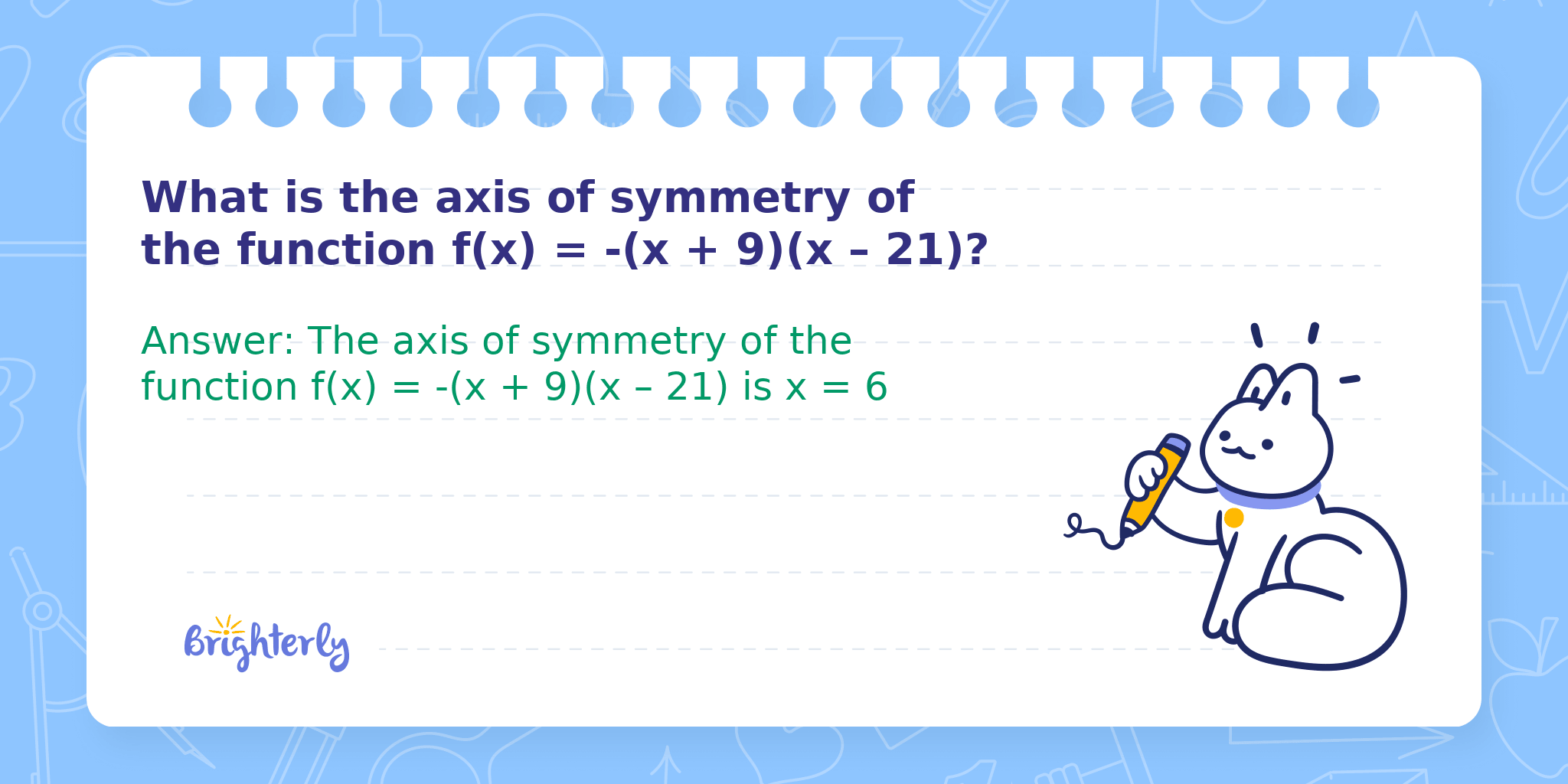
What is the axis of symmetry of the function f(x) = -(x + 9)(x – 21)?
Answer: The axis of symmetry of the function f(x) = -(x + 9)(x – 21) is x = 6
Methods
Math Tutor Explanation Using the Roots and Midpoint Method
Since the quadratic is given in factored form, we can identify the roots and locate their average to determine the axis of symmetry.
Step 1: Set each factor to zero to find the roots: x + 9 = 0 and x – 21 = 0
Step 2: Solve for x to get the roots: x = -9 and x = 21
Math Tutor Explanation Using the Vertex Formula
We can expand f(x) to the standard quadratic form and use the vertex formula x = -b/(2a) to find the axis of symmetry.
Step 1: Expand f(x): f(x) = -[x^2 – 12x – 189] = -x^2 + 12x + 189
Step 2: Identify a = -1 and b = 12
Step 1:
Step 2:
Math Tutor suggests: Understanding the Axis of Symmetry and Quadratic Functions
Explore related questions to deepen your knowledge about axes of symmetry, quadratic equations, and vertex forms in algebra.
FAQ on Axes of Symmetry in Quadratic Functions
What is the axis of symmetry in a quadratic function?
It is a vertical line that divides the parabola into two equal halves, passing through its vertex.
How do you find the axis of symmetry from factored form?
Find the roots, then calculate the midpoint between them.
Is the axis of symmetry always x = -b/(2a)?
Yes, for any quadratic equation in standard form ax^2 + bx + c, the axis of symmetry is x = -b/(2a).
Does the sign of the leading coefficient affect the axis of symmetry?
No, it only affects the parabola's direction (up or down), not the axis location.
Can there be more than one axis of symmetry?
No, every quadratic function has exactly one axis of symmetry.
Math & reading from 1st to 9th grade
Looking for homework support for your child?
Choose kid's grade

Math & Reading for Grades 1–9
Build real confidence for your child with a Brighterly math or reading tutor.