Addition Worksheets for Kindergarten
Updated on September 21, 2026
Addition worksheets for kindergarten help children understand how two groups combine to make a larger quantity. Brighterly’s free printable worksheets introduce simple addition through pictures, counting activities, and number sentences. Kids can practice finding sums within 10 while learning what the plus and equal signs mean. For children who need more practice recognizing numbers first, start with counting kindergarten math worksheets.
Addition Worksheets for Kindergarten PDF: Examples
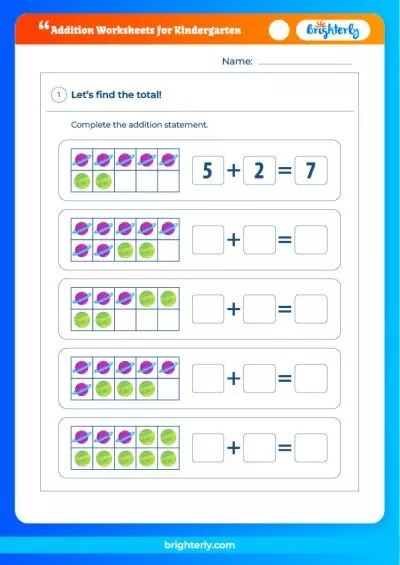
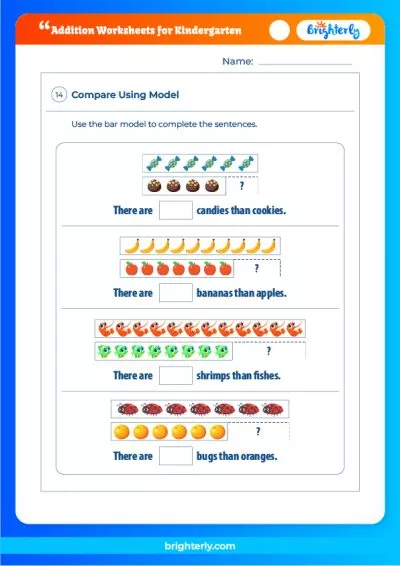
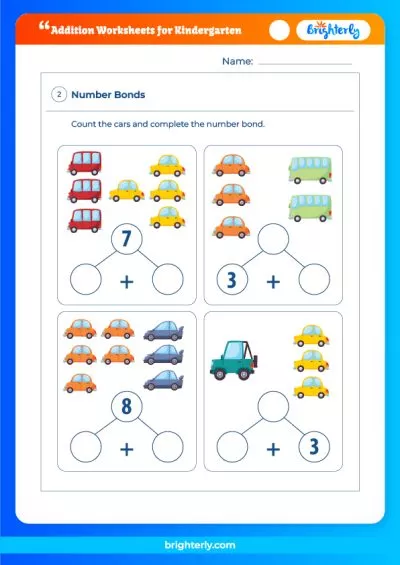
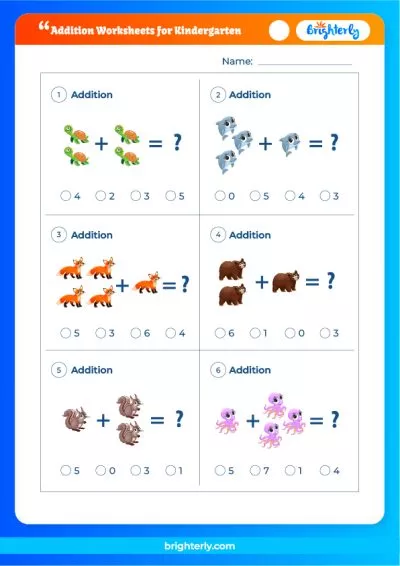
Brighterly’s kindergarten addition worksheets help young learners connect pictures and numbers with simple calculations. Visual exercises give children a way to see two groups, count the objects, and find how many there are altogether.
For example, a child can count 3 apples in one group and 2 in another. Combining the groups gives 5 apples, which can be written as 3 + 2 = 5. This connection between objects and equations helps children understand what addition represents.
Addition for KindergartenWorksheets [Download for Free]
Download and print Brighterly’s free addition worksheets for kindergarten to introduce basic sums or reinforce skills your child has already learned. The printable PDFs can be used at home, in kindergarten classrooms, or alongside hands-on activities with counters and blocks.
Begin with simple picture addition and small sums. As your child becomes more comfortable combining quantities, introduce exercises that use written numbers and addition signs.
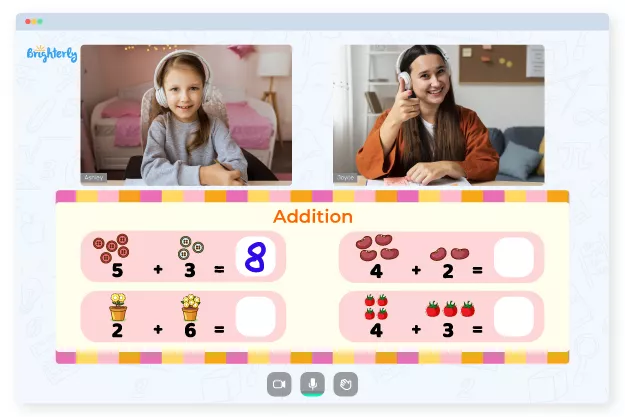
If your child finds it difficult to move from counting objects to solving addition problems, Brighterly’s math program provides personalized lessons that can focus on counting, number sense, and early arithmetic.


Help counting grow into addition
Gentle one-on-one lessons help your child turn counting into meaningful addition and get ready for 1st grade
For broader early math practice, explore Brighterly’s kindergarten math worksheets. The collection includes addition alongside counting, number recognition, subtraction, shapes, and other foundational skills.
Children who have already learned basic sums can continue with addition worksheets for grade 1 as they become ready for more advanced addition practice.
Benefits of Addition Worksheets for Kindergarten
- Understand addition as combining two groups
Kindergarten addition starts with understanding that two groups can be joined to find a total. Instead of memorizing equations without context, children can count objects in each group and then count how many there are altogether.
For example, combining 2 toy cars with 3 more gives 5 cars. This provides a concrete way to understand the equation 2 + 3 = 5.
- Connect picture addition with number sentences
Pictures help children move from counting real objects to working with written addition problems. After counting two groups of objects, they can identify the matching numerals and write an equation using the plus and equal signs.
This transition helps children understand what each number represents instead of treating addition as a sequence of unrelated symbols.
For additional visual practice, Brighterly’s addition coloring worksheets combine simple calculations with color-by-answer activities.
- Practice addition within 10
Simple sums within 10 give kindergarteners manageable opportunities to practice combining quantities. They can begin with problems such as 1 + 2 or 3 + 3 and gradually work with other combinations as their counting skills develop.
Using fingers, counters, or pictures allows children to check their answers and see why a calculation works. Over time, familiar combinations may become easier to recall without recounting every object.
- Recognize how numbers can be broken into parts
Addition helps children discover that the same total can be made in different ways. For example, 5 can be represented as 1 + 4, 2 + 3, or 5 + 0.
These relationships provide an introduction to composing and decomposing numbers. Children can reinforce the concept by using counters or drawing two groups that make the same total.
- Explore addition with visual models
Different visual representations can help children see the same addition concept in more than one way. Pictures show groups being combined, while ten frames organize counters into a familiar structure of ten spaces.
Once your child can count and combine small groups, ten frames can help them recognize number combinations and visualize how quantities fit together.
- Prepare for addition and subtraction word problems
Understanding addition through pictures prepares children to recognize situations where quantities are joined. For example, a problem about 4 birds sitting in a tree and 2 more arriving asks how many birds there are altogether.
Children ready to apply addition in simple stories can explore addition word problems worksheets for additional contextual practice.
For a wider selection of skills and difficulty levels, Brighterly’s addition worksheets collection includes resources ranging from basic sums to more advanced addition topics.
How to Use Addition Worksheets With Kindergarteners
Start with objects your child can touch and count, such as blocks, toy animals, or crayons. Place 2 objects in one group and 3 in another, then ask how many there are altogether.
Next, show the same idea using pictures or counters on a worksheet. Help your child count both groups, identify the numbers, and write the matching addition sentence.
Once the child understands the concept, gradually reduce the visual support and introduce simple number-only problems. Keep practice manageable and return to objects or drawings whenever a sum becomes confusing.
Parents looking for more teaching ideas can read Brighterly’s guide on how to teach addition, which explains ways to introduce sums through everyday objects, manipulatives, number lines, and games.
Frequently Asked Questions
What Skills Do Addition Worksheets for Kindergarten Help Children Practice?
Addition worksheets for kindergarten help children practice combining groups, counting objects, finding sums within 10, recognizing the plus and equal signs, and writing simple addition sentences. Picture-based exercises also help learners connect numbers with the quantities they represent.
What Number Range Do Kindergarten Addition Worksheets Cover?
Kindergarten addition practice commonly begins with small numbers and sums within 10. Children can use pictures, fingers, or counters to find the total before moving toward written equations and larger sums when they are ready.
Do Kindergarten Addition Worksheets Include Pictures?
Yes. Brighterly’s kindergarten addition worksheets use pictures and visual activities to help children understand how groups of objects combine. This allows beginners to connect a calculation such as 2 + 3 = 5 with quantities they can see and count.
How Should Parents Use Addition Worksheets With Kindergarteners?
Begin by combining small groups of toys or counters, then introduce picture-based worksheet problems. Ask your child to count each group, find the total, and explain the matching equation. Gradually move to simple number-only sums as their understanding develops.
Are Brighterly Addition Worksheets for Kindergarten Free to Download?
Yes. Brighterly offers free printable addition worksheets for kindergarten in PDF format. Parents and teachers can download them for classroom activities, home practice, or additional exercises that introduce basic addition through counting and pictures.


Problems with Addition?
- Does your child need additional help with understanding addition concepts?
- Start studying with an online tutor.
Choose kid's grade

Is your child finding it challenging to master the basics of addition? An online tutor could be the solution.
Book FREE lesson