Advantages and Disadvantages of Online Learning (2026)
reviewed by Jo-ann Caballes
Updated on June 1, 2026
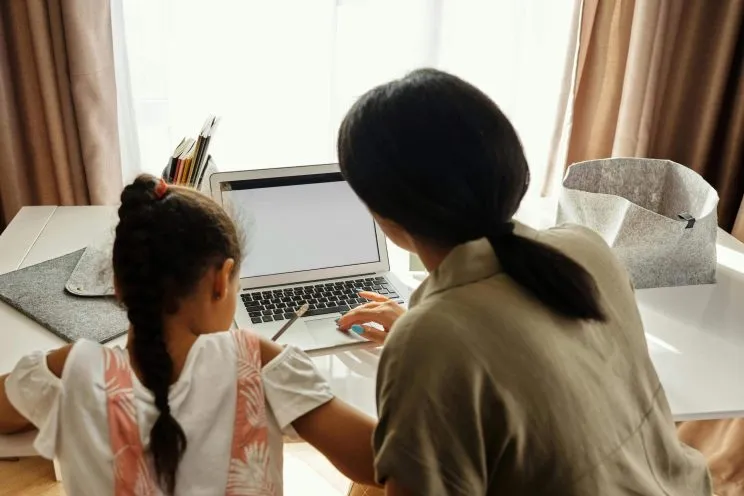
Pros and Cons of Online Learning:
- The advantages of online learning include flexibility, a personalized and 1:1 approach, cost savings, and access to more resources.
- Disadvantages like social isolation, higher screen time, and lower student engagement are also real, but you can counter them with the right habits.
- Online learning works best for self-motivated students or kids who develop discipline with the help of parents at home.
- You can make online learning work for your child by setting up a schedule, having a dedicated learning space, and creating opportunities for meeting peers.
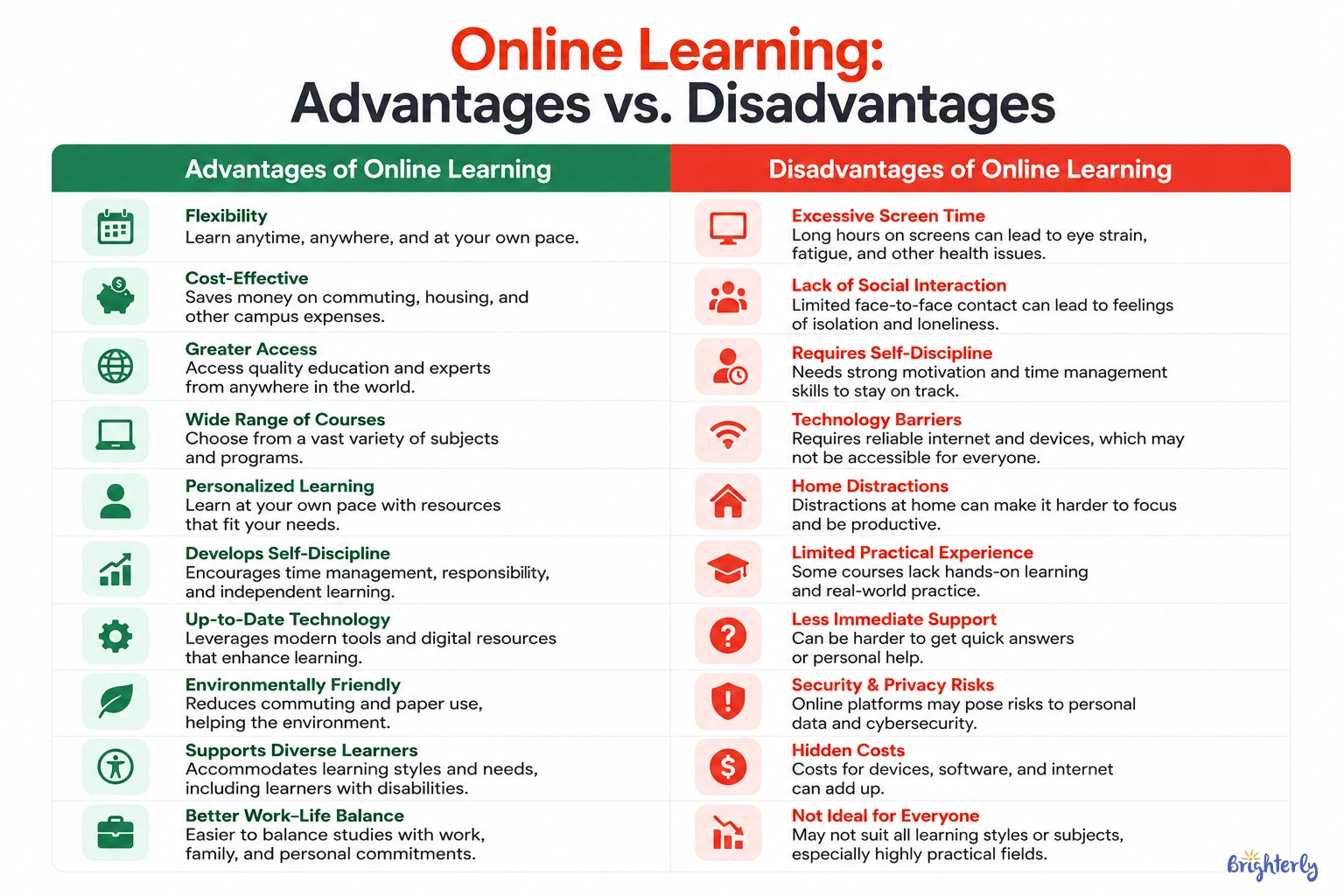
Online learning can give families a more flexible schedule and access to more learning resources, but it also comes with challenges like screen time risks and the need for strong self-discipline. So, when weighing the choices for your child’s education, exploring the advantages and disadvantages of online learning is an essential first step.
What Are the Advantages of Online Learning?
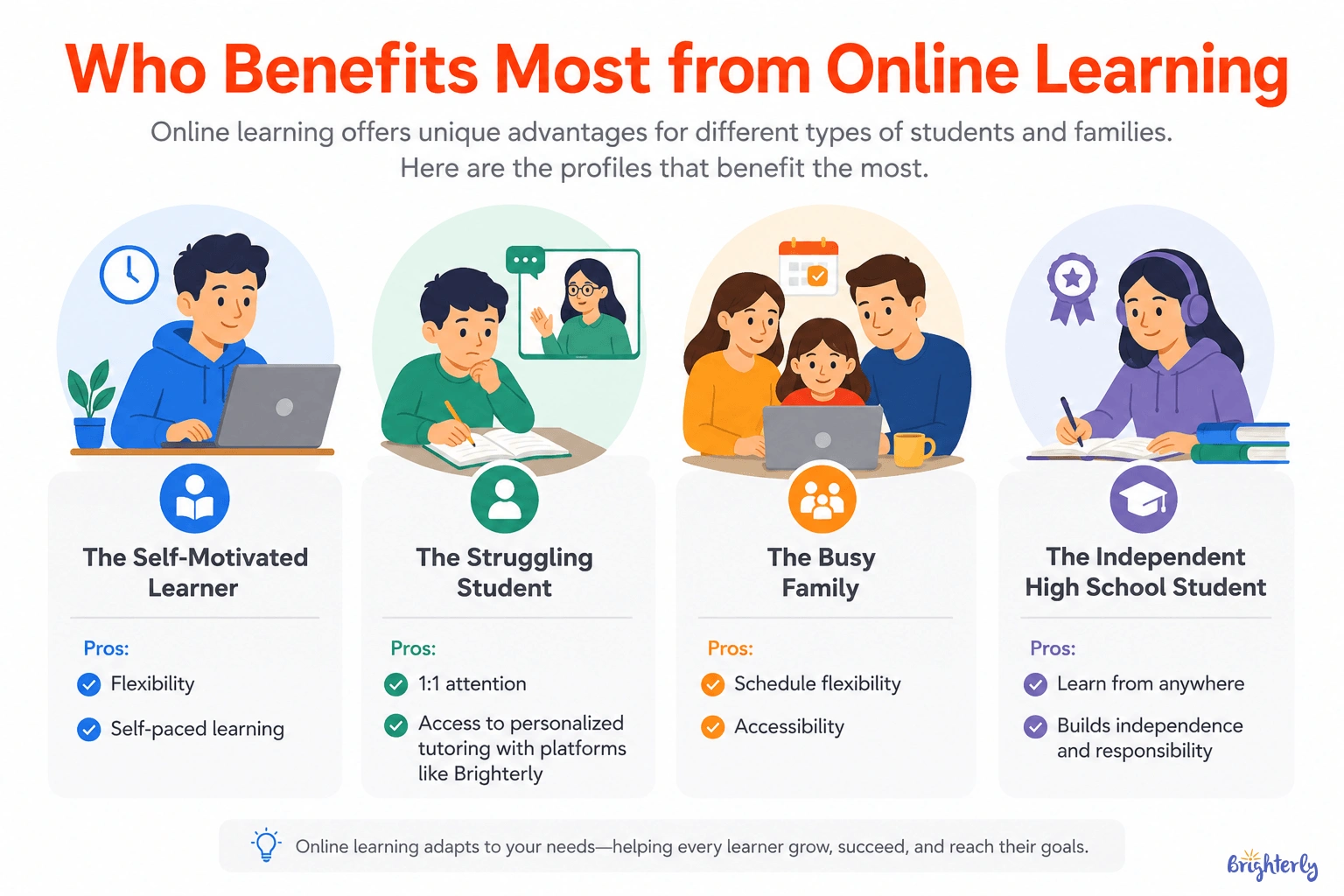
The main advantages of online tutoring vs in-person tutoring are flexibility, convenience, access to more resources and teachers, and the ability to personalize the pace of study for your child. For many families, online education also removes location barriers and makes targeted help more accessible.
Flexibility and Schedule Control
Flexibility is the first in the list of advantages of online learning, and for a good reason. It gives families and students the freedom to focus on the learning itself instead of the logistics. Instead of building your whole day around transportation and the fixed schedule of classes, online school lets your family create a flexible homeschool schedule. Online learning also lets your child learn when they’re most focused and have the energy to study, not when a bell says it’s time, and it will adapt to your family life rather than the opposite.
Lower Cost Than Traditional Schooling
Another benefit is that online education can be more affordable than many traditional alternatives. Potential savings include the money spent on transportation, books and printed materials, or in-person tutoring travel costs.
With that said, this doesn’t mean that every online program is cheap. Some full-time online schools or advanced tutoring programs can still be expensive. But in many cases, online school pros and cons include a clear cost advantage. Additionally, with online learning, you will also have the full cost breakdown right from the beginning, with no hidden costs.
Access to More Learning Resources
One of the biggest advantages of remote learning is access. Your child is no longer limited to the teachers or programs available nearby. With remote access, you can find subject-specific help, advanced classes, math and reading support, and interactive learning tools from almost anywhere. For example, if your child needs advanced math help, you can look for an online trigonometry tutor instead of searching only within your local area, where the options will be more limited. Your kid can also have access to a tutor anytime they have a question or need clarification.
“With online education, students will get immediate feedback on why their answers are correct or incorrect.”
But, I found that many students learn to “game the system” by figuring out how to answer the computer's wants without understanding the concepts behind the question. Unfortunately, this means that although the student can look like they are successful, they might just figure out how to “hack the prompt”.


Personalized Learning Experience
Personalized learning is one of the most important advantages of remote learning for many families. According to Derrington et al. (2024), 84.4% percent of families listed personalized learning as the main reason they chose online learning, as they find it gives better learning outcomes. Online learning adapts to your child in ways a traditional 30-student classroom can’t, and your child will get more individualized feedback and won’t have to rush through complex topics. For example, a child who needs 3rd grade reading help can work on grade-specific vocabulary and comprehension instead of being pushed into material that is too easy or too difficult.
Personalization is also important for children with different learning needs. For example, students with ADHD may benefit from an ADHD math tutor who can break lessons into smaller steps, use interactive practice, and help the child stay focused, versus a tutor who is otherwise great, but doesn’t have experience working with ADHD kids.
“A key benefit of remote learning is the personalized approach to learning.”

Improved Time Management and Self-Discipline
With online learning, your child needs to take more responsibility for their work, as there won’t be as much supervision as in a traditional classroom. Responsibility for the learning process will help them build time management skills, as they need to follow a schedule and complete digital assignments on time.
Needing self-discipline is a benefit and a drawback at the same time. Younger kids often need parent or teacher support, at least in the beginning, before they can learn to work independently. For older students, this independence can be empowering, as they learn how to plan, manage deadlines, and study without constant reminders.
Enhanced Technical Skills
Learning online is tied to technical skills, as your child needs some level of tech savviness to handle the learning process. They learn how to join virtual classroom sessions, upload assignments, use digital whiteboards, type responses, manage online files, and communicate through learning platforms. These skills are useful beyond school. Digital literacy is now part of everyday life, and children need to understand how to use technology safely and productively.
See how online learning can help your child progress.
See how interactive online learning can be with our 1:1 tutoring sessions!
More Inclusive for Different Learning Styles
Online learning can support different learning styles because it allows for multiple formats. Your kid can learn with private tutoring sessions, videos, games, worksheets, and more.
Overall, online learning allows for a more inclusive learning approach. For example, for reading practice, if a child has problems with decoding, they can benefit from a reading tutor for dyslexia who uses structured reading strategies. This inclusivity can be especially useful for children who need repeated explanations or who feel nervous asking questions in a crowded classroom. In some online courses, kids can rewatch a lesson, read a class recap, or write questions in the chat.
 Accessibility for Students Everywhere
Accessibility is another major point when comparing online learning advantages and disadvantages. In fact, the same research by Derrington et al. (2024) indicates that for 59.5% families, special needs and accessibility are the main reasons they choose online learning. Online learning can help children who cannot easily attend in-person lessons because of distance, health issues, family schedules, or limited local options. It can also help homeschool families who want structured lessons with professionals, but don’t want to send their child to a traditional school.
“Online studying increases access to education and provides personalized learning practices.”
The combination of new technologies has the power to transcend traditional constraints, making education – especially science-based education – more accessible and flexible. VR and games can also lower social anxiety. Students may gather in games to see the web avatars of their peers.

Explore Brighterly Learning Experience
Learn exactly how Brighterly helps students thrive through expert sessions, online tools, and proven feedback from thousands of satisfied parents
What Are the Disadvantages of Online Learning?
Online learning comes with its downsides, too. Disadvantages of online learning are too much screen time, fewer social interactions, motivation problems, and dependence on technology.
Screen Time and Physical Health Concerns
Screen time is one of the main cons of online learning, and one of the most common concerns parents have about online learning. It’s a valid one too. If your child spends several hours in front of a computer for school and then continues using screens for games, videos, or social media, the total can become too much.
Too much screen time may lead to tired eyes, headaches, and poor posture. It can also make learning feel passive if the child is only watching videos instead of interacting with the material.
The solution is not necessarily to avoid online learning completely. Instead, you can incorporate movement breaks, use printed worksheets when possible, and encourage outdoor time to build healthy screen time habits.
“Online learning works best when it isn’t only online.”
The goal is to stop being only a reader of your subject and start being a participant in it: talk to the people doing the work and gather your own observations.

Limited Social Interaction and Isolation Risk
Limited social interaction is one of the biggest disadvantages of online classes. Limited social interaction is a big disadvantage especially for families who fully homeschool their kids. Children don’t only go to school to learn math, reading, or science. At school, they also learn how to make friends, work in groups, and handle social interactions.
In some cases, online learning can include these elements, especially through live classes, group projects, and discussion boards. However, it usually requires more intentional planning, and you may need to add sports, clubs, and play dates to your schedule to balance the social development.
“Expecting children or adolescents to sit for extended periods is challenging for most learners”
For children with higher sensory or support needs, in-person learning is significantly more effective. Some may struggle with focus, others may experience heightened stress or dysregulation—situations that require immediate, skilled intervention, which is not feasible through a screen.
Online learning also places sustained demands on attention and stillness. Expecting children or adolescents to sit for extended periods is challenging for most learners, and even more so for those who are neurodivergent.
That said, there is a subset of learners—typically older students with lower support needs—who may find online environments more conducive, particularly if they benefit from reduced social demands or more control over their environment.

Requires Strong Self-Discipline
Another prominent one in the list of pros and cons of online school is the discipline children need. The freedom that makes online school attractive is also what makes it hard, as staying focused takes real self-motivation.
This is one of the cons of online learning that surprises families after they’ve already committed. And while older students can develop this discipline, it can be more challenging for younger kids, and you need to be there to guide them, at least in the beginning.
“Many children already struggle to stay focused, especially when they’re expected to sit still and watch a screen for long periods.”

Technology Barriers and Connectivity Issues
Online learning depends on technology. Your child needs a reliable device, a stable internet connection, and access to the learning platform. If one of these fails, the lesson can be interrupted. This creates a digital divide between families with strong internet connection and enough devices and families who struggle with connectivity, shared laptops, or outdated equipment.
Schools and platforms also need to think about privacy, secure access, and safe digital infrastructure. Reliable infrastructure is essential to prevent these outages, and many organizations now explore how SASE benefits can streamline secure remote access.
Reduced Motivation Without Structure
Some children lose motivation when they study online. Losing motivation can happen when lessons are too passive, assignments feel repetitive, or there is no regular teacher feedback.
Student engagement doesn’t happen automatically, not in physical, not in virtual classrooms. As part of their online learning, your child needs to have interactions, ask questions, practice, get feedback, and receive progress reports. Otherwise, they may just click through the content, the work may pile up fast, and your child risks falling behind.
Many of our students come to us assuming they can game the system and get through school without actually investing in the learning.
This shifts the goal from speed to sense-making.
Instant feedback is useful, but only if it's balanced with moments where students have to think without the system guiding, hinting, or auto-correcting them.

The solution to this motivation problem would be, according to Claire Smizer, to get kids to produce something instead of only consuming educational content.
Kids click through online lessons because nothing in the experience requires them to do otherwise.
Kids click through online lessons because nothing in the experience requires them to do otherwise. The cognitive work that creates actual learning - explaining, applying, restating, problem-solving - never happens, because the lesson never asks for it.
The fix is making the child do something meaningful in response to what they just consumed. After a math video, have them solve a problem on paper and explain their reasoning out loud. After a reading passage, ask them to summarize it in their own words, or teach the main idea back to you.

Not All Online Programs Are Equal in Quality
Lastly, not all online learning programs have the same quality. Many online programs can be engaging, structured, and effective. Other programs can feel confusing, lonely, unorganized, or simply wrong for the goals your child has.
That’s why when comparing advantages and disadvantages of online education, you need to look into how the lessons are taught, whether the teacher gives feedback, and how they measure the progress, among other factors.
Is Online Learning Effective for Kids?
When looking at what is one advantage and one disadvantage of online learning are, it all boils down to whether online classes are effective or not.
When it includes structure, interaction, feedback, and is age-appropriate, online learning can be effective. It works best when your child isn’t left to manage everything alone. The effectiveness will also vary based on your kid’s age and learning preferences. For example, while a kindergartner may prefer more game-based learning, for a high-schooler studying algebra, a targeted 1:1 tutoring with a math teacher will be more effective.
What Research Says About Online Learning Outcomes
The honest answer is that the research is mixed. And this is because online learning comes in many forms. Live tutoring and self-paced apps are not the same thing, although both belong to the online learning category.
When looking specifically at K-12 education, while there is not much research done yet on the effectiveness of online learning, there is some data worth considering. A 2021 study by Spitzer et al. in PubMed showed that for math, student performance improved during the lockdown, when they were taking online classes.
The University of Illinois Springfield’s online education overview, on the other hand, mentions that online learning may not be the best source for very young children who are “dependent students.”
At the same time, the research by Robinson et al. (2024) suggests that 1:1 and small-group instruction, whether in-person or online, give stronger learning outcomes than large-group virtual learning.
All in all, the effectiveness of online learning depends on how well the program is planned and structured, if the material matches the child’s learning stage and goals, and how much parental support kids receive.
Remote learning has an important place in the educational system.
By the 2022-2023 school year, this number has increased to 564,235 (SNAPSHOT 2024 report). Additionally, the number of states offering full-time online school options has increased from 36 in 2023 to 40 for SY 2024-2025. This reflects a continued trend towards more widespread acceptance of online education options and a response to the evolving educational needs of students.
How to Make Online Learning Work for Your Child
If you’ve reviewed the benefits and drawbacks of online learning and decided to give remote learning a try, there are a few things you can do to make it work for your child. These are not complicated steps, but they require follow-through.
- Set a schedule and stick to it. Start at the same time every day, have a consistent break schedule, and a clear end to the school day. Not knowing what to expect may cause anxiety to your child; a schedule helps to avoid that.
- Have a dedicated learning space. This doesn’t have to be a separate room. A corner in the kitchen table will work too, as long as it minimizes distractions.
- Stay involved, but don’t hover. Make sure your child knows you are there to support them, but also give them the freedom to learn and try things. You can check in on them in the morning and at the end of the study time, for example.
- Make sure to create social interaction opportunities. Organize play dates, have library visits, participate in community programs, or go to a local art class to make sure that your child is in regular contact with peers.
- Track progress. For some online learning programs, there is a dashboard for progress tracking available. In others, you can talk with the teacher. This way, you’ll know if the program needs adjustment.
Choose 1:1 online tutoring!
Book a free lesson and see how effective online learning is for yourself.
Frequently Asked Questions
What Is Online Learning?
Online learning is an educational format where your child receives instructions through a digital platform instead of a physical classroom. In K-12 online education, this can include live virtual classroom lessons, recorded video classes, online assignments, gamified learning, and tutoring sessions. Online learning can be fully remote, partially remote, and used alongside school or homeschool.
What Are the Types of Online Learning?
|
Type of Online Learning |
What it is |
Examples |
|
Synchronous |
Live classes a teacher or group at a fixed time. |
Live online classes, online homeschool reading program, group video lessons, real-time discussion |
|
Asynchronous |
Self-paced lessons |
Recorded lessons, online courses for kids, self-paced learning |
|
Blended online |
Student uses both live and self-paced learning. |
Weekly online tutoring + independent practice with provided materials, homeschool curriculum + live math support |
Is Online Learning Good or Bad for Students?
Online learning is not automatically good or bad. Online learning has both benefits and downsides, but whether the program will be effective depends on the student, program quality, and the level of support your child gets.
What Are the Biggest Challenges of Online Learning?
Some of the biggest challenges of online learning are limited social interaction (especially for fully homeschooled children), the need for strong self-discipline, and inconsistent program quality. For some families, higher screen time is a significant concern as well. However, you can manage most of these challenges with the right habits.
Is Online School Easier Than In-Person?
Online school isn’t easier or harder; it’s different and has different demands. While the academic content is generally comparable, the approach is different. Online students get a more personalized approach (in case of private tutoring), but also are responsible for their own learning. If kids lack self-discipline, they risk falling behind. At the same time, students valuing independence and self-paced learning often find online learning easier.
How Does Online Learning Affect Social Skills?
The social aspect of online learning is one of the most legitimate concerns of online schools. For families exclusively (or mostly) learning online, it’s important to supplement online school with regular in-person activities, like sports, hobby clubs, and community programs, to make sure that kids meet and get to interact with peers.
Can Online Learning Replace Traditional School?
For some students, yes, and this is already happening. There are fully accredited homeschool programs that meet the same academic requirements as in-person schools, and some students graduate from them with good academic records. However, for other students, like very young kids, or children who learn better socially, online learning may give worse results than traditional schools.

Parents seek Varsity Tutors alternatives due to cost-related problems and lack of tutoring quality. This review compares the 8 best alternatives to Varsity Tutors, the platform offering private one-to-one tutoring for kids who are struggling in math, English, sciences, languages, and other subjects. The comparison includes features, pros and cons, user feedback, and prices. 8 […]

Jul 16, 2024

Math has always been a tricky subject. So you, as a parent, are naturally interested in finding a person who will make your child understand math, not just memorize formulas. And tutors are here for it! However, modern times make their own adjustments. More and more parents want to switch from traditional offline lessons to […]
Jul 25, 2024
Math & reading from 1st to 12th grade
Looking for homework support for your child?
Choose kid's grade

Math & Reading for Grades 1–12
Build real confidence for your child with a Brighterly math or reading tutor.