25+ Classroom Management Strategies for Teachers (2026)
reviewed by Camille Ira B. Mendoza
Updated on September 21, 2026

Key Points:
- Classroom management allows teachers to establish a structure for learning, support a productive environment, and maximize the use of instructional time.
- As a teacher, use proactive strategies emphasizing routines, expectations, and relationship building to prevent behavioral incidents and establish structure.
- In contrast, apply reactive techniques to redirect or repair the behavior of students via responding to their actions.
- Consider that strategies depend on the grade level, as the students have different needs and concerns at a specific age.
For teachers, classroom management strategies are key for setting structure and supporting a productive environment. With them, you can affect performance and behavior. And as it’s about rules and expectations, the techniques you adopt in September shape how students learn throughout the year.
This guide covers 25+ best classroom management strategies, techniques, and ideas you can use, with examples, data, and tips.
What Is Classroom Management?
The classroom management definition is simple: it is the set of tools, techniques, routines, and activities that educators use to create a productive and respectful environment for students to learn. Its goal is to manage space, transitions, pacing, behavior, and relationships so that it has structure, a decent level of engagement, and a low level of disruption.
You can divide all teachers’ actions into proactive and reactive.
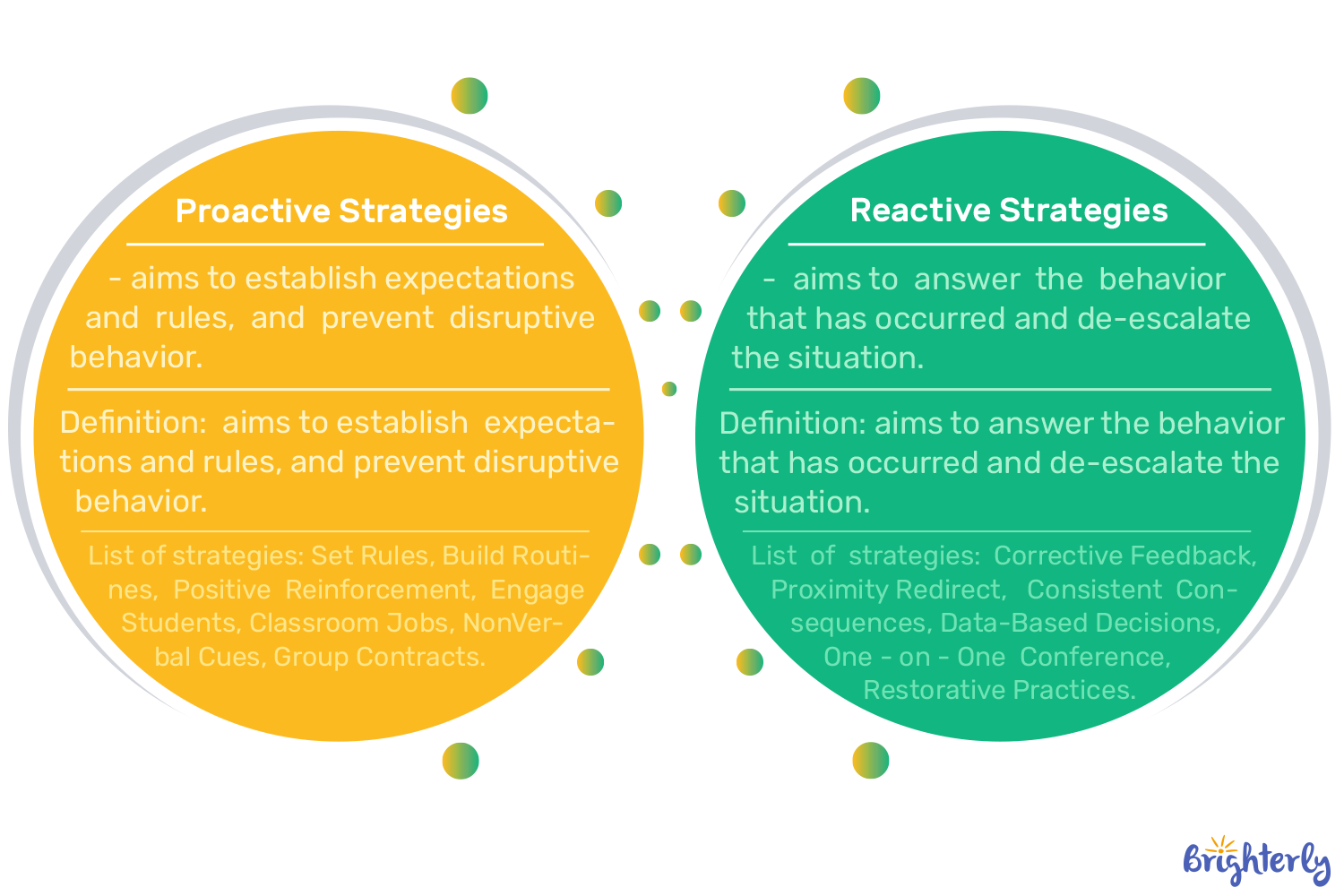
Yet, you should remember that managing the classroom is about structure and access, not control.
Explore Brighterly Learning Experience
Learn exactly how Brighterly helps students thrive through expert sessions, online tools, and proven feedback from thousands of satisfied parents
Why Classroom Management Matters for Teachers and Students
Classroom management definitely matters for teachers and students as it creates an organized space that supports learning. Such a space helps kids focus on tasks, minimize behavior-related issues, and contribute to student achievement. The importance of classroom management is hard to overstate: without it, even a strong lesson plan struggles to land.
So, the proper environment ensures engagement and psychological safety for kids. But what’s in it for teachers? It helps to decrease the level of stress and burnout.
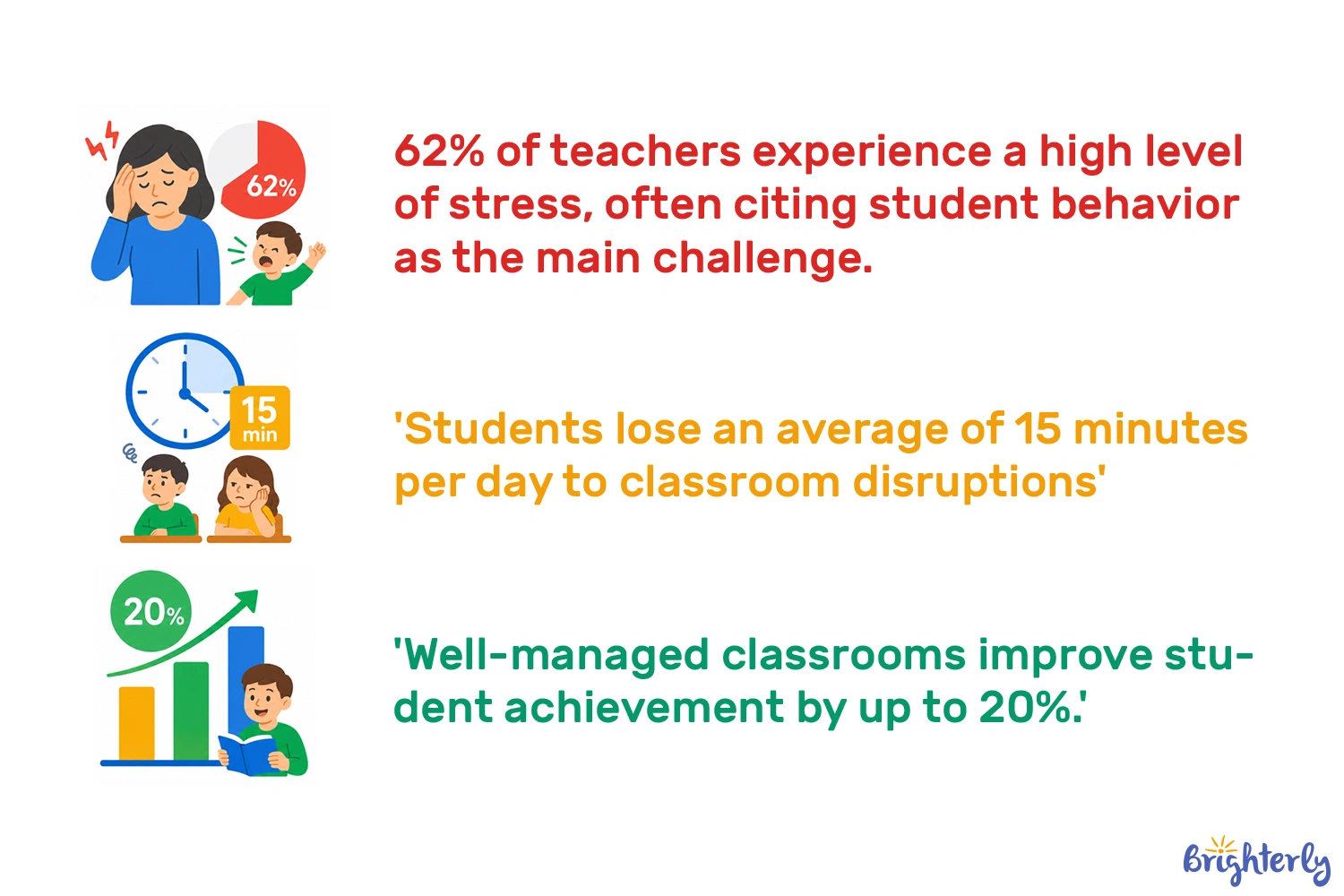
- As a 2025 Rand Education and Labor post suggests, almost 50% of students lose interest during the class about 1/2 of the time or more often. Why? Because of issues related to behavioral disruptions.
- A post from 2024, by Cindy Long, only supports it, as 68% of teachers report verbal abuse and other types of bad behavior in a class.
The issues mentioned are what classroom management helps to tackle, and the lack of it may lead to learning gaps, challenges, and additional pressure on a teacher.
Importantly, tutoring can support students and close gaps at home. When students resort to a tutoring or learning platform, let’s say Brighterly, they receive personalized plans to work on specific concepts.
Yet, for a teacher and class, continuous gaps can result in performance and attitude towards teaching experience.
Classroom Management Styles (Types)
Before choosing techniques, it helps to know the four main types of classroom management. These describe your overall style as a teacher — how you balance structure and warmth. This is a separate distinction from the proactive vs reactive grouping used for individual strategies in the table below. Most teachers lean on a mix of styles depending on the class and the grade level.
- Authoritative — high structure and high warmth. Clear expectations paired with strong relationships. This is the style most linked to positive outcomes.
- Authoritarian — high structure and low warmth. Rules are firm, but connection is limited, which can reduce engagement over time.
- Permissive — low structure and high warmth. Warm and flexible, but the lack of structure often invites disruption.
- Indifferent — low structure and low warmth. Little guidance and little connection, which tends to leave students unsupported.
Knowing your default style helps you spot what to adjust. The strategies and techniques below mostly build toward the authoritative approach, since it combines the structure and the relationships that keep a classroom productive.
25+ Classroom Management Strategies and Techniques
| Strategy | Type of strategy |
| Set clear rules and expectations | Proactive |
| Establish consistent routines and procedures | Proactive |
| Arrange your classroom | Proactive |
| Build relationships with students and parents | Proactive |
| Use positive reinforcement | Proactive |
| Encourage students’ participation | Proactive |
| Create engaging lesson plans | Proactive |
| Use a system of non-verbal cues | Proactive |
| Assign classroom responsibilities | Proactive |
| Write group contracts | Proactive |
| Gamify personal learning goals | Proactive |
| Offer different types of independent study time | Proactive |
| Use technology to support engagement | Reactive |
| Provide corrective feedback quickly | Reactive |
| Use proximity to redirect behavior | Reactive |
| Set transparent consequences | Reactive |
| Understand behavior through data | Reactive |
| Hold one-on-one conferences | Reactive |
| Involve students in problem-solving | Reactive |
| Address off-task behavior | Reactive |
| Avoid group punishment | Reactive |
| Use restorative practices | Reactive |
| Create visual schedules and morning meetings | Proactive for elementary school |
| Give students space and voice | Proactive/reactive for middle school |
| Connect material to the real world and prioritize conversations | Proactive and reactive for high school |
Proactive Classroom Management Strategies
- Set clear rules and expectations
- Establish consistent routines and procedures
- Arrange your classroom
- Build relationships with students and parents
- Use positive reinforcement
- Encourage students’ participation
- Create engaging lesson plans
- Use non-verbal cues
- Assign classroom responsibilities
- Write group contracts
- Gamify personal learning goals
- Offer different types of independent study time
- Use technology to support engagement
Note: This list of classroom management techniques can help teachers build the foundation or architecture of their classroom.
Set Clear Rules and Expectations From Day One
You can consider setting rules in a classroom as a preventive option. Such rules aim to form expectations and define the culture for the whole year. With clear rules and expectations, you shape the classroom environment beforehand with conditions. However, it’s important to make them stick. How?
- First, co-create rules with students. When they participate, it feels like ownership to them.
- Then, make classroom rules sound positive and visible. Instead of writing “No talking,” try “We keep quiet so everyone can focus.”
If you need ready-made examples by grade, see our guide to basic classroom rules for kids.
Establish Consistent Routines and Procedures
Daily routines and procedures make learning predictable, while predictability reduces anxiety and distractions. So, develop a schedule and place it where students can see it.
Simultaneously, as a teacher, you can make lessons and schedules pretty detailed. How?
- You can add micro-routines like a two-minute reset or a stretch break.
- For a middle school and high school classroom, you can add an independent reading activity.
Irrespective of the activity, remember that one anchor routine can set the mood for the whole day for kids.
Arrange Your Classroom for Success
Arranging your classroom involves creating a space that signals to children that they are there to study. Physical learning environment affects student behavior even before the class starts. That’s why you should make arrangements in your classrooms to ensure kids maintain focus, access materials, and feel comfortable.
How to arrange the classroom?
- Create clear sightlines so you can scan the room and see the kids, and kids see you.
- Create specific zones, whether it’s a calm corner, a class library, or a board for work display.
- When appropriate, rearrange spaces for collaboration, but make it clear to minimize confusion.
Build Relationships With Students and Parents
The relationships matter for students; they even make students work harder for teachers they trust. So, as a teacher, make sure you develop strong teacher-student relationships.
According to a 2023 Edutopia post, after 40 to 50 hours of interactions with students, teachers can build relationships with them. Yet, it’s important not to rush any relationship.
How to build relationships with students?
- Learn their name and personal interests.
- Consider the preferred communication style.
- Apply the 2×10 strategy (a talk with students for 2 minutes every lesson).
- Ask kids to help you with tasks.
- Be authentic and share your hobbies with kids.
- Share feedback and reports with parents.
Use Positive Reinforcement
For a teacher, positive reinforcement means recognizing that students are doing the right thing. It’s a way to support their confidence and engagement. To do it, name such occasions specifically. Praise their work, help offered to other students, their gestures, and their efforts.
At the same time, you can set a system for the whole class. They may relate to point charts, bingo referring to behavior, or marble jars as collective goals.
Encourage Student Participation and Initiative
If the learning feels passive, student engagement may drop. So, when managing a classroom, incorporate opportunities for student initiative into every lesson.
The great classroom management activities are:
- Think-pair-share
- Socratic seminars
- Choice boards
- Discussions with a changing “discussion facilitator” role
Note: Student participation also depends on motivation, so you may want to know strategies to boost student motivation.
Create Engaging Lesson Plans
One of the most effective classroom management strategies is a lesson that keeps students’ attention and prevents misbehavior. It’s often concerned with the proper designation of a lesson.
What things matter? A visual hook, a movement break, a connection to the real world, and interaction.
A good tip is to plan a lesson so that an activity that needs the highest level of energy takes place in the first 20 or 30 minutes of the lesson. After that period, the focus may start to decrease, affecting the dynamic of a classroom.
How do Brighterly tutors approach study plan creation?
At Brighterly, engaging and fun variety of lessons are at the core of reading tutoring and math program. There, our tutors focus on three things before planning a lesson:
- students’ needs to make learning relevant
- student level to affect students’ confidence
- connection to make learning personal and prevent off-task behavior.
Use System of Non-Verbal Cues and Signals
To affect the classroom in the moment, you should have a system of cues and signals that students can read right away. How? On the first day or during the first week, start training kids to respond to signals. With them, you can keep students calm and redirect their behavior.
What signals can you include?
- A raised hand for quiet or a question.
- Clapping for attention.
- Nodding to encourage a specific student.
- Raising eyebrows to signal disapproval.
Assign Classroom Jobs and Responsibilities
To make the classroom active, you may want to make sure that students participate in activities. One of the ways to do so is by offering them meaningful classroom roles.
For instance, you can appoint one student as a line reader and another as the one who delivers materials or keeps tabs on time. Find different roles and rotate them every week.
Write Group Contracts with Students
Look at the contract as a shared agreement on how you and the students treat each other. It may refer to the ways in which you manage the disagreements, provide support, or deliver tasks or questions.
Thus, start a semester with a session where you and the student co-author the classroom contract. In it, try keeping rules concise and to the point. You may write “We will be respectful,” but “We will raise a hand if we want to speak” would be more concrete.
Gamify Personal Learning Goals
For most students, gamification is a great tool to increase engagement. Why not apply it to the goals and academic targets? For instance, set a weekly or monthly goal and track their progress on a visible chart. Use stickers and points as rewards.
If it’s an independent reading session, give them a pen to take notes and write comments. If it’s math, provide them with a math challenge when they hit a certain milestone. Gamification makes learning more tangible.
Note: A math test and a reading test can be a great checkpoint or milestone for students learning at home or in the classroom, just link the results to the reward.
Offer Different Types of Independent Study Time
A significant part of classroom management is how a teacher approaches study time and independent work. You may want to offer clear options for a student to take once they’re finished with the main tasks.
As a teacher, you should focus on structure but maintain variety. Silent reading, journal writing, problem set solving, or reviewing are all valid activities for independent study time.
Besides, show students how and when to apply them to limit disruptions out of boredom.
Use Technology to Support Engagement
You have lots of technology and tools that can both support and disrupt learning in a classroom. In this regard, try to prioritize the ones that make learning interactive.
- For better interaction with students, incorporate Kahoot, Nearpod, or Miro. into the lesson. Simultaneously, do your own research and check some reading apps or math apps that you can use. At the same time, to limit the disruptive effects, you can establish norms for using technology.
- In terms of app rules, make sure students keep them closed during your instruction and define when they may be open.
Behavior Management Strategies for Teachers (Reactive)
- Provide corrective feedback quickly
- Use proximity to redirect behavior
- Apply clear consequences
- Understand behavior through data
- Hold one-on-one conferences
- Involve students in problem-solving
- Address off-task behavior
- Avoid group punishment
- Use restorative practices
Note: Compared to the previous classroom management strategies examples, the reactive ones are ways to solve behavioral issues, redirect a student’s actions, and improve understanding in the class.
Provide Corrective Feedback Quickly
One of the answers to the “how to manage behavior in the classroom” question is to address behavioral issues right away. Why? The delay in the feedback leads to the disconnection from the behavior.
For prompt corrective feedback, you can:
- Keep them brief and private, if possible.
- Use a quiet word, a light tap on the desk, or redirect a task.
- Avoid long corrections that embarrass students.
- Be specific when redirecting the behavior.
Use Proximity to Redirect Behavior
Leveraging space to stop disruptive behavior is one of the great reactive class management strategies. Such a behavior management technique can help you change kids’ behavior instantly.
How can you use it?
- Try standing near an off-task student for some time to resolve minor disruptions.
- Walk or circulate a class naturally for students to self-correct, but don’t hover.
- Use subtle non-verbals like eye contact.
Apply Clear and Consistent Consequences
Class management also requires clear and consistent consequences if students don’t follow the rules. There, one of the discipline strategies is to have predictable and fairly applied consequences for students.
You can use a tiered approach. First, the tier may be a verbal warning, then a minor consequence such as a time-out or a loss of privilege. After that, you can pick an escalation plan if needed. However, be consistent; if students see that your actions are selective, they will test your boundaries.
Understand Behavior Through Data
A good classroom management strategy to use, if you encounter strange or disruptive behavior, lies in tracking. Try to turn each case into data that you can later use.
For instance, you can record the time of day, activity, trigger, students, and outcome when an incident happens. Over a month, you may see a pattern that the same students are at the center of the incident. Based on it, you will be able to look into the reason behind the behavior disruption.
Hold One-on-One Student Conferences
When you see that something is off with a kid, you can resort to regular one-to-one conversations. During independent work time, pull the student aside and start a conversation about their behavior.
The conversation shouldn’t feel like punishment or betrayal. Instead, set it as a collaborative minute to solve a problem. Ask them, “ What was happening for you in class today?” or “What would help you focus better?” Be aware that you should be subtle and focus on giving space to kids.
Involve Students in Problem Solving
Bringing a student into the solution is a way to respond to a behavioral pattern if it persists. To engage with a student, you can use a collaborative problem-solving framework explained by Dr. Ross Greene in the Child Psych podcast.
As a teacher, you can help them solve or find answers to the problems instead of modifying the behavior affected by the problem. It’s a way to see the kid as a whole and support them.
Address Off-Task Behavior Without Stopping the Class
Minor off-task behavior is something you can react to instantly without disrupting the flow of a lesson. In many cases, the attention of the whole class is what a student may want. So, try to reset the individual with a:
- Deliberate look
- A shift in proximity
- Naming or referring to a student occasionally
Avoid Group Punishment
Punishing the whole class for the behavior of one student is a no-go. Why? It may be a source of resentment among the whole group. Instead, draw a clear line between individual and collective accountability; it can help you build a fair and trusting atmosphere in the group.
Use Restorative Practices
Restorative practices are about the activities that emphasize conversations, support peer mediation, and bring in repair agreements. That way, students develop accountability and empathy.
Note: According to the 2025 Mental Health and Wellbeing in Education article on restorative practices, certain activities can reduce violence, improve well-being, and boost socio-emotional skills.
In essence, they shift the question from “what rule was broken?” To “Who was harmed and how do we repair it?” Thus, for minor disruptions, start with small restorative conversations.
Classroom Management Strategies for New Teachers (by Grade Level)
The classroom management strategies for new teachers who work in elementary school should be about building predictability; for teachers in middle school, it’s more about structure, navigation, and support; in high school, teachers should focus on relevance and respect.
Classroom Management for Elementary Teachers
For elementary students, structure is important for developing trust. Young students thrive on it, especially if it’s backed by connection. So, the classroom management strategies elementary teachers may rely on are built around predictability and belonging. You should:
- Develop visual schedules. Try using pictures and words to post and show the daily schedule or classroom expectations. Visualize the whole structure for them, from transitions to study time.
- Back systems and check-ins with immediate feedback. Incorporate a color-coded system or digital check-in to make
- Set classroom jobs and morning meetings. For younger students, the meetings can set a social-emotional tone for the day. That’s the way to build community and, via roles, promote a sense of ownership.
Classroom Management Strategies for Middle School
For middle school students, the classroom is the place through which they may navigate identity and understand autonomy for the first time. Thus, the effective classroom strategies refer to balancing between the peer pressure, answering concerns, and being respectful.
- Give students choice and voice. You can give students choices in how they work, for instance, solo or in pairs, in this format or another. When you provide autonomy, students are less likely to assert independence via disruptive actions.
- Set a transparent system. Whether it’s about consequences or grades, it’s important to set a fair and transparent system. Students in a middle school have a good sense of fairness, so you should be consistent.
- Invest in peer relationships. In middle school, social dynamics are powerful and can be a tool to manage the classroom. So, you can seat students strategically, pair students to collaborate or support one another, and address friction if there’s any.
Classroom Management Strategies for High School
Effective classroom management for teachers in high school is about focusing on relevance, growth, and respect. At this stage, they are closer to adulthood; thus, the treatment should be adequate.
- Collaborate on rules. You may resort to a co-creation of a classroom agreement or just create new rules together. Under this strategy, you should start with a genuine conversation on the students’ needs and finish with an agreement.
- Connect materials to the real world. One way to increase engagement in the classroom is to link the content to what matters to them. Thus, try to connect every major topic to a possible career, current event, or exciting question.
- Prioritize conversations. High school students may have deep resentments. Thus, when conflicts appear, try respectful conversations first and treat them like young adults.
Note: Strong classroom management often comes down to consistent behavior support. For more reactive techniques, see our guide to behavior management in the classroom.
Turn Your Classroom Skills Into Flexible Online Work
If you enjoy helping students learn and want a flexible way to use those skills outside the classroom, online tutoring is worth a look. Brighterly works with certified math and reading teachers who tutor K-12 students one-on-one on their own schedule. The same relationship-building and lesson-planning skills that keep a classroom running are exactly what make a great tutor.
Teach on your own schedule Use your classroom experience to tutor online with Brighterly.
Conclusion
Great classroom management is a system you build, with the structure, rules, expectations, and relationships. Even if you just begin, start with 2 or 3 strategies that answer the challenge you have. For long-term effects, focus on proactive strategies.
To answer students’ behavioral changes during a class, try reactive classroom management best practices. Yet, remember that structure and trust work together to make the classroom really productive.
Frequently Asked Questions
What is the Most Important Classroom Management Skill?
The most important classroom management skill is the ability to build relationships consistently. Since students feel respected and connected to the teacher, they are more likely to meet expectations. Relationships allow developing trust, which is a foundation of any strategy.
How Does Classroom Management Affect Student Learning Outcomes?
According to the APA article on classroom management, the specific strategies affect student social and academic outcomes. The reasons relate to an increase in time spent on a task and the focus of students. Also, the management helps to reduce stress and support psychological safety.
How Do You Handle Disruptive Students in the Classroom?
To handle disruptive students in the classroom, start with a non-invasive intervention, like proximity, redirection, or a non-verbal signal. Notably, try to avoid public confrontation and escalation. Instead, resort to private feedback.
How Can Parents Support Classroom Management at Home?
To support classroom management at home, parents can ensure the home routines are consistent, discuss and review classroom agreements, and communicate with the teachers. For parents, it’s important to support the consistency the students have.


Teaching can be mentally, physically, and emotionally draining. And the duty of a teacher is to nurture both learners and own families. Unfortunately, teachers often end up forgetting to take care of themselves. However, consistent personal care is a must! Self-care recharges a person in various ways and even feeds one’s soul. For teachers, practicing […]

May 20, 2022
One teacher cannot pay equal attention to every child in a school class. One-on-one tutoring solves this issue — a student gets the undivided attention of a dedicated professional who adjusts the learning process and program according to this student’s needs. What Is One-on-One Tutoring? One-on-one tutoring is a teaching format that involves one educator […]

May 25, 2022
Math & reading from 1st to 12th grade
Looking for homework support for your child?
Choose kid's grade

Math & Reading for Grades 1–12
Build real confidence for your child with a Brighterly math or reading tutor.