A strong high school summer reading list includes a mix of classics, contemporary fiction, memoir, and nonfiction, plus at least one book your teen picked out themselves.
Classics every high school student should read are To Kill a Mockingbird, Wuthering Heights, 1984, The Great Gatsby, and Lord of the Flies.
Inside the titles on modern high school reading list, The Perks of Being a Wallflower, The Hate U Give, and The Poet X are very popular among teens.
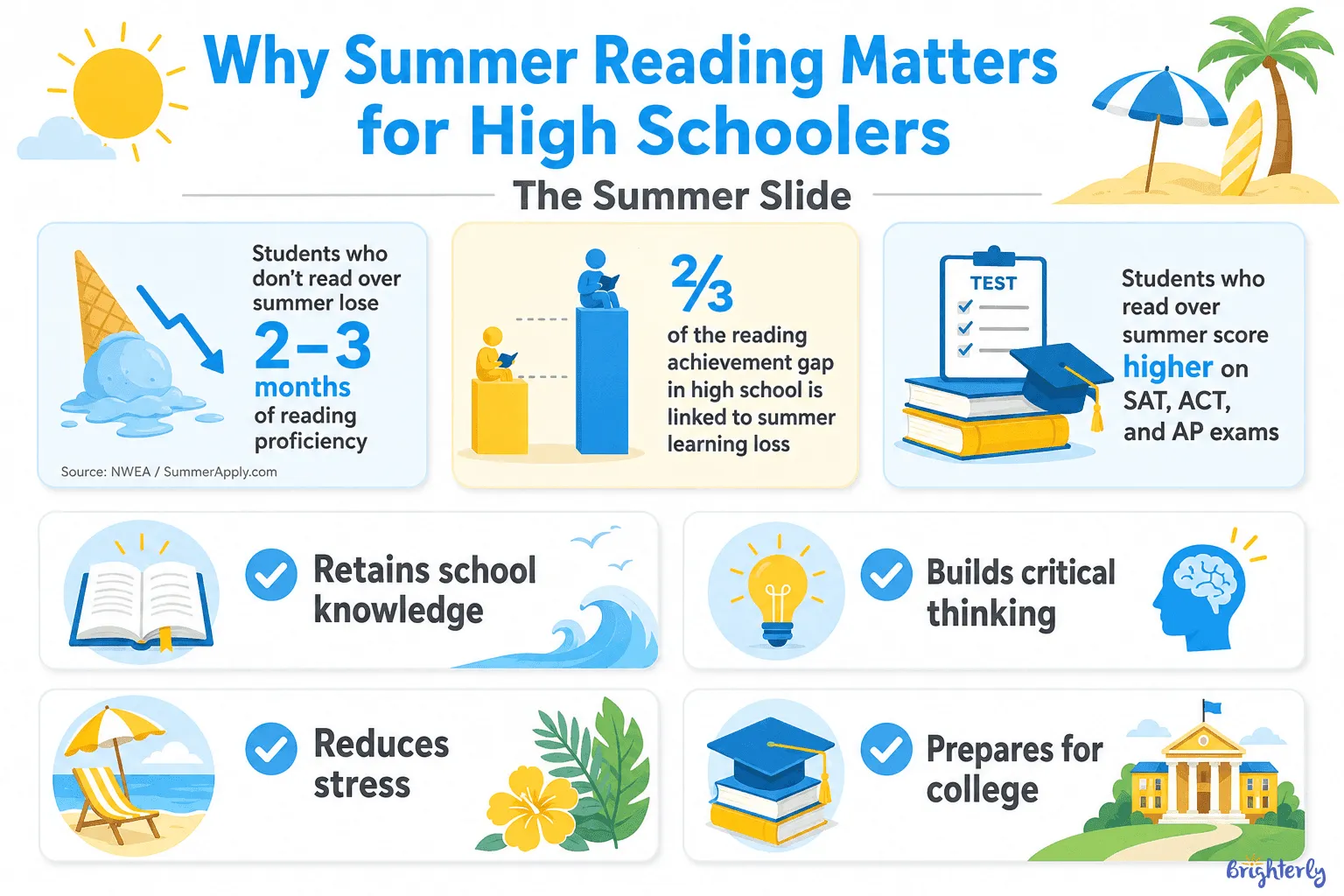
Students are significantly affected by summer learning loss (Harvard's Center for Education Policy Research and Stanford's Center for Education Policy Analysis, 2025).
A summer break sounds good, but long periods without reading cause a big summer setback. If you want to prevent a “brain drain” and keep your reading skills sharp, this curated reading list for high school students will help.
Reading program
A reading plan designed to keep you engaged.
Brighterly helps to find joy in reading, even in summer.
High School Summer Reading List 2026
An optimal summer reading list for high school mixes classics, contemporary fiction, memoir, and nonfiction, and at least one book that high school students pick themselves. The plan below helps plan your summer reading and avoid summer slide.
Classic Literature Every High Schooler Should Read
These remarkable titles are standard picks for high school reading and are sure to get you ready for classroom discussions of literary classics.
Name & Author
Short Description
To Kill a Mockingbird — Harper Lee
To Kill a Mockingbird is a 1960 Southern Gothic novel by American author Harper Lee. Young Scout Finch watches her father defend a Black man who was falsely accused of a crime, forcing readers to see how bias forms in the community.
Wuthering Heights — Emily Brontë
Wuthering Heights is a 1847 novel by English author Emily Brontë. The book follows the turbulent relationship between Catherine and Heathcliff, set on the wild, windswept Yorkshire Moors.
1984 — George Orwell
Nineteen Eighty-Four is a 1949 dystopian novel by the English writer George Orwell. Set in a totalitarian state called Oceania, this novel is about control, surveillance, and political manipulation.
The Great Gatsby — F. Scott Fitzgerald
The Great Gatsby was first published in 1925. This novel perfectly depicts the Roaring 20s and explores themes of chasing the American Dream.
Lord of the Flies — William Golding
Lord of the Flies is a 1954 novel set on an uninhabited island. It follows a stranded group of boys as they try to replicate a societal structure. The novel themes involve morality and leadership.
Contemporary Fiction and YA Fiction
If you want a modern high school reading list to add to your plan, these ones are genuinely well-written and popular among students your age. So by the end of summer, you’ll have something to talk about and improve reading skills.
Name & Author
Short Description
We Should All Be Feminists — Chimamanda Ngozi Adichie
This book-length essay, published in 2014, presents a definition of feminism in the 21st century. We Should All Be Feminists explores themes of sexuality, appearance, roles, and success.
The Perks of Being a Wallflower — Stephen Chbosky
This 1999 novel is about a 9th-grader navigating high school and building his first real friendships. Students who feel like oddballs will find this book especially interesting.
The Hate U Give — Angie Thomas
The Hate U Give follows Starr Carter, who witnesses a white police officer shoot and kill her childhood friend, Khalil. The novel explores themes of justice and doesn’t simplify moral questions for a younger audience.
The Poet X — Elizabeth Acevedo
The Poet X follows a 15-year-old Xiomara as she navigates conflicts in her family through poetry. Through her writing, students explore themes of patriarchy, sexism, and objectification of young women.
Mexican Gothic — Silvia Moreno-Garcia
Mexican Gothic is a 2020 gothic horror. The novel is one of the popular books for high schoolers and follows a young woman who’s investigating her cousin's accusations about her husband’s intention to murder her. 11th and 12th grade is the right moment to read it.
Nonfiction, Memoir, and Self-Development
This section confuses high school students — teen reading is mostly fiction. However, college-level reading is largely nonfiction, so getting used to it now will make the transition easier.
Name & Author
Short Description
An American Childhood – Annie Dillard
An American Childhood is a 1987 memoir that takes place in Pittsburgh in the 1950s and 1960s. The memoir describes how America was recovering from World War II — Dillard paints an affectionate look at her adolescent years.
Atomic Habits — James Clear
Atomic Habits is a 2018 self-help book that can be especially helpful for reluctant readers. The book talks about how to build habits that stick — students enjoy practical tools that help them build a system to achieve their goals.
A People's History of the United States — Howard Zinn
American history from a perspective of people who were left out of the standard textbook version: Indigenous people, enslaved people, women, and immigrants. This book allows students to look critically at the “traditional” history they learn in school.
Money Out Loud: All the Financial Stuff No One Taught Us — Berna Anat
Schools don’t teach financial literacy. Berna Anat helps young adults figure out budgeting and the struggles of capitalist society. It features illustrations and workbooks so teens can get down to business right away.
Hidden Systems: Water, Electricity, the Internet, and the Secrets Behind the Systems We Use Every Day — Dan Nott
Dan Nott gives teens a peek at how hidden systems work. If you’ve ever wondered how water, electricity, and the internet reach your home, this book is for you.
Graphic Novels for High School Readers
People often think that graphic novels are not “real reading”. This is a misconception — some graphic novels present complex narratives and help with understanding text structures. Graphic novels for high school students explore layered stories and nuanced themes.
Name & Author
Short Description
Maus — Art Spiegelman
Maus’ story revolves around Spiegelman interviewing his father about the atrocities he lived through as a Polish Jew in Auschwitz. He renders the story with Jews as mice and Nazis as cats. Maus is a Pulitzer Prize winner and is regularly assigned as one of the
novels for high school students and in college courses.
Persepolis — Marjane Satrapi
Persepolis is a series of graphic novels about Marjane Satrapi’s childhood in Iran after the Islamic Revolution. This novel is one of the best introductions to Iranian history and culture for American high school students.
March trilogy — John Lewis
The March trilogy is a black-and-white graphic memoir that tells the story of the Civil Rights Movement through the eyes of civil rights leader and U.S. Congressman John Lewis. Students who pair it with the To Kill a Mockingbird get a very different historical perspective.
Summer Reading List by Grade: What to Read and When
Reading in each grade in high school is not the same. To start, not all high schoolers are at the same level. A freshman is still improving vocabulary and attention span, while a senior is ready to tackle analytical, sustained reading.
Books for Freshmen and Sophomores (Grades 9–10)
High school summer reading list for grades 9–10 is all about developing the ability to stick with longer books, form reading habits, and find enjoyment in reading.
Title
Genre
The Book Thief - Markus Zusak
Coming-of-age, finction
A Wrinkle in Time — Madeleine L’Engle
Science fantasy, adventure
The House on Mango Street – Sandra Cisneros
Coming-of-age, fiction
Night — Elie Wiesel
Memoir, Holocaust literature
The Absolutely True Diary of a Part-Time Indian — Sherman Alexie
Coming-of-age, contemporary fiction
Speak — Laurie Halse Anderson
YA fiction, coming-of-age
A Long Way Gone – Ishmael Beah
Memoir, war literature
The Curious Incident of the Dog in the Night-Time - Mark Haddon
Mystery, contemporary fiction
The Maze Runner — James Dashner
Dystopian Fiction, science fiction, adventure
The Lightning Thief — Rick Riordan
Fantasy, adventure, mythology
The Fault in Our Stars – John Green
YA fiction, romance, contemporary fiction
The Book of Unknown Americans — Cristina Henríquez
Contemporary fiction, immigration literature
Books for Juniors and Seniors (Grades 11–12)
By 11th grade, students are ready for more complex themes. Teens need to be reading books that challenge them: unfamiliar perspectives and long nonfiction. College is around the corner, so it’s the right time to build analytical engagement through high school summer reading books.
Title
Genre
Pride and Prejudice — Jane Austen
Classic fiction, romance
Brave New World - Aldous Huxley
Dystopian fiction, science Fiction
The Catcher in the Rye — J. D. Salinger
Coming-of-age, fiction
Their Eyes Were Watching God — Zora Neale Hurston
Historical fiction
The Handmaid’s Tale - Margaret Atwood
Dystopian fiction, speculative fiction
A Separate Peace — John Knowles
Coming-of-age, historical fiction
The Road - Cormac McCarthy
Post-apocalyptic fiction, literary Fiction
Frankenstein — Mary Shelley
Gothic fiction, science fiction
Jane Eyre - Charlotte Brontë
Gothic fiction, romance
The Picture of Dorian Gray — Oscar Wilde
Gothic fiction, philosophical fiction
Gone with the Wind - Margaret Mitchell
Historical fiction, romance, epic fiction
Americanah — Chimamanda Ngozi Adichie
Contemporary fiction, social commentary
Reading program
Great minds start at Brighterly.
Get reading lessons and keep the summer slide under control.
Why Summer Reading Matters for High School Students
Summer reading matters for high school students because it prevents summer learning loss and keeps reading skills sharp. According to the National Bureau of Economic Research (NBER) randomized study, students who read over the summer write stronger college essays, have a larger vocabulary, and preserve skills they built over the school year. This is why summer reading programs are so popular.
What Is the Summer Slide and How Does It Affect Teens?
Summer slide is the loss of academic skills during the summer break. Teenagers are highly affected by it — according to a 2025 report from Harvard's Center for Education Policy Research and Stanford's Center for Education Policy Analysis, the average student was nearly half a grade level behind pre-pandemic achievement levels in reading and math.
Benefits of Summer Reading for High Schoolers
Builds vocabulary and keeps reading skills sharp
Develops critical thinking needed for SAT/ACT tests
Prevents summer slide and the September adjustment period
Builds healthy reading habits
Gives students context for college application essays
Stimulates interest in literature
How to Make the Most of Your Summer Reading
To make the most of your summer reading, mix formal high school summer reading lists with books of your choice. This approach reduces reading fatigue and helps students stay motivated.
Another way to make the most of your summer reading is to join a Brighterly summer reading camp. We offer live 1:1 sessions with a reading tutor who supports summer reading for high school students.
We tailor sessions based on individual reading needs with real-time personalized feedback. Our reading comprehension program allows your teen to work on their knowledge gaps and choose literature they have a genuine interest in.
Take a diagnostic reading test, and explore where your child stands before the new school year begins.
Explore Brighterly Learning Experience
Learn exactly how Brighterly helps students thrive through expert sessions, online tools, and proven feedback from thousands of satisfied parents
Online math tutor
Get personalized math tutoring from experts who help kids master math concepts
Parents reviews
Read parent feedback to see how Brighterly helps kids build strong foundation
Online reading tutor
Boost reading and language skills with engaging lessons from ELA tutors
Frequently Asked Questions
Yes. Choosing their own summer reading books is ok, and it’s probably better. A book they choose and finish builds more interest and stamina than a book they’re assigned through summer reading books in high school.
The best genres for a high school summer reading list depend on what the student is interested in. The rule of thumb is: one literary classic, one contemporary fiction title, one nonfiction book, and a title the student wants to read.
Yes. The SAT reading section tests the students’ ability to read complex texts, so reading during the summer helps improve the critical thinking needed for SAT and ACT prep. Students who read over the summer find the SAT reading section less intimidating.
To get reluctant readers to read over the summer, don’t push classics right away. Start with YA fiction — The Perks of Being a Wallflower, The Hate U Give, and The Poet X are usually the titles that high school students finish in two or three sittings. Then, you can move to some complex literature.
Yes. Most public libraries run free summer reading programs for high school students. You can visit your local library to explore annual summer reading lists. For students who need structured support, a Brighterly reading tutor can provide a reading list, plus targeted lessons to address specific reading challenges.
Help your kid excel in math
Book a free demo lesson with a Brighterly tutor and see real progress after the first month.