How to Write a Thesis Statement: Steps, Examples & Templates (2026)
reviewed by Franz Jerby Delos Santos
Updated on July 23, 2026
Key Points
- Learning how to write a thesis statement comes down to understanding how to state the main claim of the piece and making sure it’s arguable.
- The formula behind a thesis statement is Topic + Claim + Reasons, which makes writing one far less intimidating, whether for a five-paragraph essay or a full research paper (Brock University).
- A thesis statement falls into three main types — analytical, expository, and argumentative (Purdue Owl).
- Students in the US still struggle with core writing skills, including forming clear thesis statements — the average U.S. student English scores 11.6 points below what colleges expect (ACT report, 2025).
- Learning and practicing writing thesis statements with a tutor can help kids build a solid foundation in academic writing and literacy skills.
A thesis statement is a key part of academic writing that helps students introduce the main idea of their piece, explain what this piece is about, and what they were trying to prove as an author. Find out how to write a thesis statement step-by-step with examples and templates to make sure you can structure it for any writing task.
What Is a Thesis Statement?
According to the UNC Writing Center, a thesis statement is usually a single sentence that states the central claim of this paper and explains the writer’s interpretation of the significance of this claim. Besides, the thesis statement also acts as a road map of a paper, showing readers what to expect from the piece.
Students usually begin to work with thesis statements in late elementary through middle school, when they make their first steps toward more formal, structured writing. And since writing is essential for creating a thesis statement, the lack of this skill can complicate the process. According to the ACT 2025 report mentioned in the writing statistics Brighterly reviewed, the average English score is down to 18.4. This data shows that U.S. students struggle with writing skills, which may influence their ability to form a clear thesis statement.
Note: Find out how to get better at writing with simple techniques, like proofreading, using worksheets, and reviewing grammar basics. Alternatively, for more guided help, consider addressing a specialized online writing tutor.


Professional writing help for your kid
Our writing program includes lessons on essay structure, including the thesis statement.
What Is the Purpose of a Thesis Statement?
According to the Purdue OWL, the purpose of a thesis statement is to shape the paper’s central claim, provide the main takeaway, help the reader see the paper’s purpose and focus, provide the roadmap of the essay or research, and make sure the central claim encourages argument and discussion in readers.
Where Does the Thesis Statement Go?
The Purdue OWL states that the thesis statement should appear early in the paper, preferably after the first paragraph, which is usually the introduction. Placing the thesis statement before the main body of the paper allows the reader to see the main claim first, so that when they move to every other part they automatically position it against that main claim in their head.
How Long Should a Thesis Statement Be?
A thesis statement can be one or two sentences long, although most sources, including the Purdue OWL and UNC Writing Center, state that one sentence is the standard. A single sentence is usually enough for a short essay with one clear reason, while the writer may need two sentences when the claim requires two or three supporting reasons explained.
Whether it’s one or two sentences, the thesis statement should be short enough to read in one breath.
Explore Brighterly Learning Experience
Learn exactly how Brighterly helps students thrive through expert sessions, online tools, and proven feedback from thousands of satisfied parents
Types of Thesis Statements
According to the Purdue Owl, there are three main types of thesis statements — analytical, expository, and argumentative. Each type serves a different goal and depends on the writing task. Analytical thesis statements break down the main claim, expository explains it, and argumentative provides supporting evidence for it.
Analytical Thesis Statement
An analytical thesis statement breaks down an issue or an idea into smaller parts and explains how or why something works. In simpler terms, this type of thesis statement looks at each part of the main claim to help the reader understand it better.
Expository Thesis Statement
An expository thesis statement format is the simplest type of thesis statement for most kids since it basically explains an idea or an issue to the readers — there’s no need to present evidence or take a position, as it focuses on facts or steps rather than on assertions.
Simply put, an expository thesis statement:
- Explains rather than argues
- Doesn’t take a side
- Focuses on facts.
Note: For students looking to build more detailed claims, exploring descriptive writing can be useful.
Argumentative Thesis Statement
An argumentative thesis statement makes a central claim about the topic and finds supporting evidence to justify that claim. This claim could be an opinion, proposal, or evaluation. The main goal is to convince the readers that the claim is persuasive and there’s strong evidence on its side.
This type of thesis statement is often the most difficult for students because it has to be supported with clear evidence and reasons.
Note: Knowing how to write a conclusion paragraph can also help tie the evidence and reasons together to end an argumentative thesis on a strong note.
How to Make a Thesis Statement Step-by-Step
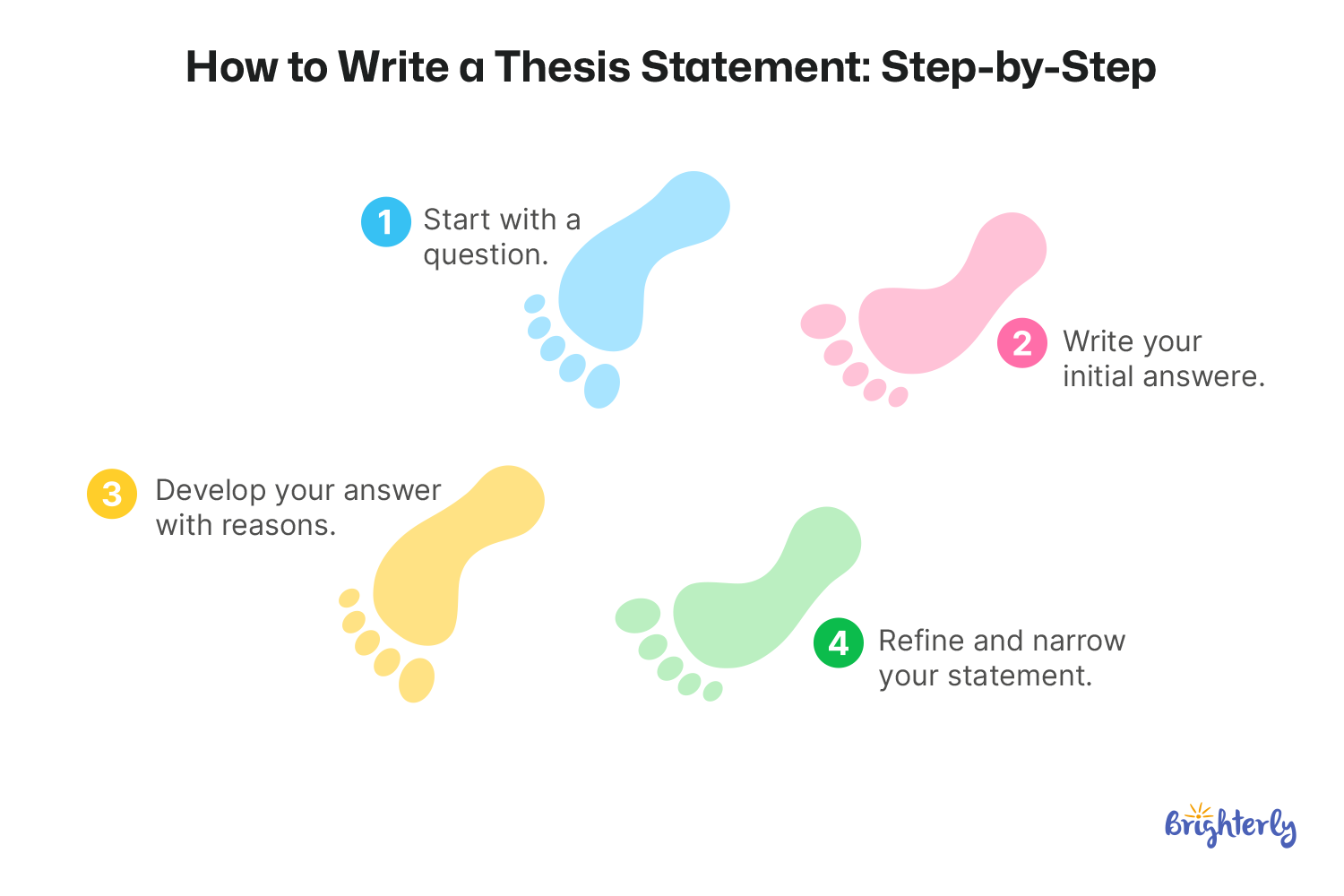
The main steps of writing a thesis statement include turning the topic of the paper into a question, answering this question, adding reasons that support these answers, and finally tightening the wording. These steps help to keep a thesis statement specific and focused rather than vague and weak.
Step 1: Turn Your Topic Into a Question
When you think about how to start a thesis statement, the first thing to consider is whether the topic of the paper is assigned or not.
According to Indiana University’s Writing Tutorial Services, if the topic is assigned, it’s best to reduce the topic of your paper into a direct question to form a thesis statement. And if the topic isn’t assigned, it’s best to start by thinking of a specific question you want to answer rather than a broad subject.
In both cases, starting with a question helps to focus on what exactly the paper needs to claim and explore.
Example: Why are dogs good pets?
Step 2: Write Your Initial Answer
The next step is to answer the question you defined before. You can keep the answer short and simple — it should help you to structure your paper without getting too overwhelmed.
Example: Dogs are good pets.
Step 3: Add Your Reasons (the “Why”)
At this stage, add a couple of reasons that support your answer to make your thesis statement more detailed and specific.
Example: “Dogs are good pets because they are friendly, loyal, and love to play.”
Including reasons is crucial — without knowing how to introduce evidence, you can’t form a clear thesis statement.
Step 4: Refine and Narrow It
At the last stage, read your thesis statement aloud and decide if it’s specific and clear enough. This is when you refine your thesis by removing extra words, cutting the fluff, and checking if it answers the previously defined question.
Example: “Dogs make great companions because they are friendly to people, loyal, and love to play with children.”
For students who struggle with writing a thesis statement, tutoring can be an option. Expert tutors who teach our reading program and online writing for K-12 students adapt lessons to each child and help kids build stronger academic foundations.
During one-on-one online lessons, students work with an essay writing tutor who helps them not only fix the gaps in writing skills but also learn the basics of grammar and essay structure. For kids who need reading and writing help, our ELA tutor helps improve weak phonics skills and poor reading fluency.
Simple and effective online writing lessons
Our writing tutors help struggling learners become confident academic writers.
Thesis Statement Formula and Template
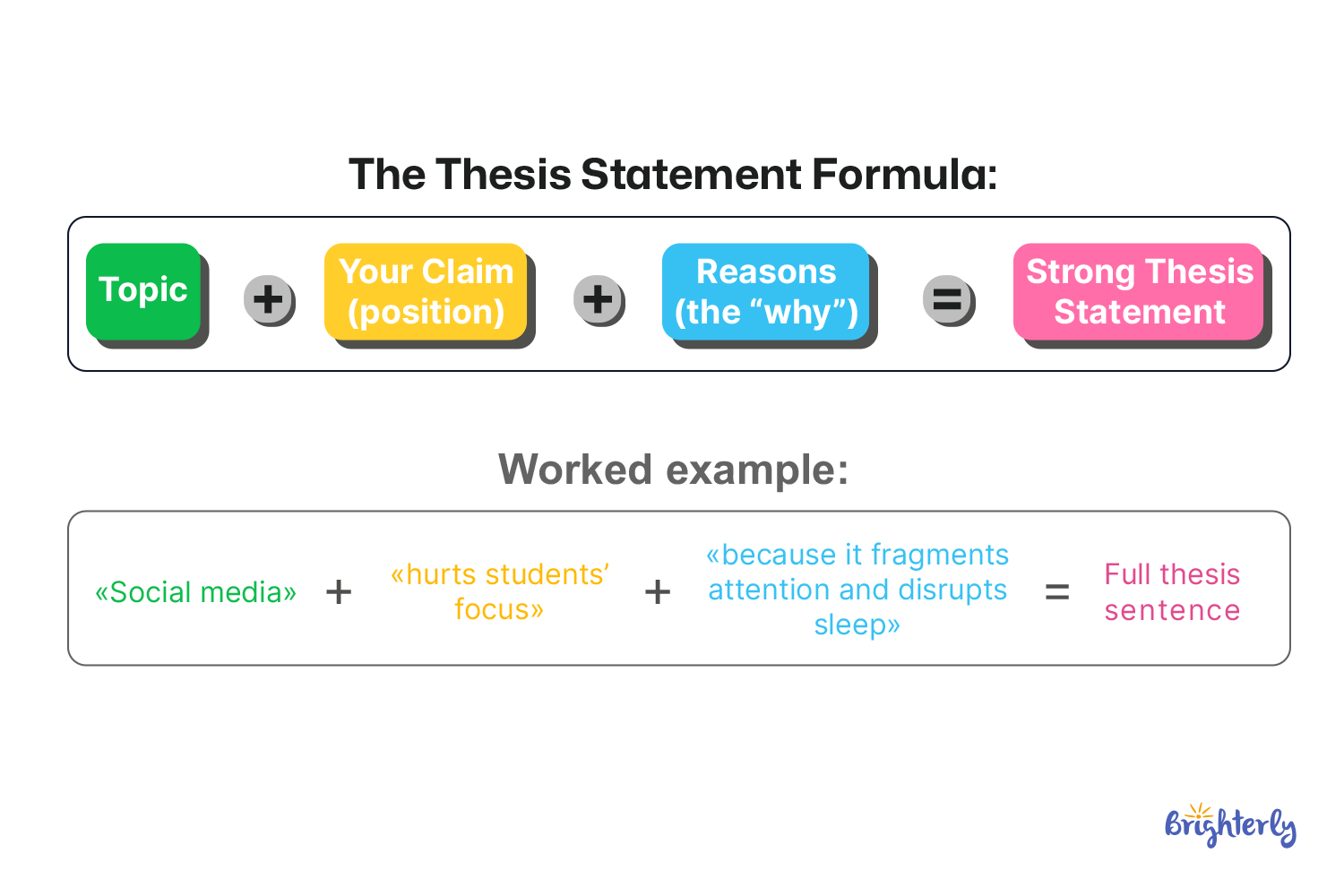
According to Brock University, the simple formula to follow when creating a thesis statement outline is Topic + Claim + Reasons = Thesis Statement. You can also use specific templates and sentence starters that are most common when writing a thesis statement according to this formula:
- [Topic] is [claim] because [reason 1], [reason 2], and [reason 3].
- Although [opposing view], [topic] actually [claim] because [reason].
- By examining [topic], this essay shows that [claim], particularly through [reason 1] and [reason 2].
Sentence starters to use when writing the first draft before narrowing the wording later:
- “This essay argues that…”
- “The evidence shows that…”
- “Because of [reason], [claim]…”
Thesis Statement Examples (by Essay Type)
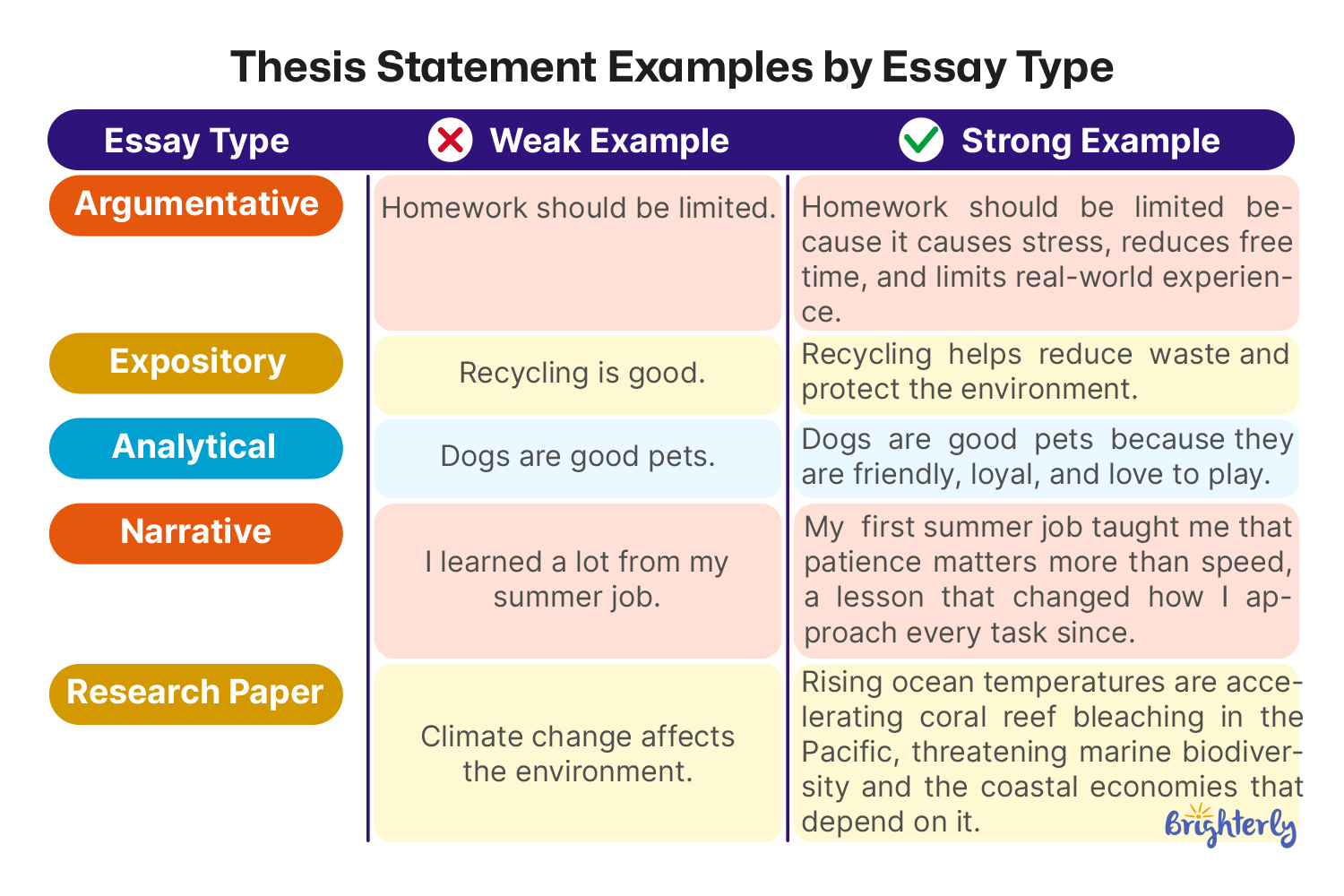
Examples of thesis statements for each type of essay can help you understand what exactly a thesis statement looks like and how it differs depending on the type of essay you’re writing — argumentative, expository, analytical, narrative, or a research paper.
Argumentative
- Weak: “Homework should be limited.”
- Strong: “Homework should be limited because it causes stress, reduces free time, and limits real-world experience.”
Expository
- Weak: “Recycling is good.”
- Strong: “Recycling helps reduce waste and protect the environment.”
Analytical
- Weak: “Dogs are good pets.”
- Strong: “Dogs are good pets because they are friendly, loyal, and love to play.”
Narrative
- Weak: “I learned a lot from my summer job.”
- Strong: “My first summer job taught me that patience matters more than speed, a lesson that changed how I approach every task since.”
Research Paper
- Weak: “Climate change affects the environment.”
- Strong: “Rising ocean temperatures are accelerating coral reef bleaching in the Pacific, threatening marine biodiversity and the coastal economies that depend on it.”
Thesis Statement Examples by Subject
|
Topic |
Weak Thesis Statement Example |
Strong Example of a Thesis Statement |
|
Friendship |
“It’s important to have friends.” |
“It’s important to have friends because you have someone to share your good and bad moments with.” |
|
Working out |
“Working out is good for you.” |
“Working out is great for everyone because it strengthens your body, reduces stress, and helps improve your health overall.” |
|
Mental health |
“Taking mind breaks is important.” |
“Taking mind breaks is important because it helps improve productivity and focus.” |
|
Reading |
“Students have to read every day.” |
“Students have to read every day because it helps them develop imagination and creativity, while improving their vocabulary and comprehension.” |
|
Online learning |
“Online learning is convenient.” |
“Online learning is convenient because you can manage your own time, learn with experts, and improve your skills from home.” |
|
Pets |
“Having pets is good for you.” |
“Having pets is good for you because they reduce stress, provide companionship, and they’re fun to play with” |
|
Technology |
“Technology is helpful.” |
“Technology helps students learn faster because it provides instant feedback, personalizes practice, and makes research easier.” |
|
Homework |
“Homework takes too much time.” |
“Homework should be limited to under an hour a night because excessive assignments can interfere with sleep patterns, family time, and outside-of-school interests.” |
|
Health |
“Eating healthy is important.” |
“Eating healthy improves concentration and energy, which directly affects how well students perform in school.” |
Strong vs Weak Thesis Statements: How to Tell the Difference
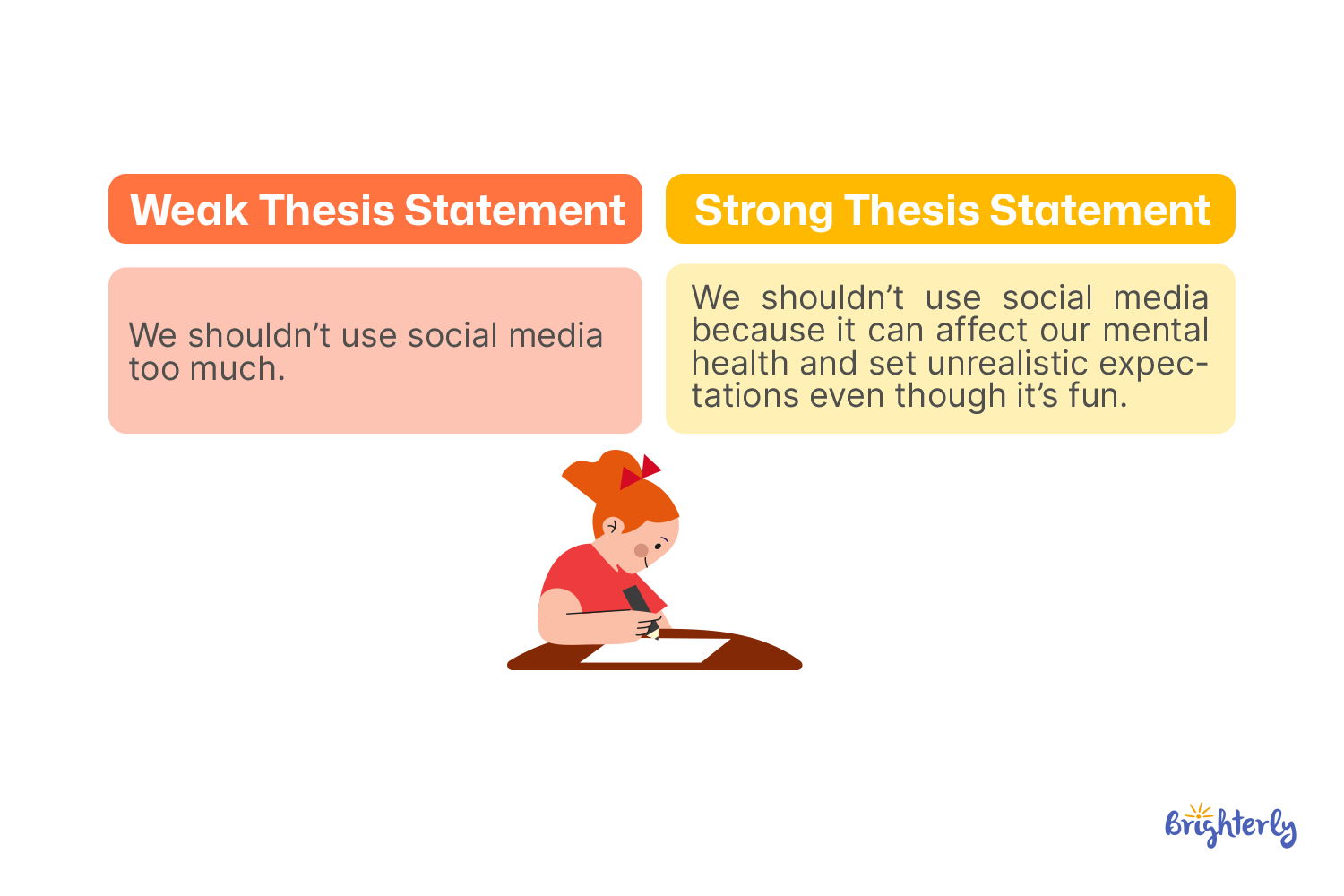
To tell the difference between a strong thesis statement and a weak one, define whether it matches the criteria of a strong thesis statement — has a clear main idea (claim), no filler words, includes your opinion, is specific, stays focused on the main idea.
The features of a strong thesis statement are:
- Clear main idea: Make sure the reader knows what the essay is about
- No watery sentences: Avoid wordy essays.
- Take a stance: Show your opinion and defend it.
- Be specific: Say why something is good/bad/effective, etc.
- Focused on the main idea: Avoid going off subject.
Wayne Lowry, Interim Chief Executive Officer at Sunny Glen Children’s Home, says:
“The big mistake students make is being too vague.”


Common Thesis Statement Mistakes to Avoid
Common thesis statement mistakes include stating a fact instead of an arguable claim, trying to fit in too many ideas, being unclear or confusing in your argument, not narrowing down, or sitting on the fence instead of taking a stance.
Stating a Fact Instead of an Arguable Claim
Wayne Lowry explains what exactly that means:
“The most common thesis mistake I see students make is writing a statement that is just a fact or observation rather than an arguable claim.”
Trying to Say Too Much
Trying to put every idea into one sentence usually backfires. A strong thesis should be narrow, so that you’ll be able to defend it within the space of one paper.
Being Unclear or Confusing
Making a clear statement with supporting evidence is enough — you don’t have to do anything else. Staying on point and presenting your opinion is key.
Being Too Broad
Don’t try to argue everything in one thesis. Narrow your claim to be specific and make the thesis provable.
Sitting on the Fence
A thesis that covers both sides doesn’t take a stance. For your thesis to be strong, choose a position and commit to it, even when the topic is complicated.
Conclusion
Knowing how to write a good thesis statement comes down to having a clear arguable claim, staying on point, expressing your opinion, and featuring supporting evidence. You can also use a formula, templates, and examples for creating a strong statement for different essay types.
And if you need professional support, our tutors can help teach thesis statement writing and overall literacy in a fun and easy way.
Frequently Asked Questions
Can a Thesis Statement Be a Question?
No, a thesis statement can’t be a question. It has to be a clear claim — a position that you commit to and will support in the rest of the paper. You can ask a question when you’re thinking about what you want to argue, and the answer to that question can be your thesis statement.
Can a Thesis Statement Be Two Sentences?
Yes, a thesis statement can be two sentences. Although one sentence is usually enough for a simple academic essay with a single reason, two sentences can give you more room if you need to mention more supporting reasons. One or two sentences, a statement needs to be brief and easily readable.
What Is the Difference Between a Thesis Statement and a Topic Sentence?
A thesis statement covers the main claim of the whole paper, while a topic sentence covers the main idea of a particular paragraph. A thesis statement usually comes after the introduction, while the topic sentence opens the paragraph it belongs to.
Do All Essays Need a Thesis Statement?
Yes, most academic essays need a thesis statement, especially if it’s an argumentative, expository, and analytical writing task. Narrative and personal essays can be exceptions — they often revolve around the main idea without stating it as a single claim sentence.
What Is a Three-Point Thesis Statement?
A three-point thesis statement includes three specific reasons or examples the essay will cover, usually in the exact order they’ll appear. For example, “Dogs make great pets because they are loyal, playful, and easy to train” is a three-point thesis statement.
How Can a Thesis Statement Be Improved Before Submitting?
To improve a thesis statement before submitting, read it aloud and make sure it takes a clear position, is specific and not vague, previews the essay’s reasons, and raises an argument a reader can agree or disagree with. If your thesis doesn’t match any of these criteria, revise it.



Below are the options that offer these and other features, so that you can find the perfect tool for your child. Paid Multiplication Apps: Comparison Best for Platform Pricing (as of Aug 2026) Prodigy Math Gamified learning Web, iOS, Android Starts at $9.95/month Mathletics Skills assessment and review Web, iOS, Android $99/year IXL Diagnostics […]

Apr 11, 2026

What do 3rd graders learn? In the 3rd grade, the curriculum is built around five main subjects: math, reading, writing, science, and social studies. As such, by the end of the year, kis are expected to read and understand simple texts, solve trivial math problems, and be able to express their ideas in a clear […]

Apr 13, 2026
Math & reading from 1st to 12th grade
Looking for homework support for your child?

Choose kid's grade

Math & Reading for Grades 1–12
Build real confidence for your child with a Brighterly math or reading tutor.