Slope – Types, Definition With Examples
Updated on July 31, 2026
In math, slope is a number that tells you how steep a line is and which way it tilts — you calculate it as the rise (vertical change) divided by the run (horizontal change), written m = rise ÷ run. A positive slope rises from left to right, a negative slope falls, a zero slope is flat, and a vertical line has an undefined slope. Slope shows up everywhere from math in the real world — road grades, wheelchair ramps, and stock charts all describe steepness the same way a line does on a graph.
What Is Slope?
Slope is the measure of a line’s steepness and direction on a coordinate plane, found by dividing the vertical change between two points by the horizontal change between them. The formula is m = (y₂ − y₁) ÷ (x₂ − x₁). A larger absolute value means a steeper line; the sign tells you whether the line goes up or down as you read left to right.
The letter m stands for slope in almost every equation you’ll meet in algebra and geometry. Because slope compares change in y to change in x, it is also called a rate of change — miles per hour and dollars per month are real examples of slope.
Expert Math Tutors for Every Level
Connect with professional and certified educators who provide specialized support for every grade level, from elementary school basics to advanced algebra
The 4 Types of Slope
There are four types of slope: positive, negative, zero, and undefined. A positive slope rises from left to right, a negative slope falls, a zero slope is a flat horizontal line, and an undefined slope is a vertical line. The diagram below shows how each one sits on a coordinate plane.

Positive Slope
A positive slope moves upward from left to right, so the line’s endpoint is higher than its starting point. It shows a positive relationship between the two variables: as x increases, y increases too. The steeper the line, the faster y rises. Example equation: y = 2x + 3.
Negative Slope
A negative slope moves downward from left to right, so the endpoint is lower than the start. It shows an inverse relationship: as x increases, y decreases. Example equation: y = −2x + 3.
Zero Slope
A zero slope is a horizontal line that neither rises nor falls. No matter how much x changes, y stays the same, so its equation is simply y = b (for example, y = 3).
Undefined Slope
An undefined slope is a vertical line. Because the run (change in x) is 0, the formula would require dividing by zero, which is impossible, so the slope is undefined. Its equation is x = a (for example, x = 4).
How to Find the Slope of a Line
To find the slope of a line, pick two points on it, subtract the y-values to get the rise, subtract the x-values in the same order to get the run, then divide. You can also read it straight from a graph by counting units — see our guide on how to find the slope from a graph.
Step 1. Label your two points (x₁, y₁) and (x₂, y₂).
Step 2. Find the rise: subtract y₁ from y₂.
Step 3. Find the run: subtract x₁ from x₂ in the same order.
Step 4. Divide rise by run. Example: for (1, 2) and (3, 8), m = (8 − 2) ÷ (3 − 1) = 6 ÷ 2 = 3.
Slope Equations and How to Write Them
Two equations describe a line using its slope: slope-intercept form and point-slope form. Slope-intercept form, y = mx + b, is the most common because m is the slope and b is the y-intercept — the point where the line crosses the y-axis.
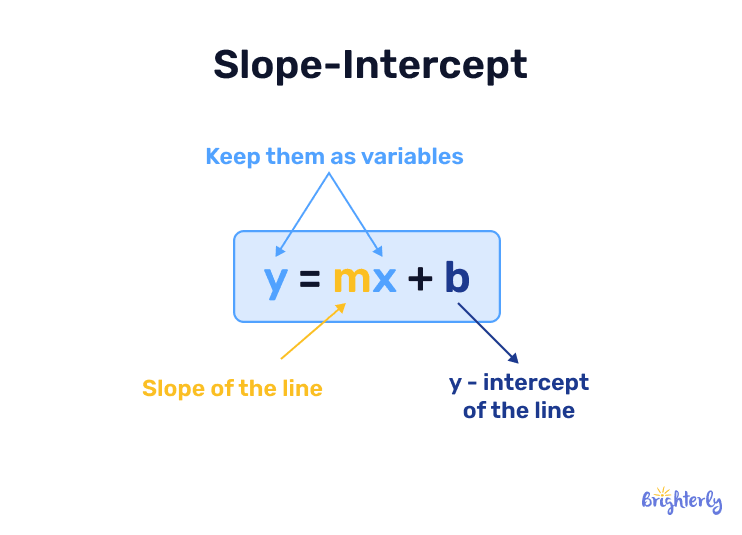
Slope-Intercept Form
Slope-intercept form is written y = mx + b. Substitute your slope for m and the y-intercept for b. A line with slope 2 crossing the y-axis at 3 is y = 2x + 3.
Point-Slope Form
Point-slope form, y − y₁ = m(x − x₁), is used when you know the slope and one point on the line. Plug the slope in for m and the known point in for (x₁, y₁), then simplify if needed.
Solved Examples of Slope
Example 1. Find the slope through (2, 1) and (6, 9). Rise = 9 − 1 = 8; run = 6 − 2 = 4; m = 8 ÷ 4 = 2.
Example 2. Find the slope through (0, 5) and (4, 5). Rise = 5 − 5 = 0; run = 4 − 0 = 4; m = 0 ÷ 4 = 0 (a zero slope).
Example 3. Find the slope through (3, 1) and (3, 7). Run = 3 − 3 = 0, so the slope is undefined (a vertical line).
Slope: Practice Math Problems
Try these yourself, then check your answers. Working through problems with a friend — or a Brighterly algebra tutor — is the fastest way to make slope stick.
- Using y = 2x + 3, find y when x = 4. (Answer: 11)
- Using y = −3x + 1, find y when x = 2. (Answer: −5)
- For the line y = 5, what is y when x = 7, 10, or 100? (Answer: 5 every time — a zero slope)
- List three points on the line x = 4. (Answer: e.g. (4, 0), (4, 1), (4, −2) — an undefined slope)
Slope Worksheets
Put this into practice with related Brighterly worksheets:
Frequently Asked Questions About Slope
What Is Slope in Simple Terms?
Slope is a number that describes how steep a line is and whether it goes up or down as you move from left to right. You find it by dividing the vertical change (rise) by the horizontal change (run). A steep hill has a large slope; a gentle ramp has a small one; flat ground has a slope of zero.
How Do You Find the Slope Between Two Points?
Use the formula m = (y₂ − y₁) ÷ (x₂ − x₁). Subtract the second y-value from the first to get the rise, subtract the x-values in the same order to get the run, and divide. For (1, 2) and (3, 8), the slope is (8 − 2) ÷ (3 − 1) = 3.
What Are the Four Types of Slope?
The four types are positive (rises left to right), negative (falls left to right), zero (a horizontal line), and undefined (a vertical line). Positive and negative are opposites, and so are zero and undefined — one is perfectly flat, the other perfectly upright.
Why Is the Slope of a Vertical Line Undefined?
Slope is rise divided by run, and a vertical line has no horizontal change, so the run is 0. Because you cannot divide by zero, the slope has no numerical value and is called undefined. Horizontal lines are the reverse: their rise is 0, giving a slope of exactly zero.
What Does the Slope Represent in Real Life?
In real life, slope is a rate of change. On a distance-time graph, it is speed; on a ramp, it is steepness; on a cost graph, it is price per unit. A steeper line means a faster rate of change, which is why slope is so useful outside the math classroom.


Math & reading from 1st to 12th grade
Looking for homework support for your child?

Choose kid's grade

Math & Reading for Grades 1–12
Build real confidence for your child with a Brighterly math or reading tutor.