Surface Area Worksheets
Updated on June 23, 2026
Surface area worksheets offer students a structured way to calculate the total exterior area of three-dimensional figures — prisms, cylinders, pyramids, cones, and spheres — by summing the areas of each face or curved surface. Applying these formulas requires students to first visualize a solid’s net, then calculate the area of every component, including the lateral faces of a rectangular prism, cone frustum, or composite solid. Visualizing how a net unfolds into a three-dimensional solid is a spatial skill that a geometry tutor can make concrete by isolating each face formula before combining the full surface area.
Download Surface Area Worksheet PDFs
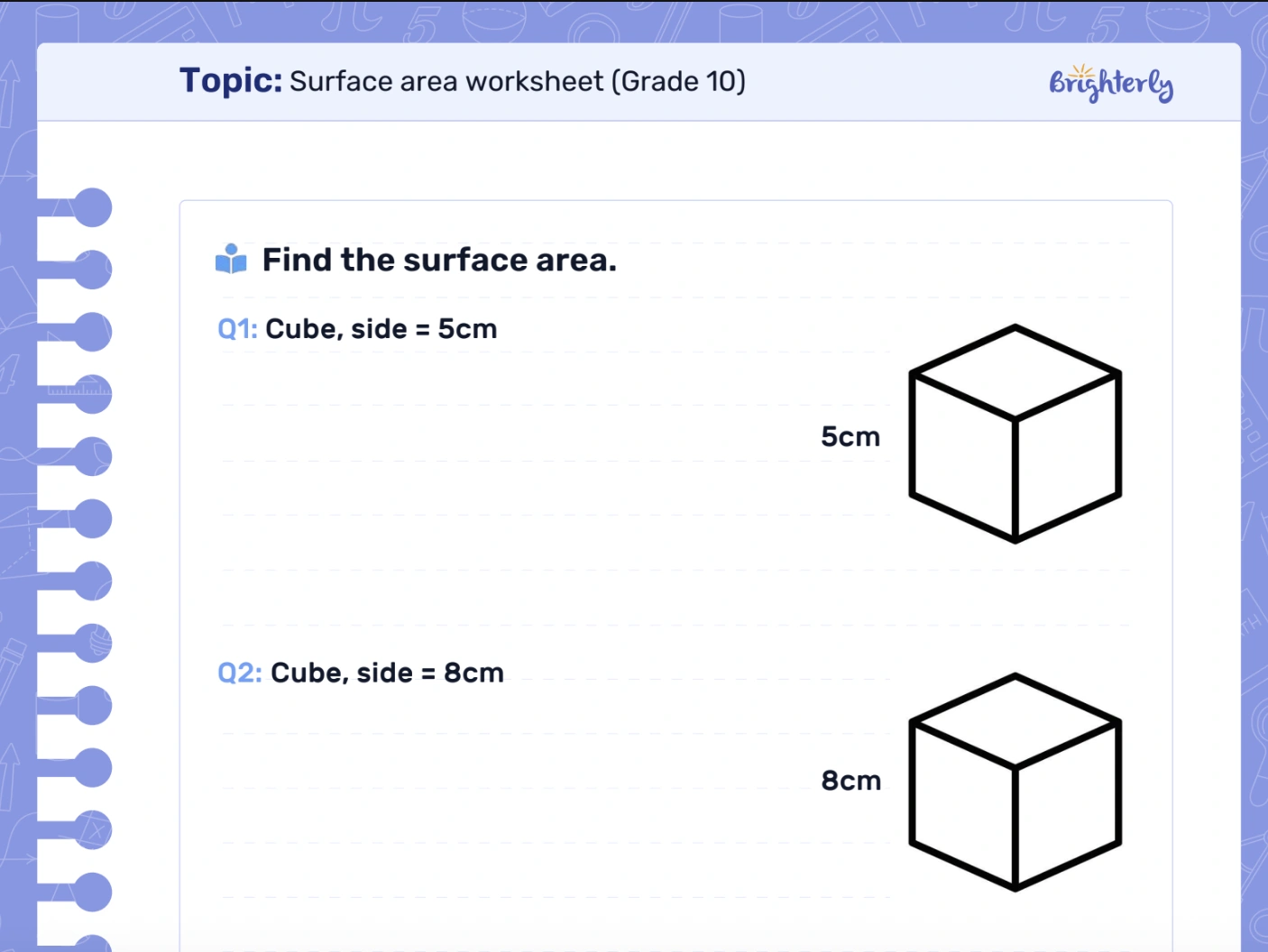
Access our comprehensive collection of printable surface area worksheets designed to reinforce advanced geometric concepts and calculation skills for prisms, pyramids, cylinders, and spheres.
More surface area and volume worksheets
Extend your three-dimensional geometry practice with these closely related resources — covering combined surface area and volume calculations, circular base areas for cylinders and cones, rectangular face nets for prisms, and triangular face areas for pyramids.
- surface area and volume worksheets
- 7th grade volume and surface area worksheets
- area of a circle worksheets
- area of a rectangle worksheets
- area of a triangle worksheets


Help your child reach their full potential!
Answer a few quick questions about your child’s learning, and we’ll recommend next steps.
Benefits of Surface Area Worksheets
Engaging with surface area worksheets develops a deep understanding of how two-dimensional shapes combine to form the outer boundaries of three-dimensional solids. By working through diverse problems — from straightforward rectangular prism nets to complex composite figures like frustum cones — learners refine their ability to decompose structures and apply algebraic manipulation to geometric contexts. This practice is essential for high school geometry standards and for preparing for advanced coursework in trigonometry and calculus. Surface area calculation also has significant real-world applications in engineering, manufacturing, and construction, where determining material requirements for coating surfaces is a routine task. Regular practice strengthens logical reasoning and precision, ensuring students can accurately solve problems involving both lateral and total surface area across a wide range of three-dimensional shapes.


Math & reading from 1st to 12th grade
Looking for homework support for your child?

Choose kid's grade

Math & Reading for Grades 1–12
Build real confidence for your child with a Brighterly math or reading tutor.