Volume and Surface Area Worksheets Grade 7
Updated on September 10, 2026
Volume and surface area worksheets grade 7 help students practice measuring the inside and outside of three-dimensional figures. Brighterly worksheets reinforce finding the volume and surface area of prisms, using dimensions correctly, working with nets, and choosing square or cubic units. Students can also review rectangular prisms before starting the exercises.
Volume and Surface Area Worksheets Grade 7 PDF: Examples
Brighterly’s Grade 7 worksheets help students distinguish between surface area, which measures the total area of a solid’s outer faces, and volume, which measures the space inside it. Learners apply formulas to rectangular and other prisms, interpret diagrams, and solve problems using given dimensions.
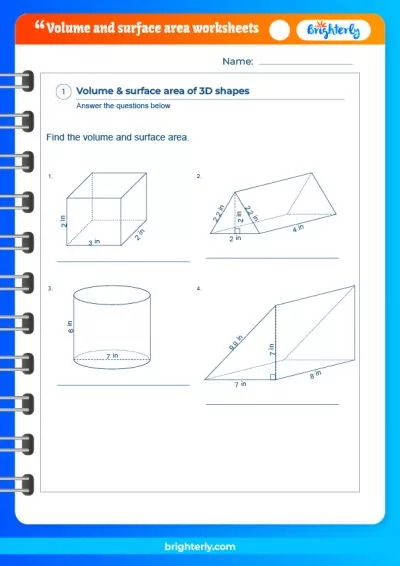
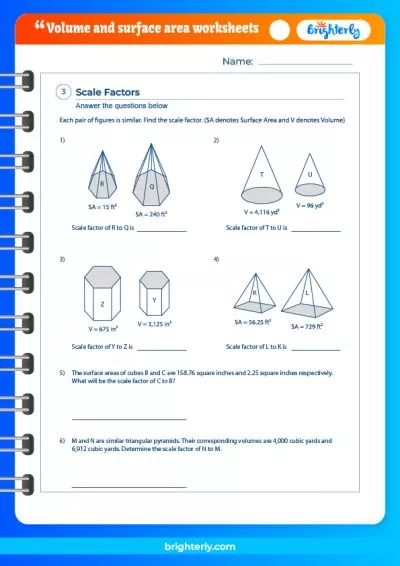
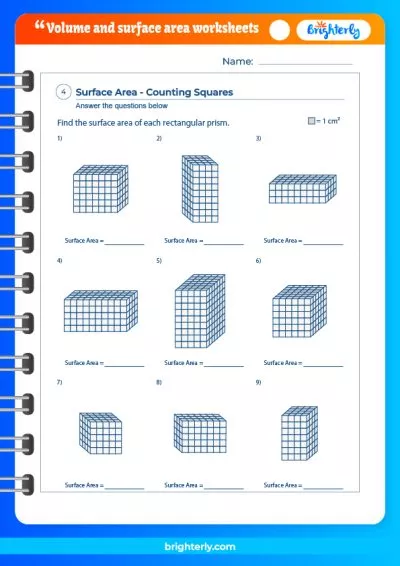
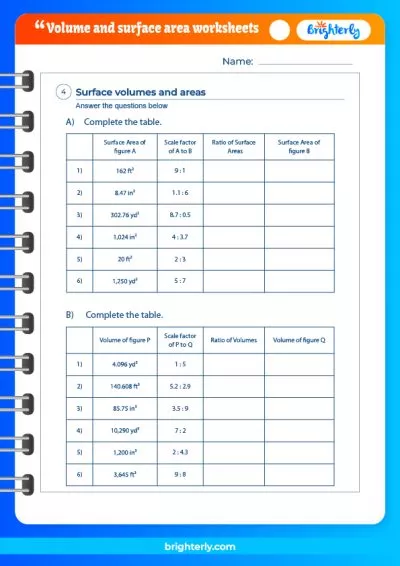
7th Grade Volume and Surface Area Worksheets [Download for Free]
Download and print Brighterly’s free volume and surface area worksheets grade 7 for additional practice at home or in class. Students can use the answer keys to check formulas, calculations, and measurement units and identify which part of a problem needs more review.
Parents can also review Brighterly’s guide to 7th grade math skills to see how geometry and measurement fit into the broader Grade 7 curriculum.
If your child knows the formulas but struggles to identify which one a problem requires, a 7th grade math tutor can provide targeted practice with geometry, measurement, and other Grade 7 skills.


Make 3D geometry easier to visualize
Targeted practice helps your child connect surface area, volume, and 3D shapes
Students who need to review the difference between the two measurements can practice them separately with surface area worksheets and volume worksheets. Once each concept is clear, mixed exercises require learners to decide which measurement a problem is asking for.
For broader middle school geometry practice, explore Brighterly’s geometry worksheets and measurement worksheets. Both collections include volume and surface area alongside related area and measurement topics.
Students can also use 7th grade math worksheets to practice these skills alongside proportions, rational numbers, equations, probability, and other Grade 7 concepts.
Benefits of Volume and Surface Area Worksheets Grade 7
Understand the Difference Between Surface Area and Volume
Surface area measures how much space covers the outside of a three-dimensional figure, while volume measures the space contained inside it. Keeping these ideas separate helps students select the correct formula and measurement units for each problem.
Practice Finding the Surface Area of Prisms
To find total surface area, students calculate the area of every face and add the results. Nets can make this process easier because they show the three-dimensional solid unfolded into its individual two-dimensional faces.
For example, a rectangular prism has six rectangular faces. Brighterly’s rectangular prism guide explains how its net connects directly to the total surface area calculation.
Calculate the Volume of Prisms
Students learn that the volume of a prism can be found by multiplying the area of its base by its height. For a rectangular prism, this becomes length × width × height. Answers are written in cubic units because volume measures three-dimensional space.
Students can review this relationship in Brighterly’s guide to the volume of a prism.
Use Square and Cubic Units Correctly
Surface area is measured in square units, such as cm² or in², because it represents two-dimensional faces. Volume is measured in cubic units, such as cm³ or in³. Worksheets give students repeated practice choosing the correct unit for each measurement.
Break Complex Figures Into Familiar Shapes
Some geometry problems become easier when students divide a figure or its net into rectangles, triangles, or other familiar shapes. Learners who need additional practice decomposing figures can use area of composite figures worksheets as a foundation.
Apply Surface Area and Volume to Real-World Problems
Volume and surface area appear in practical situations involving boxes, containers, rooms, packaging, storage, and materials. Worksheet word problems help students decide whether they need to measure how much a solid can hold or how much material is needed to cover its exterior.
Students who later move to more advanced solid geometry can continue with volume of prisms and cylinders worksheets, which extend volume calculations to additional three-dimensional figures.
Frequently Asked Questions
What Skills Do Volume and Surface Area Worksheets Grade 7 Cover?
Volume and surface area worksheets grade 7 help students practice calculating the surface area and volume of three-dimensional figures, interpreting dimensions and nets, applying geometry formulas, and using square and cubic units correctly.
What Shapes Are Included in Grade 7 Volume and Surface Area Worksheets?
Grade 7 worksheets commonly include prisms and other three-dimensional figures. Students may calculate measurements from labeled diagrams, use dimensions to find missing values, and solve problems involving rectangular or triangular prism models.
What Is the Difference Between Surface Area and Volume?
Surface area measures the total area covering the outside faces of a three-dimensional figure and is expressed in square units. Volume measures the amount of space inside the figure and is expressed in cubic units.
Do Brighterly Volume and Surface Area Worksheets Grade 7 Include Answers?
Yes. Brighterly volume and surface area worksheets grade 7 include answer keys so students can check their calculations and review mistakes involving formulas, dimensions, arithmetic, or measurement units.
How Should Students Use Volume and Surface Area Worksheets Grade 7?
Students should first identify the three-dimensional shape and decide whether the problem asks for surface area or volume. They can then label the dimensions, choose the appropriate formula, calculate carefully, and check that the final answer uses square or cubic units.


Struggling with Geometry?
- Is your child having difficulties with understanding geometry concepts?
- An online tutor could provide the necessary guidance.
Choose kid's grade

Does your child need additional assistance with mastering geometry lessons? Start learning with an online tutor.
Book FREE lesson