Homework Stress: How to Help Your Child Feel Calmer About Homework
reviewed by Tamaya Govender
Updated on November 12, 2026
Key points:
- Homework stress is a common mental tension or worry that students feel when assignments are too much; 56% of high school students named it as a key source of stress (Stanford, 2014).
- The signals indicating that homework feels overwhelming are stomachaches and headaches, trouble sleeping, avoidance, meltdowns, and a drop in grades.
- Homework is too much when it goes beyond the 10-minutes-per-grade rule or regularly cuts into sleep time.
- What can lower the pressure is a steady routine, a calm space, time management methods, support from parents and teachers, and enough sleep.
- When homework stress lasts for weeks with no break, it can turn into academic burnout, which calls for less pressure, not more structure.
- When stress is constant, parents should turn to a teacher, counselor, or tutor, depending on the reasons behind the stress.
Homework stress can be an issue for many families, bringing confusion about whether they need to push or pause. Much depends on what is behind the stress: a skills gap, pressure, or disorganization. This guide shows how homework may bring tension, how to decrease it with home and task management, what to do when it turns into academic burnout, and when to ask a counselor or tutor for homework help.
What Is Homework Stress?
Homework stress is the mental and emotional tension or worry a child feels when assignments demand more than they can handle. For them, the work becomes too heavy in terms of time, energy, or support.
How would a stressed student behave? They can fear the work and freeze before the task, especially if a problem feels too hard. The common reasons behind homework stress can be:
- Heavy workload
- Lack of understanding
- Tight deadlines and packed schedules
- Fear of mistakes
- Learning differences (including ADHD, dyslexia, or slow processing speed)
Homework is often just one part of a bigger picture, as school feels stressful for many students. Research supports this.
For instance, a 2014 Stanford study of 4,317 students at 10 California schools found that 56% named homework a primary source of stress, with tests and grade pressure named by 43% and 33%, respectively. Another 2025 study published in Humanities and Social Sciences Communications, but among university students in Spain, also names homework overload among top stressors.
Explore Brighterly Learning Experience
Learn exactly how Brighterly helps students thrive through expert sessions, online tools, and proven feedback from thousands of satisfied parents
Signs Your Child Is Stressed About Homework
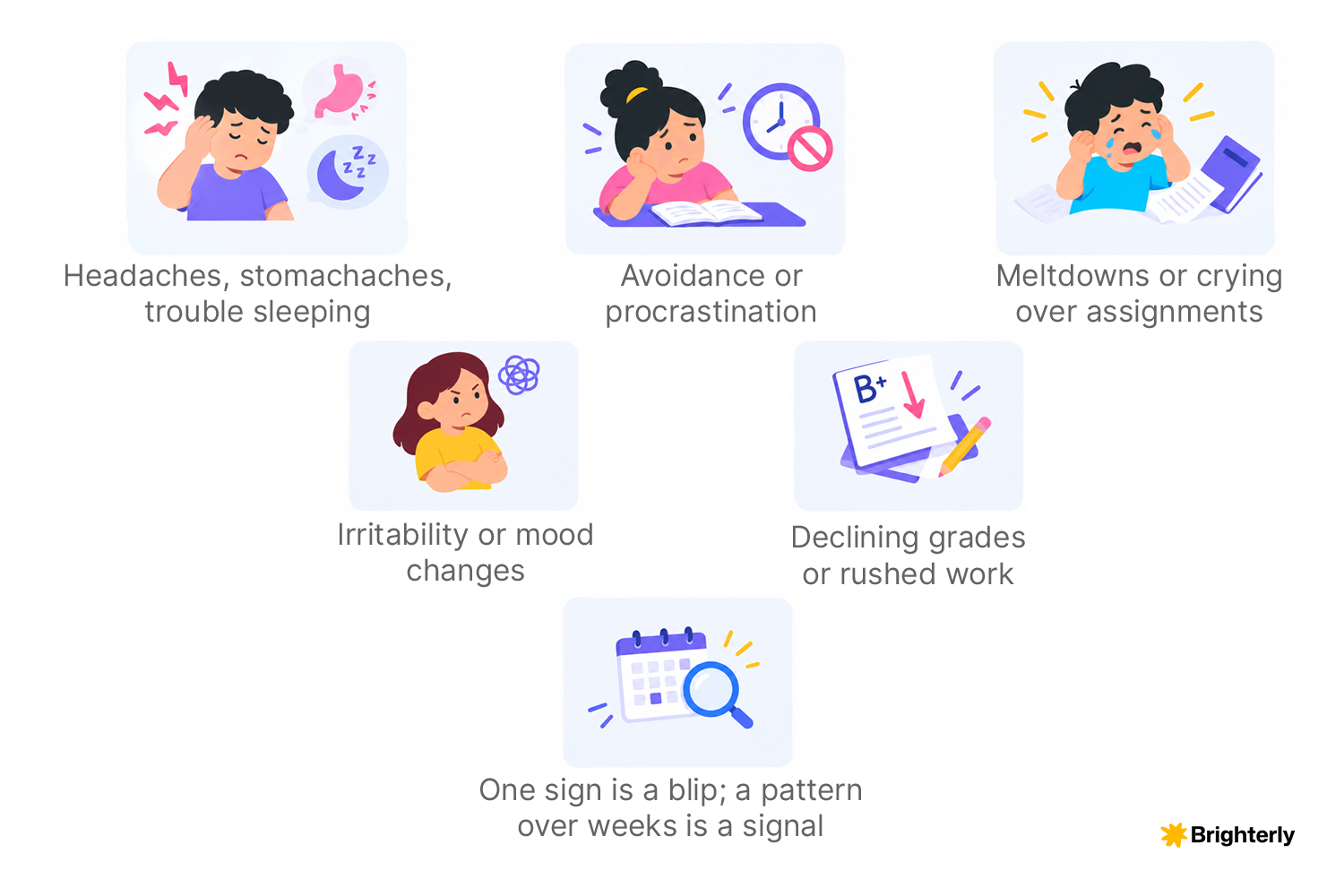
Physical symptoms, changes in mood, sudden outbursts, or a drop in grades are indicators that stress from homework is affecting kids. Children find it hard to tell directly that they are stressed. Instead, their body or behavior will give you signs. Look for the following:
- Physical symptoms. They include headaches, stomachaches, and trouble sleeping.
- Avoidance and procrastination. Children may “forget” about assignments or find a reason to postpone doing them.
- Meltdowns or crying. Children may break down over assignments.
- Irritability or mood change. Because of rising pressure, children may snap at others or withdraw from homework altogether.
- Drop in grades. Stress can push kids to skip questions or rush through the work, which affects overall performance.
Note. One individual sign is not necessarily a problem. A pattern is more worrying, as it may drain a kid and lead to academic burnout (more on this below).
How Much Homework Is Too Much?
Homework becomes too much when it goes beyond national guidelines, takes time from sleep or family, or turns into pure repetition.
The first case when homework is too much is exceeding the 10 minutes per grade level rule recommended by the National Education Association (NEA). For example, under NEA guidelines, a 2nd grader should spend about 20 minutes, a 5th grader about 50 minutes, and an 8th grader about 80 minutes.
Also, homework may be too much when it stops encouraging learning and becomes doing homework for the sake of points. The same Stanford report (2014) found that students averaged 3.1 hours of homework a night, while earlier research shows that the benefits of homework level off at about 2 hours a night.
A large 2025 study of students in China found that homework helps, but only up to a point, and then it works the other way. For elementary school, it’s 1 hour a night; for middle school and high school, that point is 1.3 hours and 2.4 hours, respectively.
You can check our article to get the full picture of homework statistics.
Don’t let homework take your family evenings
Our tutors customize lessons based on kids’ needs and struggles 

How to Make Homework Less Stressful for My Child
To make homework less stressful for your child, you should focus on developing an appropriate zone and workspace for a kid to do homework, helping them manage time, support and communicate about the homework, and ensuring they don’t neglect basic needs.
Build a Predictable Homework Routine
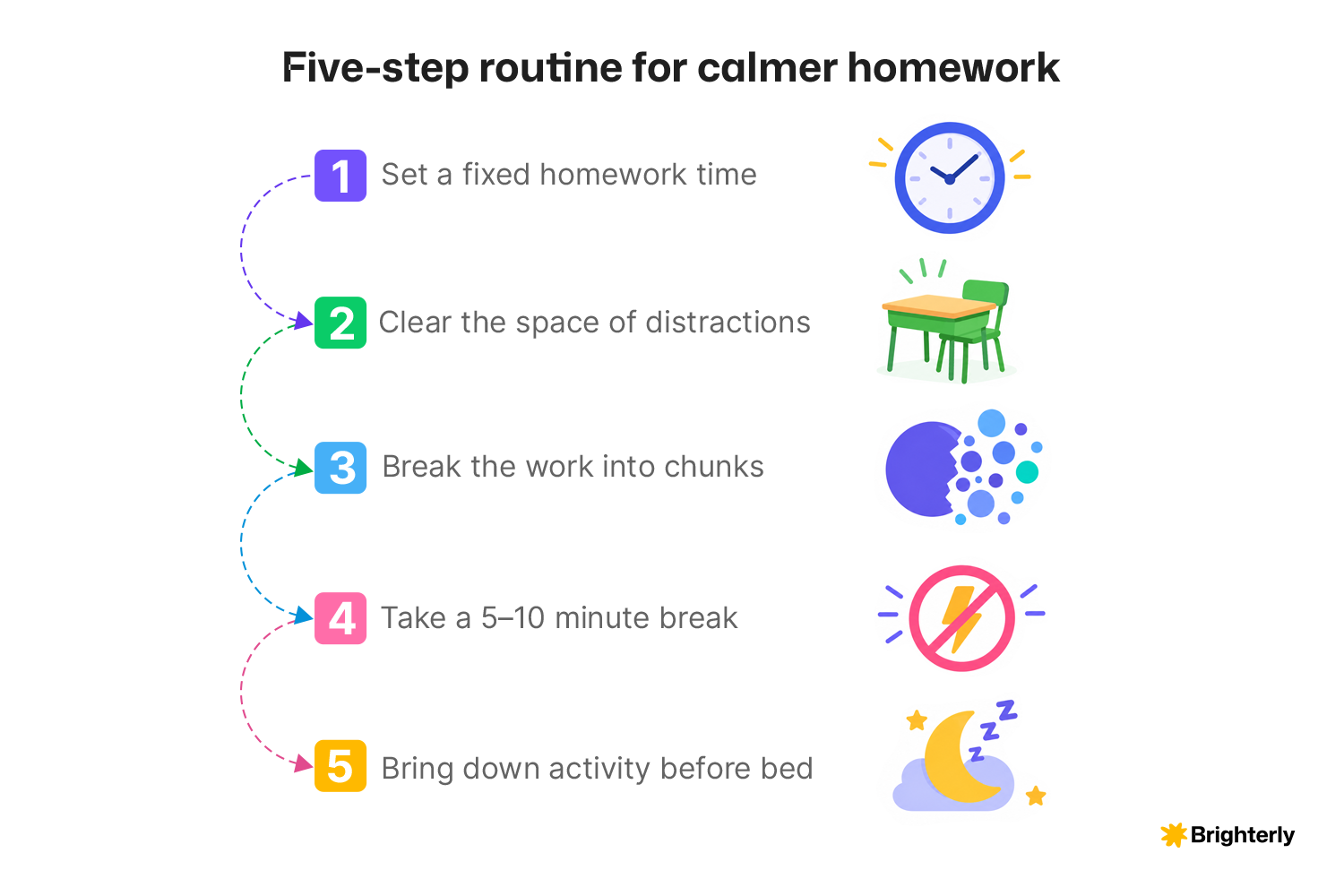
Children are calmer when they understand and know what comes next. That’s why one of the tips is to set a routine and make homework predictable. How?
- Pick a consistent time when kids start and finish homework.
- Agree on an order for assignments.
- Keep both balanced and steady during weeks and months.
- You can even add small rituals or a snack time.
A fixed rhythm builds tolerance, keeps homework from spilling into the night, and helps kids feel in control of their time.
Koren Hudson, Chief Clinical Officer at Horizon Recovery, shares how routine connects to the child’s nervous system:
“When a child melts down over homework every afternoon, I look at their nervous system before I look at the homework.”

Importantly, if you see that the evening routine starts to change or a kid struggles with tricky assignments, you’d want to get math homework help. At Brighterly, we pair a child with a tutor so they can deal with problems together in an engaging way.
Set Up a Distraction-Free Homework Space
Next, a dedicated space can also help to reduce stress. It allows kids to keep focus and makes starting the homework easier. As a parent, you should:
- Choose a quiet spot with good light and a clear surface.
- Keep the materials and supplies within kids’ reach, so they won’t get distracted or find a reason to.
- Put the phones away and switch off the TV or media devices.
For younger children, a kitchen table may work, especially if you stay nearby. Older students may prefer a separate desk, for instance, in their room. In any case, when the children have a tidy space where they can work, the brain knows it’s time to focus.
Break Big Assignments Into Smaller Steps
Kids may feel stressed if they see the assignment as too big to deal with. A huge project often feels impossible, while small tasks are not. So, try to teach them how to approach big tasks and not feel overwhelmed by them. The goal is to make each task small enough to finish.
For this, you can sit down with your child, list every step, and guess or evaluate how long each will take. Next, check these steps off one by one. In the end, it’s a skill that answers how to manage homework stress and time around it.
Note. With big assignments, starting may be the hardest part. So, if you see a kid is trying to delay the work, you can benefit from some tips on how to stop procrastinating.
Build In Short Breaks
Children should have breaks. Why? Because tiredness is often a source of mistakes and stress. So, after 20 or 30 minutes of focused work, let your child take a small break of 5 or 10 minutes.
However, remember that children who are younger may want breaks sooner. You should encourage them to move, drink water, or have a snack. Also, try to avoid having them use screens during this break.
A short break is a simple answer to how to deal with homework stress in the moment. When you see frustration rising, pause, take a short break, and come back to the task in 5 minutes.
Offer Support Without Taking Over
As a parent, your role is to be present and supportive, not necessarily to solve the problems. Kids should struggle through tasks and be able to do it themselves. The good ways to offer support are to:
- Ask questions such as “What have you tried to solve it?” or “What does the task ask you to do?”
- When asked, don’t just hand over the answers; give hints that point them in the right direction.
- Praise the effort and strategy they use, not just the correct answer.
The right questions and support will help them build resilience and develop a growth mindset; that’s a way to help kids with homework in the long run.
Amy Funkenstein, MD, adult, child, and adolescent psychiatrist, underlines how the support should and shouldn’t look:
“Whatever you do, don’t solve it for them! You can be there as their emotional support person.”
Loop In the Teacher When Something Isn’t Working
Teachers can make changes in the learning process and make interventions to help kids. They can support your child, yet they can’t fix what they don’t know about.
So, when homework and stress collide at home night after night, you can loop the teacher in. How? Send a short but specific note sharing:
- How long assignments take
- Where your child is stuck
- What the evenings are like
After it, you can ask about the purpose of the assignments, flexibility on deadlines, and ways to lighten the load. It’s a way to find the right supporting strategies, identify where the stress is coming from, and how to make it lighter.
Dani Peloquin, EdD, Director of Instruction at Fusion Academy, underlines that reaching out to a teacher is the right step if you see that stress is unhealthy.
“An unproductive struggle happens when a student doesn’t have the tools or skills necessary to work through the problem, and the challenge becomes insurmountable.”
Protect Sleep and Downtime
Sleep deprivation may be both a symptom of homework stress and a cause of more. The rationale is that tired students may struggle with memory and mood. Lack of sleep also weakens problem-solving, which makes homework even harder.
As a parent, set a firm stop time for homework. Also, establish rules for screen time before bed, so it doesn’t keep a kid up all night.
On the other hand, if assignments take up bedtime, you can treat it as a workload issue. Your next step can be to raise it with a teacher. The ultimate goal is to protect bed, play, and family time, as the kids would need it to recharge.
When Homework Stress Turns Into Academic Burnout
Most homework stress fades once a tough project is done or the load gets lighter. But when the pressure lasts for weeks or months with no real break, it can turn into academic burnout. Burnout doesn’t go away after a weekend off, and it has three parts:
- Emotional exhaustion. Your child feels drained, even after a full night’s sleep.
- Cynicism. They stop caring about school as a whole, not just homework, and lose interest in subjects they used to enjoy.
- A low sense of accomplishment. They feel that nothing they do is good enough, so they stop trying.
The signs of homework stress listed above still apply, but they spread beyond homework time: stomachaches on school mornings, excuses to stay home, and withdrawal from friends or favorite activities. A heavy workload is a common cause, especially when it comes with pressure to get perfect grades and a packed schedule. Academic pressure is also one of the leading causes of mental health issues in students, as our student mental health statistics show.
How to Help a Child Recover From Academic Burnout
The routine steps above still help, but recovery starts with taking pressure off rather than adding more structure:
- Lower the demands for a while. Ask the teacher about a lighter load or flexible deadlines until your child recovers.
- Make time for things that aren’t school. Hobbies, play, and movement aren’t lost study time. They help the brain rest and recharge.
- Praise progress, not perfection. Celebrate the effort your child put into a hard task instead of focusing only on grades.
- Listen before you fix. Give your child space to talk about how they feel. Once they feel heard, it’s easier to see together what needs to change.
“The biggest mistake parents make is treating burnout as a motivation problem rather than a nervous system collapse.”

If the signs last for several weeks, it’s time for the extra help described below.
When to Get Extra Help With Homework Stress
You should get extra help with homework stress if the routine you set in place does not help, while the kids consistently struggle to understand concepts, experience emotional distress, and spend lots of time on basic assignments. In particular, consider extra help when:
- The stress lasts more than a few weeks despite the changes and strategies you applied.
- You see that physical symptoms, like headaches and stomachaches, keep coming back.
- Your kids start avoiding school or withdrawing from activities.
- A child has a drop in grades because of a lack of skill.
- Assignments now take hours.
When choosing help, you have various options. One of them is to resort to a school counselor or pediatrician, suitable for cases when the issue is mostly stress. Another option is tutoring, as tutors can help when the issue is the skills behind the assignments. You can also back up skill gaps with homework help websites or homework help apps; however, they may not fix the cause of the struggle.
At Brighterly, our tutors work 1-on-1 with your kid online, help them build confidence, and close the gaps that can make homework stressful. Whether you decide to take a math or reading program, we customize learning to the children’s needs and goals.
Improve your kid’s skills to make homework easier
Our tutors personalize plans to close foundational gaps
Conclusion
Homework stress usually comes from the load, the setting, or gaps in skills. To help, set a routine, break big tasks into steps, and protect your child’s sleep. If the stress lasts for weeks and spreads beyond homework, it may be academic burnout, so lower the pressure first. At the same time, when trying to support a kid, don’t solve the problems for them, but bring in an expert early.
In the end, you don’t have to fix everything at once. Yet, if you see that a kid has foundational gaps that make homework a huge stress, resort to Brighterly personalized tutoring. You can check pricing plans here, or book free session before committing to anything.
Frequently Asked Questions
What Age Do Kids Usually Start Feeling Stressed About Homework?
Children usually start feeling stressed about homework in early elementary school (around ages 6 to 8), when formal assignments appear for the first time. During this period, stress appears from mental fatigue or multi-step instructions. The stress becomes more intense during middle and early high school as workloads grow.
Can Homework Stress Affect a Child’s Sleep or Appetite?
Yes, homework stress can affect both a child’s sleep and appetite. In particular, homework may disrupt sleep cycles and bring school or homework anxiety before bedtime as the mind is active and replays school worries. High-stress tasks may shift how the body processes hunger and lead to loss of appetite or comfort eating. As the Stanford report (2014) indicates, severe stress related to homework may result in weight changes.
Should a Child Skip Homework on a Bad Day?
A child can skip homework on a bad day, yet it should be treated as an exception and not turn into an escape route. If a kid is emotionally exhausted, their brain starts working in a survival state. Within it, the part that’s responsible for learning and memory is not so effective. When kids are having a meltdown, pushing them to do homework may create a negative association with school and fuel resentment.
What’s the Difference Between Normal Homework Stress and Something More Serious?
The main difference lies in how long and how deeply the stress lasts or affects kids’ daily activities and whether it allows a kid to recover and enjoy life. Normal homework stress related to tough assignments is temporary. However, chronic stress, triggering physical symptoms and social withdrawal, may indicate more serious issues, including academic burnout.
How Can a Parent Tell if Their Child Needs a Tutor Rather Than More Time on Homework?
A parent can tell if their child needs a tutor when the kid has foundational skills gaps that don’t allow the kid to understand core concepts. In this case, extra time may bring frustration and tears. In contrast, children need more time or a better routine when the work fits their level and skills, but they get distracted, are tired, or procrastinate.
What Should a Parent Do if a Teacher Is Assigning Too Much Homework?
Parents should communicate with the teacher in a constructive manner, track the time spent on assignments, and ask for reasonable changes to the workload. Before communicating with the teacher, you should track time with notes, considering guidelines. During the conversation, you can share home observations and ask for modifications. You can also ask for the school counselor’s participation and request setting up an IEP or 504 plan.


Your child’s school report card, the library shelf, and a reading app may all show different reading levels — they all can be right, because each may use a different scoring system and often a different chart to compare them. See what a reading level conversion chart shows, why charts may give different numbers for […]

Oct 26, 2026

If your child is a high-ability learner craving greater depth and faster progression, given that standard school curricula move at a fixed pace, you’re most likely considering enrichment programs for gifted students (and rightly so!). The following top programs differ in format, curriculum, flexibility, level of personalization, pricing, and much more – choose the one […]

Nov 03, 2026
Math & reading from 1st to 12th grade
Looking for homework support for your child?

Choose kid's grade

Math & Reading for Grades 1–12
Build real confidence for your child with a Brighterly math or reading tutor.