How to Teach Division to Kids (2026 Guide)
reviewed by Jessica Kaminski
Updated on July 18, 2026

Key Points
- Explain division to a child as sharing or grouping items into equal parts. Start with simple examples using real objects so the idea feels concrete.
- According to a 2022 University of Pennsylvania study prepared by the Emily Szkudlarek, Haobai Zhang, Nicholas K DeWind, and Elizabeth M Brannon, significant part of children aged 6–9 can intuitively divide before they recognize the division symbol or solve basic division equations.
- There are many effective ways to teach division, from equal sharing and connecting with multiplication to column division and word problems.
- Students who work through division worksheets build fluency faster by applying concepts to varied practice problems.
- Combining any method with highly personalized tutoring — such as Brighterly’s math and reading platform — speeds up learning, eliminates stress, and boosts outcomes.
This guide explains how to teach division to kids, helping parents and tutors use simple methods, clear examples, and step-by-step practice.
What Is Division? Key Concepts Before You Start Teaching
Division is an arithmetic operation of splitting a number into equal parts or groups. Division answers questions ” How many are in each group?” or” How many groups can I make?”
For example:
- 12 ÷ 3 = 4 → 12 items split into 3 equal groups give 4 in each group;
- 15 ÷ 5 = 3 → 15 items grouped into sets of 5 make 3 groups.
This process is also closely connected to multiplication. Division helps check or reverse multiplication facts and understand how numbers work together:
If 3 × 4 = 12, then 12 ÷ 3 = 4 and 12 ÷ 4 = 3.
Sharing vs. Grouping: The Two Types of Division
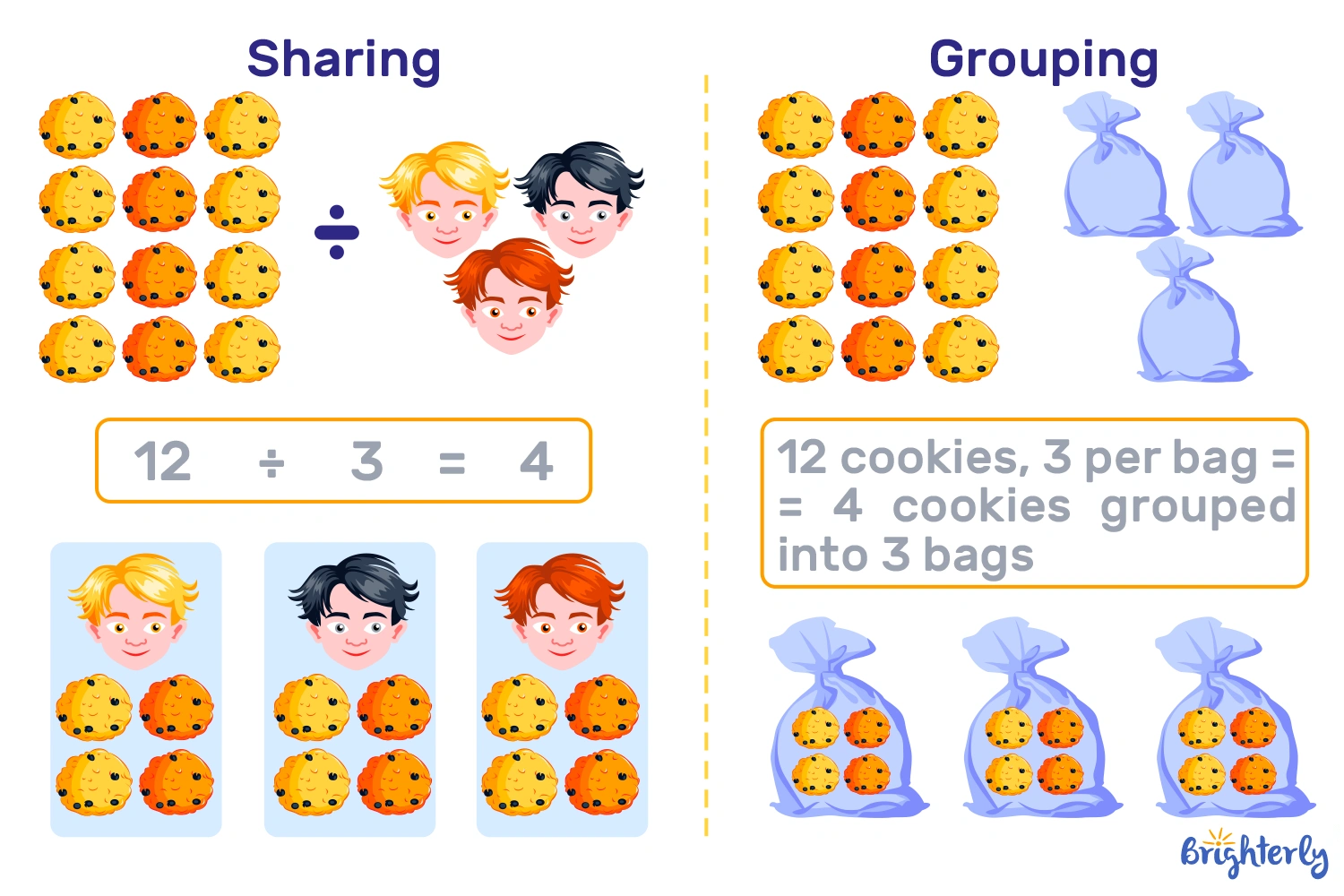
There are two ways on how to explain division to a child — sharing and grouping:
- Sharing means the number of groups is known. The child needs to figure out how many go in each group.
Example: 12 cookies shared among 3 children — how many does each get?
- Grouping means the group size is known. The child needs to figure out how many groups can be made. This type connects well to repeated subtraction and is common for Grade 3–4.
Example: 12 cookies, 3 per bag — how many bags are needed?
Division Vocabulary Every Child Needs to Know
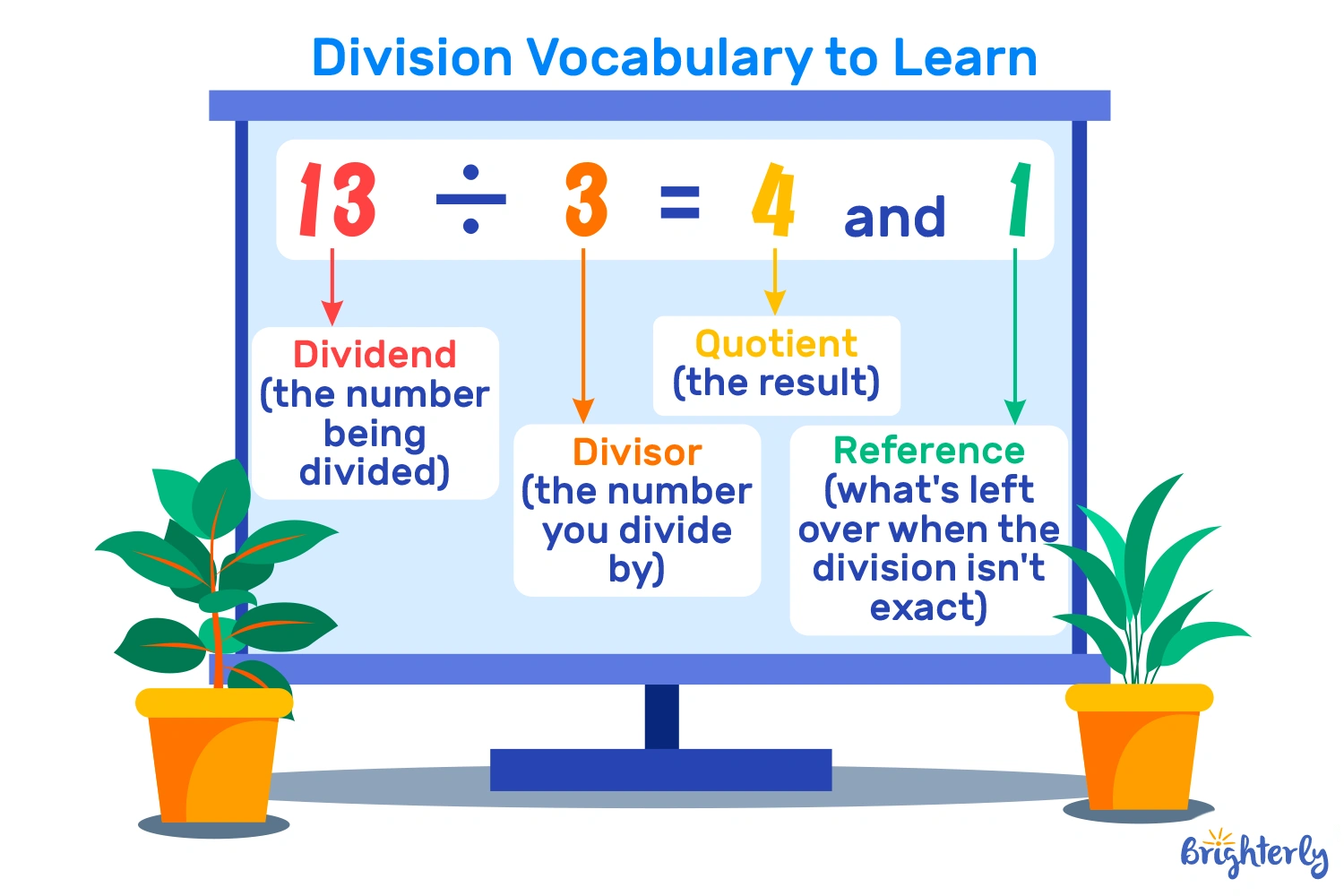
Use proper division vocabulary from the start: dividend, divisor, quotient, and remainder. These division terms appear on U.S. state assessments and in the classroom:
- Dividend: the number being divided (13 in 13 ÷ 3)
- Divisor: the number you divide by (3 in 13 ÷ 3)
- Quotient: the result (4 in 13 ÷ 3 = 4)
- Remainder: what’s left over when the division isn’t exact (13 ÷ 3 = 4, remainder 1)
For instance, don’t ask children how much 15 divided by 3 is. Instead, ask them how much the quotient is if the dividend is 15 and the divisor is 3.
Using correct terms signals to your child that you take their learning seriously and builds confidence over time.
Explore Brighterly Learning Experience
Learn exactly how Brighterly helps students thrive through expert sessions, online tools, and proven feedback from thousands of satisfied parents
When Do Kids Start Learning Division?
In the US, kids usually begin learning the formal concept of division in third grade, around ages 8–9. After Grade 3, division becomes more advanced. Before that, children often meet division informally. For example, a kid needs to share toys or cookies with friends, which eventually boils down to dividing them. That’s why it’s a good idea to slowly introduce division concepts to your child starting at age 3.
Here is how division skills develop by grade:
| Grades | Division skills | Examples |
| Grades 1–2: informal foundation | Children begin with simple sharing and grouping in everyday situations. They may not call it division yet, but they are already building the idea behind it. | 8 grapes shared between 2 kids |
| Grade 3: formal introduction to division | Students learn division as equal sharing, equal groups, and the inverse of multiplication. They start solving basic facts and simple word problems. | 12 ÷ 3 = 4 and 3 × 4 = 12 |
| Grade 4: larger numbers and remainders | Children move on to multi-digit division and learn what to do when the answer is not exact — including how to apply division in word problems. | 26 ÷ 4 = 6 remainder 2 |
| Grade 5: multi-digit division and decimals | Students work with multi-digit divisors and begin using division with decimals and fractions in more complex problems. | 6.4 ÷ 0.8 = 8 or 156 ÷ 12 = 13 |
How to Teach Division to Grade K-2
The best way to teach division to Grade 2 is through real-world examples and entertaining activities. The same approach also works well if you are wondering how to teach division to Grade 1 students, who learn best through sharing, grouping, and play.
Equal Groups and Sharing
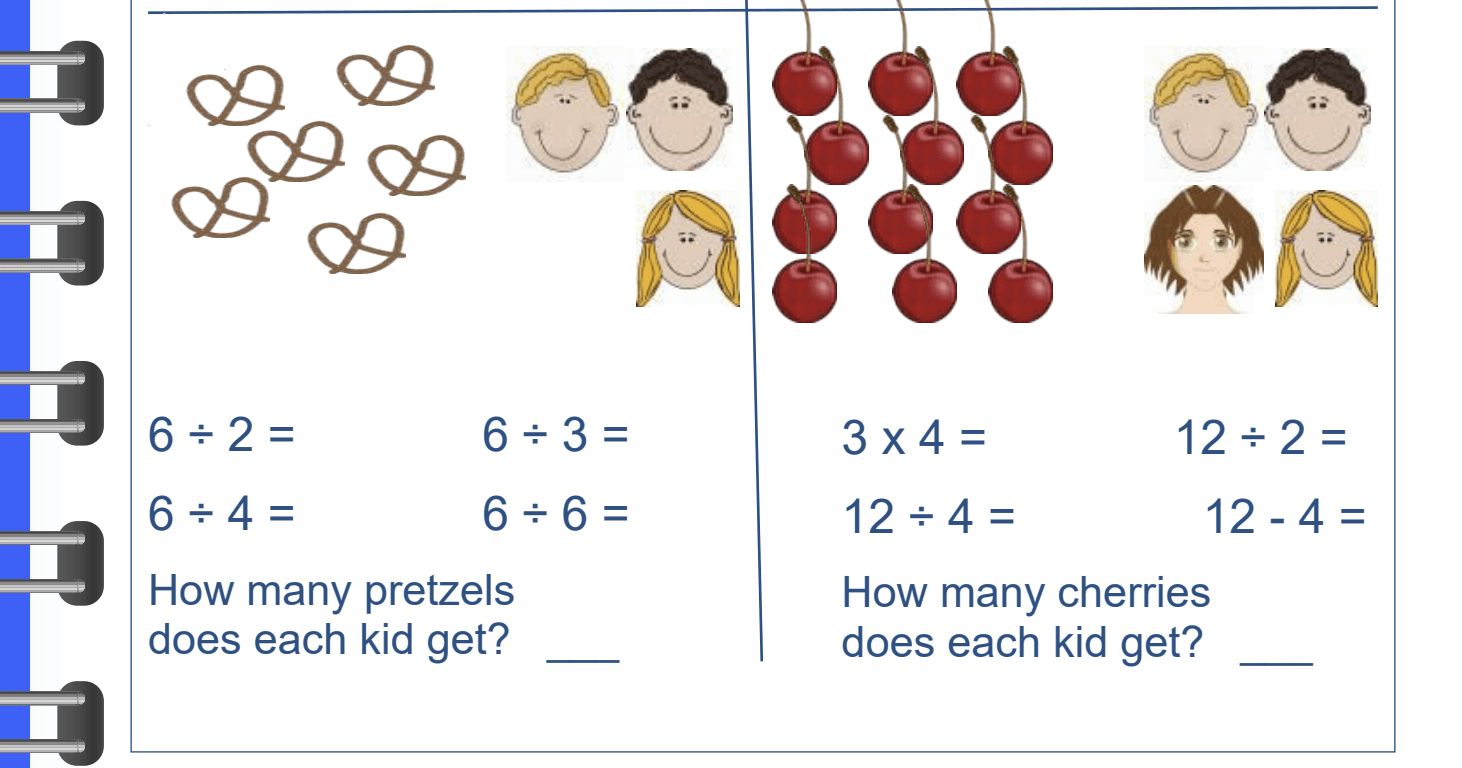
One of the best ways to teach easy division for Grade 2 and up is to use equal sharing. This strategy helps kids understand the core logic of division and its purpose, which facilitates the whole process.
Example:
- Give a child 12 crackers and ask them to share them equally among 3 toys. Each toy gets 4 crackers.
- Show 10 buttons and ask how many groups of 2 they can make.
These simple examples help kids understand what division does before they solve written problems. Free division worksheets for 2nd grade from our library pair well here. They help children work on sharing, grouping, and equal sets with visual models and more practice.
Songs, Games, and Manipulatives
If you are looking for another strategy on how to teach kids division, use math songs. Songs make abstract math concepts easier to remember. The Division Song for Kids is always effective for young learners by turning division into subtraction, grouping, and sharing — concepts that 1st- and 2nd-graders already understand.
Math games work well, too. Simple activities like sorting objects into equal groups, rolling dice to make sharing problems, or racing to build matching sets turn practice into fun play.
Manipulatives such as blocks, counters, or beans allow children to sort objects into groups by hand. This activity helps young learners understand an abstract idea.
Does Your Child Struggle with Division?
Our tutors make division click for early learners — visual, guided, personal.


How to Teach Division to Grade 3
The best division strategies 3rd grade students can use are fact families, arrays, and number lines. To build division fluency in Grade 3, ensure that your kid has a strong foundation in multiplication, and then present division as the opposite of multiplication. Soon, your child will start noticing that 3 x 4 = 12, while 12 / 3 = 4 and 12 / 4 = 3.
Connecting Division to Multiplication Facts
Once your kid has solidified their knowledge of multiplication facts, turning them into division facts will be a piece of cake.
From the multiplication table, a 2nd grade student already knows that 6 x 7 = 42. Now it’s a matter of explaining that division reverses multiplication, so 42 divided by 6 equals 7. As soon as they know how to multiply, they’ll be able to divide any number from the multiplication table with no further memorization.
Using Arrays and Number Lines to Visualize Division
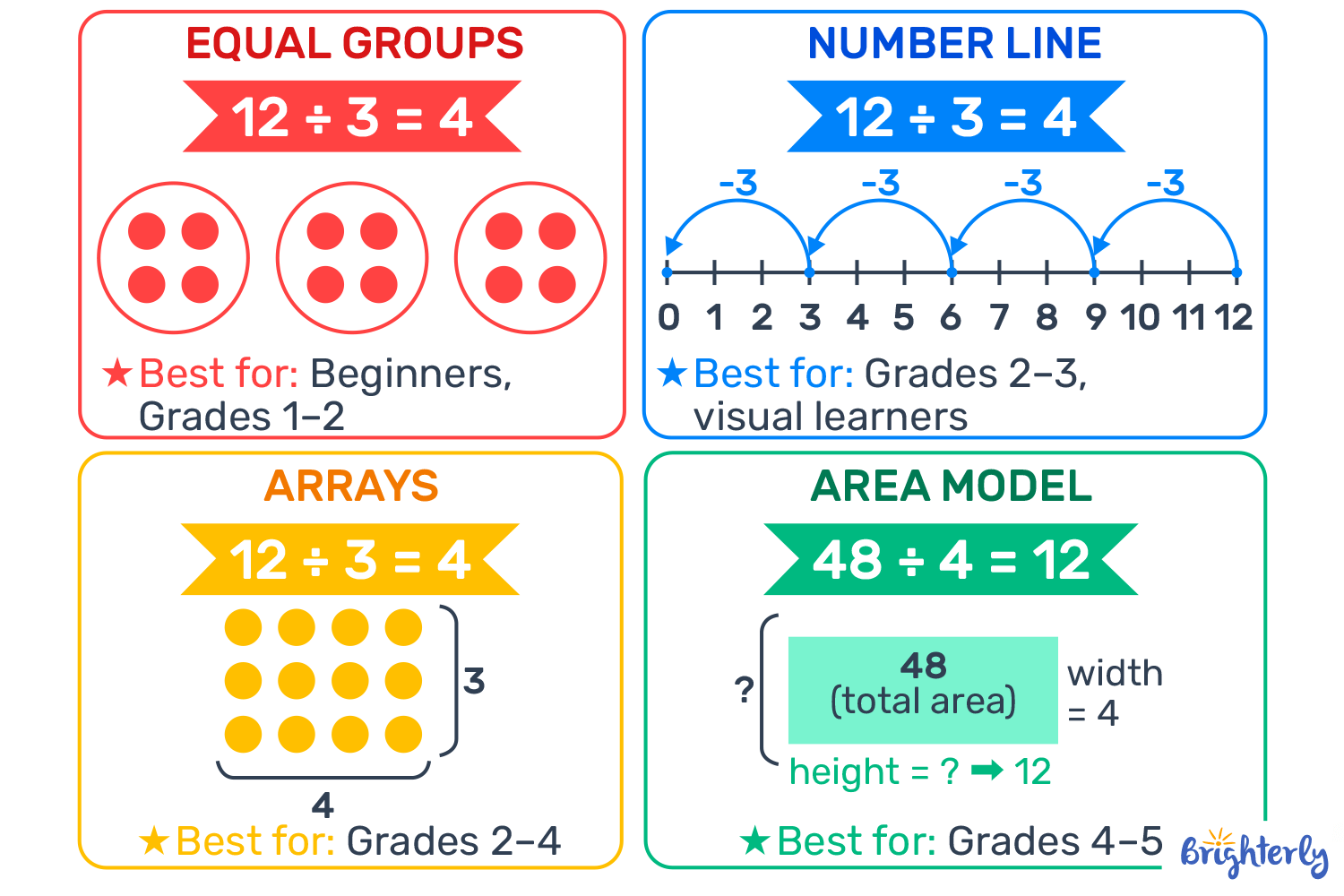
An array shows how you can arrange objects into equal rows or columns. A number line shows division as equal jumps. For example, start at 12 on the number line and make equal jumps of 3 back to 0. Then count the jumps: 1, 2, 3, 4. That shows 12 ÷ 3 = 4.
For extra practice, use division worksheets 3rd grade to provide a child with as many practice problems as they need to build skills and confidence.
How to Teach Division to Grade 4 and Up
For teaching division to 4th graders and above, move beyond the equal sharing approach to more advanced skills. Children begin working with remainders, area models, word problems, and later, decimal division.
If a child struggles to grasp division, our math program with expert tutors can guide them step by step with hands-on examples and clear explanations. Whether your child learns at school or at home, you can also use our free 4th grade division worksheets to build accuracy, confidence, and problem-solving skills.
Teaching Division with Remainders
Start with small numbers and make sure your child understands the concept of division with remainders.
Using bananas, balls, or any other item available at home, show them that sometimes when you try to share things equally between a few people or groups, there are a few left over that you can’t distribute unless you cut them.
Example: Let’s assume you are 4 in the family. Take 5 cups to divide among the family members. After giving 1 cup to everyone, your kid will clearly see that 1 is left, so this is the remainder.
Using the Area Model for Division
The area model uses a rectangle where the total area represents the dividend. One side shows the divisor, and the missing side shows the quotient.
Example: For 48 ÷ 4, draw a rectangle that is 4 units wide. Then find the height that gives a total area of 48. The height is 12, so 48 ÷ 4 = 12.
An area model helps children see division as finding a missing part.
Teaching Division with Word Problems
When teaching your child about dividing numbers, go beyond simple problems, such as 56 divided by 7, into word problems. Once you think about it, you’ll realize that you can always come up with word division problems for your child, whether at home, on the way to school, or shopping.
Explain to your child that in real situations, no one will ask them to divide 20 by 4. Instead, they’ll have to know: If muffins cost $4 each and your child has $20, how many muffins can they buy?
Dividing Decimals in Grade 5 and Up
Once you move beyond how to learn division for beginners, you’ll also run into dividing decimals, or numbers with a decimal point (not integers).
First, practice a few examples of dividing a decimal by a whole number. Teach your child to pay close attention to the decimal point’s position and what happens to it.
Example: 6.4 ÷ 4 = 1.6
Once they master this process, you can venture into dividing a decimal by a decimal. You can use a money-based example to make the concept more concrete and easier to understand.
Example: Split $6.40 among 4 people. Each person gets $1.60, so 6.40 ÷ 4 = 1.60.
10 Practical Ways to Teach Division at Home
Start teaching division at home with the most visual, hands-on methods, especially if your child is younger or finds abstract numbers hard to picture.
If you’re not sure whether your child needs specialized help in learning division, you can use our free diagnostic math tests to check their level and decide.
If your child needs more structured help, our math program offers 1:1, personalized lessons with expert tutors. Brighterly pricing is affordable, starting at only $17.70 per lesson on a 12-month plan covering 2 lessons per week (with a 20% discount).
Make Division Practice Stick
Give your child more division practice with a professional tutor
#1 Practice Equal Sharing with Real Objects
Use everyday examples. For example, give your child 4 apples and make them share them equally with their brother or sister.
Slowly make problems harder by increasing the number of objects and the number of people to be shared among. Your kid will grasp the concept and be able to handle more and more complicated division examples.
#2 Connect Division to Multiplication Tables
Once multiplication tables are solid, show how each fact family works in reverse. Pick a fact like 6 × 4 = 24, then show the related division facts: 24 ÷ 6 = 4 and 24 ÷ 4 = 6.
Write them as a fact family to make the connection clear. Practice with multiplication tables using flashcards or quick drills. This practice helps children see division as “finding the missing number,” not learning something completely new.
#3 Practice with Arrays
All you need to do is show your child how to present division into a grid on a piece of paper, where the dividend equals the total number of cells in the table, the divisor equals the number of rows, and the quotient equals the number of columns.
An array is a great way to visualize the abstract concept, so it’s particularly good for visual learners.
#4 Use Number Lines
Number line division is one of the most commonly used practices in U.S. classrooms. You can also use number lines at home.
Draw a number line and start from the total. For example, begin at 12 and make equal jumps of 3 back to 0. Count the jumps: 1, 2, 3, 4 — so 12 ÷ 3 = 4.
#5 Teach with Remainders Using Manipulatives
Take a handful of counters and try to divide them equally. When they don’t split evenly, explain to the child that what they get is a remainder.
#6 Division Through Word Problems
Frame problems around everyday situations like food, sports, or shopping. For example, use a scenario with 24 cookies packed into boxes that hold 6 each, and ask how many boxes are needed. Before solving, ask the child to identify the dividend, divisor, and quotient.
Real-world scenarios help a child understand what the problem is asking and build both comprehension and calculation skills.
#7 Check Division Using Multiplication
Teach kids to verify answers by reversing the operation. If 28 ÷ 4 = 7, then 7 × 4 should equal 28. This habit builds number sense, catches errors early, and deepens understanding of fact families.
#8 Introduce Long Division
Long division is a step-by-step method for dividing larger numbers that are too difficult to solve mentally. It breaks the problem into smaller parts, helping children divide, multiply, subtract, and bring down digits in a clear order. To support your child as they practice these steps, you can also use our long division calculator as an extra visual aid to check their work and reinforce the process.
When numbers get bigger, kids need a step-by-step written method — this is the foundation of teaching long division.
#9 Play Division Games and Activities
Game-based learning is one of the best ways to teach division. For instance, play Monopoly with your kid and ask them to divide the money among all players. Start with an easy example. Have them distribute $100 to 4 players. Gradually introduce more complex problems by having them divide $250 among the same 4 players.
As you’re having family fun while studying, your kid won’t even realize when they’ve become a division master.
#10 Integrate Cooking and Real-Life Division
Cooking together with your child is another way to practice division while having fun as a family. The benefit of being able to eat the final product further stimulates them to do all necessary multiplications, divisions, and other mathematical operations to complete the recipe.
For example, divide all ingredients by 2 if you’re cooking just for yourselves. Multiply by 3 if you’re inviting friends over.
Common Division Mistakes and How to Fix Them
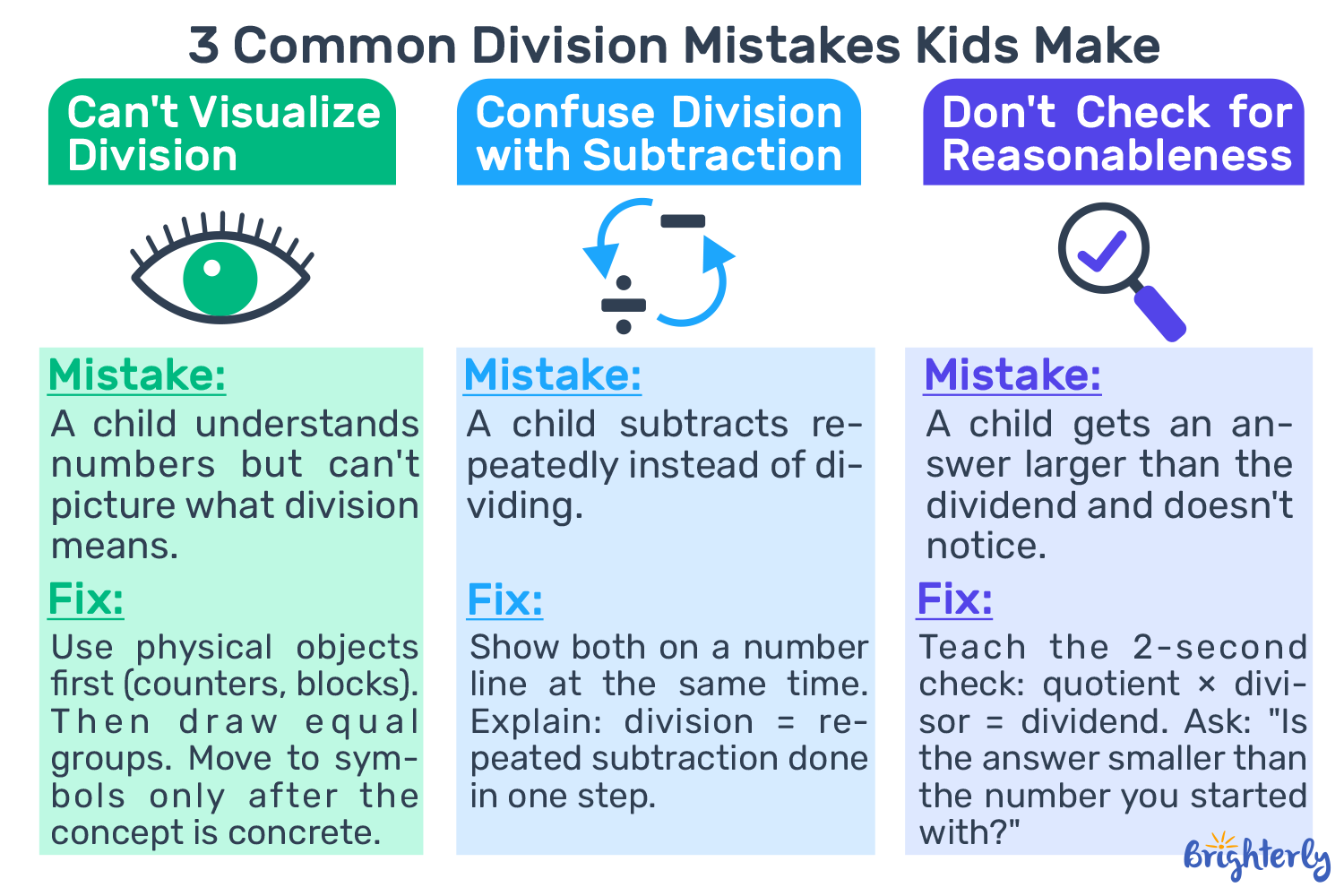
If division feels hard for your child, it’s often due to three common patterns. If you recognize them early, it becomes much easier for your child to learn.
Can’t Visualize Division
Kids struggle to visualize division because the concept is abstract. Numbers like 12 ÷ 3 don’t show what’s actually happening. Children who can calculate answers often don’t understand why they work, which leads to confusion later with word problems, remainders, and fractions.
How to fix: Start with physical objects (counters, blocks) to make equal groups tangible. Then move to drawings. Introduce symbols only after the concept is concrete.
Confuse Division with Subtraction
Another factor that hinders many children’s learning of division is that they subtract instead of dividing. Division is repeated subtraction, so kids who subtract repeatedly aren’t entirely wrong. The problem is they’re using the slow version without realizing a faster one exists.
How to fix: Show both operations on a number line at the same time. Mark how many steps subtraction takes, then show division arriving at the same answer in one move. The connection clicks visually in a way that explanation alone rarely achieves.
Don’t Check Answers for Reasonableness
Kids focus on procedure and finish a problem without asking, “Does this make sense?” A quotient larger than the dividend is a clear mistake, but it goes unnoticed when the child is only thinking about steps.
How to fix: Teach a two-second check. First, multiply the quotient by the divisor. Does it equal the dividend? Add a size check too: the quotient should always be smaller than the dividend when dividing by a whole number greater than 1. If a child gets 84 ÷ 4 = 840, the size alone signals the error.
Teaching Kids Division with Ease
Most kids don’t struggle with division because it’s hard — they struggle because it was introduced too fast, too abstract, too early. The 10 proven strategies in this guide work because they start with what kids already understand: sharing, grouping, and multiplication. Build the foundation first.
For children who need more structured support, Brighterly’s 1:1 math tutoring adapts to each child’s pace and fills gaps before they grow.
Frequently Asked Questions
What Is the Best Order to Teach Division Concepts to Beginners?
Start with equal sharing using physical objects, move to equal groups and arrays, then introduce formal notation and division vocabulary. Connect to multiplication fact families before moving to multi-digit problems or remainders.
How Do You Help a Child Who Keeps Confusing Division with Subtraction?
To help a child distinguish between division and subtraction, explain that division is a faster way to do many subtractions at once. For example:
- Show “how many times” connection: 12 ÷ 3 = 4 means you subtract 3 by 4 times: 12 − 3 = 9 → 9 − 3 = 6 → 6 − 3 = 3 → 3 − 3 = 0.
- Compare with subtraction: 12 − 3 = 9 (one step). 12 ÷ 3 = 4 (how many times you subtract 3).
When Is a Child Ready to Start Learning Division?
A child is ready to start learning division when they can group objects into equal sets and understand basic multiplication facts, at least up to 5 × 5. Schools typically introduce division in third grade, around ages 8–9, as the opposite of multiplication.
How to Explain to a Child What a Remainder Is?
To clearly explain what a remainder is, use simple examples like:
- If you have 10 candies and want to share them between 3 kids, each child gets 3 candies. One candy is left — it is the remainder.
- If you have €14 in a shop and a toy costs €12, you can buy 1 toy and have €2 left — that’s the remainder.
What Division Strategies Work Best for Visual Learners?
Visual learners understand division best when they can see how numbers break into equal parts. Use rows and columns, group objects, or draw circles to split items evenly. Show division on a number line as equal jumps backward. Area models and bar models help with larger problems. Color-coding groups or steps can also make patterns easier to follow.
How to Make Division Practice Less Frustrating for Kids?
- Teach in short 10–15-minute sessions.
- Start with small numbers and build up gradually.
- Use games, real-life examples, or visuals to make problems easier to understand.
- Avoid correcting every mistake at once.


The best math curriculum for homeschooling targets individual needs, is flexible, and doesn’t cost much. This guide compares 10 proven math programs with their features, pricing, and advantages and disadvantages to help you select the most appropriate one for your child. The Brighterly math program customizes learning to your kid’s specific requirements via real-time tutoring. […]

Apr 18, 2022

When the math ain’t mathing with your child, spicing up your lessons with some catchy and relatable math quotes for kids can make things less awkward. Even for older kids, fun quotes can help ease the tension and reduce math-related anxiety. In this article, I’ve gathered the best phrases that always make my school lessons […]
Apr 29, 2022
Math & reading from 1st to 12th grade
Looking for homework support for your child?

Choose kid's grade

Math & Reading for Grades 1–12
Build real confidence for your child with a Brighterly math or reading tutor.