How to Write a Conclusion Paragraph: Step-by-Step Help
reviewed by Franz Jerby Delos Santos
Updated on February 24, 2026

The conclusion paragraph is the final stop of any essay, and it seems to be the hardest part for schoolchildren. A strong ending helps the reader understand your point and remember your message, and many kids know what they want to say, but it’s so difficult to wrap up their ideas! Grab some pieces of advice on how to write a strong conclusion in this article.
Key points
- A conclusion paragraph brings the whole essay together and gives the reader a sense of completion.
- Strong conclusions restate the main idea in fresh words and connect key points.
- Introducing new facts or arguments in the final paragraph weakens the overall message.
- With guided support from Brighterly tutors, students learn how to write (including well-structured conclusions) in a heartbeat.
What is a conclusion?
A conclusion is the last piece of writing in an essay or any research paper that summarizes the main ideas and gives the paper a finished ending.
A conclusion paragraph has one important function: to bring the entire paper together. In this final paragraph, the writer reminds the reader of the main points from the body paragraphs, connects them to the original idea, and ends with a final thought.
What is a good conclusion?
A good conclusion connects ideas logically and helps the reader follow your final thought. When it is strong enough, the reader will understand why the essay matters. An effective conclusion will reflect on what has already been said and show the bigger picture. No transitions, and it is abrupt or unfinished, even if your ideas are superb.
How to make a conclusion in 7 steps?
- Revisit the main idea
- Summarize key points from the body
- Connect ideas with transition words
- Show why the topic matters
- Avoid adding new information
- End with a strong final thought
- Read and refine your concluding paragraph
Revisit the main idea
The first step in writing a conclusion is when you return to your thesis statement, which is the main idea of your essay, but by no means should you copy it word for word. You understand your topic and can explain the same idea using different words, can’t you? The goal is to restate, not repeat. This part reminds the reader what the essay was about, but in a more reflective tone than the introduction.
For example, if your paper was aimed at answering the question of why reading every day helps children learn, your concluding paragraph might restate that idea by highlighting how regular reading develops skills in the long run.
Enjoy the challenge of writing with Brighterly
Writing a conclusion is a hard nut to crack for kids of all ages, and for adult writers sometimes, too. All because it asks them to distill an entire essay into one thought, and this is far from easy! Children can’t recognize at once which ideas matter most or how to wrap everything up into a single sentence, and they might need help at this stage.
When kids repeatedly struggle with writing a conclusion (or writing in general), this can lead to losing joy in learning. Perhaps this is a time for parents to seek extra support, preferably with individual tutoring. If your child faces a writing problem, you can check out the Brighterly math and reading platform offering personalized help through experienced writing & reading tutors.

Children practice to restate ideas using transition words, learn creative ways to start a conclusion paragraph and its structure through guided, human-led lessons within the Brighterly writing program which is fully aligned with US state standards. Instead of guessing how to wrap up an essay, they learn how to write a good outline step by step with real feedback and encouragement.
Take our quick quiz to discover the perfect learning solution based on your child’s needs. 

Check the basics behind this term
Brighterly focuses on what helps children learn: human connection and patience. Technology supports the process, but nothing replaces the bond between a tutor and a child. Tutors adapt to each student’s pace, explain, and use engaging reading & writing worksheets to spark curiosity, alongside reading & writing tests to check understanding. So, no worries, your child will feel safe exploring ideas and making mistakes while learning how to write, and a good conclusion as well.
Summarize the key points
So, the main idea is restated. The next step in the conclusion paragraph structure is to briefly summarize the most important points from the body of the essay.
Conclusions are critical for any essay’s success. It’s your last opportunity for persuasion, for argument. The writer reminds the reader of the purpose of the paper and highlights the key ideas that support it. For example, if your essay discussed the benefits of daily reading, your conclusion might briefly mention improved vocabulary, better focus, and stronger comprehension. And all these in one or two sentences (oh, yes, this is hard!). No matter how hard it is to execute, it keeps the conclusion paragraph format clean and easy to follow. That’s why this step is crucial.
Use transition words to connect ideas
Transition (linking) words help your conclusion paragraph flow smoothly and sound complete. These words show the reader that the essay is coming to a close.
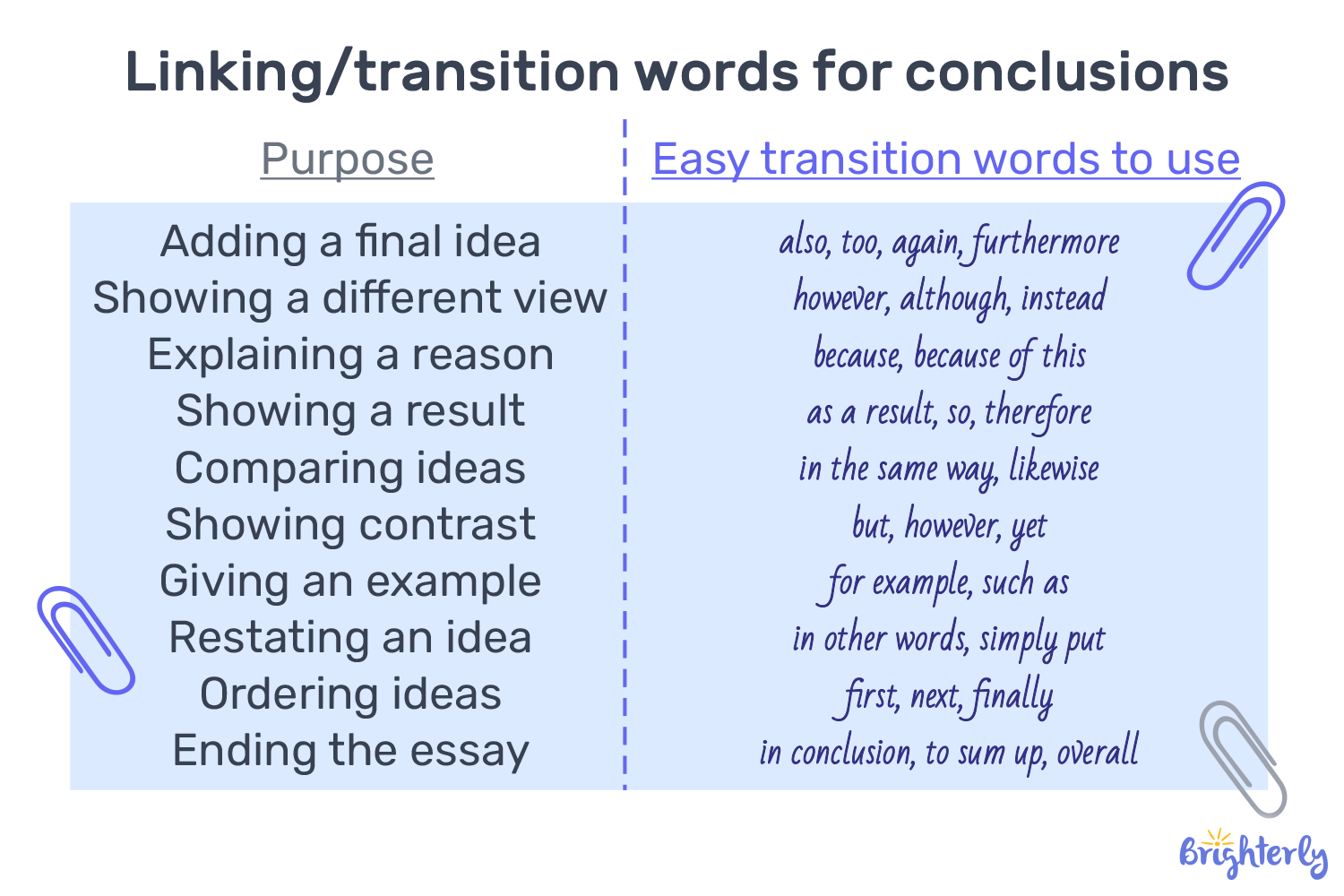
Explain why your topic matters
At this stage, your conclusion paragraph should go beyond summarizing and help the reader understand why the topic is important. This is where you remind readers of the purpose of your paper and show the broader meaning of your ideas.
When you’re able to connect the essay’s topic to real life, bigger implications, or future action, this is the best description of how to write conclusion. If we talk about school essays, this might mean explaining how the topic affects students, families, communities, or learning in general. A good conclusion will help the reader see the value of everything they’ve just read.
If you want to explain why your ideas matter, take one step back and show what they change or how they affect other people. For example, a student might write, “This topic matters because it shows how everyday habits can shape the way we think and treat others.” A sentence like this indicates the value of the whole essay, including its facts.
Avoid adding new information
A conclusion paragraph is not the place for new facts, examples, ideas, or statistics. It must do its job, which is to bring everything together, not to start something new. When you add fresh information at the end, you’ll confuse your reader and make them wonder why it wasn’t explained earlier in the essay.
Instead, it would be nice to focus only on ideas you have already discussed in your paper. You can restate them, connect them, and summarize in the broader sense. But by no means should you introduce anything unfamiliar. For example, if a student suddenly adds a new stat or argument in the concluding sentences, it weakens the whole section, since the reader is left waiting for an explanation that never comes.
So, all parts of a conclusion should leave the impression of completeness because it closes the circle. It shows the reader that the writer has finished their thought. Full stop.
End with a strong final thought
A strong conclusion always finishes with a logical closing sentence. In a good conclusion paragraph, the final thought shows the writer’s skill to end an essay in such a way that the reader remembers the key message.

I can give you one of the how to write a strong conclusion paragraph tips I use myself. Imagine stepping back and looking at the whole paper at once — a bird’s eye view, so to speak. Then extract the most important message (or several messages) you want to convey, highlight a lesson learned, suggest a broader idea, or remind the reader why the topic matters.
For example, in a conclusion paragraph example, a student might write:
“We can make smarter choices and think more carefully about the actions we take every day when we know [the facts from your essay].”
Ending this way gives the concluding paragraph a sense of purpose.
Read and refine your conclusion paragraph
A good concluding paragraph should sound clear and complete when read out loud. So, read it again, better twice after you’ve finished your work. If you feel something is rushed, confusing, or awkward, it probably needs a small fix. Small edits, such as changing a word, shortening a sentence, or improving a linking word, may be key to leaving a strong final impression.
It’s really helpful, when refining your conclusion paragraph, to ask yourself a few questions:
- Does it remind the reader of my main idea?
- Does it connect my key points?
- What if someone decided to skip the whole text and read only my conclusion? Would they understand what my paper was about?
If the answers are ‘yes’, your structure of a conclusion paragraph is working.
How to start a conclusion paragraph?
You can choose an opening sentence that signals you’re finishing and pulls the reader into your final thought, and guides the reader from the body of the essay into an explicit ending.
How do you write a conclusion that doesn’t sound flat? The best-kept secret lies in the first sentence, which sets the tone for everything that follows. It works like a bridge –– the reader crosses from details of your research and examples towards distilled meaning and reflection, which are the essential parts of a conclusion. This opening doesn’t repeat the introduction and doesn’t summarize. Its main function is to prepare the reader for closure.
Most students learn only one or two starters and use them again and again. But there are so many ways to start a conclusion! All depends on the type of essay and the effect you want to achieve.
Classic conclusion starters
These work well for school essays, reports, and exams.
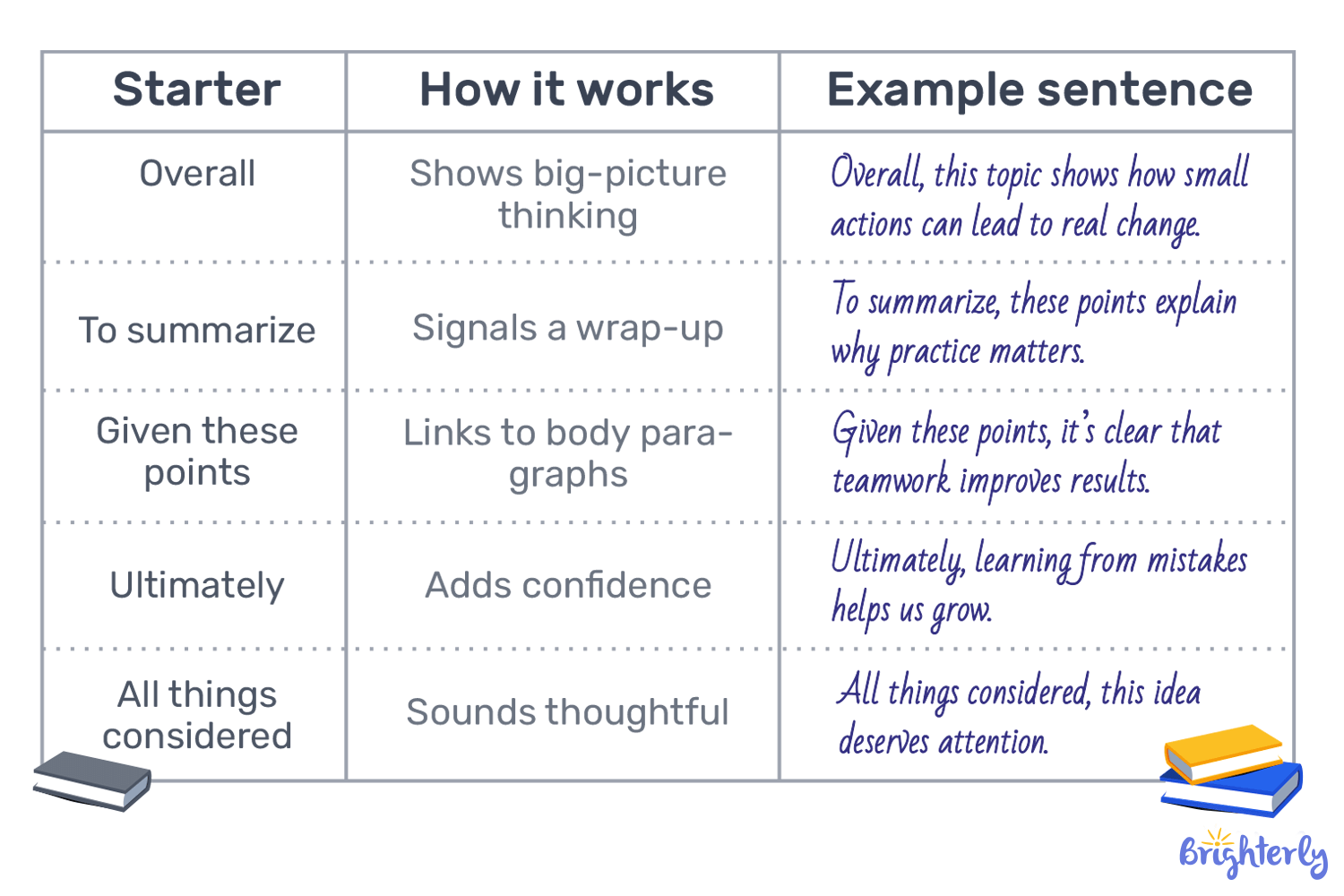
These starters help students follow the structure without sounding repetitive.
Note: Grab more starters and lots of other helpful tips in How to write an introduction paragraph article and use them for your academic writing
Original and creative conclusion starters (stand out!)
These starters are perfect for personal essays, reflections, opinion writing, and other creative assignments, and they still work within a good conclusion paragraph format.
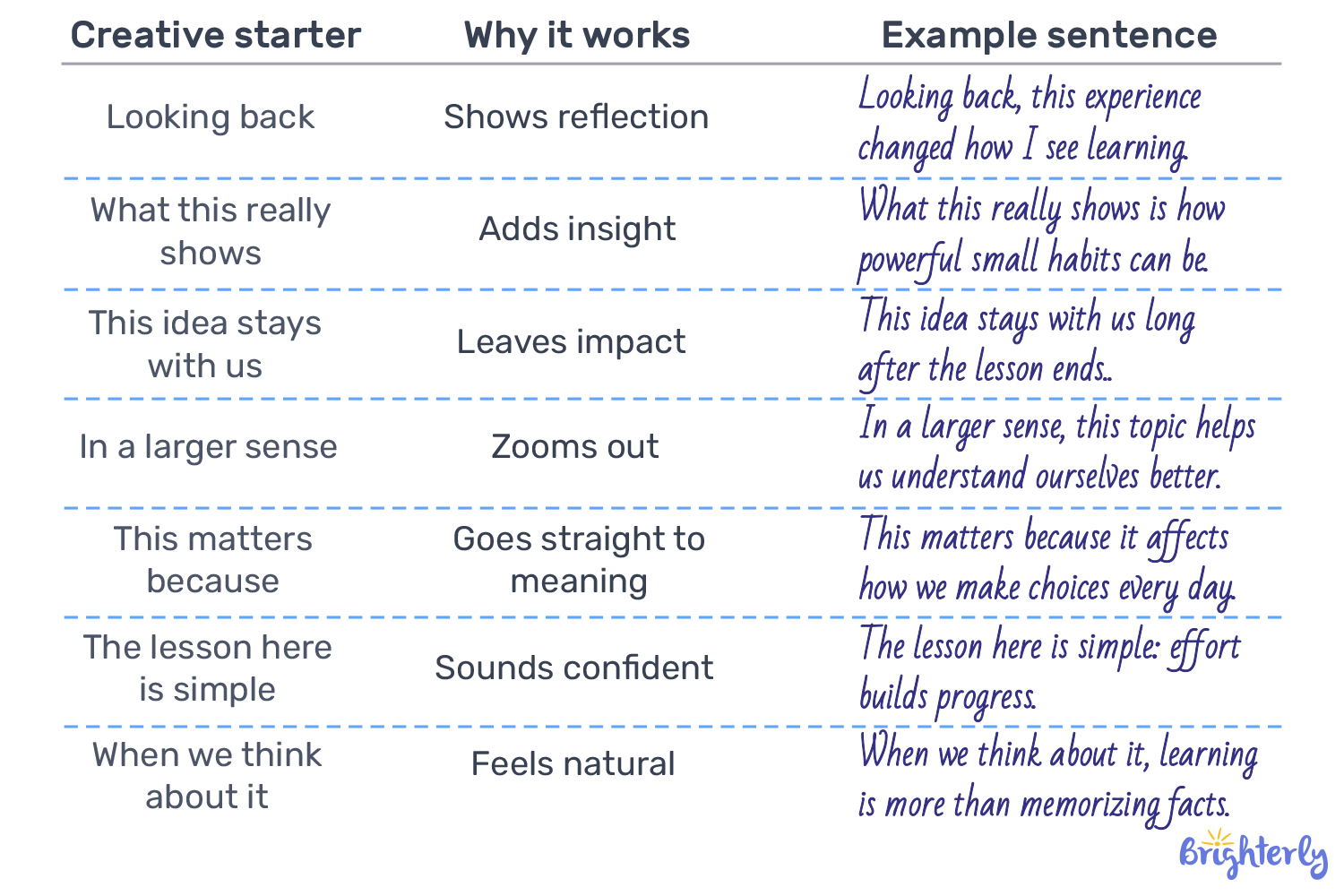
These starters will help you move beyond pure academic formulas and adapt to various topics. You can also try this how to write a conclusion paragraph example: Read only your first and last sentences. If you see that they connect smoothly and your inner feeling says it’s finished, then have no doubts – your conclusion paragraph shines bright!
Note: If you want to train your creative writing muscles as a pro, check out these 10 best tools for kids’ creative writing.
Check the basics behind this term
Take our quick quiz to discover the perfect learning solution based on your child’s needs.
How to end a conclusion?
The best way to end a conclusion is with a sentence that conveys a final insight or a gentle call to action (CTA) that motivates the reader to reflect on your whole paper.
If the first sentence opens the door, the last one closes it. Here, numerous students make a mistake, thinking they must sound “smart,” when in fact a good ending sounds intentional and usually falls into a few patterns:
- a lesson learned,
- a broader implication,
- a question,
- or a simple CTA.
These endings are integral parts of a conclusion paragraph, and they don’t repeat details, don’t add new ideas, and don’t trail off. They just show that the essay has reached its natural stopping point.
Below are some examples you can reuse and adapt.
Possible ways to finish a conclusion paragraph
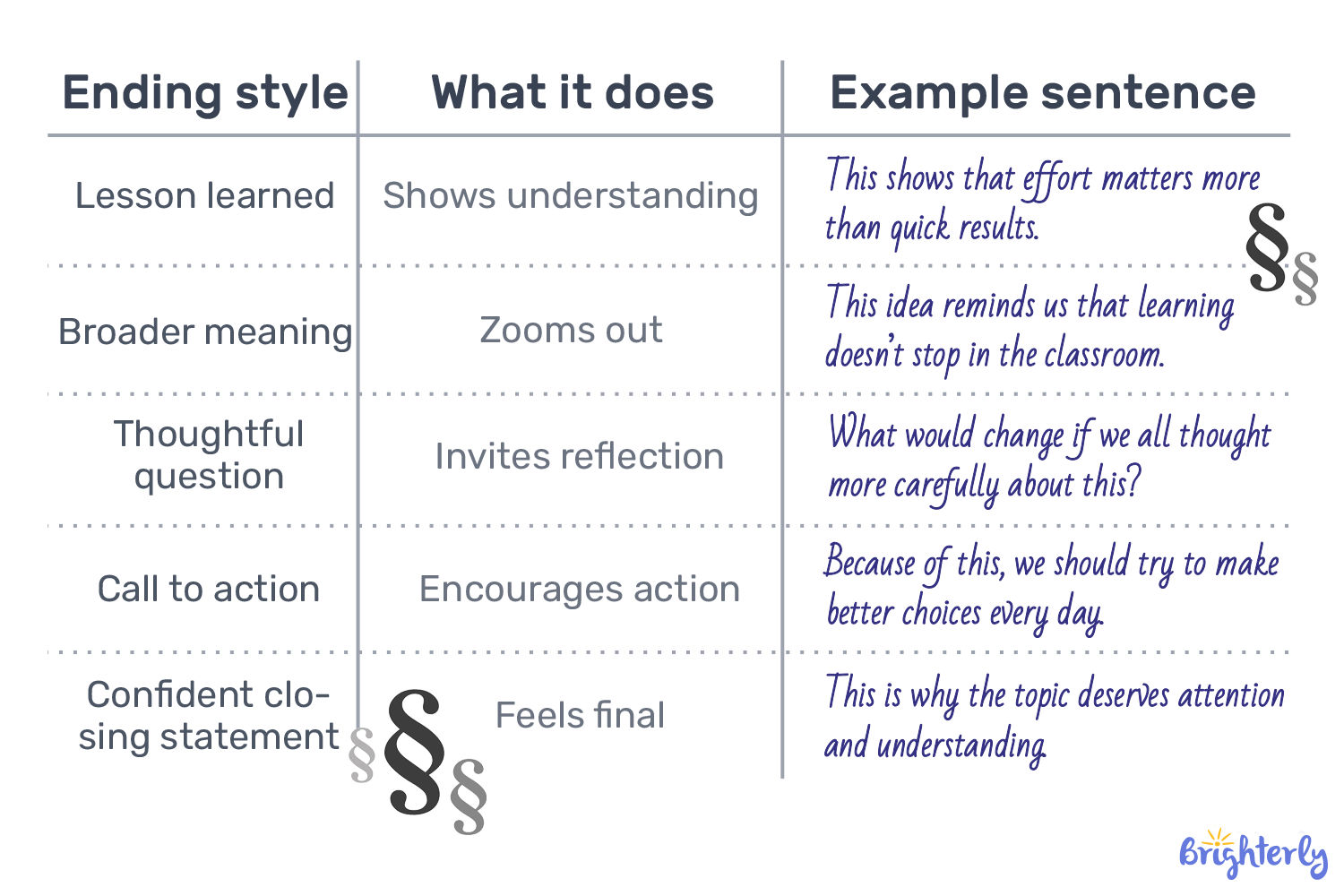
One of the most useful how to write a conclusion paragraph tips is that your last sentence should sound as if it could not belong anywhere else in the essay. If that sentence only works at the end, you’ve written a strong closing.
What does a conclusion paragraph include?
- A restated main idea
- A brief summary of key points
- A sentence that explains why the ideas have value
- A final sentence
A restated main idea
Every conclusion paragraph should remind the reader what the essay was about. The main idea is restated in fresh language. No word-for-word copies! This is the backbone of the conclusion structure.
A brief summary of key points
This part is supposed to bring together the most important ideas from the body paragraphs. This summary is short and selective, so it highlights meaning, not details.
A sentence that explains why the ideas have value
This part is dedicated to explaining the impact, value, or broader implications of your essay. A good conclusion paragraph always includes this part, which is deeper than a plain summary.
A final sentence
The last sentence provides closure in a rounded way. It may offer a lesson, a broader message, or a CTA.
In practice, you can use this checklist as a conclusion paragraph outline:
- Did I restate my main idea?
- Did I connect my key points?
- Did I explain why the topic is valuable?
- Did I end with a clear final thought?
If all four answers are “yes,” it means that your concluding paragraph does more than wrap things up. Together with the introduction, it makes a sort of a frame to better convey your message.

Therefore, before drafting the final paragraph, take a moment to revisit your essay as a whole. Read the introduction again and reflect on how your thinking has developed while you were writing. By the end, you usually understand the topic more deeply than when you began and your conclusion is the right place to capture that insight and show what the text revealed to you.
Note: Sometimes the smartest move is to save the beginning and the ending for last (I do so myself). When the main text is finished, it becomes much easier to shape an introduction and a conclusion paragraph that belong together and reflect what you wanted to say, without forcing ideas that don’t quite fit.
A stance I feel is justified by the fact that a good conclusion paragraph structure doesn’t tie up loose ends, but shows you can think about your topic more sincerely. Instead of being a boring afterthought, the conclusion becomes proof that you can explain what your ideas mean in a larger sense.
Perhaps it’s time to throw away the “just restate everything” tips students often hear. Perhaps not yet. For now, mastering these parts helps my students write conclusions so that the reader sees the point of the whole essay. This is a skill of paramount importance that will make every future writing more intentional.
Final thoughts
Good conclusions don’t happen by accident. They come from connecting ideas, showing why they matter, and finishing with a thought that sounds complete. When students understand how to write a strong conclusion paragraph and develop a habit, writing becomes a skill they can reuse in any assignment in both school and adult life.
Brighterly writing & reading tutors gently support children as they learn to put these writing tips into practice. Book free reading lesson and help your child finish their ideas thoughtfully and with growing self-belief.



If you’re reviewing AdaptedMind as a learning platform for your child, it’s a good idea to read some AdaptedMind reviews to understand what existing customers like and dislike about the platform. I’ve spent years tutoring children, so now I aim to help you make the right choice for education. Here, I have collated real user […]

Feb 10, 2026
If searching for a reading platform has led you to consider Reading Eggs vs Hooked on Phonics, then you will want to know the difference between the two. As a reading tutor with years of experience, I want to help you make the right choice for your child’s education. Here, I will compare the features, […]

Feb 12, 2026
Math & reading from 1st to 9th grade
Looking for homework support for your child?

Choose kid's grade

Math & Reading for Grades 1–9
Build real confidence for your child with a Brighterly math or reading tutor.