How to Get Better at Mental Math: Tips, Tricks, and Daily Exercises
reviewed by Jo-ann Caballes
Updated on May 5, 2026
Key Points
If your child struggles with numbers without the use of a calculator, you need to figure out how to get better at mental math. In brief, mental math is the ability to calculate in your head. This guide provides 11 proven tips to develop mental arithmetic skills through a simple daily routine.
How to Improve Mental Math: 11 Strategies That Work
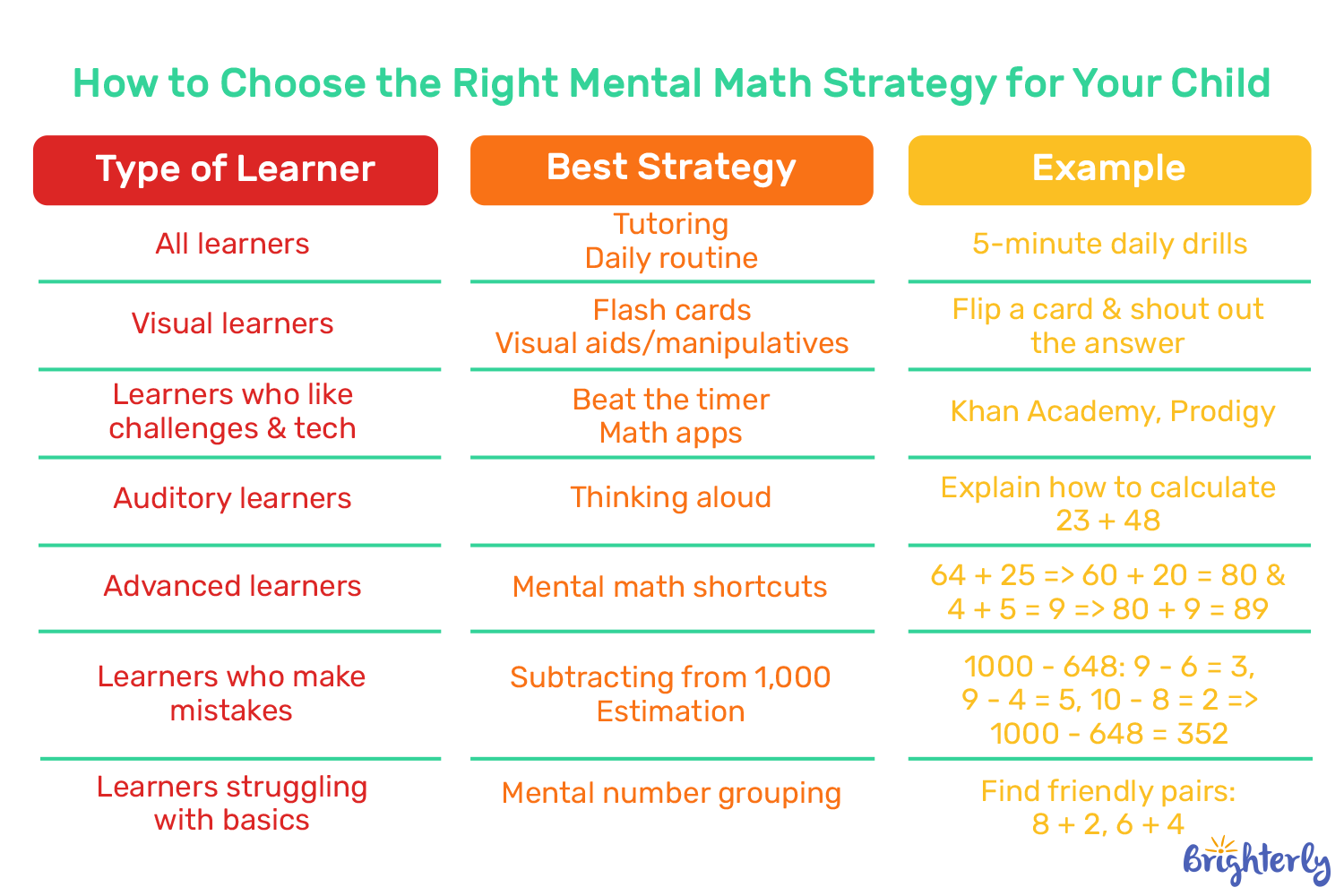
- Practice with a math tutor
- Use flashcards for fact recall
- Beat the timer
- Think aloud
- Use visual aids
- Apply mental math shortcuts
- Subtract from 1,000
- Estimate before you calculate
- Group numbers mentally
- Use the right digital tools
- Introduce a daily routine
While parents often associate learning mental math with arithmetic drills, the process goes beyond and requires carefully designed methods. In support, Claire Smizer, Brighterly Educational Advisor, states:
“Math fact practice is good – fluent recall frees working memory for higher-order thinking.”
The National Council of Teachers of Mathematics warns that timed fact tests contribute to math anxiety, supported by Jo Boaler's research that speed emphasis disproportionately drives girls and students with learning differences away from math. The fix isn't less practice - it's better practice.


Practice with a Math Tutor
Best for: All learner types
One of the best ways to get better at mental math is through practice with professional math tutors. Qualified private tutors can provide the right guidance where parents fall short.
A good tutor can identify the bottlenecks in your child’s mental processing of numbers and help your child develop numerical intuition and build a mental path to the right answer themselves.
The Brighterly math program for kids offers 1:1, online tutoring personalized to the requirements of your child. We assign the right online math tutor who dives into your child’s strengths and learning gaps to provide targeted support for improving mental math. Our friendly, compassionate tutors make sure all sessions are engaging and fit the interests of your kid.

At Brighterly, we start with foundational skills before moving to advanced abilities. Specifically, our teachers will show your child how to visualize numbers and develop the cognitive stamina needed to hold multiple steps of a problem in their heads. They will teach them how to perform operations like mental subtraction and division correctly, without writing or using a calculator.


Math support personalized to your child’s needs!
Our tutoring improves mental math skills by focusing where your kid needs support.
Use Flashcards for Fact Recall
Best for: Children who need to build quick recall and recognition
Flashcards can be a great tool when learning how to get faster at mental math. Flash cards can help your kid develop the ability to answer a math question without even thinking.
With flashcards, the trick is to shift the focus from studying to playing by turning the activity into a high-speed game. For example, you and your child both flip a card, and the first one to shout the sum or product wins. Such games can turn the chore of learning mental math into a challenging, engaging, and fun quest.
Another game idea is to create a “speed pile”, where you have several stacks of flashcards, and your kid is trying to beat their own record for clearing the deck. Make sure to mix cards with different difficulty levels and operation types to keep your little one attentive and alert as they solve mental math problems.
Beat the Timer
Best for: Kids who like challenges and gamified learning
Another way you can help your child improve mental math capabilities is by using a timer. Learning to work under time constraints is an important skill since both in math class and in daily life, kids often find themselves in situations where they need to make quick calculations.
When your child has a set time limit, they are forced to abandon the slow methods, like counting on their fingers, and rely on mental math shortcuts to get the right answer.
There are many types of beat-the-clock strategies you can use, and you can come up with your own varieties. Here is one approach that works well:
- Start with a sprint of 10 relatively simple problems to give your kid a sense of the challenges ahead.
- Track their first attempt with a stopwatch.
- Then, repeat the round at the same level of difficulty, but aim for getting the right answers 5-10 faster.
- Then repeat again, reducing the time further.
- As they try to beat their own record, your child will start prioritizing efficiency and looking for quicker ways to solve the problem in their head.
Think Aloud
Best for: Auditory learners
Yet another strategy on how to improve mental math skills is to verbalize the studying process. By thinking outloud, your child needs to organize their thoughts and explain their logic in solving the problem. This procedure helps them spot what methods they use in their solutions. As your kid walks you through their thought process, you can also see where their logic works and where it might fail so that you offer a feasible adjustment.
To implement this shortcut, start by asking your child to explain how they solve a math problem as if they were a math teacher explaining it to the class. Begin with a simple problem and progress to more complicated examples over time.
Use Visual Aids
Best for: Visual learners
Mental math feels abstract at first, especially for young learners who understand things practically. To avoid overwhelming your little one when getting started, use visual aids to support the learning process.
You can make use of pictures, real-life objects (beads, legos, toys) and tools like number lines and base-ten blocks. You can even go old-school and use an abacus. Physical manipulatives can help your child visualize how numbers behave and change to build a mental map in their consciousness before they have to make calculations without tools.
Visual aids give a physical shape to what your child needs to do in their mind. As they become more comfortable with mental calculations, you can gradually reduce the use of visual tools. By this time, your kid should be able to visualize numbers and operations in their head without external help.
Claire Smizer offers another way to use physical tools to learn mental math:
“One of my favorite mental math practice methods was to use the numbers on the clock in the classroom to have the students create meaningful number sentences that they could explain.”
Apply Mental Math Shortcuts
Best for: Advanced learners
Once your little one starts getting confident, move to more math-heavy tricks to make quick calculations in their minds. The most popular mental math shortcuts include:
- Front-end addition: Front-end addition means adding large numbers first. Schools teach kids to add from left to right. In mental math, it is often quicker to start with larger numbers. Present 64 + 25 as 60 + 20 = 80 and 4 + 5 = 9, and 80 + 9 = 89, which is the final answer.
- Doubling and halving: When your child needs to multiply two numbers that seem hard, they can halve one number and double the other. In calculating 16 x 5, we halve 16 to get 8 and double 5 to get 10, 8 x 10 = 80. This calculation is easy.
- Rounding or compensation: If your kid is working with a number close to a round number, they can treat it as a round number and then adjust. In the case of 45 + 19, they can think 45 + 20 = 65. Next, they need to subtract: 65 – 1 = 64.
- Multiplication by 11: When multiplying by 11, especially 2-digit numbers, you can split the digits, add them together, and place the sum between the 2 digits. So, 24 x 11 = 2_4, where _ = 2 + 4 = 6. 24 x 11 = 264.
Subtract from 1,000
Best for: Students who get confused with borrowing and regrouping
A classic mental mathematics calculation trick applies to subtracting from a thousand. This simple rule completely removes the need for borrowing and regrouping, which avoids unnecessary confusion.
To use this shortcut, your child needs to subtract the first and second digits of the number from 9, then the final digit from 10. For example, to calculate 1000 – 648, your child should do the following: 9 – 6 = 3, 9 – 4 = 5, and 10 – 8 = 2. The answer is 352.
In addition to making mental subtraction easier, this trick is also fun for kids to learn as it feels like a secret code.
Estimate Before You Calculate
Best for: Kids who rush and make careless mistakes
When your child is still learning how to get good at mental math, the estimation-first approach can be a great guardrail as it helps catch major errors. Developing estimation skills prevents making silly errors, boosting self-confidence. If your child rounds a number to the nearest ten or hundred, they get an expected range for the answer. This number serves as a basis for comparison.
For example, in the case of 49 x 5, a student can think, “Well, it’s almost as much as 50 x 5, which is 250. So, my answer should be slightly less than 250.”
So, if a kid gets a final answer that’s much more or less than 250, they can quickly see their mistake and rework the steps. Self-checking is key for math accuracy.
Group Numbers Mentally
Best for: Students struggling with basic addition and subtraction
The next trick works best when your child has a long string of numbers to add. The most common approach in this case is linear: students simply process the numbers in the order they appear, starting from the left. As the running total gets larger, additions become more confusing.
In mental grouping, the process is different. Your child needs to look at the entire list of numbers first and try to find “friendly” pairs, like 2 and 8 or 3 and 7. These pairs are much easier to add and result in round numbers, which are also more pleasant to work with. So, your little one needs to restructure the problem to make the calculation easier, mental addition becomes faster and improves mental math skills. Practice until this process becomes a habit.
Use the Right Digital Tools
Best for: Children who learn better through technology
The right digital tools can offer many great ways to improve your child’s math skills. The best math websites and apps for learning mental math encourage active learning, match activities to the learner’s level, and emphasize exercises over pre-recorded videos. Online platforms help keep track of progress over time and identify what skills you need to focus on more vigorously.
For instance, Khan Academy provides conceptual foundations, computational shortcuts, and interactive practice. Prodigy also supports the establishment of mental math skills through Math Facts, a feature designed to build math fluency through short, engaging sessions.
The Brighterly after school math program provides frequent targeted learning sessions. Our teachers adjust the learning plan to the exact skills that your child needs to develop after a careful assessment and in consultation with you.

Willing to try?
Regular math sessions starting at $17.70/class!
Our tutors focus on what your child needs rather than a generic program.
Introduce a Daily Routine
Best for: Kids who benefit from structure and schedule
A consistent daily routine makes learning mental math automatic rather than stressful. Short, daily sessions reduce resistance, make practice feel like a normal part of the day, and stimulate working memory. In 2025, the Association for Psychological Science explained that brief, timed practice sessions are optimal for learning math at a deep, conceptual level as they strengthen memory.
Allocate 5-10 minutes at the same time each day, for example, after school and before doing homework. Keep the structure simple: a quick warm-up, 1 focused strategy, and a drill. Repeating this structure daily will help your little one know what to expect and stay engaged.
For improving mental math skills, consistency matters more than duration. Daily exposure to exercises helps develop recall speed, identity patterns, and eliminate hesitation.
Explore Brighterly Learning Experience
Learn exactly how Brighterly helps students thrive through expert sessions, online tools, and proven feedback from thousands of satisfied parents
How to Practice Mental Math Daily: A Simple Routine
The best routines for how to learn mental math include a consistent, short daily structure that keeps practice organized and a weekly plan that avoids boredom. Each day, start with a quick warm up, practice one strategy, solve a few problems, review answers, and fix mistakes.
Daily 5-Minute Structure (Repeat Monday-Friday)
- 1 minute – Warm up: Quick recall (doubles, addition/subtraction within 20, or time tables).
- 2 minutes – Strategy practice: Focus on one mental math trick (rounding numbers or multiplying by 11).
- 1 minute – Speed drill: 5-8 mixed problems to build math fluency.
- 1 minute – Review: Check answers and correct mistakes together.
Weekly Plan
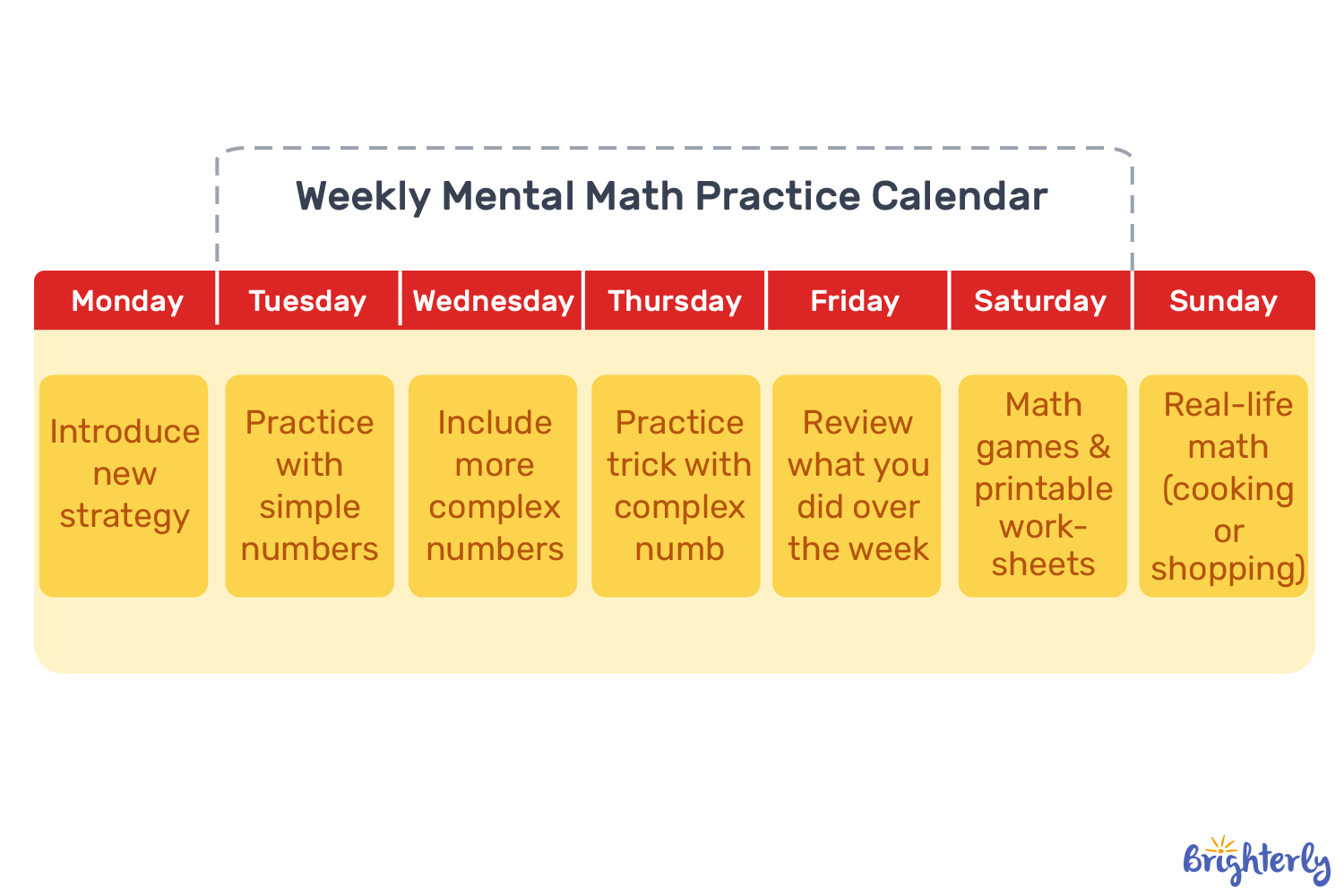
- Monday-Tuesday: Practice one new strategy, starting with simple numbers. Progress slowly and focus on understanding.
- Wednesday-Thursday: Apply the same trick to slightly harder problems and mix in older mental math skills.
- Friday: Do a mixed weekly review (addition, subtraction, multiplication, division) to support knowledge retention.
- Saturday-Sunday: Practice math games, real-life math (cooking or shopping), or different printable math worksheets to keep it casual and relaxing.
When to Introduce New Tricks
Aim to add one new mental math trick per week. Teach new mental math strategies only after your child feels comfortable with the current one. Rushing through multiple tricks simultaneously will lead to confusion, hesitance, and lack of confidence in your kid’s own power. It’s OK to stay on the same technique for 2 weeks when needed as long as you solidify skills.
How to Track Progress
Use a simple notebook or checklist to keep track of how much your child is improving mental math skills. Record:
- Number of problems solved correctly in 1 minute
- Types of mistakes made during the drill
- Time taken to complete arithmetic drills
Make sure to recognize weekly improvements to help your kid build pride.
When to Level Up Difficulty
Increase the level of challenge when your child is able to solve most problems quickly and accurately. Make transitions gradual: for example, progress from single-digit to double-digit numbers or combine operations (e.g., 12 x 4 + 8). Don’t hurry if your little one’s not ready yet to avoid frustration and discouragement.
Common Mental Math Mistakes (and How to Fix Them)
The mistakes that parents and children make most often when studying mental math include:
- Memorizing without understanding: Relying purely on memorization (among which are memorizing multiplication tables) can limit the practicability of mental calculations. When numbers change slightly, kids get stuck.
Fix: Encourage breaking numbers apart (e.g., 8 x 7 = 8 x 5 + 8 x 2) so that your child understands how calculations work, not just remember numbers.
- Skipping estimation: Many students jump right into exact answers without checking if the result makes sense. Students who skip estimation make more avoidable errors.
Fix: Build the habit of quick rounding first (e.g., 59 + 42 ≈ 60 + 40) to create a mental compass before solving.
- Practicing inconsistently: Practicing only occasionally doesn’t build speed and confidence. Improving mental math requires repetition and consistency.
Fix: Keep sessions short but hold them daily. 5-10 minutes of daily exercises is more effective than hourly sessions once a week.
- Avoiding difficult operations: Children tend to stick to addition and multiplication as they feel more intuitive while avoiding division and multi-step problems. This habit creates learning gaps.
Fix: Introduce challenging mathematical operations gradually using simple numbers. Increase difficulty as your child’s confidence grows.
- Not establishing a feedback loop: If you don’t check answers and correct mistakes immediately, kids end up repeating the same errors without realizing it.
Fix: Provide immediate, constructive feedback. Ask how they got the answer and go through the steps together.
The good news is that you can easily avoid these mistakes if you keep them in mind when building your daily routine.
Frequently Asked Questions
At What Age Should Kids Start Learning Mental Math?
Most children begin informal mental math around the age 5-6 when they start understanding basic number logic. At this age, kids usually begin with counting and simple addition. More structured mental calculation practice typically works best in grades 2-3 (age 7-8) when children develop stronger number sense. At this stage, short, fun math activities build confidence, speed, and accuracy.
How Long Does It Take to Improve at Mental Math?
With just 5-10 minutes of daily practice, most children start to get better at mental math within 4-6 weeks. Progress depends on consistency and regularity more than on learning session length. Regular, short exercises help kids start solving problems in their head quickly, accurately, and confidently. Using strategies like tutoring, estimating, and grouping numbers help achieve solid results faster.
What Is the Difference Between Mental Math and Number Sense?
Number sense is the foundation – how well a child understands numbers, what they represent, and how they relate to each other. Mental math, on the other hand, is the practical application of this understanding to solve math problems in your head. Strong number sense capabilities support the development of mental math skills.
Can Mental Math Be Improved If a Child Already Struggles in Math Class?
Yes, mental arithmetic can improve even if a child faces problems in math classes. Mental math builds step by step, starting with simple operations like addition facts. Focusing on small, achievable wins helps rebuild confidence quickly and makes it easier to move to more complex calculations over time with consistent, low-pressure practice.
Are Mental Math Techniques Different for Adults and Kids?
The core techniques on how to improve mental math for adults and kids are the same, but the approaches differ. Adults benefit more from math speed drills and pattern-based practice, while children need visual support and step-by-step strategies first. Building understanding comes before speed, especially for younger learners who’re still developing confidence with numbers.
Do Mental Math Apps Actually Help Kids Improve?
Yes, mental math apps can help kids improve skills when they adapt to the child’s level and include interactive timed practice. The most effective apps offer instant feedback and adjust difficulty as skills grow. Passive, video-only apps are less helpful as they neither engage problem-solving nor build calculation speed.



Children’s learning environment can have a dramatic impact on how well they learn and how motivated they are in the classroom, whether that’s at home or in a homeschooling environment. Creating a positive learning environment will improve their experiences and learning outcomes. Here are more reasons why it matters and how you can create a […]

May 06, 2022
To teach math to 5-year-olds, you need engaging math activities and tips to help them understand and like what they learn. This guide shows how to teach key skills expected from kindergarten kids so they feel comfortable with school-level math. What Math Should a 5-Year-Old Know? Math skills and knowledge expected from 5-year-olds include counting […]

May 19, 2022
Math & reading from 1st to 12th grade
Looking for homework support for your child?

Choose kid's grade

Math & Reading for Grades 1–12
Build real confidence for your child with a Brighterly math or reading tutor.