20 Phonics Games for Kids: From Preschool to 3rd Grade
reviewed by Laila A. Lico
Updated on September 18, 2026
Key points: Phonics games for kids are one of the best ways to bring phonics to life for your child. The best games focus on one clear skill at a time, and they make letter-sound and reading practice feel like play. This guide covers 20 fun games organized by grade level and the skill they address. Game Grade Mode Skills Letter Sound Hunt Preschool Hands-on Beginning sounds Alphabet Picture Sort Hands-on Letter-sound recognition Alphabet Treasure Hunt Preschool Hands-on Alphabet recognition, letter sounds Letter Sound Tap Preschool Online Letter-sound recognition Sound Detective Kindergarten Hands-on Phonemic awareness, beginning/middle/end sounds Phonics Fishing Kindergarten Hands-on CVC words, blending sounds CVC Flip Book Kindergarten Hands-on CVC words, blending sounds CVC Word Builder Kindergarten CVC words, blending sounds CVC words, left-to-right blending Word Family Sort 1st grade Hands-on Decoding, blending sounds Blending Puzzle 1st grade Hands-on Consonant blends, word families Spin & Read 1st grade Hands-on Consonant digraphs Digraph Sort 1st grade Hands-on Vowel teams, decoding Phonics Bingo 2nd grade Hands-on Vowel teams Vowel Team War 2nd grade Hands-on Vowel teams 2nd grade Hands-on R-controlled vowels, decoding Sight Word Relay 2nd grade Hands-on Sight words, reading fluency Word Ladders 3rd grade Hands-on Prefix/Suffix Flip 3rd grade Hands-on Prefixes, suffixes Cup Stack 3rd grade Hands-on Prefixes, roots, suffixes, syllables Syllable Jigsaw 3rd grade Hands-on Multisyllabic words Explore Brighterly Learning Experience Learn exactly how Brighterly helps students thrive through expert sessions, online tools, and proven feedback from thousands of satisfied parents Phonics games work because they turn repeated reading practice into something your child wants to do. They aren’t a shortcut or only a supplementary way to develop phonemic awareness, but one of the most effective methods for it, and here’s why: A meta-analysis by Foorman et al., originally published in 2016 and updated in 2019, confirmed that structured phonics learning activities, including game-based learning, can help speed up letter-sound recognition among early readers. The research remains relevant today, as its core recommendations remain widely accepted and aligned with current evidence-based reading instruction practices.
See where your child stands in reading
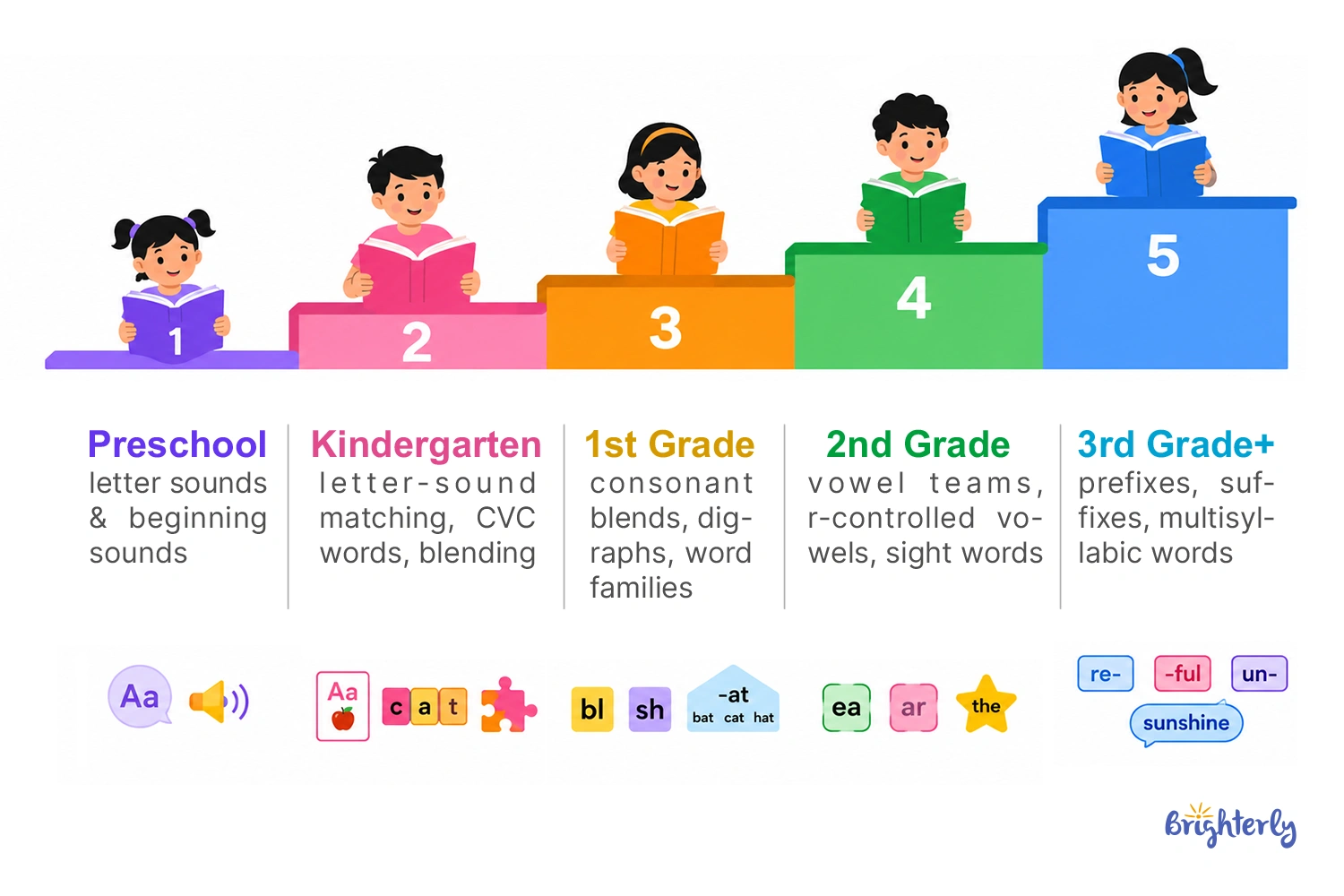
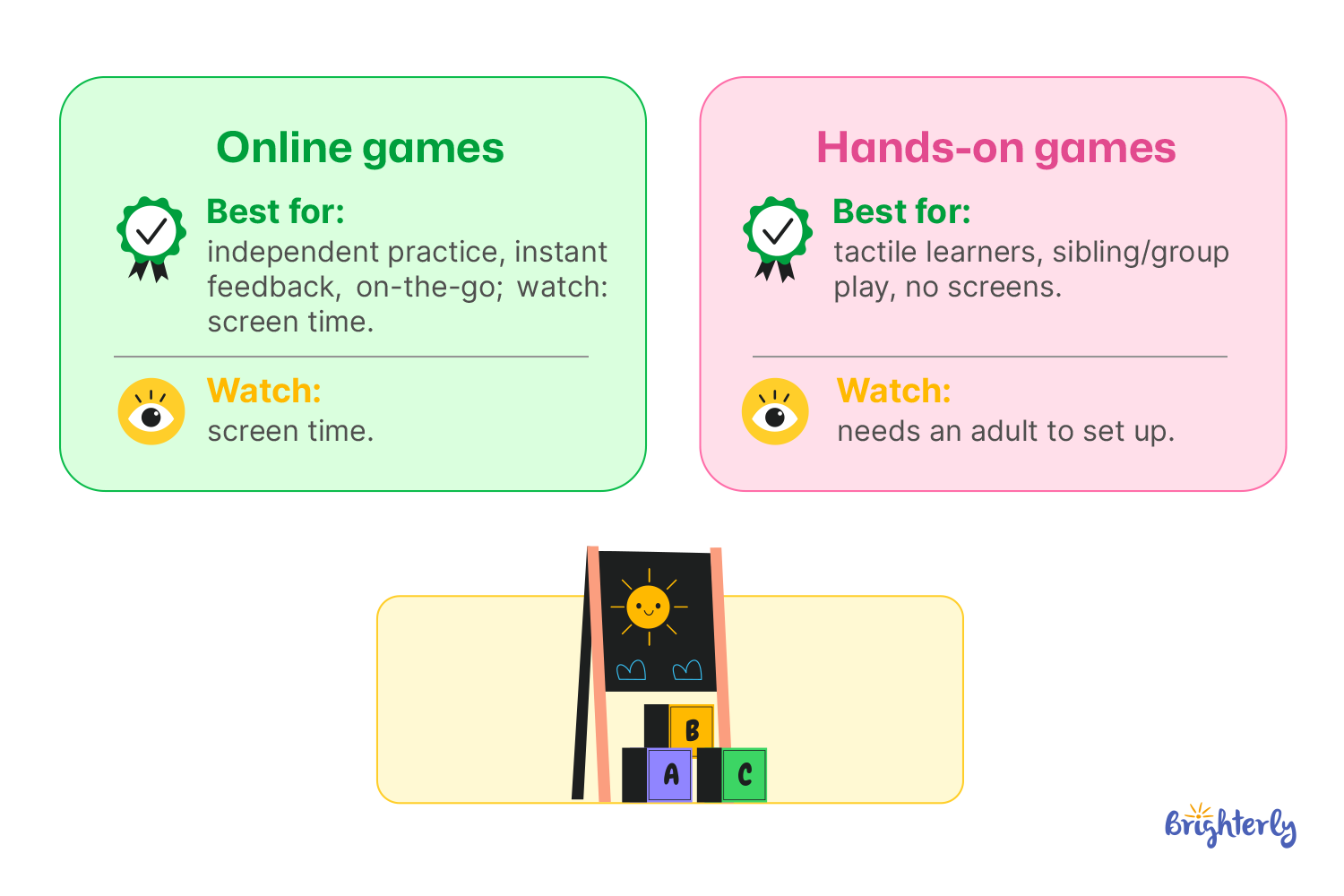
Book a free lesson to find out which phonics skills your child still needs to master Phonics games for preschoolers focus on letters and sounds, which are the building blocks of every skill that follows. Type: Hands-on Skill: Beginning sounds Call out a letter sound, like /b/, /m/, /s/, and send your child around the house to find objects that start with it. Give them a bag to collect what they’ve found. When they return, name each item together. This game will give them much more sound practice than a full page of letter tracing. Type: Hands-on Skill: Letter-sound recognition Print or cut out 10-12 pictures and lay out two letter cards as column headers. Your child sorts each picture under the letter it starts with, saying the sound before placing it. Start with easy-to-distinguish pairs like /s/ and /m/. As your kid gets better, you can add more columns and more pictures. Type: Hands-on Skill: Alphabet recognition, letter sounds Write letters on small cards and hide 6-8 of them around a room. When your child finds a card, they say the letter name and its sound before keeping it. You can make the game more energetic and keep your child more active by setting a timer. Do this for multiple rounds and compare times. Type: Online Skill: Letter-sound recognition As the name suggests, in this game, your child hears a sound. They then need to tap the matching letter on screen, getting instant feedback on each choice. You can look for free versions on online phonics games sites, and many of those also work on tablets. Note: For this age group, make sure to keep the sessions short, around 5-10 minutes. Phonics games for kindergarten are slightly more complicated. They start to develop phonemic awareness and show kids that words consist of parts. Type: Hands-on Skill: Phonemic awareness, beginning/middle/end sounds Say a word slowly and ask your child to identify whether the target sound falls in the beginning, middle, or end. In a simple sheet, create three columns (B, M, E) and have them mark the correct box for each answer. Type: Hands-on Skill: CVC words, blending sounds This is one of the more popular interactive phonics games. Write CVC words on paper fish, attach a paper clip to each, and tie a magnet to a stick for the rod. When your child catches a fish, they sound it out before adding it to their pile. You can make the game even more interesting by adding nonsense words. The goal here is to help your kids recognize sounds, not words. Type: Hands-on Skill: CVC words, blending sounds For these kindergarten phonics games, connect three index cards with a ring and write onsets on the first card, vowels on the second, and endings on the third. Your child needs to flip through combinations to build words and say the words out loud. They can build both real and nonsense words to make the game a bit more challenging. The physical flipping also helps to slow down the blending step. Type: Online Skill: CVC words, left-to-right blending Your kid needs to drag letter tiles into three slots to form a CVC word. They then hear the word read back immediately. The audio feedback after each build is what makes this format effective, as your child hears the blended word the moment they complete it, strengthening letter-sound recognition and connection in real time. Phonics games for 1st grade should target skills like word families and blending sounds for effective learning. Type: Hands-on Skill: Word families, rhyming words Write three rhymes at the top of columns on a sheet of paper (-at, -an, -ot). Shuffle word cards and have your child sort each into the right column, reading it aloud as they go. Once sorted, they read down each column to hear the family pattern again. Note: For tracking progress and making learning fun, you can explore Brightrely’s 1st grade reading test, which allows for an immediate knowledge check. Type: Hands-on Skill: Decoding, blending sounds Write words on cards and cut them into sound parts, such as sh + op, ch + in, or fl + ag. Your child needs to put the pieces together and read the word. This makes blending more visual and helps kids see how sounds combine to form a word. Type: Hands-on Skill: Consonant blends, word families Make a simple paper spinner with beginning blends like bl, st, cr, and fl. Place word endings around it, such as -ack, -op, -ip, or -ag. Your child spins, combines the beginning and ending, and reads the word, even if it turns into a silly one. You can also assign scores, with real words getting one point and made-up words getting two points, as they’re typically harder to read. Type: Hands-on Skill: Consonant digraphs Make cards with digraphs like sh, ch, th, and wh, plus picture or word cards such as ship, chair, thumb, and whale. Your child matches each word to the correct digraph. After matching, ask them to read the word and underline the digraph. Phonics games for 2nd grade move on to targeting vowel teams, r-controlled vowels, and sight words, and teaching kids how to build and disassemble words, and that words consist of different particles. Type: Hands-on Skill: Vowel teams, decoding Create bingo cards with words or sound patterns your child is learning, such as ai, ee, oa, ar, er, and or. Call out a sound, pattern, or word, and your child marks the matching square, but they need to say the sound or word out loud before matching. Bingo cards work well for review because they keep repetition light and fun. Type: Hands-on Skill: Vowel teams This one is a pair game, which your kid can play with you or other children. Players flip one word card each simultaneously, and whoever reads their card correctly first wins both. If both read correctly, it’s war, and they need to flip three more. The faster reader takes the pile. The competitive format drives a large number of decoding reps in a short time. Type: Hands-on Skill: R-controlled vowels, decoding You need three dice for it. Make three columns for beginning sound, vowel pattern, and ending sound, and assign parts to each rim of each dice (e.g., -ar, -er, -ir for endings). Your child rolls the dice to choose one part from each column and builds a word. Some words will be real, and some will be silly. The real words then go on the list, and at the end, your kid needs to choose three words and make sentences with them. Note: Brighterly also offers 2nd grade phonics worksheets and a 2nd grade reading test to help kids keep building their skills effectively at home. Type: Hands-on Skill: Sight words, reading fluency Place sight word cards across the room, and set a timer for 60 seconds. Your child runs or walks to a card, reads it aloud, and brings it back. Organize a second round for the cards they stumble on. For a calmer version, place the cards on a table and ask your child to read as many as possible in one minute without rushing. Tracking helps both you and your kid to see how they’re progressing. Phonics games for 3rd grade are typically a bit more complicated, focusing more on word structure and spelling patterns, and showing that word particles often have meanings of their own. Type: Hands-on Skill: Spelling patterns, word structure The game starts with one word, and each player then changes a single letter at a time to reach the target word. For example, cat can become cot, then hot, then hit. Each change comes with a clue so that kids aren’t overwhelmed. Type: Hands-on Skill: Prefixes, suffixes Write base words on one set of cards and prefixes or suffixes on another. Your child builds words such as replay, unhappy, helpful, or careless, then reads them aloud and explains what each one means. Seeing that “un-” reverses the word, while, say, “-ful” adds a quality, can feel like an exciting puzzle. Type: Hands-on Skill: Prefixes, roots, suffixes, syllables Write prefixes, root words, suffixes, or syllables on plastic cups. Your child stacks the cups to form a word, then reads it aloud and explains its meaning. The cup-stacking format is especially effective for more complex words, as the physical component makes it easier to visually break the word down before reading it fully. Type: Hands-on Skill: Multisyllabic words Print out longer words, and cut them into individual syllables. Your child needs to reassemble the pieces into complete words, and then read each other out as they do. Reassembling syllables helps them to develop a sense for multisyllabic words and improve their spelling and decoding skills. Both online and hands-on phonics learning games can help your child practice recognizing sounds and improve their reading skills. The better choice depends on your child’s age, attention span, and learning style. But you don’t have to choose one or the other. In fact, a good mix of both can often work best, as you can use hands-on and printable phonics games for active practice and online phonics games for short review sessions. Phonics skills grow step by step, so the best phonics games for preschoolers and kindergarten kids will depend on what they’re learning now. Here is a skill ladder you can use as a reference as you choose the right game for your child: Grade Level Main Skill Preschool Alphabet recognition, letter sounds, beginning sounds Kindergarten Letter-sound matching, blending sounds, CVC words 1st Grade Word families, rhyming words, consonant blends, digraphs 2nd Grade Vowel teams, r-controlled vowels, sight words, smoother decoding 3rd Grade+ Prefixes, suffixes, multisyllabic words, spelling patterns, segmenting If you notice the game feels too hard for your child, move one step back; if you notice your kid breezes through it, add more challenge. For extra practice, our phonics worksheets can support printable review at home. If your child needs more guided help, you can also work with a phonics tutor who can adjust lessons to their reading level. Pairing games with a structured reading program at the right level helps your child avoid frustration and resistance towards reading.
Find your child’s reading starting point!
Our phonics tutors build a plan around the skills your child actually needs. Preschool phonics games are structured, yet playful learning activities that can help your kid learn phonics and letter-sound relationships in a no-pressure format. Phonic games cover skills like alphabet recognition, CVC words, vowel teams, and more, depending on your child’s level. Because they feel like play, younger learners engage with them more willingly. For most children, you can start playing phonics games as early as age three. At this age, children are just learning letter sounds and recognizing the letters of the alphabet. It’s important you use simple and fun phonics games at this stage. The preschool and kindergarten games in this guide suit kids between the ages of 3 and 6. Struggling readers will benefit more from games that target their specific gap rather than their grade level. A 2nd grader still working on CVC words will get more from Phonics Fishing than from Vowel Team War. It’s important, though, to make sure that the games you choose for your child make each step visible. No. While a great supplementary tool, phonics games are not a replacement for systematic instruction. With these games, your kid can practice the skills they’ve already been introduced to, but they’re not enough to serve as a material that teaches them phonics fully. As often as they can, without making the games boring or overwhelming. Short, frequent sessions work better than long, occasional ones, especially as your kid has just learned the topic. As a start, aim for five to ten minutes of phonics game play three to five times per week, for enough repetition. Yes. In fact, group play can often make the learning even more effective. Games like Phonics Bingo, Vowel Team War, and Sight Word Relay, which you’ll find in the guide, are naturally competitive and work well with two or more players. Most reputable free phonics games are safe, but before your kids start them, there are a few things you should keep in mind. Look for websites that don’t require young kids to make accounts, don’t include third-party advertising, and specifically target young learners. Also, mind the screen time and make sure to supervise the sessions. Learning is changing, and so are schools and education practices. Math class doesn’t look the same as it did decades ago. The new math teaching method aims to help kids learn, but leaves parents puzzled and occupied. In this new math vs old math review, I break down these two concepts, underline differences, and show […] Oct 20, 2025 As a classroom teacher, I’ve watched hesitant readers transform once they learn how to use context clues. It’s like handing them a quiet superpower: suddenly, unfamiliar words stop being roadblocks and start being puzzles they can solve. This guide will offer practical teaching context clues strategies, examples from the classroom, and printable material to support […] Oct 20, 2025
20 Phonics Games at a Glance
Preschool
Roll-a-Word
Spelling patterns, word structure
Why Phonics Games Work

Phonics Games for Preschoolers
Letter Sound Hunt
Alphabet Picture Sort
Alphabet Treasure Hunt
Letter Sound Tap
Phonics Games for Kindergarten
Sound Detective
Phonics Fishing
CVC Flip Book
CVC Word Builder
Phonics Games for 1st Grade
Word Family Sort
Blending Puzzle
Spin & Read
Digraph Sort
Phonics Games for 2nd Grade
Phonics Bingo
Vowel Team War
Roll-a-Word
Sight Word Relay
Phonics Games for 3rd Grade and Older Kids
Word Ladders
Prefix/Suffix Flip
Cup Stack
Syllable Jigsaw
Online vs Hands-On Phonics Games: Which to Choose
Phonics Skills by Grade Level
Tips to Get the Most Out of Phonics Games
Frequently Asked Questions
What Are Phonics Games?
At What Age Should Kids Start Playing Phonics Games?
What Phonics Games Help Struggling Readers?
Are Phonics Games Enough To Teach A Child To Read?
How Often Should Kids Play Phonics Games?
Can Phonics Games Be Played In Small Groups Or With Siblings?
Are Free Online Phonics Games Safe For Young Children?





Math & reading from 1st to 12th grade
Looking for homework support for your child?

Choose kid's grade

Math & Reading for Grades 1–12
Build real confidence for your child with a Brighterly math or reading tutor.