How to Add Fractions? Step-By-Step Guide
reviewed by Jo-ann Caballes
Updated on September 7, 2026

Key Points:
Adding fractions is one of the building blocks of further math. Knowing how to do it correctly is a fundamental math skill for kids. Read on to learn how to add fractions with common and different denominators, and some effective teaching tips.
How to Add Fractions?
For correct fraction addition, you need to first make sure that they have the same denominator. If your fractions have different denominators, you need to find the least common denominator (LCD) and then multiply them to make your fractions equivalent.
For example, the LCD of 1/3 and 1/6 is 6. Since the LCD of 3 and 6 is 6, multiply 1/3 by 2/2 to get an equivalent fraction:
- 1/3 x 2/2 = 2/6
Next, add the numerators together, keep the denominator, and simplify the answer when needed:
- 2/6 + 1/6 = 3/6 = 1/2
Explore Brighterly Learning Experience
Learn exactly how Brighterly helps students thrive through expert sessions, online tools, and proven feedback from thousands of satisfied parents
What Is the Formula for Adding Fractions?
The formula for adding fractions changes based on whether the fractions are “like” or “unlike”, or whether they have the same denominators or not. To add the fractions to each other correctly, your child needs to follow the golden rule of fractions, which is that they can only add parts that are the same size.
Adding Fractions with the Same Denominator
When adding fractions with the same denominators, the fractions are already the same size. In this case, the formula is simple, and was already discussed earlier: your kid needs to add numerators to each other, and keep the denominators the same:
a/b + c/b = (a + c) / b
For example: 1/4 + 2/4 = (1 + 2)/4 = 3/4
Adding Fractions with a Different Denominator
Fractions that don’t have the same denominator are not the same size, so your kid can’t add them before making them equivalent. The first step here is finding the LCD to convert the fractions to the same size. The formula here would be the following:
a/b + c/d = (a x d) + (b x c) / b x d
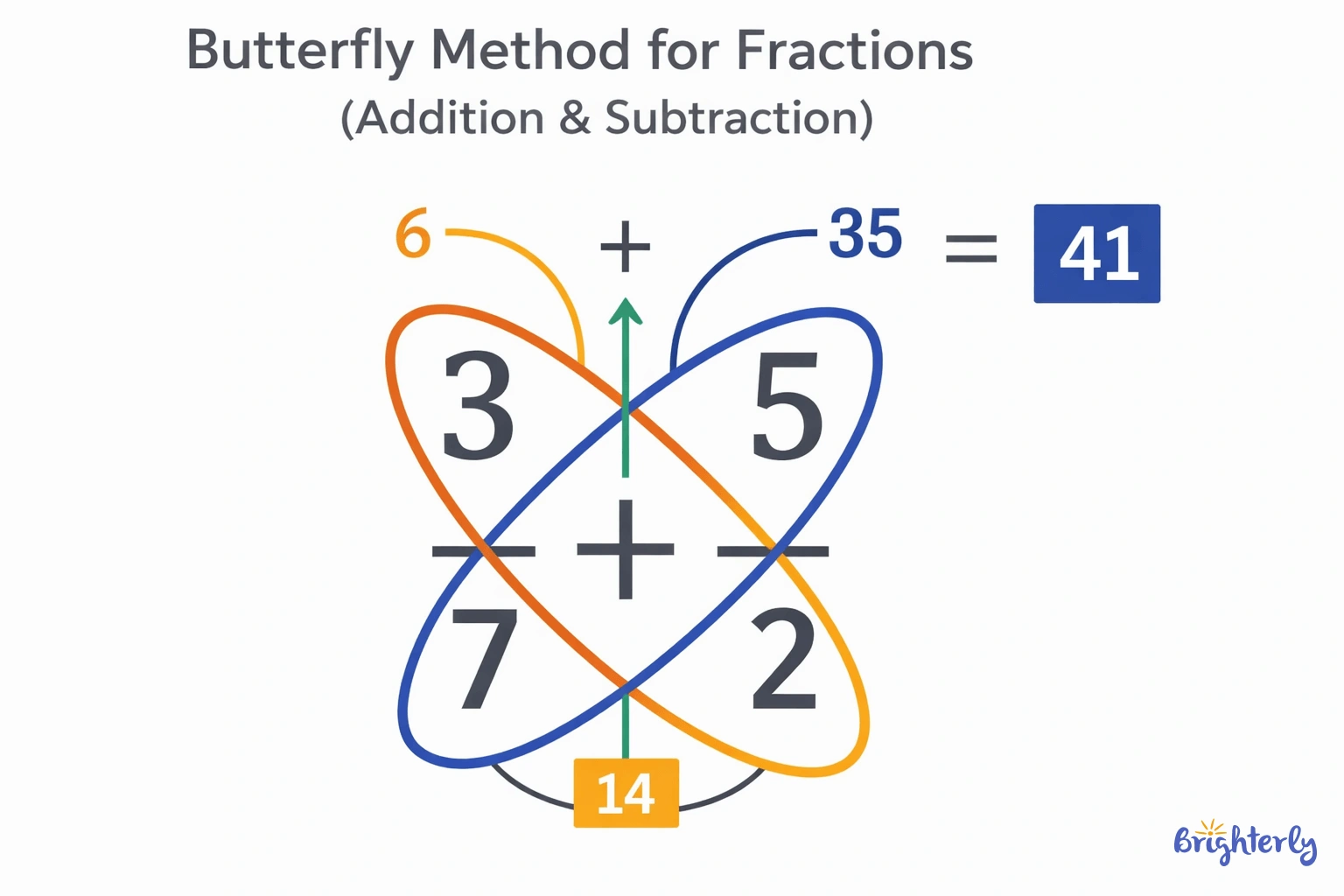
Here, your child needs to essentially cross-multiply the numerator and denominator of opposite fractions. They are then adding the multiplication of the numerators and dividing by the product of denominators. This is known as the butterfly method. Here’s an example:
2/4 + 3 / 6 = (2 x 6) + (3 x 4) / 4 x 6 = (12 + 12) / 24 = 1
Adding Fractions Steps (Beginner-Friendly Checklist)
Here is a quick step by step how to add fractions checklist your kid can use to solve any fraction problem:
- Check denominators — Check the bottom numbers (denominators), and if they are the same, skip to step 4.
- Find a common denominator — If the denominators are different, find a number that both denominators can be divided by without a remainder (LCD).
- Convert fractions — Multiply the top and bottom number of each fraction so they both have that new common denominator.
- Add numerators — Add the top numbers (numerators) together; keep the denominator the same.
- Simplify — If applicable, simplify the fraction.
Once your child has worked through the checklist, a free fraction calculator that shows every step is a quick way to confirm both the answer and the method.
How To Add Fractions With The Same Denominator
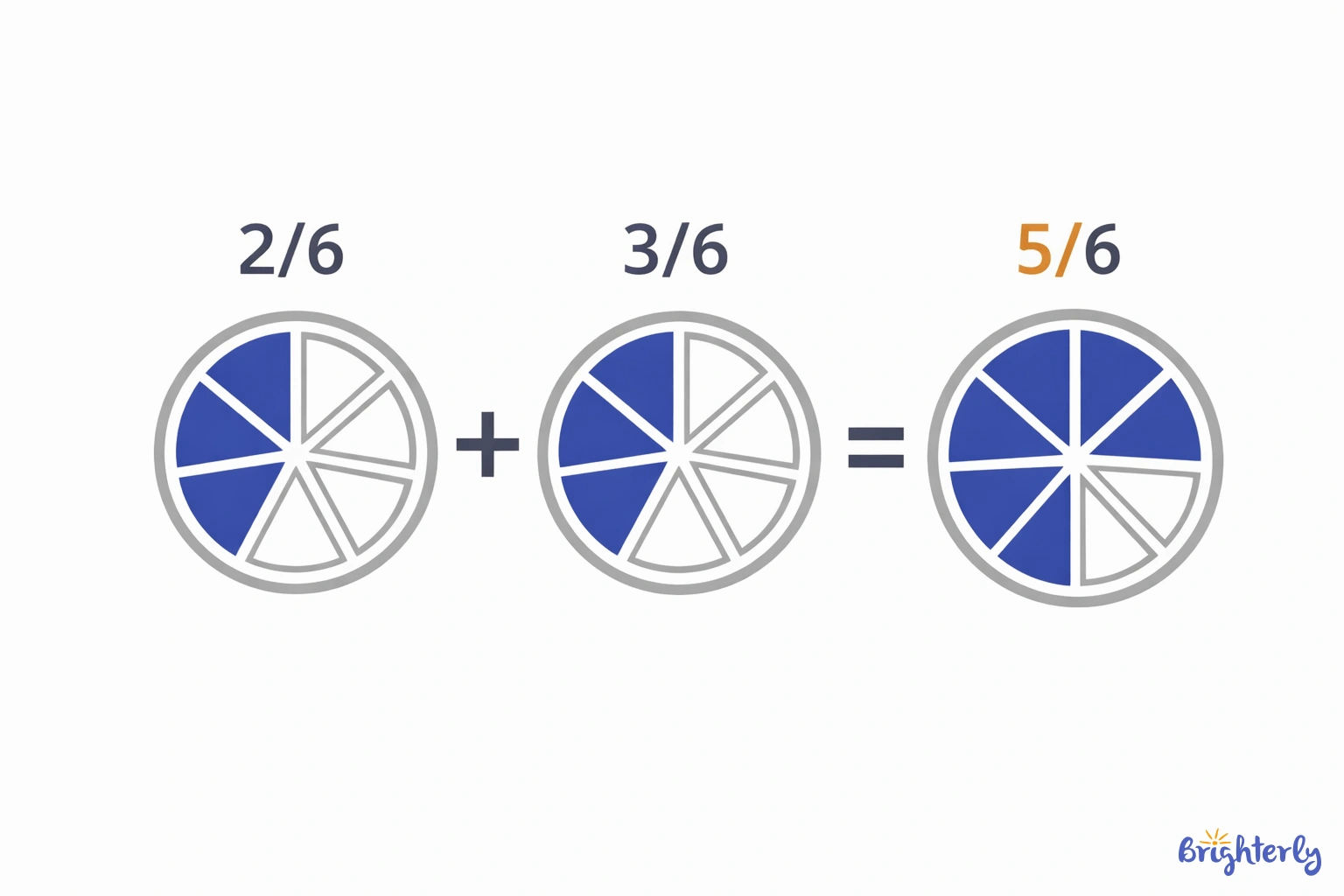
To complete fraction addition with the same denominator, add the top numbers together while keeping the bottom number.
Even though the process is straightforward, it commonly becomes the point of confusion for these kids who are just learning fractions.
“Before diving into fractions, students need a gut-level sense of what a fraction actually is. That means putting something they understand and relate to in their hands (yes, literally).”
In a pinch, any visual anchor works — I lean toward fraction strips so students can see a part against the whole — but even having kids create their own pizza fraction cards (a pizza they draw and then cut into pieces and label) gives it a real-life, tangible connection that a printed diagram just can't achieve.


Once that foundation is in place, same-denominator addition is genuinely straightforward — and here’s the key reason why: when two fractions share a denominator, their pieces are the same size. You’re essentially just counting how many pieces you have in total. Different denominators mean different-sized pieces, which is why they can’t be added directly.
The method, step by step:
- Add the numerators (the top numbers) together, keeping the denominator exactly as it is.
- Simplify if possible. Check whether both numbers share a common factor and divide down.
Here’s how that looks in practice:
4/14 + 6/14 = 10/14
Both 10 and 14 can be divided by 2, so the simplified answer is 5/7.
Practical Tips for Adding Fractions with the Same Denominator
- Instead of multiplying the denominators right away, find the smallest multiple that both denominators share. You will get smaller numbers that you can easily manage. This is especially useful if your child is dealing with complex-looking fractions like 25/100, which simplify to 1/4.
- When practicing, move from simple to more complex examples. For instance, you can start from something like 1/4 + 2/4, which boosts your child’s ability to perform addition with the same denominators. Only move on to more complex fractions with different denominators, like 1/3 + 2/5, once your child has perfected it.
- After adding, check if the sum can be reduced to its simplest form. If the numerator is larger than the denominator, convert it to a mixed number. For example, 5/4 is a fraction where the numerator is larger than the denominator, so your kid can also write it as 1 ¼. 5/4 is known as an improper fraction, while 1 ¼ is a mixed fraction.
Benefits of Adding Fractions with the Same Denominator
- This method brings a pattern to the process, meaning a kid has a system for solving a problem. Thus, they should find the least common denominator (LCD), adjust numerators, add, and simplify — that’s it.
- This approach helps to boost problem-solving skills with your child. Understanding what LCD is and learning to find it is a decisive step.
- Using a common denominator helps students compare fractions easily and better understand fraction size. Thus, kids become more confident overall while solving math problems.
How To Add Fractions With Different Denominators
When you need to teach your child how to add fractions with different denominators, both the math and the teaching process get a little more interesting. Your kids can’t add them because they are of different sizes or types for easier understanding. To solve these fractions, make the denominators identical.
The key step here, and the easiest way to add fractions, is by finding the LCD. To do this, your child needs to find the least common multiple of the denominators. For small numbers, the easiest way to do this is to list, say, 10 multiples of the first denominator, then start listing the multiples of the second denominator.
Once you stumble upon a number in the second row that’s present in the first row, that’s present in both columns, that will be their LCD. For example, let’s say you have the fractions 1/3 and 2/5.
- Multiples of 3: 1, 3, 6, 9, 12, 15, 18, 21, 24, 27
- Multiples of 5: 5, 10, 15
As you can see, we have 15 in both columns. Since it’s the smallest number you can divide both 3 and 5 without a remainder, it is the LCD of these two numbers.
Children then need to convert the fractions:
- For 1/3: Multiply top and bottom by 5 to get 5/15
- For 2/5: Multiply top and bottom by 3 to get 6/15
Now that the denominators match, all they need to do is add the numerators:
5/15 + 6/15 = 11/15
The last step then is to simplify the fraction when possible. Since 11/15 is already in its simplest form, this step is not necessary.
Note: If you notice that your kid is struggling to find the LCD, a quick tip is to multiply the denominators together. While this won’t always give them the lowest common denominator, it will always give them one that works.
Need personalized math help from experienced tutors?
Brighterly’s certified tutors offer personalized 1:1 classes tailored to each child.


How to Add Mixed Fractions
Mixed fractions are essentially the fractions consisting of both whole numbers and fractions. For example, 1 3/8 is a mixed fraction. Luckily, the process is quite simple, and you can teach your child how to find the sum of mixed fractions quite quickly. There are two methods to do so.
As part of the first method, children first add the whole numbers and then the fractions. Let’s take an example of 1 1/4 and 2 2/4.
- Add the whole numbers as a first step: 1+ 2 = 3
- Then, add fractions: 3/4
- Add them together: 3 + 3/4 = 3 3/4
Note: If the denominators are different, you can still add the whole numbers, but you need to find the LCD and equalize the denominators.
The second method is the improper fraction method, when your kid needs to turn mixed fractions into improper fractions before adding them. Let’s look step by step how to add fractions using this method, and use 1 1/2 and 2 2/3 as examples.
- Multiply the whole number by the denominators and add the numerator, to get the numerator of the improper fraction: 1 1/2 = ((1×2) + 1) / 2 = 3/2, and 2 2/3 = ((2 x 3) + 2) / 3= 8/3
- Then, find the LDC. For 3/2 and 8/3, it’s 6.
- Convert your fractions: 3/2 becomes 9/6 and 8/3 becomes 16/6
- 9/6 + 16/6 = 25/6
- Convert back to a mixed number: 25 divided by 6 gives 4, with a remainder of 1. So, the final answer is 25/6 = 4 1/6
How to Add Fractions with Whole Numbers
Both teaching and learning how to add fractions with whole numbers can be quite simple. For this, your children need to try to combine a whole number and a fraction into a mixed number through addition. For example,
3 + 1/4 = 3 1/4
Since a mixed number is just a whole number plus a fraction, you don’t need complex math.
To add a whole number and a fraction, you can either combine them into a mixed number or convert the whole number into a fraction to find the total.
Common Mistakes when Adding Fractions
| Mistake | Why it happens | Correct method |
| Adding the denominators |
Treating the bottom numbers like whole numbers (e.g., 1/2 + 1/2 = 2/4 ). |
If the slices are the same size, the denominator stays the same. (1/2 + 1/2 = 2/2 = 1) |
| Ignoring unlike denominators | Trying to add fractions of different sizes without converting them first. | You must make the denominators the same size before you can total them up. |
| Adding only the numerators | Forgetting to adjust the top number when changing the bottom number. | If you multiply the bottom by 2, you must multiply the top by 2 to keep the value the same. |
| Ignoring the whole number | In mixed fractions, only add the fractions and drop the whole number. | Add the whole numbers together, then add the fractions, and combine at the end. |
Teaching Tips for Parents and Tutors
- Learning to add fractions with a math tutor
- Practicing with worksheets
- Completing interactive whiteboard exercises
- Playing online math games
- Using the common denominator method
- Utilizing visual representations
Learn to Add Fractions with Math Tutors
Sometimes, your child may face difficulties with adding fractions steps they need to take. In this case, they may need a professional helping hand to clarify the pattern, walk them through the learning process, and provide sufficient practice. The most effective and reliable way to do this is through a math program for kids with experienced tutors.
On the Brighterly educational platform, your child will work with accredited tutors using curricula aligned with US and state standards. All the classes are held 1:1, with tutors paying full attention to your child’s learning needs and progress. The teachers customize each class to match each child’s interests and hobbies, ensuring your kid stays engaged and active throughout the lesson. Brighterly offers individualized classes for K-12 students, starting from $17.70/lesson (12-month plan, with 20% discount applied).
Not sure if you need professional help? Your child can take our diagnostic math test to see where they need assistance.
Practicing with Worksheets
When learning math, practice is key, and fraction worksheets give your child a versatile and effective way to get that practice. By giving your kid these sheets to work through, you not only give them a chance to put what they learned into practice, but also get a glimpse into how they are doing and how quickly they are improving.
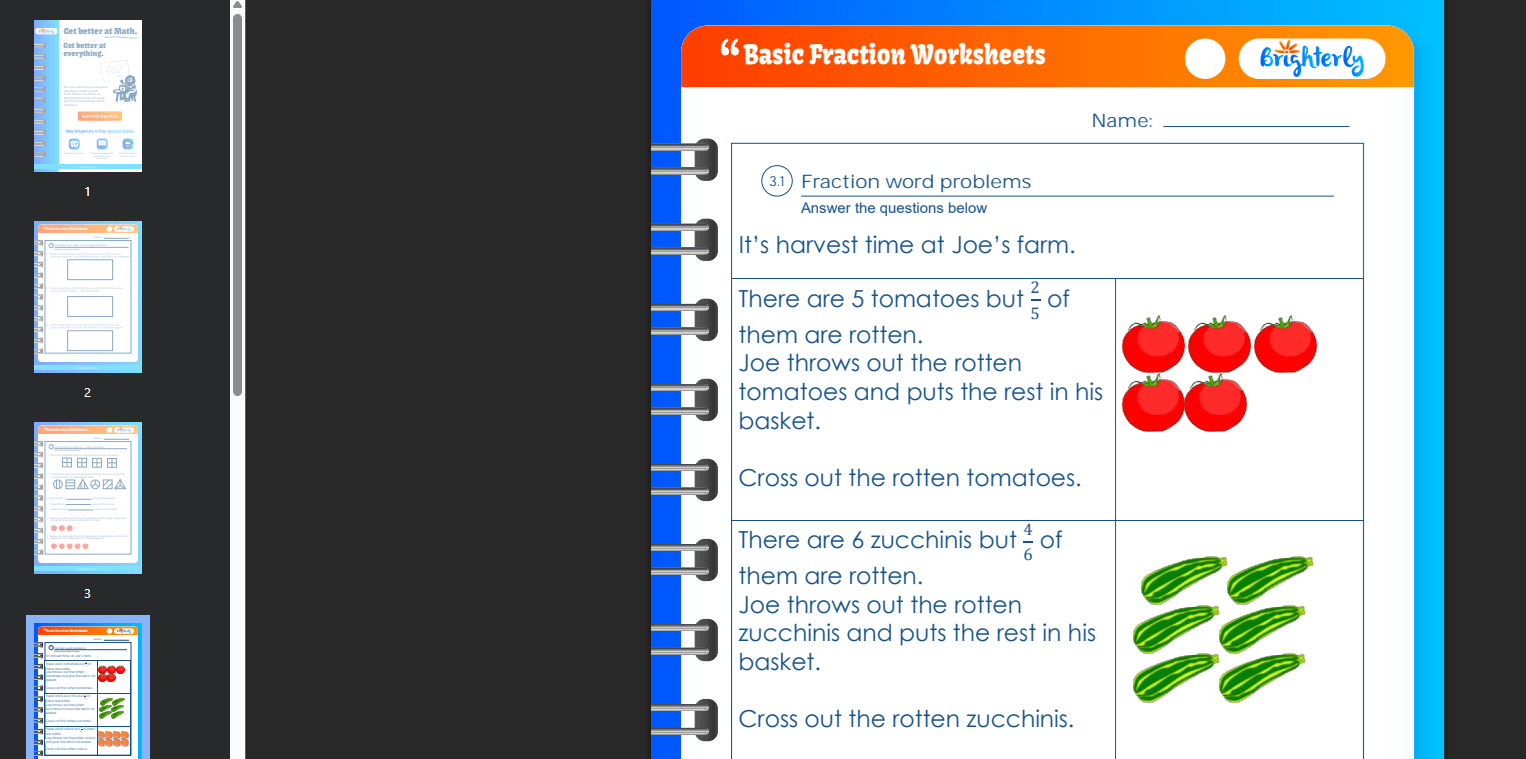
Another benefit is that while textbooks can often get repetitive, worksheets come in many different styles, ranging from illustrations to word problems, to ensure your child tackles fraction addition from all angles.
Note: Brighterly offers a wide range of free printable math worksheets for students in each grade, including fraction operations worksheets.
Does your kid need extra fractions practice?
Help them get tailored guidance through 1:1 lessons with experienced math tutors.
Completing Interactive Whiteboard Exercises
Writeboard exercises are an effective way to teach adding fractions through graphic depiction. With interactive whiteboards, your kid can manipulate fraction bars, drag and drop numbers, and visualize sums, bringing the topic to life. This approach effectively demonstrates common denominators, fraction models, and step-by-step calculations. Here’s how you can do it.
- On the whiteboard, you can use visual fraction models like bars, circles, or number lines. Dragging and resizing these tools helps to understand concepts like common denominators.
- With drag-and-drop activities, kids can move numbers, fraction pieces, or denominators into place. Games like this make learning more active and engaging than just writing down answers.
- Break down the example of adding fractions into steps with guided animations. This way, the whole flow will seem more straightforward.
Playing Online Math Games
Learning fraction addition doesn’t always require a textbook. To bring some interactivity into the learning, you can use online (and offline) math games. Examples include puzzles, timed challenges, drag-and-drop exercises, and real-world scenarios. These days, you can find dozens of fraction games online.
One of the huge benefits is that they come with adaptive difficulty levels and rewards, helping kids concentrate on the task and improve their mental math skills.
Using the Common Denominator Method
Since fractions represent parts of a whole, having a common denominator for the fractions is a must. This is not only done because it’s easier, but because you can’t do it otherwise: fractions with different denominators are different “species”, they don’t fit with each other.
The common denominator method is a non-negotiable when teaching your child how to add fractions. Once you have the common denominator, all that is left is to add the numerators, while keeping the denominator.
Utilizing Visual Representations
If you can choose only one method to teach your child how to add fractions, it should be through visuals. Fractions indicate a part of a whole, and there are very few better ways to understand that than through seeing it. The variety of approaches is another benefit of this method. You can use visual models like fraction bars, pie charts, number lines, blocks, grids, or get a little crafty and make cutouts.
With color-coded fraction pieces or digital interactive tools, your child can compare fractions, find common denominators, and understand how fractions are equivalent to their representations. This is an approach effective for anyone: meta-analysis of existing research by Schoenherr et al. (2024) in Education Research Review confirmed that using visualization in math had positive and lasting effects on learning.
Note: Check this article for other valuable ways to teach fractions.
What Is the Best Way to Teach Adding Fractions?
Just to summarize, here are some of the most popular steps for adding fractions:
- If your kid is a visual learner, they will benefit from varied pictorial representations, whiteboard exercises, or playing math games.
- Looking for ways to learn adding fractions with unlike denominators? After the child grasps the overall flow, move to worksheets and math tasks for a good portion of practice.
- But if you’re looking for guided help with a math tutor who would walk children through all the steps, stopping and explaining all issues, the Brighterly math tutoring platform may be the best choice.
Don’t hesitate to book the free demo lesson now to test the learning flow here yourself!
Frequently Asked Questions
How Do You Add 1/4 and 1/2?
First, find a common denominator. Since 2 goes into 4, convert 1/2 into 2/4. Now that the parts are the same size, add the numerators (1 + 2) while keeping the denominator the same. The result is 3/4.
Is There a Trick to Adding Fractions Faster?
One trick is the butterfly method. Multiply the denominators to get a new bottom number. Then, cross-multiply the numerators with the opposite denominators and add those results to get your new top number. It’s a perfect shortcut for fractions with different denominators.
What Is the Formula for Adding Fractions?
For fractions with the same denominators, you can use a/b + c/b = (a+c)/b. For different denominators, the formula is a/b + c/d = (ad + bc)/bd. This way, you will make sure both fractions have the same denominator before calculating the sum of the fractions.
Can You Add Whole Numbers and Fractions Together?
Yes. The easiest way is to combine the whole number and the fraction to get a mixed fraction (e.g., 5 + 1/3 = 5 1/3). Alternatively, you can turn the whole number into a fraction by placing it over 1 (e.g., 5 = 5/1), find a common denominator (in this case, it would be 15), and add the fractions.


Recognizing the meaning and difference between < and > feels natural to adults, but for kids, you need to know exactly how to teach greater than and less than. As a parent and math tutor with several years of practice myself, I’ll show you 8 different ways so you can choose the one that suits […]
Mar 18, 2025

As parents, you should stay on top of current education trends to make sure that your child gets access to the best learning options available. Being a teacher, I’m always following the latest developments in the field, and here I’m sharing the main ones with you. Key points Online learning, gamification, personalization, and the use […]
Apr 26, 2025
Math & reading from 1st to 12th grade
Looking for homework support for your child?

Choose kid's grade

Math & Reading for Grades 1–12
Build real confidence for your child with a Brighterly math or reading tutor.