Why Is School So Stressful?
reviewed by Angeluz L. Ruelo
Updated on November 10, 2026

If your child dreads Monday mornings, gets a stomachache before tests, or melts down over homework, school stress may be the reason. It’s more common than many parents think, and it can start as early as kindergarten.
Usually, the cause is something you can spot and work on: pressure from friends, a packed schedule, too little sleep, or fear of tests. In this article, we break down seven common sources of stress at school and share practical ways to help your child feel calmer, especially when a big test is coming up.
What Is Anxiety in Schools?
Worry about failing or falling behind in school is common among students of all ages. However, some types of anxiety are more evident than others. For example, you could see that your child’s anxiety levels consistently rise just before their tests or exams.
Sometimes, students’ nervousness in class manifests in quite diverse ways. For example, they could have a stomachache, sweat, throw up, avoid schoolwork, or act out in class. Some forms of school anxiety are hard to spot in young children, so the stress can build up for months before anyone notices.
Anxiety, in its most frequent form, acts as a mental prison, preventing worried students from focusing on their classes and making learning a chore.
Explore Brighterly Learning Experience
Learn exactly how Brighterly helps students thrive through expert sessions, online tools, and proven feedback from thousands of satisfied parents
7 Things Causing Stress At School
Many parents ask, “Why is school so stressful for my kid?” The answer is rarely one thing. Here are seven of the most common causes:
1. Social Pressure
For most students, school is stressful because of social pressure. When kids start competing for their teachers’ attention, it may lead to social anxiety in the classroom. Over the year, students will also seek opportunities to compete or work with their classmates to strengthen their friendships.
Some pupils have an innate gift for making friends and interacting with others. However, other youngsters may struggle with social awkwardness, manifesting in various ways, including extreme shyness or a generalized feeling that they don’t belong in a group.
Help your child reach their full potential!
Answer a few quick questions about your child’s learning, and we’ll recommend next steps. 

2. Change In Routine
When included in the typical school calendar, some activities, such as assemblies or fire drills, might disrupt the usual routine of pupils. These kinds of things might shake their self-assurance.
Kids feel safer when they know what to expect. Teachers can help by announcing changes in advance, and parents can help by talking through the new schedule at home so the change doesn’t catch their child off guard.
3. Lack Of Enough Sleep
You may assume that grownups are the only ones who suffer from insufficient sleep. However, it might still impact kids already crammed into their schedules between school, extracurricular activities, homework, and family time. As a result, many of them don’t get the sleep they need.
Kids who are short on sleep are more likely to be moody, clumsy, and less focused in class. The American Academy of Sleep Medicine recommends 9–12 hours of sleep a night for children aged 6–12 and 8–10 hours for teens aged 13–18. A consistent bedtime and no screens in the last hour before sleep make that much easier.
4. Extracurricular Activities
Participation in extracurricular activities, whether sports, the arts, music, or clubs, makes attending school exciting for many children. Competing at a high level in most of these pursuits requires regular practice and dedication to instructors and teammates. Some sports need practice even when it’s not game day, and students seldom get a vacation.
Because games, recitals, and competitions happen in front of coaches, teammates, and parents, kids often feel pressure to perform well every time. A child who makes a mistake in an important game may feel they let the whole team down.
As a result, some kids stop enjoying activities they used to love. And when practice takes up too many evenings, there’s less time left for homework and sleep.
5. Test Anxiety
Test anxiety is stress before, during, or after a test that makes it harder for a child to show what they know. Researchers estimate that 25–40% of adolescents in Western countries experience test anxiety (Frontiers in Psychology, 2025), and it can lower a score even when a child has studied well. Below, we explain how to spot test anxiety and what parents can do to help.
Help your child reach their full potential!
Answer a few quick questions about your child’s learning, and we’ll recommend next steps.
6. Organization
If kids have a habit of misplacing their school items, such as backpacks, papers, and other materials, maintaining order in their belongings may be a source of anxiety and tension. A child who spends the morning searching for a missing worksheet starts the school day already stressed. Simple systems help: one folder per subject, a checklist by the door, and a few minutes each evening to pack the backpack for tomorrow. A family member or a tutor can help a child build these habits.
7. Unstructured Time
Recess, lunch, and the time between classes have fewer rules than lessons do. In a classroom, children know when to talk or ask questions. Without that structure, some kids don’t know how to join a conversation or a game, and these moments become the most stressful part of their day.
Help your child learn to handle varied circumstances by talking to their instructors or school administration if you see they have trouble having meaningful conversations in unstructured settings. To help a kid learn to deal with different situations, a teacher may suggest that students eat in the classroom rather than in the cafeteria.
How to Help Your Child With Test Anxiety
Test anxiety responds well to simple routines, especially when parents help. Start by learning the signs, then use the strategies for before, during, and after the test.
Signs of Test Anxiety
- Physical: sweating, nausea, upset stomach, headache, a racing heart.
- Emotional: fear, helplessness, feeling overwhelmed.
- Behavioral: trouble concentrating, negative thoughts (“I’m going to fail”), putting off studying.
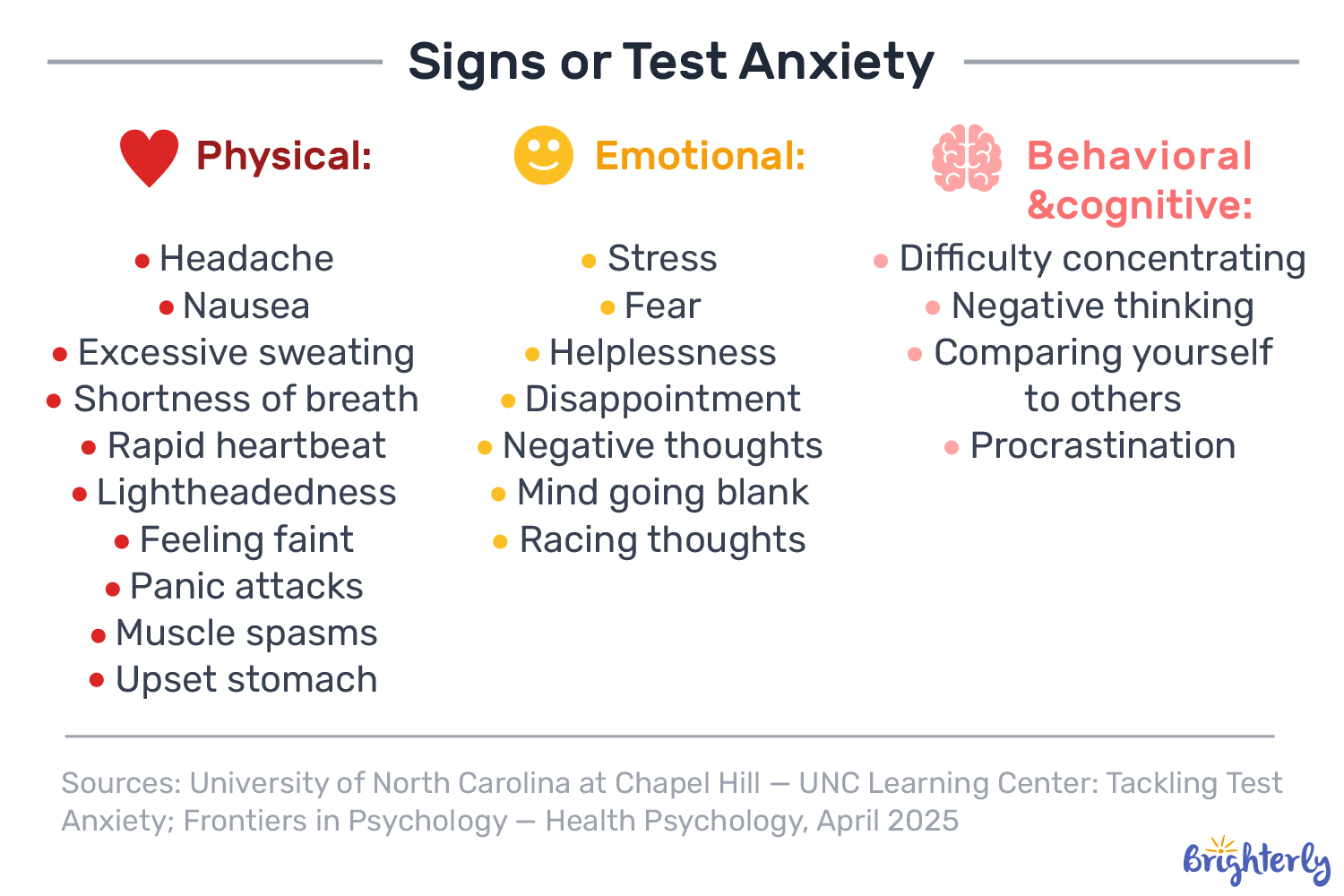
Note: If your child shows several of these signs before every test, and their test scores are much lower than their homework grades, test anxiety may be the reason.
Before the Test
- Build a study routine early. Short daily sessions that start days before the test work better than last-minute cramming.
- Practice with real test formats. Set up a “practice test” at home so the real one feels familiar. For math, see our guide on how to study for a math test.
- Fill knowledge gaps. Kids who feel confident in the material feel less anxious. A free math test or reading test can show where your child needs practice.
- Protect sleep and meals. A regular bedtime the week before, a light dinner the night before, and a breakfast with protein on test day.
“Most kids who freeze on a test know more than they think. What they're missing is practice with the feeling of being tested.”


During the Test
- Box breathing. Breathe in for 4 counts, hold for 4, breathe out for 4, hold for 4. A few rounds calm the body within a minute.
- Positive self-talk. Teach phrases like “I prepared for this” and “One question at a time” instead of “I don’t know anything.”
- One question at a time. Read each question slowly, answer what you know, and skip hard ones to come back to later.
After the Test
- Separate the score from the child. Ask “What was the hardest question?” instead of “What score did you get?” One test doesn’t define how smart they are.
- Talk it through. Discuss how your child felt, not just the wrong answers. If anxiety keeps coming back, talk to their teacher too.
When to Get Professional Help
If these strategies don’t help and anxiety keeps affecting your child’s grades or well-being, start with the school counselor or your child’s pediatrician. They can assess how serious it is and refer you to outside support if needed.
Conclusion
School stress usually comes from a mix of things: friends, routines, sleep, activities, tests, organization, and unstructured time. The good news is that most of these causes can be spotted and worked on. Watch for the signs, talk with your child about what feels hardest, and work with their teachers on a plan. For test anxiety, small routines before, during, and after the test make a real difference.
Frequently Asked Questions
Why Is School So Stressful for Kids?
School can be stressful because of social pressure, tests, busy schedules, lack of sleep, and changes in routine. Stress becomes a problem when it lasts for weeks and starts affecting sleep, mood, or grades.
Is Test Anxiety a Learning Disability?
No. Test anxiety is an emotional and physical reaction to tests, not a difference in how the brain processes information. With the right strategies, most kids can learn to manage it.
How Do I Know if My Child Has Test Anxiety or Just Nerves?
Normal nerves fade once the test starts and don’t affect the result much. Test anxiety lasts, often causes physical symptoms like nausea or a racing heart, and leads to scores that are consistently lower than your child’s homework grades.
At What Age Does Test Anxiety Start?
Test anxiety usually appears in the school-age years, when kids start taking regular tests and notice that their performance is being graded and compared.
How Can Parents Help the Night Before a Big Test?
Review key material briefly, serve a balanced dinner, limit screen time, and make sure your child gets enough sleep. Remind them that they’ve prepared and will be okay.


On average, homeschooling costs between $500 and $2,500 per year, which is significantly lower than private school tuition. Still, how much does homeschooling cost in your case will depend on the structure of the homeschool program, the platform of your choice, and the add-ons you want. This guide shows the price range for different homeschool […]

Jun 14, 2022

Soft skills useful in adult life, such as teamwork, leadership, and initiative, cannot be simply “taught” at school. These are the skills to be built through extracurricular activities. This article discusses everything about such activities, what extracurriculars to choose for your child, and how those can affect college admission and kids’ future. What Are Extracurricular […]
Jun 14, 2022
Math & reading from 1st to 12th grade
Looking for homework support for your child?

Choose kid's grade

Math & Reading for Grades 1–12
Build real confidence for your child with a Brighterly math or reading tutor.