How to Teach Kids Social Skills: A Step-by-Step Guide by Age
reviewed by Marvi M. Andres
Updated on November 13, 2026
Key Points:
- Learning how to teach kids social skills works best one skill at a time: show it, name it, rehearse it, try it with peers, and praise it.
- Short, frequent practice, like 5 minutes of role-play three evenings a week, fits busy family schedules and keeps learning playful.
- Role-play with exact scripts prepares kids for tough moments like joining a game, losing, or disagreeing with a friend.
- An age-by-age table shows which social skills to expect from preschool through middle school, plus one way to practice each.
- The Brighterly learning platform gives kids extra low-pressure practice asking questions and speaking up during 1:1 math and reading lessons.
Social skills for kids are the abilities children use to get along with others: sharing, taking turns, listening, reading feelings, and solving conflicts with words. The most reliable way to teach them is to pick one skill, show it, rehearse it, let your child try it with peers, and praise the exact behavior. This guide gives parents a 5-step plan, 12 at-home methods, an age-by-age table, ready-to-use scripts, and signs that a child needs extra support.
How Do You Teach Kids Social Skills?
Parents who want to know how to teach social skills can start with one rule: break each skill into small, visible steps and practice them on purpose. Model the skill, give it a name, rehearse it at home, set up a real-world try, and praise the specific behavior. Repeating that cycle for one skill at a time builds habits that carry over to school.
That sequence matches what research supports. A 2023 meta-analysis of 424 studies, summarized by the Yale Child Study Center, found that school social-emotional programs that are sequenced, active, focused, and explicit (SAFE) have the strongest effects. Gains in students’ social and emotional skills lasted six months or more after programs ended. Parents can borrow the same structure when deciding how to teach their child social skills at home.
- Pick one skill. Choose the skill that causes the most friction right now, such as interrupting or grabbing toys. Micro-goal: one skill for two weeks.
- Model it out loud. Narrate your own behavior: “I’m waiting until Dad finishes talking.” Micro-goal: three narrations a day.
- Name it and rehearse it. Give the skill a short label, like “wait your turn,” and act it out together. Micro-goal: 5 minutes of role-play, 3 evenings a week.
- Set up a real try. Plan a short playdate, family game, or store trip where the skill will come up. Micro-goal: one planned try per week.
- Praise the exact behavior. Say what your child did: “You waited for Mia to finish her turn.” Micro-goal: one specific praise after every try.
A practical rule of thumb: once your child uses the skill without a reminder in most situations, add the next one and keep the first in light rotation.
Which Social Skills Should Kids Have at Each Age?
Social skills for children grow in a predictable order: preschoolers learn to share and take turns, early elementary kids learn to cooperate and handle losing, and tweens learn to read group dynamics and resolve conflicts on their own. According to the CDC’s 5-year milestone checklist, most children (75% or more) follow rules or take turns in games with other kids and keep a conversation going for more than three back-and-forth exchanges by age 5.
| Age | Skills most kids are building | One way to practice |
| 3–5 (preschool) | Taking turns, sharing toys, naming basic feelings, short back-and-forth conversations | Turn-taking games like Simon Says; use a kindergarten readiness checklist before school starts |
| 6–8 (early elementary) | Cooperating in groups, losing without a meltdown, following classroom rules, apologizing | Cooperative board games plus a “good game” script |
| 9–11 (upper elementary) | Reading others’ feelings, compromising, handling teasing, keeping friendships going | Role-play disagreements; discuss characters in chapter books |
| 12–14 (middle school) | Navigating group chats and friend groups, speaking up assertively, standing up for others | Talk through real dilemmas from school or a favorite show |
Expectations for ages 6 and up reflect what educators commonly see in classrooms, and every child’s timeline varies. Social skills for preschoolers are the foundation, so an older child who missed early practice may need to start with turn-taking before tackling compromise.
Personalized help for social skills growth
One-on-one lessons at Brighterly are developed to improve confidence and clear self-expression
Explore Brighterly Learning Experience
Learn exactly how Brighterly helps students thrive through expert sessions, online tools, and proven feedback from thousands of satisfied parents
12 Ways to Teach Social Skills at Home
These social skills activities for kids fit into ordinary routines, from dinner to car rides. Each method targets a specific skill, so choose the ones that match what your child finds hardest instead of trying all 12 at once. Teaching social skills at home works best when one or two methods become daily habits.
1. Model the Behavior You Want to See
Children copy what adults do far more than what adults say. When a parent greets a neighbor by name, apologizes after snapping, or listens without checking a phone, a child sees the skill in action. Narrate the reason behind your choice: “I’m upset, so I’m taking a breath before I answer.” Narration turns a private habit into a lesson the child can repeat.
2. Name Feelings Out Loud
Kids can’t respond to a friend’s frustration if they can’t recognize it. Label emotions during everyday moments: “Your brother’s face is red, and his fists are tight. He looks angry.” Then play emotion charades, where family members act out a feeling using only their face and body while others guess. The game trains kids to read body language before they react.
3. Rehearse Real Situations With Role-Play
Role-play gives kids the words before they need them. Act out the moments that go wrong most often, swap roles so your child also plays the other kid, and repeat each script until it sounds natural. Keep sessions to about 5 minutes so practice stays playful. These scripts cover the situations parents ask about most:
| Situation | What your child can say |
| Joining a game | “That looks fun. Can I play next round?” |
| Losing a game | “Good game. Want to play again?” |
| Disagreeing with a friend | “I see it differently. What if we try both ideas?” |
| Wanting a turn | “Can I have it when you’re done?” |
| Interrupting by mistake | “Sorry, go ahead. I’ll wait.” |
| Asking a teacher for help | “Excuse me, I’m stuck on number 4. Can you show me the first step?” |
4. Use Learning Time to Practice Asking for Help
Homework and tutoring sessions are social practice in disguise: kids ask questions, accept corrections, and explain their thinking to another person. Parents often notice that a child who freezes in a big class speaks up more easily one-on-one. At Brighterly, a K-12 learning platform aligned with US state standards, kids work with an online math tutor or a reading tutor in personalized 1:1 interactive lessons, so asking “Can you explain that again?” becomes routine.

Between lessons, free printable math worksheets give kids a reason to ask a parent or sibling for help and to explain out loud how they solved a problem. Explaining a solution to someone else practices the same turn-taking and clear communication kids need in group work.

Help kids learn through play
Interactive lessons at Brighterly teach listening, patience, and teamwork in a fun way.
5. Use Social Stories Before New Situations
A social story is a short, simple narrative that walks a child through an upcoming situation step by step: who will be there, what will happen, and what the child can do. Write one before the first day of school, a birthday party, or a dentist visit, using your child’s name and real details. Read it together two or three times beforehand. Teachers often use social stories before transitions because predictable steps lower worry. Learn more about the importance of storytelling for young children.
6. Play Cooperative and Turn-Taking Games
Social skills games for kids work best when they build in waiting, sharing, and handling a loss. Cooperative games, where everyone wins or loses together, shift kids from “I beat you” to “we did it.” Board games add turn-taking and rule-following, and math board games practice those skills alongside counting. Debrief afterward: “What did you do when you rolled a one?” More ideas are in this guide to game-based learning.
7. Host Short, Structured Playdates
Long, unstructured hours with a new friend can overwhelm a child who struggles socially. Keep early playdates to 60 to 90 minutes, invite one child, and plan a shared activity such as baking or building a fort. Stay nearby to coach, not referee: whisper a script (“Ask Leo which color he wants”) instead of solving the problem. End the visit while both kids are still having fun.
8. Practice Reflective Listening
Active listening means hearing someone and showing you understood. Teach the “say it back” move: after a family member speaks, your child repeats the main point in their own words (“So you want me to feed the dog before dinner?”). Practice during car rides with a short story or a sibling’s news. In class, the same skill helps kids follow multi-step directions and respond to classmates during discussions.
9. Praise the Exact Behavior
Vague praise like “good job” doesn’t tell a child what to repeat. Name the action and its effect: “You let your sister pick the show first, and she looked so happy.” Specific praise right after the behavior shows kids which choices make social moments go well. For more on what keeps kids trying, read about what motivates your child.
10. Give Your Child a Household Job
A regular family job teaches kids that a group counts on them. The CDC lists simple chores, like clearing the table after eating, among the milestones most children reach by age 5. Start with one job, such as setting out napkins or feeding a pet, and connect it to others: “Everyone could eat because you set the table.” That link between action and group impact prepares kids for classroom cleanup and group projects.
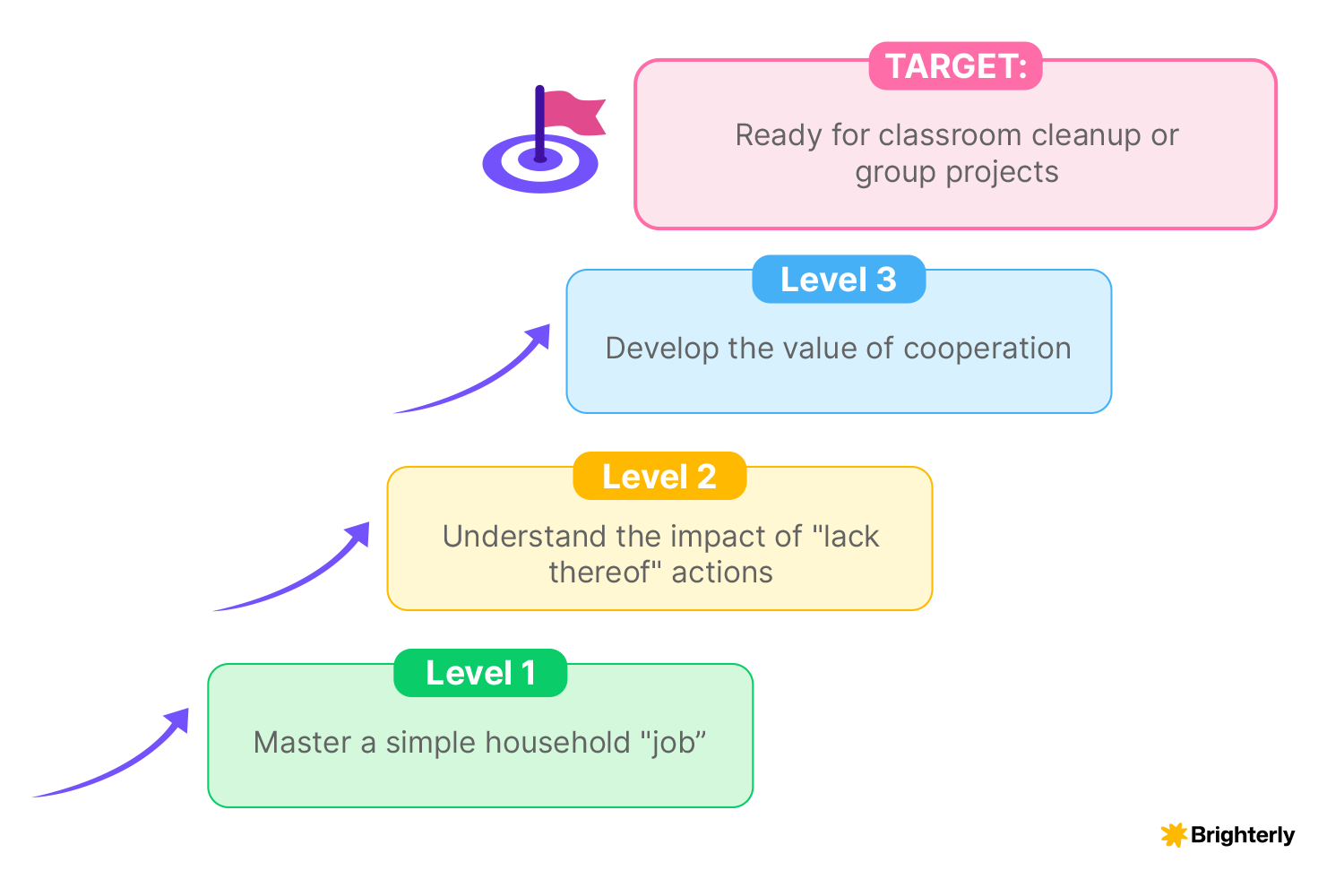
As kids get older, add jobs that involve other people, like helping a younger sibling pack a backpack. Browse more life skills for kids that build independence and responsibility.
11. Read Books and Talk About Characters
Stories let kids practice empathy with low stakes. Pause during reading to ask, “How do you think she felt when her friend left?” or “What could he say to fix it?” Older kids can track a character’s choices with a character traits worksheet. For children who find it hard to infer feelings and motives from text, reading comprehension lessons build that skill directly, and free reading worksheets add practice at home.
12. Teach a Calm-Down Routine Before Conflict
Kids can’t use social skills while they’re flooded with anger. Teach one calm-down routine while your child is calm: three slow breaths, a squeeze of the hands, then words. Practice it like a fire drill so it becomes automatic. Once your child is calm, ask, “What do you want to say to Sam now?” Strong emotional regulation makes every other social skill easier to use. These mindfulness activities for kids add more options for different ages.
Which Social Skills Matter Most for School Success?
The social skills that matter most at school are the ones kids use with classmates and teachers every day: listening, cooperating, communicating clearly, and managing emotions. In an EdWeek Research Center survey of 499 educators conducted in December 2025 and January 2026, more than 3 out of 4 said students should be taught self-management, cooperation, problem-solving, and effective communication. These 10 kids social skills show up in nearly every school day:
- Taking turns: waiting in line, in games, and in conversation.
- Sharing: offering materials and space without being asked.
- Listening: looking at the speaker and responding to what they said.
- Following directions: completing multi-step instructions from adults.
- Asking for help: naming what’s confusing instead of giving up.
- Cooperating: working toward a shared goal in a group.
- Managing emotions: calming down before speaking or acting.
- Showing empathy: noticing and responding to how others feel.
- Resolving conflicts: using words and compromise instead of force.
- Respecting personal space: asking before touching people or their things.
Why Are Social Skills Important for Children?
Early social skills are linked to outcomes years later. A 2015 study in the American Journal of Public Health followed children from kindergarten to age 25 and found that kids rated higher in prosocial skills were more likely to graduate from college and be employed, and less likely to have been arrested, according to a Penn State summary. The study shows a link, not proof that social skills caused those outcomes.
Friendship is also a current classroom concern. In a 2026 EdWeek Research Center report, educators named struggles developing friendships as the top student challenge they rely on social-emotional learning to address.
What Mistakes Slow Down Social Skills Progress?
The most common mistakes are well-intentioned: correcting kids in public, giving vague instructions, forcing interactions, and rescuing them from every disagreement. Each one removes either the child’s dignity or the chance to practice. Parents looking for how to improve social skills in kids who seem stuck can start by checking this list.
| Mistake | Why it backfires | Try this instead |
| Correcting in front of peers | Embarrassment makes kids avoid social situations | Use a private signal, then talk later |
| Saying “be nice” | Kids don’t know which action you mean | Name the behavior: “Wait until she finishes talking” |
| Forcing hugs or friendships | Teaches kids to ignore their own comfort | Offer choices: wave, high five, or hello |
| Solving every conflict | Removes practice with conflict resolution | Step in only when it’s unsafe; coach from the side |
| Comparing kids to siblings | Turns a skill into a contest for approval | Compare your child to their own progress last week |
Is My Child Shy or Struggling With Social Skills?
A shy child is slow to warm up but connects once comfortable. A child who struggles with social skills wants connection but doesn’t know how to get it, or keeps losing friends after making them. Shyness is a temperament, not a problem to fix, while social struggles show up as repeated conflict, rejection, or distress around peers. Knowing the difference shows parents how to help a child with social skills: practice at home for one, extra support for the other.
These signs suggest a child may need more than practice at home:
- No friends at school for several months, and your child seems upset about it.
- Frequent hitting, grabbing, or meltdowns with peers after age 6.
- Rarely making eye contact or responding to their name.
- Trouble keeping a short back-and-forth conversation going by kindergarten.
- Losing social or language skills they used to have.
When Should You Talk to a Pediatrician?
Talk to your child’s pediatrician or school counselor if any of these signs last more than a few months, appear in several settings, or come with anxiety or sadness. A professional can screen for speech delays, ADHD, autism, or anxiety and can refer families to a social skills group or therapist. An early evaluation means support can start sooner.
Conclusion
Social skills are taught the same way as any other skill: one target at a time, shown, rehearsed, tried, and praised. Start with the friction point your child faces most this week, pick one method from the list, and give it two weeks before switching. For extra low-pressure practice speaking up and asking questions, book a free 1:1 lesson on the Brighterly platform.
Frequently Asked Questions
What Causes Poor Social Skills in Kids?
Poor social skills in kids usually come from too few chances to practice, not a character flaw. Common causes include limited time with peers, a shy or anxious temperament, speech or language delays, and conditions such as ADHD or autism. Stress at home or a recent move can also set skills back for a while. Most of these causes respond to targeted practice and, when needed, professional support.
What Is the 7-7-7 Rule for Kids?
The 7-7-7 rule is a viral parenting routine: seven minutes of undivided, screen-free attention with your child in the morning, after school, and at bedtime. Psychologists quoted by the Australian Psychological Society describe it as dedicated connection time. For social skills, the after-school block is a natural moment to debrief: “Who did you play with today? What would you try differently?”
What Is the 3-3-3 Rule for Children?
The 3-3-3 rule is a quick grounding technique for anxious moments: name three things you see, three sounds you hear, and move three parts of your body. Cleveland Clinic describes it as a mindfulness tool that pulls attention back to the present. Kids can use it before joining a group or after a conflict to calm down enough to choose their words.
How Do You Teach Social Skills to Kids With Autism or ADHD?
Teaching social skills for kids with autism or ADHD uses the same core methods with more structure and repetition. The National Clearinghouse on Autism Evidence and Practice lists social narratives, modeling, video modeling, visual supports, and social skills training among its evidence-based practices for autistic learners. Many kids with ADHD know the rules but struggle to pause, so calm-down routines and immediate praise help. These ADHD statistics show how common the condition is.
How Long Does It Take to Improve a Child’s Social Skills?
Kids often show progress on one specific skill within a few weeks of regular practice, while broader skills like conflict resolution take months. Progress is rarely a straight line: a child may use a new script perfectly at home and forget it at a party. Track one skill at a time, and look for fewer reminders rather than perfection.
How Can I Help My Child Make Friends at School?
Help your child make friends at school by creating repeated contact with the same few kids. Ask the teacher who your child plays with, invite that classmate for a short playdate, and sign up for one small-group activity like a club or team. Practice one conversation opener at home, and celebrate small wins, like sitting with someone new at lunch.


Establishing a safe learning environment is a must to predispose students to study effectively, build confidence, and grow as individuals. This article offers 26 actionable strategies on how to create a safe space that provides the right physical, psychological, and emotional conditions for fruitful education and personal development. Key points A safe school environment is […]

Jun 03, 2022

On average, homeschooling costs between $500 and $2,500 per year, which is significantly lower than private school tuition. Still, how much does homeschooling cost in your case will depend on the structure of the homeschool program, the platform of your choice, and the add-ons you want. This guide shows the price range for different homeschool […]
Jun 14, 2022
Math & reading from 1st to 12th grade
Looking for homework support for your child?
Choose kid's grade

Math & Reading for Grades 1–12
Build real confidence for your child with a Brighterly math or reading tutor.