Best Reading Programs for Kids
reviewed by Janice S. Armas
Updated on September 9, 2026
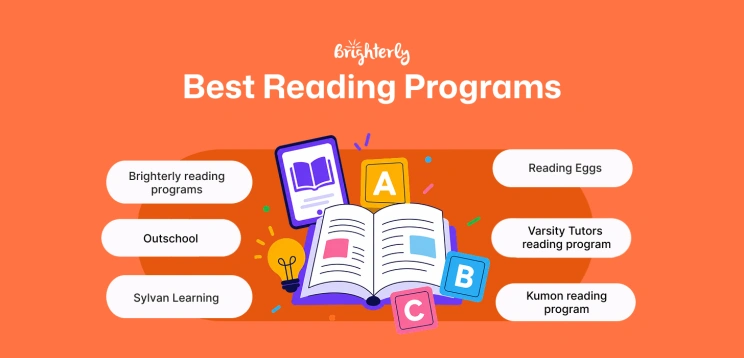
Top Recommendations:
- The online reading program for kids must focus on phonemic awareness, systematic phonics, reading fluency, vocabulary building, and comprehension, flow from simple to complex concepts, offer initial placement testing and ongoing progress monitoring, and employ age-appropriate interactive elements. Brighterly delivers on all of these, which is why it tops our list.
- For toddlers, consider Reading Eggs – self-paced, gamified, built for the youngest, and teaches early literacy with fun activities and animation.
- If your kid is between 3 and 12 years old, think of reading programs for kids like Kumon, which focus on structured progression and repeatable practice in foundational phonics, decoding letter sounds, and word development.
- The live instruction and 1:1 tutoring are available at Brighterly, Outschool, Sylvan Learning, and Varsity Tutors – popular platforms with live human teachers and customized learning.
Choosing the best reading program for kids means matching its offers and opportunities to your kid’s learning style, age, academic needs, as well as your budget and family schedule. The following most popular options vary from foundational self-paced practice tools for toddlers to advanced live-tutoring platforms, comparing features, pricing, and pros and cons.
Best Reading Programs at a Glance
|
Program |
Format |
Live tutor |
Free trial |
Best for |
Starting price per month (Sept 2026) |
|
Brighterly |
1:1 online tutoring |
✅ |
✅ (1st lesson) |
Custom plans, K-12 |
$141.60 (2 lessons/week, 12-month plan, 20% off) |
|
Reading Eggs |
Self-paced online reading curriculum |
❌ |
✅ |
Ages 2-12 early literacy |
$8.33 |
|
Sylvan Learning |
In-person center, 1:1 online tutoring |
✅ |
✅ (diagnostic assessment) |
K-12 personalized reading intervention |
Around $400 (2 sessions/week) |
|
Kumon |
In-person center, self-paced daily worksheets |
❌ (supervised independent study) |
✅ (1-week or 2-week promo periods) |
Ages 3+ daily reading drills and mastery |
$140 |
|
Outschool |
Live online group, 1:1 small classes |
✅ |
❌ |
Flexible schedules & diverse class topics |
$40 |
|
Varsity Tutors |
1:1 interactive online tutoring |
✅ |
❌ |
Custom K-12 academic support, test prep |
$299 (8 hours of tutoring) |
* Brighterly’s price is for 2 lessons/week in a 12-month plan with a 20% discount.
** Sylvan Learning’s price is approximate for 2 sessions/week.
** Varsity Tutors’ cost applies to 8 hours of tutoring.
*** All statements mentioned above and below are based on publicly available information on the official websites as of September 2026.
Exploring alternatives?

Explore Brighterly Learning Experience
Learn exactly how Brighterly helps students thrive through expert sessions, online tools, and proven feedback from thousands of satisfied parents
Match the Program to Your Child’s Age and Grade
| Age group | Best reading program for kids | Format | Monthly price range (Sept 2026) |
|
Pre-K/K (ages 3-6) |
Reading Eggs |
Self-paced gamified digital app; digital + print |
From $8.33 |
|
Grades 1-3 (ages 6-8) |
Reading Eggs, Brighterly, Outschool |
Self-paced digital apps; live 1:1 tutoring; group classes |
$8.33-$141.60 |
|
Grades 4-8 (ages 9-13) |
Brighterly, Kumon, Outschool, Varsity Tutors, Sylvan Learning |
Live 1:1 reading tutoring; live group classes; independent worksheets |
$40-$400 |
|
Grades 9-12 (ages 14+) |
Sylvan Learning, Kumon, Varsity Tutors, Brighterly |
Live 1:1 tutoring; exam prep; structured literacy program worksheets |
$140-$400 |
Brighterly Reading Program
Best for: K-12 students seeking after-school reading and writing help with a personal tutor under an individualized plan
At Brighterly, we offer a reading program for K-12 students that is based on a foundation-first approach. We also provide professional assistance for writing and reading comprehension support.
Brighterly Key Features
- Early reading tutoring, middle school or high school reading – our tutors qualify: We apply a strict application process, ensuring each potential candidate is experienced, well-versed, and possesses the needed communication skills to meet our highest quality standards.
- Personalized reading program: Given that we prioritize customization in the first place, our tutors adjust the learning plan for your kid based on their expectations and progress, yet keep it fully aligned with the US state standards.
- Free materials on reading-related topics: At Brighterly, we offer a wide range of free reading worksheets and diagnostic tests kids can use for home practice of specific topics, like vowels, author’s purpose, or reading comprehension.
Brighterly Reading Cost
As of September 2026, our pricing plans for reading are discounted by 20% and entail 2 lessons per week:
- Learning Membership 1-month plan: From $21.90/lesson.
- Learning Membership 3-month plan: From $21.40/lesson.
- Learning Membership 6-month plan: From $20.20/lesson.
- Learning Membership 12-month plan: From $17.70/lesson.
Brighterly Pros and Cons
| Pros | Cons |
|
|
|
|
|
|
|
|
|


See where your child’s reading stands
A free 45-minute lesson pinpoints their reading level and next step.
Reading Eggs
Best for: parents of kids aged 2-12 who want to achieve the reading objectives in the short term
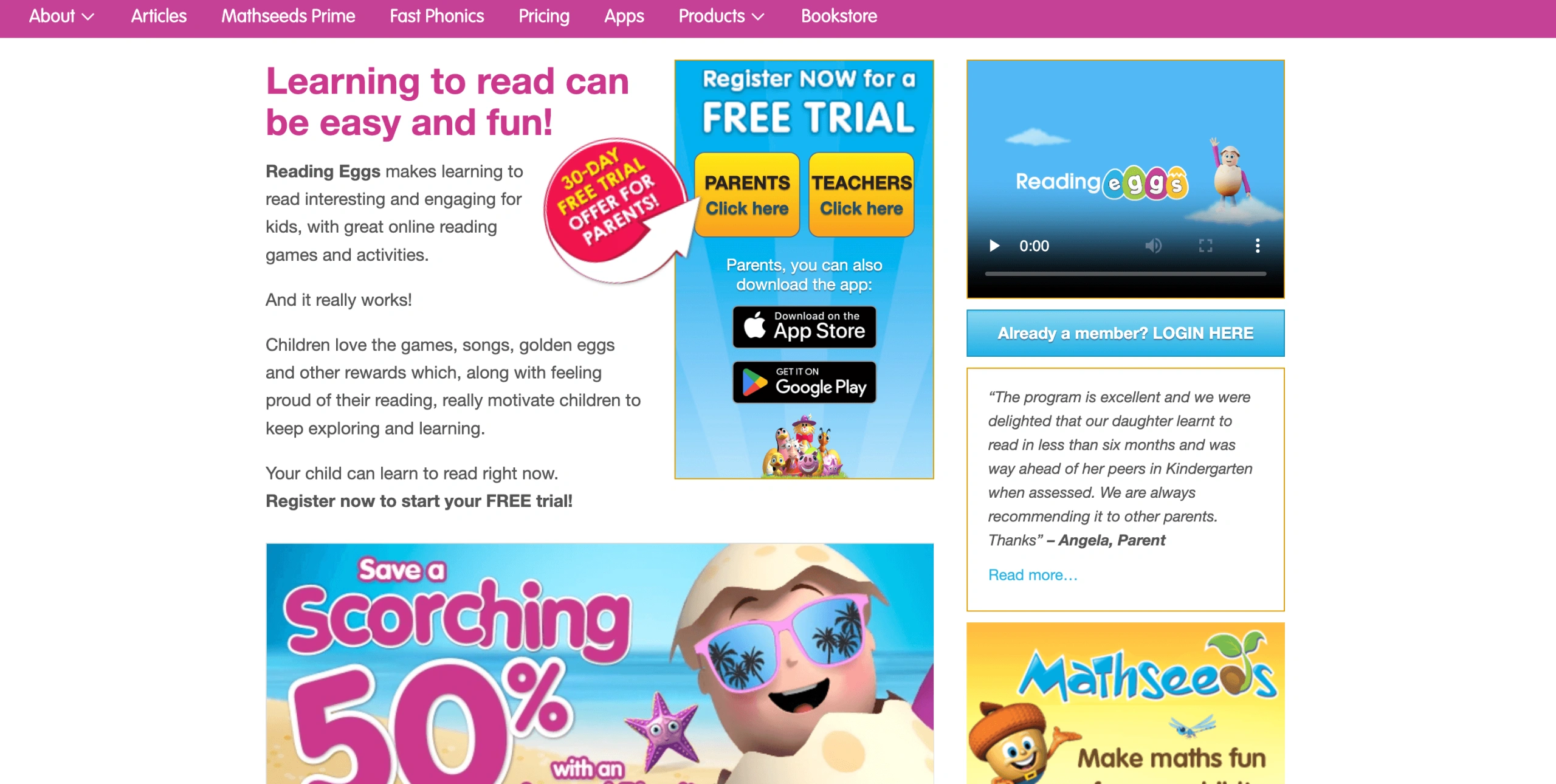
Reading Eggs can be considered the best reading program for kindergarten and school-age students because it provides in-depth literacy schemes for struggling readers who want to learn to read online. Reading Eggs promotes interactive practices and integrates a strong reward system, which helps kids to build confidence and feel pride in their achievements. Reading Eggs’ literacy programs for kids include fun animation, lots of gamelike activities, and learning through words and sounds.
Note: According to a 2024 study from the University of Education, Winneba, combining phonemic awareness instruction with phonics instruction significantly improved reading achievement among students with reading difficulties.
Reading Eggs Features
- Age-oriented materials: Online reading programs for struggling readers, such as Reading Eggs, provide toddlers and juniors with extensive practice through games. For middle-schoolers, they offer to build on reading comprehension and grammar competencies.
- Vast collection of learning sources: The platform has a huge collection of 4,000+ books.
- Progress tracking tools: Reading Eggs sends instant reports that allow parents to track both the speed and quality of their child’s progress.
Note: Learn more about the experiences parents share after using Reading Eggs, or if you’d like to find out about its pricing policy and how it compares to others, read through this 2026 updated guide.
Reading Eggs Pricing
At Reading Eggs, you can book either the Reading & Math or the Homeschool Max program, and as of September 2026, expect to pay as follows:
- $13.99 per month or $99.99 per year for Reading & Math
- $41.90 per month or $299 per year for Homeschool Max
Reading Eggs Pros and Cons
| Pros | Cons |
|
|
|
|
|
Sylvan Learning
Best for: Pre-K to Grade 12 students seeking personalized tutoring help for test prep
One of the top things about Sylvan Learning’s best learn to read programs is that it caters to a wide range of individuals, serving preschoolers and high school students alike. Its secret is personalization. Sylvan will ask a child to undergo a diagnostic test and then construct the best-fitting program for them, which is especially helpful for test preparation.
Sylvan Learning Features
- Personalized learning format: Sylvan offers small-group and individual lessons, up to your requirements.
- Engaging programs that work: A highly interactive approach that helps in better memorization.
- 24/7 support: Although the service offers numerous individual activities, a tutor is always available to provide guidance when needed.
Sylvan Learning Pricing
Sylvan prices differ by location and frequency of studying. Yet, as of September 2026, with the average $50/class, taking 1 class per week will cost you around $200 per month. If you aim for 2 classes per week, be ready to double this sum. Note that specific services like ACT and SAT preparation can reach around $900 per class.
Sylvan Learning Pros and Cons
Despite its broad subject coverage, as of September 2026, Sylvan Learning has only earned a 3.2 score on Trustpilot, and here are some reasons why.
| Pros | Cons |
|
|
|
|
|
Kumon
Best for: autonomous preschoolers and schoolers seeking worksheet-based, self-disciplined practice
Kumon’s online reading programs for kids stand on a series of worksheets, which makes it very different from other programs in this list. The point is to develop a learner’s autonomy. While a teacher is still there to help, most work will be done independently.
Kumon Features
- Worksheet-based practice: Rigid worksheets are designed to encourage critical thinking and independence.
- Short yet regular scheduling: Lessons last 30 minutes per day and should be taken 1-2 times/week.
- Focus on self-discipline: The program is designed to teach kids reading confidence rather than relying on personalized support or interaction.
Note: Read recently updated Kumon reviews based on 2025-2026 verified user reviews, as well as Kumon’s pricing guide on plans and policies.
Kumon Pricing
Kumon costs differ by center and location, with the average monthly cost ranging from $140 to $225, as of September 2026. Note that you’ll need to pay the registration fee and purchase learning materials in the first month, which will cost parents around $100 extra.
Kumon Pros and Cons
| Pros | Cons |
|
|
|
|
|
Outschool
Best for: readers of different ages who want to get an online reading class under different learning formats
Outschool is a learning marketplace where it’s possible to find the best learn to read program under several formats, including group courses or personalized sessions with teachers with public school teaching backgrounds. So, prepare for a wealth of choices and lots of scrolling.
Outschool Features
- The wide range of programs: Outschool offers over 30,000 programs in total to suit different learner requests.
- Learner-first approach: The huge database at Outschool lets them match even niche learner needs with top-class tutors.
- Flexible learning formats: You can enroll in individual and group classes, as well as reading clubs and options for dyslexic learners.
Note: Explore lately summarized the most recent (2025-2026) real user reviews about Outschool, as well as updated Outschool pricing tiers for 2026-2027.
Outschool Pricing
As of September 2026, Outschool offers several monthly subscription packages:
- $40 per month (you can try it for free first), covering 1 group class per week
- $70 per month, covering 2 group classes per week
- $120 per month, covering 2 group classes per week, with more extra credit benefits
- $240 per month, covering 4 group classes per week, with more extra credit benefits
Note: Outschool provides payment details in “credits,” where one credit is approximately equivalent to $0.5. Usually, you can expect to be charged about 30 credits per class when participating in a group program and 50-150 credits when studying individually.
Outschool Pros and Cons
| Pros | Cons |
|
|
|
|
Varsity Tutors
Best for: K-12 learners seeking the best-suited teacher and ready to dedicate time and effort to finding the perfect reading tutor.
Varsity Tutors puts a strong emphasis on its team teaching at home reading programs for kids. It offers both one-on-one lessons and group sessions for up to 12 children. Their schedule focuses on personalization, as Varsity Tutors strives to understand individual needs.
Varsity Tutors Features
- Rigorous hiring process: Varsity Tutors cares about the tutoring quality on the platform and introduces background checks.
- Flexibility in teaching methods: Tutors at Varsity can implement multiple learning approaches to help kids achieve better memorization and reading comprehension.
- Multiple formats: It’s possible to find a tutor at Varsity with the needed level of flexibility and accessibility for each learner.
Varsity Tutors Pricing
As of September 2026, the prices on Varsity are not transparent and differ from tutor to tutor, but on average, expect to pay from $299 to $480 per month for 8 hours of tutoring.
Varsity Tutors Pros and Cons
| Pros | Cons |
|
|
|
|
|
Reading help that adapts to your child
1:1 Brighterly tutor rebuilds the plan around the gaps that slow them down.
Apps vs Websites vs Tutoring – Which Format?
If you’d like your kid to be able to engage in self-paced practice on a mobile phone or tablet, apps can provide structured learning with interactive games and short daily lessons. Such solo practice can further help them establish consistent daily reading (and learning overall) habits. Browse the most popular reading apps for kids and pick those aligning with your child’s age and learning goals.
For browser-based resources that your child can use on a desktop or laptop (without downloading software), check out the best reading websites in 2026. These online hubs feature digital libraries and printable worksheets that you may use at home or in school.
When your kid can easily sound out words yet struggles to extract meaning, synthesize main ideas, or make logical inferences, it means they can’t link decoding and understanding. Specialized comprehension tools focus on critical thinking, context clues, and story retention, employing guided questions and real-time passage analysis.
Conclusion
Given that every child learns differently, ensure you carefully consider the learning format, age-appropriateness, and what level of personal guidance is optimal for your kid. Book a free reading lesson with Brighterly and check if all factors match what you’re looking for.
Frequently Asked Questions
How to Choose a Reading Program?
If your toddler or preschooler is easily distracted…
➔️ Opt for a self-paced software platform that employs gamification.
If your early elementary student reads text by blindly guessing words based on pictures…
➔️ Choose phonics-first reading programs for elementary students.
If your kid sounds out words well but reads sentences too slowly…
➔️ Select a program that prioritizes guided oral practice and reading fluency with repetitive reading aloud.
If your kid has some learning barriers (like dyslexia) or no longer aligns with public school grade levels…
➔️ Look for a live and customized instructional format (preferably 1:1) with human educators.
What Are the Best Reading Programs for Struggling Readers?
- Brighterly offers individualized 1:1 online tutoring with a foundation-first approach, using careful pre-learning evaluations and customized lesson plans to address particular gaps and learning fears.
- Reading Eggs (for ages 2-12) provides structured literacy schemes, interactive practice, fun animations, and a reward system specifically aimed at struggling readers.
- Kumon focuses on building learner autonomy and discipline, employing structured, self-paced worksheets.
- Outschool – a marketplace providing flexible live formats – includes specialized options for dyslexic learners.
Are Online Reading Programs Effective for Struggling Readers?
In a 2026 meta-analysis published in Research in Developmental Disabilities, scientists analyzed 30 randomized controlled trials involving 4,851 elementary students with reading difficulties and found a statistically significant small-to-moderate improvement in reading outcomes (g = 0.35).
Separately, a 2025 meta-analysis published in the Journal of Cognitive Enhancement found a medium overall effect (g = 0.433) of digital interventions among poor readers. Another 2025 randomized controlled trial – ‘The Effects of Virtual Tutoring on Young Readers’ (published in SageJournals) – found that virtual early-literacy tutoring produced statistically significant gains, and some students received the largest effects due to one-on-one tutoring.
How Much Do Reading Programs for Kids Cost in 2026?
- Reading Eggs – for self-paced gamified practice – costs yearly from $8.33/month for Reading & Math.
- For the worksheet-based program Kumon, be ready to pay from $140 to $225/month.
- At Outschool, the price for live group classes starts at $40/month for 1 group class per week.
- 1:1 online tutoring at Brighterly is now 20% off (valid for September 2026) and starts at $17.70/lesson – 12-month plan for 2 lessons/week. Varsity Tutors averages $299 to $480 per month for 8 hours of tutoring.
- For in-person and specialized intervention at Sylvan Learning, expect to pay around $50/session.
Which Reading Programs for Kindergarten Are Best?
Reading Eggs provides early literacy schemes with fun animations, interactive games, delightful music, and reward systems for kids aged 2-12. Kumon might be another good fit for autonomous young learners who strive for daily worksheet practice. Otherwise, consider Sylvan Learning, given that all students here – from preschoolers to older ones – first get a diagnostic assessment and further a personalized interactive instruction.
What’s the Difference Between a Reading Program, a Reading App, and a Reading Website?
Reading apps are for mobile phones and tablets, feature interactive games and short daily lessons aimed at building daily reading habits, and are for self-paced practice.
Reading websites are for desktops and laptops, require no software downloads, and offer digital libraries and printable worksheets for home or school use.
Reading programs contain structured curricula, customized learning plans, diagnostic placement tests, and live human educators (1:1 or in groups). These specialized tools focus on critical thinking, context clues, real-time passage analysis, and guided oral practice.
How Many Days a Week Should a Child Use a Reading Program?
Research doesn’t establish a universal number of days per week for using a reading program. However, recent evidence supports making reading a regular habit. A 2025 study published in Contemporary Educational Psychology found that more frequent reading was positively associated with subsequent reading achievement. Therefore, for an online reading program, consistent use several times a week is reasonable and practical, although the optimal frequency depends on your child’s age and goals, as well as the program’s design.

The Russian School of Math cost range is between $41.50 to $111 per lesson, though the exact price heavily depends on the center location and the course chosen. This guide will describe in detail how the RSM pricing model works so you can decide if it is worth it. How Much Does Russian School of […]

Jun 10, 2025
Wondering, is Huntington Learning Center worth it? You’ve come to the right place! As a private math tutor with years of experience in helping children improve their skills, I’ll give my unbiased opinion and honest Huntington Learning Center reviews. Read on for an unbiased answer. Key Points Range of features: 8/10. The Huntington Learning Center […]

Jun 18, 2025
Math & reading from 1st to 12th grade
Exploring alternatives?
Take a short quiz!
Choose kid's grade