How to Memorize Multiplication Tables: 15 Simple Tips That Work
reviewed by Jo-ann Caballes
Updated on August 4, 2026
Key Points
- The best strategy on how to memorize the multiplication tables is understanding the logic behind the operations, step-by-step learning, and gradual progression from easier to harder columns.
- 1:1 math tutoring can support your child’s learning of the multiplication charts through a personalized curriculum.
- Fun ways to memorize times tables faster include visualizations, rhymes, real-life examples, and memory tricks.
These 15 tips will help you find out how to memorize the multiplication tables without unnecessary stress. A combination of practice worksheets, short tests, memory tricks, daily study sessions, and gamified techniques works best for most learners. Working with a qualified tutor further helps master multiplication via personalized instruction and practice.
Getting Started: Preparation and First Steps
The process of how to teach times tables starts with proper preparation. First, bring together all supporting materials, visuals, and manipulatives needed to illustrate how multiplication works and to practice examples. Next, introduce your kid to the idea of multiplication before jumping into actual problems.
Gather the Right Materials
In preparation, collect all educational materials necessary for learning the multiplication tables, including games, flashcards, books, copybooks, and subscriptions to math websites. These resources can guide you and your child through memorizing the multiplication tables.
Note: Select exciting and engaging tools to boost your child’s willingness to learn. If you’re unsure where to start, check out the best math learning websites.
Introduce the Concept Before Drilling
When getting started, introduce the multiplication table to your child and the meaning behind it. Show multiplication as a replacement for tedious addition. Also, explain the need for learning the multiplication tables. Demonstrate how we use math skills in the real world, focusing on the need for multiplication in daily activities to spike your kid’s curiosity.


Learn multiplication tables with professional math teachers!
Our tutors customize real-time instruction & gamify practice to make learning fun & effective.
Explore Brighterly Learning Experience
Learn exactly how Brighterly helps students thrive through expert sessions, online tools, and proven feedback from thousands of satisfied parents
How to Memorize the Multiplication Table: 15 Tips
The best way to learn the multiplication tables is to supplement 1:1 tutoring sessions with daily practice worksheets, regular tests, chunking and visualization techniques, and aloud repetition. Interactive games, age-appropriate apps, and real-world examples can turn tedious memorization into a fun activity that motivates your little one to persist.
#1 Learn with a Qualified Math Tutor
A private tutor can help your child learn multiplication fast. Qualified tutors understand how each child’s brain works to create personalized programs tailored to their learning style. Data shows the benefits of tutoring as high-dosage tutoring (2 times/week) helps students improve learning results by 3-15 months worth of knowledge, depending on grade level.
Our K-12 online learning platform for kids offers 1:1, real-time, personalized tutoring. Our STEM-based math program starts with a thorough evaluation of your child’s current level and future needs to prepare a learning plan that addresses their specific requirements in terms of multiplication and other skills.
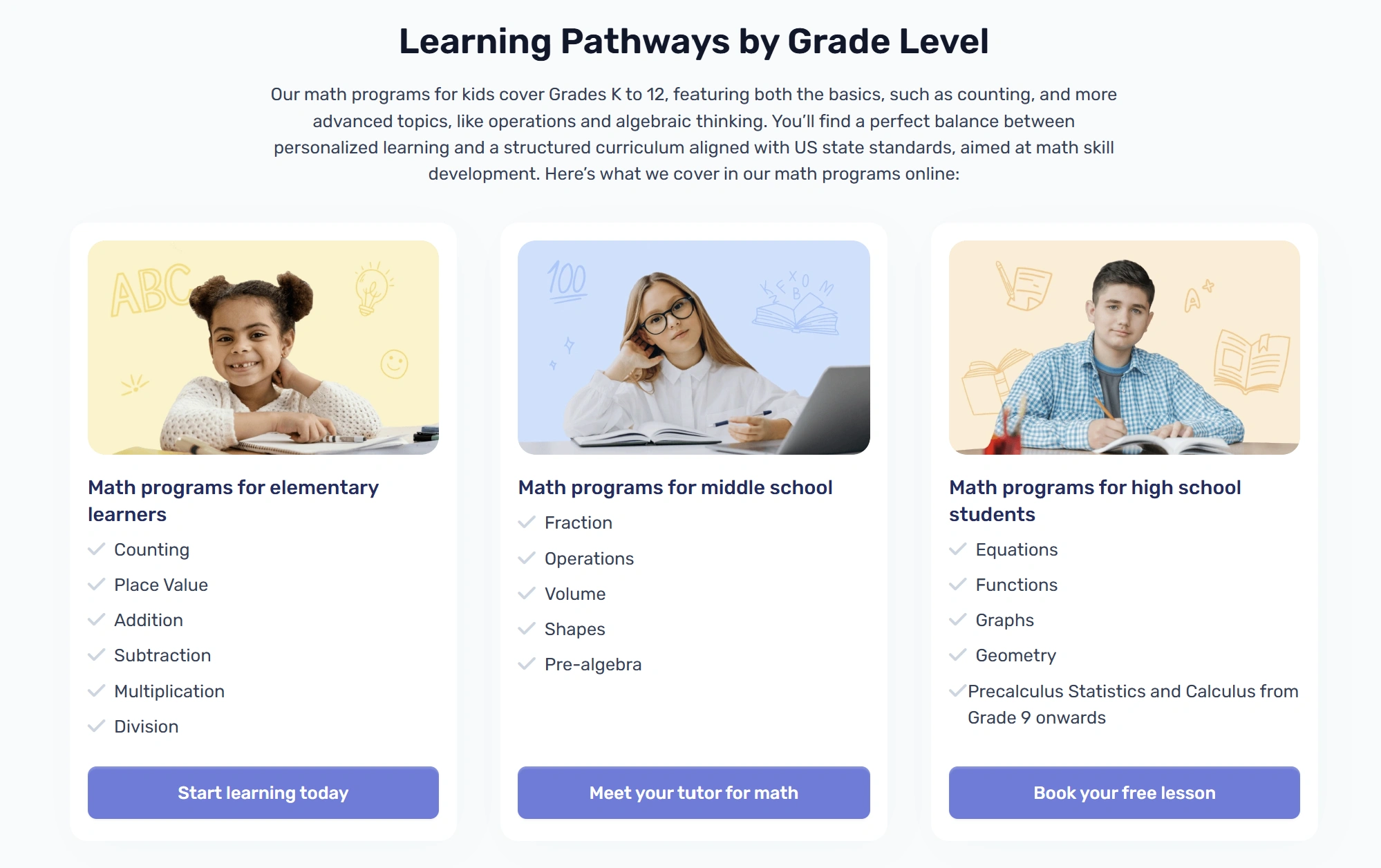
Our tutors hold a Bachelor’s degree or more and 5+ years of teaching experience, plus training in pedagogy. Teachers are qualified to work with students with different learning needs as they adapt the math class methodology to each kid’s background and personality. Following the US state standards, math tutors provide customized instruction to build understanding of how multiplication works and game-based practice to make education fun.
90% of the 890 Brighterly reviews on Trustpilot (as of August 2026) show 4- and 5-star experiences. This feedback from July 2026 shows how the positive attitude inspires love for learning and improvement in skills:

Our pricing plans start from $17.70/lesson with a 12-month subscription for 2 lessons/week, with a 20% discount applied.
#2 Use Multiplication Worksheets
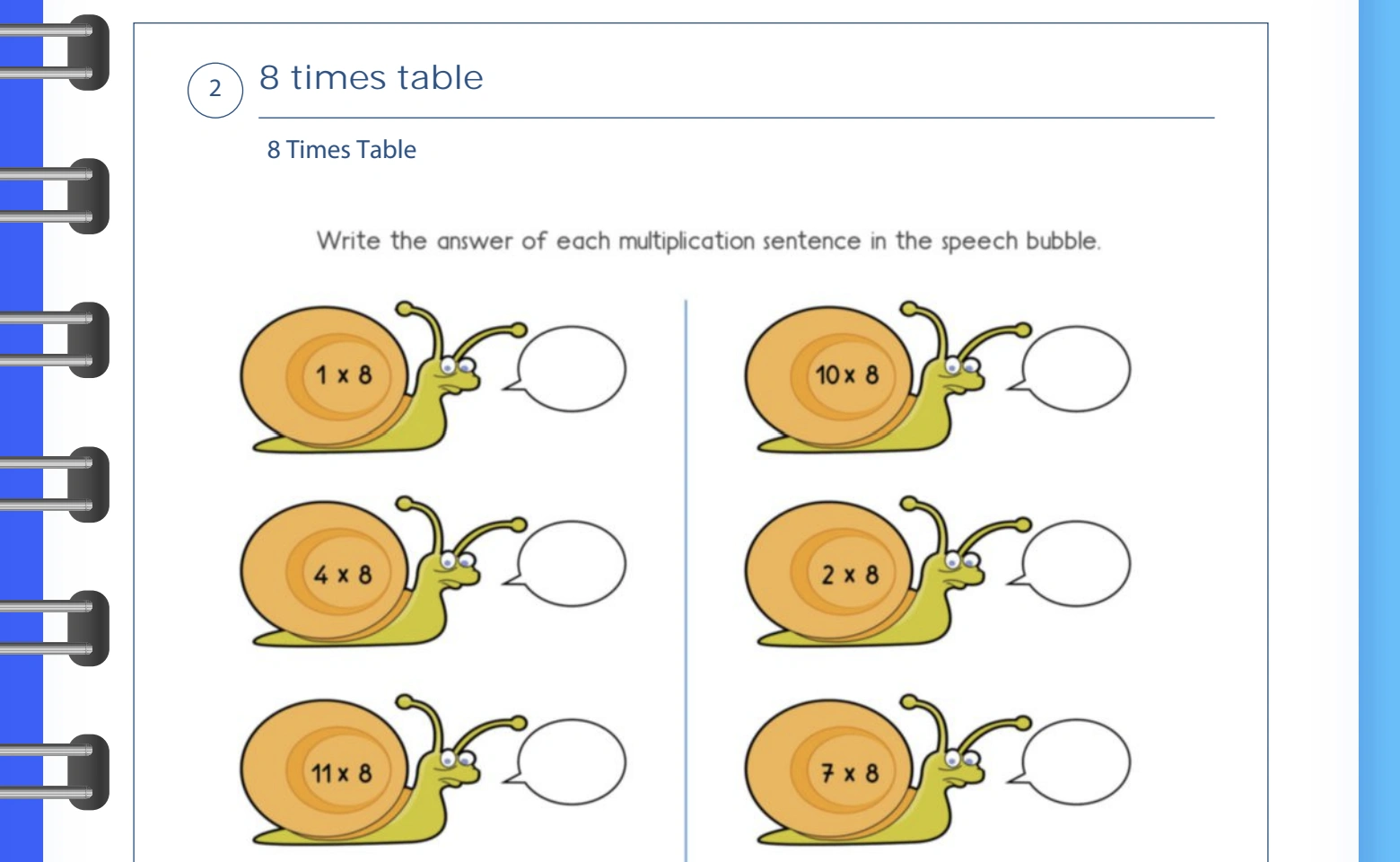
Printable practice worksheets are excellent tools for drilling multiplication tables. Multiplication tables worksheets allow your child to work independently, helping them recall the knowledge outside of classes and practice at their own pace.
We offer free multiplication tables 1-12 printable worksheets. Our resources provide real-life examples, attractive pictures, and simple language to help young learners practice actively, recognize patterns, and gradually store core multiplication facts in their long-term memory while having fun.
#3 Practice with Short Tests
Another proven strategy on how to learn the multiplication tables is interactive math tests. Short quizzes and tests make learning effective as kids practice in a structured format, see their success, track progress, and identify areas for future focus.
Note: According to 2025 research published in Frontiers in Psychology, retrieval practice, like tests, offers better results for young students than simple re-reading of school materials. Active learning encourages kids to retrieve information from memory, helping them understand and memorize it better than passive strategies.
On our website, you can find free multiplication table tests to diagnose your child’s current knowledge and monitor progress over time. Our tests use illustrations and real-life situations to make learning multiplication relevant and engaging.
#4 Understand the Logic and Principles First
Before you get to memorization, you have to explain to your child what multiplication is and why it’s important. Build on your kid’s math knowledge and use familiar terminology to ensure they understand the meaning and logic behind multiplication and get a sense of it.
Once your little one comprehends that 5 x 2 is the same as 2 + 2 + 2 + 2 + 2, the abstract concept of multiplication becomes tangible, and they start to see the principles and logical patterns behind each line.
#5 Use Memory Techniques: Chunking, Visualization, Patterns
Memory techniques like chunks, visualizations, and pattern recognition present helpful tricks to learn multiplication facts with less effort:
- Chunking method: Break multiplication into small chunks. Learn the 2s, 4s, and 8s together because you simply need to double.
- Visualization: Make the multiplication problem a visual task. Picture 8 x 5 as 8 human hands with 5 fingers each.
- Pattern recognition: Highlight the patterns in the multiplication charts. Show your kid that odd numbers multiplied by 5 end in 5, and even numbers multiplied by 5 end in 0.
Memory tricks can significantly cut down the time you need to teach multiplication as your child builds connections rather than relying on rote memorization.
#6 Master the Commutative Property
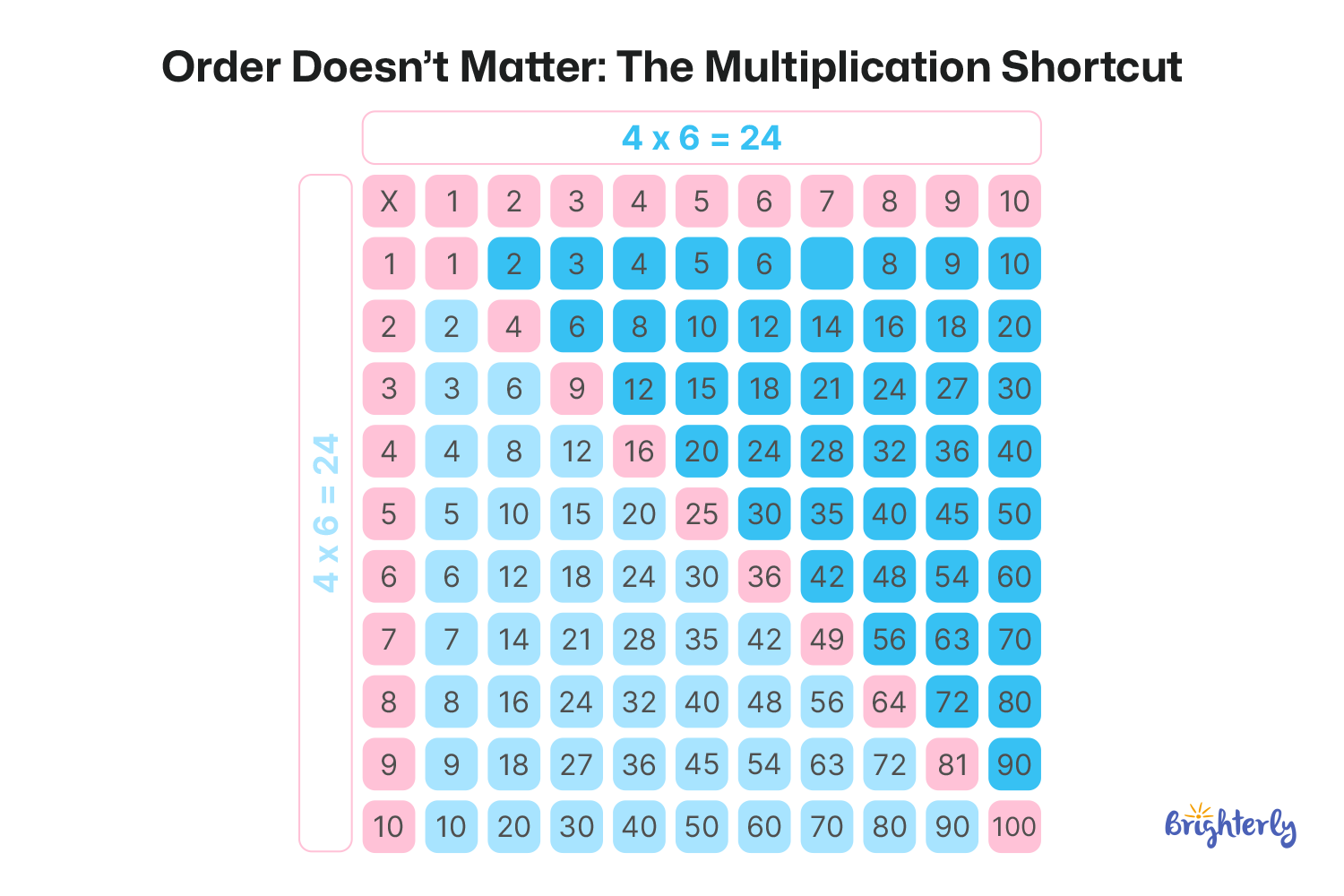
Teaching the commutative property helps you reduce the time for learning multiplication in half, as your child needs to memorize only half the possible equations. The commutative property states that the order of numbers doesn’t matter when multiplying them.
For example, 4 x 6 = 24, and 6 x 4 = 24. In multiplication, it doesn’t matter which number is first and which one is second – the answer is the same. If we cut the multiplication table along the diagonal, the two parts are mirror images of one another.
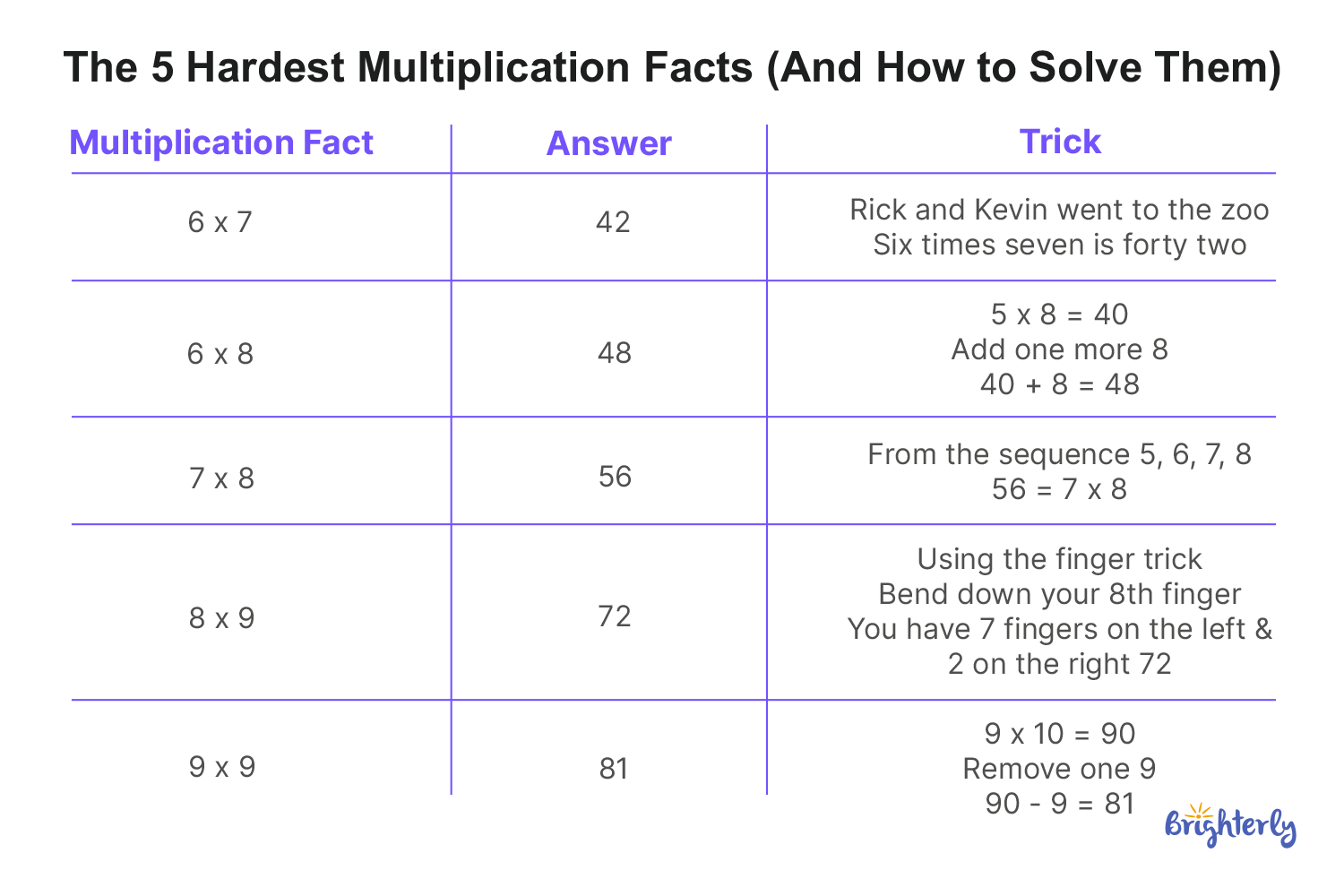
#7 Learn the Hardest Facts First
Instead of going through the multiplication charts in order, memorize the hardest equations first, while your child’s memory is still fresh. Most children find the following facts to be the hardest:
- 6 x 7 = 42
- 6 x 8 = 48
- 7 x 8 = 56
- 8 x 9 = 72
- 9 x 9 = 81
Many kids consider these sentences helpful:
- Six sevens are forty-two.
- Six eighths are forty-eight.
- Seven eighths are fifty-six.
- Eight nines are seventy-two.
- Nine nines are eighty-one.
Alternatively, you can use tricks to memorize these difficult multiplications. To calculate 6 x 8, use 5 x 8 = 40 and add one more 8 = 48.
#8 Build a Daily Practice Routine (with Rest Days)
The key to how to learn multiplication fast is through building a routine that includes short daily practice sessions intertwined with fixed rest days. Allocate 5-10 minutes a day to structured math sessions:
- Revise the tables you’ve learned.
- Learn a new chart.
- Conclude with examples.
Throughout the day, incorporate multiplication into your child’s life. Highlight how computer science uses math, or ask them to calculate how much you’ll spend on pens using the unit price.
Give your kid relaxing days so their brain can rest and prepare for new knowledge. Have Sundays off or take a day off after memorizing each table.
#9 Start Easy: Begin with 2s, 5s, and 10s
To ease your child into multiplication, begin with the most straightforward charts. Kids find the 2s, 5s, and 10s most intuitive. Learning each of these charts takes little time, so in a few short days, your kid will know half the tables, building their confidence and motivation.
Here are some tricks to use:
- To multiply by 2, simply double the number.
- To multiply by 5, add a 0 after the original number and divide by 2.
- To multiply by 10, copy the number and add a 0 after.
#10 Repeat Tables Aloud
Reciting the multiplication table out loud works on multi-sensory learning, auditory processing, and motor repetition to help remember it. The overall result is that the more children repeat numbers, the better they memorize them.
You can turn daily aloud repetitions into an entertaining activity while driving to school or walking in the park.
1:1 support tailored to your child!
Online math tutoring that builds knowledge & confidence for strong foundations.
#11 Make It Interactive with Apps and Games
No one likes boring lessons, so adopting interactive practices and tools like math games and math apps for kids can make all the difference in memorizing the multiplication charts. Find the right tool based on your child’s interests:
- If your child likes video games, look for game-based math websites that teach multiplication.
- If your kid prefers singing and dancing, incorporate those into your learning routine. Map groups of numbers to musical beats and body moves.
- If your little one enjoys mysteries, print out the multiplication table with gaps and task your child with filling in the missing numbers.
#12 Use Visual and Creative Memory Tricks
Using visual memory is a simple yet proven method to learn the multiplication tables. If your child is a visual learner, use the Pythagoras square to help them see the concept behind multiplication.
In case your kid is an auditory, kinesthetic, or musical learner, add math-related poems to your multiplication table learning sessions. Here is the “Table of 9” math rhyme:
Nine, eighteen, twenty-seven, thirty-six,
Learning nines is a nifty fix!
Nine, eighteen, twenty-seven, thirty-six,
Practice hard, and you’ll get your tricks!
#13 Learn Step by Step, Column by Column
Teaching the multiplication charts all at once will overwhelm your child. Instead, create a step-by-step process where you start with the easiest and gradually expand to harder columns.
- Learn the easiest columns – 1, 10, 2, and 5.
- Move to the medium columns – 3 and 4.
- Finish with the most difficult columns – 6, 8, 9, and 7.
As your child learns the first few tables quickly, their self-esteem will grow, making them feel prepared for the rest.
#14 Use Simplifying Shortcuts
Multiplication tables have many interconnections, so simplifying tips make memorizing easier. Here are some tricks to help your child learn multiplication:
- When multiplying by 2, just add the number to the same number: 6 x 2 = 6 + 6 = 12.
- When multiplying by 4, double the number and then double it again: 7 x 4 = 7 x 2 x 2 = 14 x 2 = 28.
- Get started FREE multiply the number by 10 and then halve it: 10 x 6 = 60, and 5 x 6 = 30.
- When multiplying by 9, add 0 to the number and subtract the number: 6 x 9 = 60 – 6 = 56.
#15 Use Real-Life Objects and Two Backup Tricks
A final strategy on how to learn multiplication is using real-world situations and real-life objects, as this makes lessons fun and practical. Real-life personalized learning is easy to start: Take out the toys from the basket and divide them into pairs. Give your child 4 pairs to make 8 to teach them that 2 x 4 = 8.
To conclude, here are 2 more multiplication tricks:
- Addition method: Multiplication is simply repeated addition: 5 x 5 = 5 + 5 + 5 + 5 + 5 = 10 + 5 + 5 + 5 = 15 + 5 + 5 = 20 + 5 = 25.
- Finger counting for 9 times table:
-
- Spread your 10 fingers in front of you.
- To calculate 9 x 1, lower the first finger.
- What’s left? 9 fingers. That’s your answer!
- For 9 x 2, drop the second finger.
- What’s left now? 1 finger and a space followed by 8 fingers. Your answer is 18!
- Continue up to 9 x 9 (8 and 1 or 81).
How Long Does It Take to Memorize Multiplication Tables?
You usually need 1-2 months of intensive daily practice to learn the multiplication tables. At school, students typically take the entire academic year, grade 3, to memorize the tables. However, with a structured routine and strong strategies, it’s possible to learn multiplication in 20-30 days.
The actual time that multiplication tables memorization takes depends on:
- Math skills
- Lesson frequency
- Study approach
- Used tips
While there isn’t a single way how to memorize the multiplication tables in one day, combining multiple strategies such as understanding the principles, using memory techniques, learning column by column, and working with a tutor can help speed up the process. Real-life calculations also work well as they help children connect abstract math concepts with real-world situations.
Why Should Children Memorize the Multiplication Table?
Children should memorize the multiplication table to build fundamental math skills that will help them solve complex life problems more easily. Knowing math lets kids do well at school and succeed throughout life. Learning multiplication also helps you acquire confidence by gaining trust in your knowledge.
Note: Memorizing the multiplication table not only makes doing math faster, but it also helps grow memory functions.
Common Mistakes When Learning Multiplication Facts
The most common mistakes parents make when teaching the multiplication tables are:
- Not explaining the theoretical concept
- Trying to memorize all the tables at once
- Starting too late in the school year
- Not connecting multiplication facts with real-life examples
- Not exercising daily
- Making practice sessions automatic and dull
Instead, an easy way to learn multiplication is to demonstrate the logic, tackle one chart at a time, start early, use real-world situations, practice regularly, take advantage of technology and fun apps, and have rest days. Working with an expert tutor also helps tailor studying to the learning gaps and strengths of your child.
How to Teach Multiplication to Struggling Students
An effective way to teach the multiplication tables to struggling students is to hire an online math tutor with relevant qualifications like working with children with dyscalculia or ADHD. A professional math teacher can develop a customized learning plan and educational materials that address the specific requirements of any child in an efficient, yet respectful and considerate manner.
Additionally, you can look for worksheets to practice multiplication at home, math games that make memorization fun, and songs or rhymes that further facilitate the process. Be patient, repeat the tables together, and make learning sessions short with plenty of breaks.
Frequently Asked Questions
How Can a Child Memorize Multiplication Tables in 1 Hour?
While learning multiplication in 1 hour is impossible, the best strategy on how to memorize the multiplication tables fast is to focus on the commutative property (4 x 8 = 8 x 4) and on simplification tricks (2 x 4 = 4 + 4). When you have limited time, start with the easiest tables – 2, 5, 9, and 10 – to achieve quick progress.
What Grade Do Kids Typically Learn Their Multiplication Tables?
Under the US state standards, children memorize the times tables in grade 3. Kids study the foundational concepts behind multiplication – like counting in groups, skip counting, and repeated addition – in grade 2. After learning the products of single-digit numbers in grade 3, students expand into the multiplication of multi digit numbers and fractions in grade 4.
Should Kids Use Flashcards or Apps to Memorize Times Tables?
Kids can use both paper flash cards and online apps together to memorize the multiplication tables effectively. Flash cards support active recall through tactile repetition, and interactive apps use gamification to encourage kids to practice daily and keep them engaged in learning.
Why Does My Child Keep Forgetting Multiplication Facts They Already Learned?
The most common reason why a child forgets the times tables is that they stored the facts in their short-term memory because you rushed quick memorization instead of building conceptual understanding and gradual memorization. To help your child retain information long-term, explain the logic, use manipulatives to visualize concepts, and repeat practice daily.
Is It Enough to Understand Multiplication, or Do Kids Need to Memorize It?
Understanding the meaning of multiplication is key, but children also need to memorize basic multiplication facts to perform mental math and solve daily problems quickly. Conceptual understanding builds the foundation of how numbers work, while memorization frees up working memory to handle more complex math operations.
How Many Minutes a Day Should Multiplication Practice Take?
Multiplication practice should take 5-10 minutes a day. Short, focused daily sessions build memory faster and more efficiently than longer, less frequent sessions, for example, on the weekend. Research published in Educational Psychology Review in 2025 confirms the effectiveness of spacing out practice over numerous sessions in learning math.
Conclusion
The best way to memorize the multiplication tables is to combine a few techniques, like songs, visual aids, and worksheets, while practicing consistently. You can also try a multiplication facts game to make studying more entertaining. And if you want to give your child instruction and practice tailored to their unique needs, you can check out our tutoring.
Book a free lesson with no commitment to try the teaching style and see if it fits your kid’s requirements.



Thanksgiving is an unofficial start of the holiday season, so we all like to have fun with our loved ones. Nevertheless, it is an opportunity to consolidate children’s knowledge in an informal setting. Implement the best Thanksgiving math activities into your holiday routine to improve your child’s math skills while still having a good time! […]
Apr 05, 2022

The 20 best math apps for kids in 2026 range from gamified practice tools to live 1:1 tutoring – covering every age, skill level, and budget. This guide breaks these apps down by features, learning style, and pricing so parents can choose the right fit for their children. Paid Math Apps for Kids: Comparison Math […]
Apr 05, 2022
Math & reading from 1st to 12th grade
Looking for homework support for your child?

Choose kid's grade

Math & Reading for Grades 1–12
Build real confidence for your child with a Brighterly math or reading tutor.