What Makes Elementary Tutoring Effective?
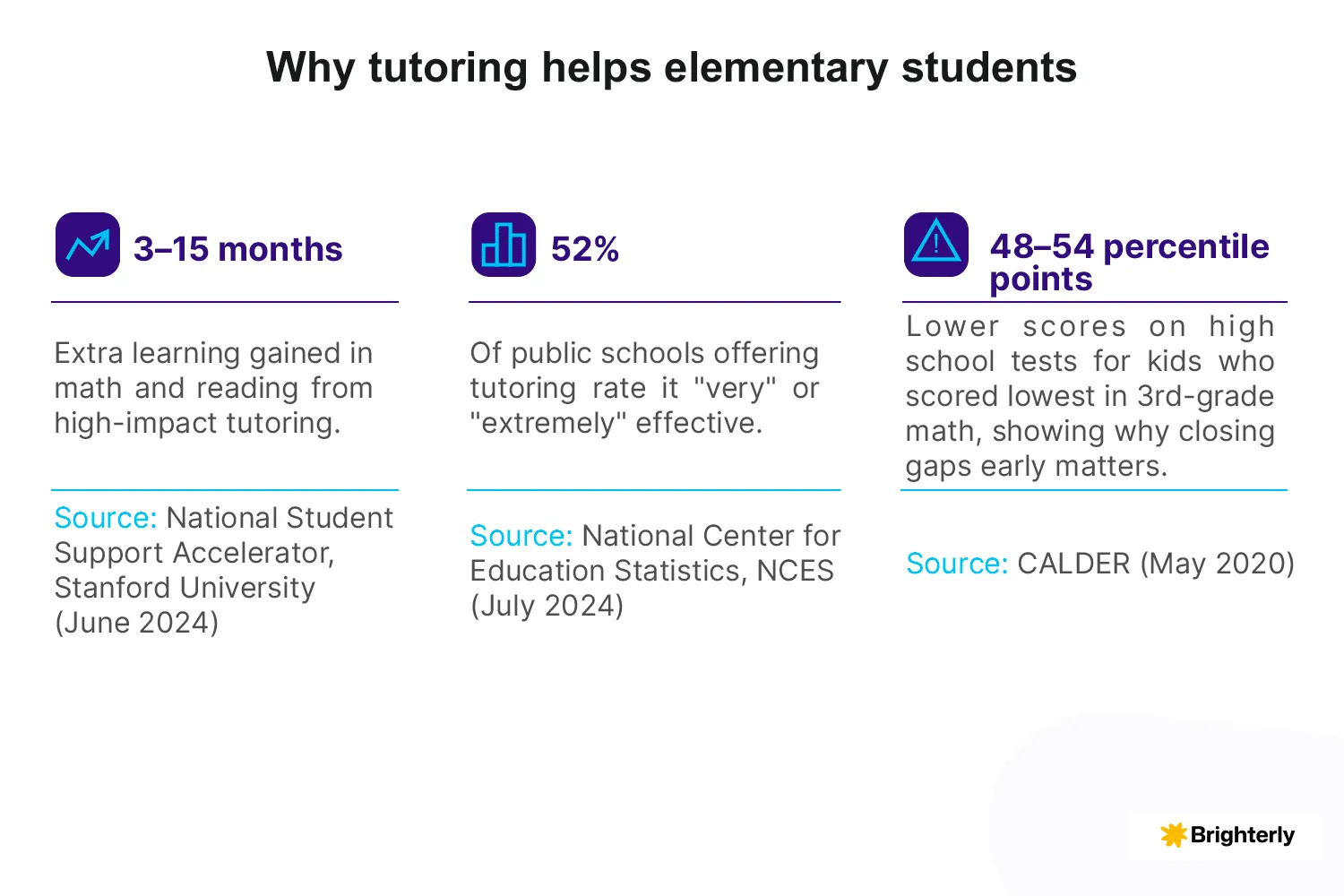
Not every kind of tutoring leads to the same results. The learning gains found in Stanford’s research come from what the National Student Support Accelerator (NSSA) calls high-impact tutoring, which has a few defining features:
- Frequency: at least three sessions a week, each 30 minutes or longer
- Small groups: one-on-one or up to four students per tutor, with one-on-one being most effective
- A consistent tutor: the same trained tutor every session, so the child builds a trusting relationship
- Progress tracking: the tutor checks what the child has learned and adjusts the next sessions
- Curriculum alignment: lessons connect to what the child learns at school
Occasional homework help or reteaching can be useful, but it doesn’t produce the same growth as regular, structured sessions.
Types of Tutoring for Elementary Students
Types of tutoring for elementary grade students include online classes through tutoring websites for elementary students, in-person tutoring and tutoring centers, and free/community tutoring programs that local schools, libraries, or organizations offer. You can choose the type of tutoring that fits you best based on price, location, and goals.
Online Tutoring for Elementary Students
Online tutoring is a way to connect your child to a tutor no matter where you are, with no need to commute. A child can join an online lesson via a video call, usually through a digital tutoring platform. For example, our elementary math tutors or elementary reading tutors teach elementary-grade students through one-on-one online sessions that a kid can join from their account on the website.
In-Person Tutoring and Tutoring Centers
In-person tutoring for kids usually happens in tutoring centers for elementary students or at home. In both cases, the biggest difference from the online tutoring format is that the educator is physically present in the room. This type of tutoring can be suitable for kinesthetic learners and kids who find it hard to keep focus when the teacher is on the screen. If you’re comparing options in your area, our math tutors near me guide covers tutoring by city.
Free and Community Tutoring Programs
Free tutoring is usually available through the school services, a local library, or a community organization. This tutoring type is worth considering if your child needs occasional learning help rather than constant guidance, since free tutoring for elementary students usually implies classes in small groups rather than personal lessons.
In case your kid is struggling, needs to fill big learning gaps, or is far behind the program, you may need to seek either an online or an in-person private tutor.
What Subjects Do Elementary Tutoring Programs Cover?
Most tutoring programs for elementary students cover the core subjects kids learn at that grade level: math, reading, writing, and science. Besides, such programs teach kids basic learning habits like study skills and organization, which they will need throughout their educational journey.
Math Tutoring for Elementary Students
Math tutors for elementary students usually teach kids foundational number sense, basic arithmetic operations (addition, subtraction, multiplication, division), fractions, decimals, word problems, and introductory geometry — the basics students need to know at this grade level. However, the math tutoring program heavily depends on what math knowledge a child already has.